Tag: ad

  • Timex goes after Apple Watch with hypocritical billboard

    Timex goes after Apple Watch with hypocritical billboard

    Surely no one in the wristwatch industry expected the Apple Watch to have an amazing success that it has experienced so far. First released in April 2015, Apple’s original plan was to promote the timepiece as fashionable jewelry. But it quickly became apparent to Apple that the wearable was selling as part of the Apple eco-system and as a tech device in its own right. Apple pulled the device out of high-end jewelry stores and focused on carrier and department store sales.
    Eventually, the wearable became known for its health-related features that no doubt helped to drive sales. Now, the Apple Watch is the most popular watch on the planet. That’s right, the Apple Watch outsells every other watch on Earth and that includes your famous luxury brands like Rolex, other more downscale brands like Seiko, affordable brands like Casio, and of course, mid-to-low-end brands like Timex.
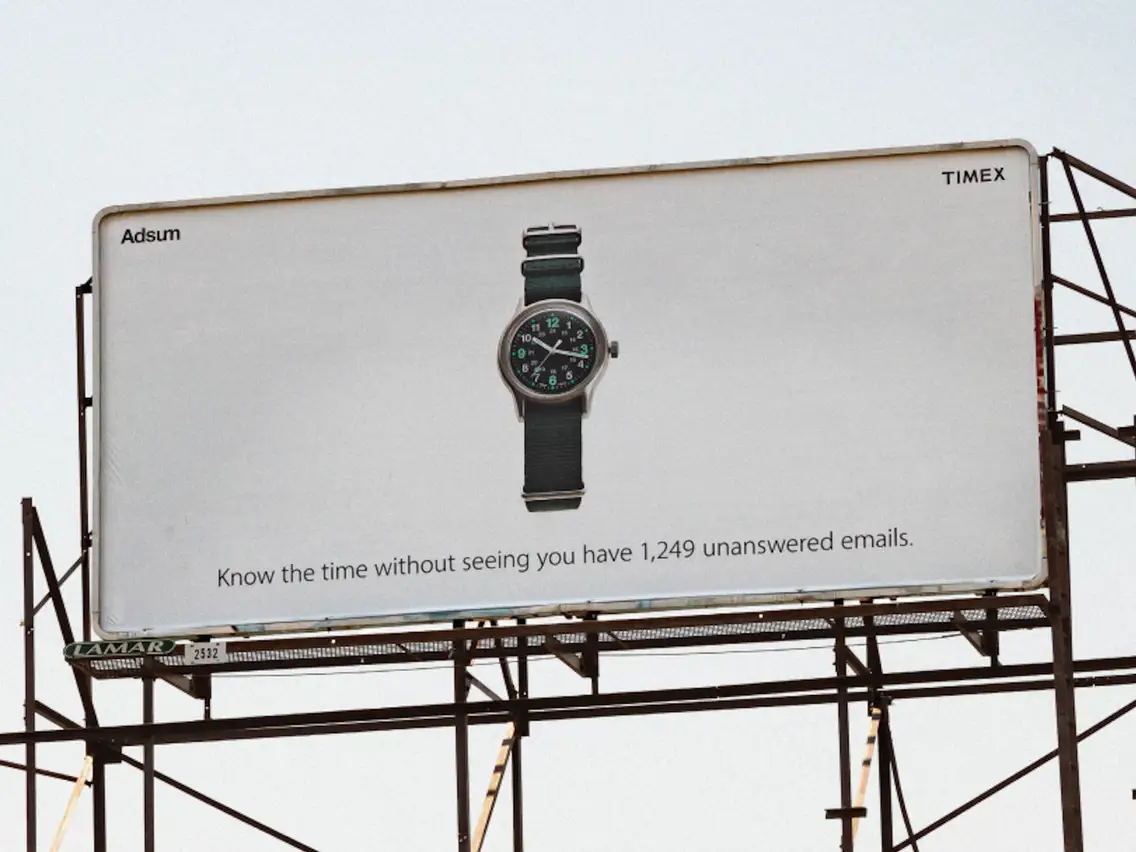
    Timex has been around since 1854 and has thus seen plenty of trends in the wristwatch market over the last 168 years. But we’d venture to guess that nothing has impacted the company more than the smartwatch, especially the Apple Watch. Timex decided to take on Apple and its timepiece on a billboard in New York City (yes, the “Big Apple”) that promotes its new $140 analog watch which was developed in partnership with a Brooklyn clothing company called Adsum.
    Even though this watch is sold out, Timex continues to have its billboard passing along the message that it wants Apple Watch users to read. “Know the time without seeing you have 1,249 unanswered emails,” the copy says on the sign. That refers to the Apple Watch’s ability to pass along notifications about your emails.
    Yeah, there is some hypocrisy involved with the billboard. Timex does have its own line of smartwatches and guess what? They pass along notifications. In fact, the Timex website notes that its smartwatch “Plays nice with your phone” and adds that “Over a hundred years of watchmaking has taught us that your watch becomes part of your soul. With notifications and fitness sensors, that bond is even stronger.”
    And the iConnect by Timex smartwatch, which is out of stock on the Timex website but is available from online retailers, will show email notifications. In fact, one retailer states, “Stay connected wherever you are. You can receive texts, Facebook, WhatsApp and email notifications on the touchscreen display of your iConnect by Timex smartwatch.”
  • HBO Max reveals plans to introduce ad-supported subscription tier in 2021

    HBO Max reveals plans to introduce ad-supported subscription tier in 2021

    HBO Max is the most expensive streaming service of its kind at the moment, as subscribers must pay $14.99 per month to access its offering. However, the company confirmed plans to introduce a cheap alternative for those who can’t afford the high price of a monthly subscription.

    The news was revealed as part of a recent call with investors, along with information about HBO Max’s expansion worldwide. First off, AT&T stated that it expects HBO Max to reach around 150 million subscribers by 2025, which will become possible after expanding the service to 60 international markets this year (39 in Latin America/Caribbean region and 21 in Europe).

    Also, AT&T confirmed plans to launch an ad-supported option (AVOD) in June but didn’t offer any details about pricing. WarnerMedia chief Jason Kilar reaffirmed HBO Max’s commitment to its customers to provide them with original shows and premieres of Warner Bros movies.

    However, he said that the new ad-supported plan will not have access to day-and-date premieres of Warner Bros movies, although everything else will be the same. Also, he confirmed that HBO Max doesn’t plan to put ads on HBO’s original series.

    According to the company’s estimations from October 2019, HBO Max and HBO have around 90 million subscribers. The ad-supported version of HBO Max will only be available in the US in June.

  • Apple releases a new TV ad for its latest iPhone

    Apple releases a new TV ad for its latest iPhone

    Apple U.K. has just shared the company’s new 30-second ad for the second-generation Apple iPhone SE which officially launches today, right in the middle of a global pandemic. The iPhone SE (2020) borrows the look and the design of the iPhone 8 including the 4.7-inch LCD display with a 750 x 1334 resolution. That works out to an old school 16:9 aspect ratio and there is no notch, no TrueDepth camera, and no Face ID. In fact, the iPhone SE (2020) is equipped with the Touch ID fingerprint scanner.

    To power its new budget-priced phone, Apple is using the A13 Bionic chipset. Built using TSMC’s 7nm process node, the chip carries 8.5 billion transistors and is the same powerful component used to drive the entire iPhone 11 family. Apple also saw fit to give the phone’s memory a 50% bump from 2GB of RAM to 3GB, and also improved the single 12MP camera on the back with a new Image Signal Processor (ISP). Apple claims that the new ISP, together with the A13 Bionic, makes the rear camera the best single snapper setup on a smartphone. That’s a clear shot at the Google Pixel 3a series.

    Available in White, Black, and (PRODUCT)RED, the iPhone SE (2020) is offered with 64GB, 128GB and 256GB of memory for $399 (24 monthly payments of $16.62), $449 (24 monthly payments of $18.70) and $549 (24 monthly payments of $22.87) respectively. As we mentioned, the device is available starting today.

    The new 30-second ad, which you undoubtedly will see on television this weekend in the U.S. and U.K., is called “The Opening” and shows a man who has just received his iPhone SE and is ready to unbox it. On his knees in front of a table, he makes some room by pushing everything off the table. He dramatically opens the box and with sweaty hands (you can see him wipe them on his pants) he peels off the plastic protective film. You might remember that there was a time when enthusiasts could not get enough of the sound of the plastic film being peeled off a brand new phone. And as the film is removed, you can see that another change Apple made to the iPhone SE (2020) was to move the iconic Apple logo to the middle of the rear panel matching its location on the iPhone 11 series. And the ad concludes with Apple’s new tag line, “Lots to love. Less to spend.”

    So now we await the unveiling of the 2020 iPhone 12 series which will be the company’s first to offer support for 5G connectivity. Most analysts are now going along with TF International’s Ming-Chi Kuo, who seems to have a direct link to the mind of Apple CEO Tim Cook. Kuo expects four new iPhone models to be delivered this fall including the 5.4-inch iPhone 12, the 6.1-inch iPhone 12 Plus, the 6.1-inch iPhone 12 Pro, and the 6.7-inch iPhone 12 Pro Max. All four models will be powered by the more powerful and energy-efficient 5nm A14 Bionic chipset and all four will also support both sub-6GHz and mmWave 5G networks.

    The new iPhone 12 handsets will borrow a design from the iPhone 5s as the rounded top is flattened out and a stainless steel strip surrounds the casing. The standard models will feature a dual-camera setup on the back (12MP Wide, 12MP Ultra-Wide) and we should see a quad-camera setup on the “Pro” models (12MP Wide, 12MP Ultra-Wide, 12MP Telephoto and a LiDar Time of Flight depth sensor). The iPhone 12 Pro Max could feature sensor-shift image stabilization instead of optical image stabilization (OIS) for “shake-free” videos. The new technology stabilizes the camera’s sensor while OIS stabilizes the camera’s lens.

    Depending on the analyst, Apple will either have the iPhone 12 series ready on time, or they will delayed by four to eight weeks because of the pandemic.

  • Facebook will ban and remove ads promising cure for the coronavirus

    Facebook will ban and remove ads promising cure for the coronavirus

    While governments are working hard to limit the coronavirus outbreak and to protect their citizens’ health, Facebook is working to protect people from misinformation in regards to the current public health situation.

    The tech giant will now ban ads promising a cure for the coronavirus, or ads that attempt to create a sense of urgency about the situation, which, as defined by a Facebook spokesperson, means implying of limited supply or other ways to urge people to buy coronavirus related products right away.

    The social media platform will also remove content containing conspiracy theories that have been flagged by health organizations, along with claims that create confusion in regards to available health resources.

    A lot of social platforms are experiencing surges of misinformation regarding COVID-19, which can prove to be harmful to people. Facebook used fact-checkers to suppress false news or misinformation in its news feed, and now it has decided upon completely removing such content from the platform.

  • Google removes apps from the Play Store for Ad fraud

    Google removes apps from the Play Store for Ad fraud

    A successful Android app developer with over half a billion installs to its credit is having its apps removed by Google from the Play Store. DO Global, based in China, has had 46 apps erased from Google’s Android app storefront after an investigation conducted by BuzzFeed found serious issues with the apps. Before Google started taking action against the developer, DO Global had approximately 100 apps in the Google Play Store making this one of the biggest actions ever taken against an app developer by Google. The remaining apps will be removed shortly. DO Global had been a wholly owned subsidiary of well know Chinese internet firm Baidu. But last year, the unit was spun off and Baidu kept a 34% stake.

    The initial report from BuzzFeed said that at least six of the apps from DO Global would click on ads even if the app was not being used. Online security firm Checkpoint, in partnership with BuzzFeed, found the apps loaded with malware that it dubbed PreAMo.That’s because the apps fraudulently clicked on banner ads served up by mobile ad networks Presage, Admob, and Mopub. Checkpoint states that the malware was installed from these six apps a total of 90 million times.

    Some of the apps involved were credited to developers like “Pic Tools Group” and “Photo Artist Studio,” and their true ownership was hidden by DO Global. That’s another violation of Play Store rules. The developer contact information was also different on several of the apps, obfuscating their true owners. The actual titles include apps like RAM Master-Memory Optimizer; Photo Editor-Makeup Camera & Photo Effects and Crashy Cops. DO Global claims that its apps have 250 million monthly active users, and said that its mobile ad platform reaches 800 million people.

    “We fully understand the seriousness of the allegations. Therefore, after reading the reports about our apps, we immediately conducted an internal investigation on this matter. We regret to find irregularities in some of our products’ use of AdMob advertisements. Given this, we fully understand and accept Google’s decision. Moreover, we have actively cooperated with them by doing a thorough examination of every app involved…moving forward, we will strictly follow relevant regulations and continue conducting a comprehensive review of our products. Lastly, during this process, we have caused misunderstandings and great concern due to our being unable to communicate in a timely manner and provide complete information. We offer our sincere apologies.”-DO Global

    In a statement, Google said that it will always investigate malicious behavior by apps. When it finds violations, it will prevent a developer from monetizing an app through AdMob and/or remove an app from the Play Store.

  • Airasia keen to buy digital platforms to boost digital business

    Airasia keen to buy digital platforms to boost digital business

    Airasia Group Bhd is keen to acquire digital platforms abroad to boost its digital business segment.

    AirAsia Group chief executive officer Tan Sri Tony Fernandes said: “For sure…some will be M&A (merger and acquisition), some will be joint-ventures.”

    Asked which country the group was eyeing, he said: “Wait and see.”

    Fernandes was speaking to reporters after launching a brand new rooftop at AirAsia RedQ here, tonight. Also present was AirAsia executive chairman Datuk Kamarudin Meranun.

    Going forward, Fernandes said digital business would become a large part of the group’s revenue.

    “But I don’t want to make any prediction but many years ago I said ancillary income will be a big part of our business, and it became 25 percent. I believe digital will be much bigger,” he added.

    Commenting on the new rooftop, Fernandes said the idea was to drive integration between the staff from different departments toward an exciting digital future.

    “Digital is more about department working closely together. We are on a very exciting journey turning Airasia into more than just an airline,” he added.

  • APAC mobile advertising market booming

    APAC mobile advertising market booming

    The Asia Pacific region is leading in mobile ad request with a growth of 44%. This is almost twice the average growth of the Americas and EMEA regions, both of which are pegged at 23%.

    This was the conclusion of the Global Trends in Mobile Advertising H2 2018 report by Smaato, which offers programmatic insights designed to help publishers and advertisers with their decision-making on ads.

    Among others, the report investigated in-app growth, advertising spending, mobile video and advertising fraud.

    The mobile ad market is healthy, according to Smaato, with significant growth across all key advertising metrics, including ad request volume and eCPMs. Demand and supply both increased year-over-year, as advertisers direct more money into mobile advertising.

    In the APAC, India stood out from the pack with a 425% growth in mobile ad requests. This was more than twice the growth rate of the fastest growing markets in EMEA and the Americas, which were led by Spain at 152% and the USA at 170% respectively.

    Smaato says India’s meteoric ad request growth is characteristic of an emerging mobile market in which the number of mobile device owners, their time spent on mobile, and overall app downloads all rise quickly.

    When it comes to the top countries for eCPM growth, Singapore (154%), Japan (125%), Australia (111%), Hong Kong (99%) and Indonesia (96%) topped the charts. As comparison, eCPMs increased in the United States by 79% and in Canada by 70%, while Switzerland (92%) and the United Kingdoms (66%) topped the chart in the EMEA.

    “The impressive ad request and eCPM growth in APAC are driven by app developers finding new ways to better monetize their content even as consumers are spending more time on apps. Advertisers from all verticals are realizing that apps are where consumers are — and they are directing more funds into this channel,” Smaato APAC managing director Alex Khan said.

    “With app usage increasing across the region, there will also be more monetization opportunities for mobile publishers.”

    The full report can be downloaded here (free registration).

  • Facebook fighting a war against clickbaiting posts

    Facebook fighting a war against clickbaiting posts

    Facebook will this week begin demoting news feed posts from people and pages that use clickbaiting to get greater reach.

    In what it describes as an effort to promote more meaningful and authentic conversations on the platform, Facebook staff have detected different types of clickbaiting – or in social media lingo, “engagement baiting” – to show spammy and sensational content less on the news feed. But the clampdown will exclude posts that ask people for help, advice, or recommendations.

    Facebook warns that business pages and publishers that use engagement baiting will get less engagement, and more significant drops in reach if they repeatedly use the tactic.

    As a result, pages should continue to focus on posting relevant and meaningful stories that do not use engagement bait tactics.

    To learn more about clickbaiting and how to avoid using it on Facebook guidelines.

  • AdColony Ups its Mobile Video Offering

    AdColony Ups its Mobile Video Offering

    AdColony, the largest independent mobile advertising platform, today announced the launch of Aurora™ HD Video, a suite of interactive mobile video creative products that fundamentally changes the way consumers can physically engage with video content. Aurora™ HD Video allows advertisers to immerse consumers into video content in a way never before seen in mobile advertising, delivering branding and engagement goals with TV-like reach.

    Powered by AdColony’s Instant-Play™ technology, the video gives marketers access to powerful graphic capabilities, interactive content that is enhanced with haptic effects and other native mobile capabilities that result in an experience for the viewer that is more immersive than anything else in market.

    “The future of Mobile Video is here, and, it is very different from what anyone has experienced yet,” explained Vikas Gulati, managing director of AdColony for Asia Pacific. “Video ads have always been a one-way street, yet, users want more than that. They want custom graphic effects that provide a life-like experience and content that rewards them for interacting with it.”       

    From creating fully shoppable video experiences, to changing backgrounds, to switching between concurrently-running videos, Aurora™ HD Video allows users a range of ways to interact and  personalise the experience on their screens.

    As one of its first advertisers, AdColony partnered with Disney to launch a mobile campaign for its global blockbuster release: Pirates of the Caribbean: Dead Men Tell No Tales which ran in the U.S. and APAC. 

    The campaign comprises an online treasure hunt that allows users to unlock rewards by engaging with the content in front of them. As a custom trailer for the film played, consumers tapped specific items on the screen, and were rewarded with exclusive video content from the film for everything they found. You can experience the video here.

    Added Gulati: “Mobile is no longer just an extension of TVs or digital videos. Mobile creative requires  crystal clear sound and picture quality, buffer-free video playback in apps, and a variety of post-video experiences to drive consumer actions. We are excited to have Disney as our very first Aurora™ advertiser and look forward to delivering results on brand and performance levels.”

    The Evolution of Instant-Play™ HD

    AdColony has been a leader in mobile video since 2011, when they launched Instant-Play™ HD video, a proprietary technology that ensures crystal clear, buffer-free video playback in apps. AdColony also pioneered the ability to engage with mobile video with their 2013 launch of dynamic end cards that provide the viewer with a variety of immersive, engaging post-video experiences to drive consumer actions. Since bringing these products to market, AdColony has run over 26 billion minutes of mobile video ads, and driven 78 billion impressions. 

    The Aurora™ video suite is powered by the AdColony 3.1 SDK. AdColony’s SDK is currently in more of the top 1,000 apps than anyone outside of Google, and this deep integration with top publishers allows advertisers to access the company’s latest and most innovative technology in the most popular apps in the world.

  • Facebook warns again on ad growth, shares dip from high

    Facebook warns again on ad growth, shares dip from high

    Facebook’s total revenue went up 49 percent to $8.03 billion. Facebook’s shares dipped from a record high on Wednesday after the world’s biggest online social network warned investors once again that its advertising revenue growth would likely come down from current high levels.

    The warning appeared to outweigh Facebook’s surging quarterly profit and revenue, fueled by growth in its mobile ad business, which is still not showing much sign of slowing down as the company nears the five-year anniversary of its initial public offering.

    Chief Executive Mark Zuckerberg said in a statement it was a “good start to 2017.”

    Facebook’s shares fell 2.7 percent in after-hours trading to $147.60. They had closed at an all-time high of $153.60 on Tuesday.

    Chief Financial Officer David Wehner said on a conference call after the earnings announcement that the company expects its ad revenue growth to come down significantly over the rest of 2017, repeating prior company warnings that it is hitting a limit in “ad load,” or the number of ads it can squeeze onto users’ pages before upsetting them.

    Facebook said quarterly profit rose 76.6 percent year-over year to $3.06 billion and total revenue went up 49 percent to $8.03 billion.

    The company caused some brief confusion on Wall Street by only issuing numbers conforming to Generally Accepted Accounting Principles (GAAP) without warning. Previously it also issued non-GAAP numbers, which it had said provided greater transparency and were closely watched by investors and analysts.

    The social media giant is expected to generate $31.94 billion in mobile ad revenue globally in 2017, up 42.1 percent from a year earlier, according to research firm eMarketer.

    That would give Facebook a 22.6 percent share of the worldwide mobile ad market, with archrival Google of Alphabet Inc projected to be the leader with a 35.1 percent share, according to eMarketer.

    Facebook continued its march toward the 2 billion user threshold, saying it had some 1.94 billion people using its service monthly as of March 31. That was up 17 percent from a year earlier.

    Analysts on average had expected monthly active users of 1.91 billion, according to financial data and analytics firm FactSet.

    Net income attributable to Facebook shareholders rose to $3.06 billion, or $1.04 per share, in the first quarter from $1.73 billion, or 60 cents per share, a year earlier.

    Mobile ad revenue accounted for about 85 percent of the company’s total advertising revenue of $7.86 billion in the first quarter ended March 31, compared with about 82 percent a year earlier.

    Analysts on average had expected total ad revenue of $7.68 billion, according to FactSet.

    Earlier in the day, Zuckerberg said the company would add 3,000 people over the next year to monitor and remove murders, suicides and other inappropriate material from its network, which have become a threat to Facebook’s valuable public image.

  • The Trade Desk launches in Indonesia to capitalise on digital ad potential

    The Trade Desk launches in Indonesia to capitalise on digital ad potential

    The Trade Desk has launched into Indonesia, a market it believes has huge potential for growth in programmatic ad trading. The company has launched alongside partnerships secured with Unruly, Grapeshot, Spotify, Tapad and Mobilewalla.

    Matt Harty, SVP of Asia and Australia at The Trade Desk, told The Drum that with Zenith numbers claiming that Indonesia will be in the top 10 ad markets in the world within the next three years, it was important to establish local operations.

    “It’s compelling stuff, there’s a huge growth in middle class and it’s a boat I can’t see us wanting to miss. Boston Consulting figures suggest there will be 141 million Indonesian middle class by 2020, adding 8 or 9 million consumers buy big ticket items each year. I don’t think other markets will see a demand for 9 million new bikes each year, as first time buyers. It couldn’t be more exciting as a market,” he said.

    The office, which will be located in Jakarta’s central business district, will be the sixth for the ad tech company in Asia Pacific region. The office will launch with two members of staff, with the Singapore office still acting as its regional headquarters.

    The timing of the launch has been set to ensure that brands and agency planners have strategies in place ahead of Ramadan, which takes place in late May this year. Harty said that after taking a year to work out the Indonesian market last year, ahead of launch, a key learning was how important it was to plan ahead of the religious holiday.

    “Last year was the first year of real scale doing business in Indonesia, but from Singapore. We were taken by surprise about key things around Indonesian planning, so now we have boots on the street and are very well prepared and we time to be in place for Ramadan,” he added.

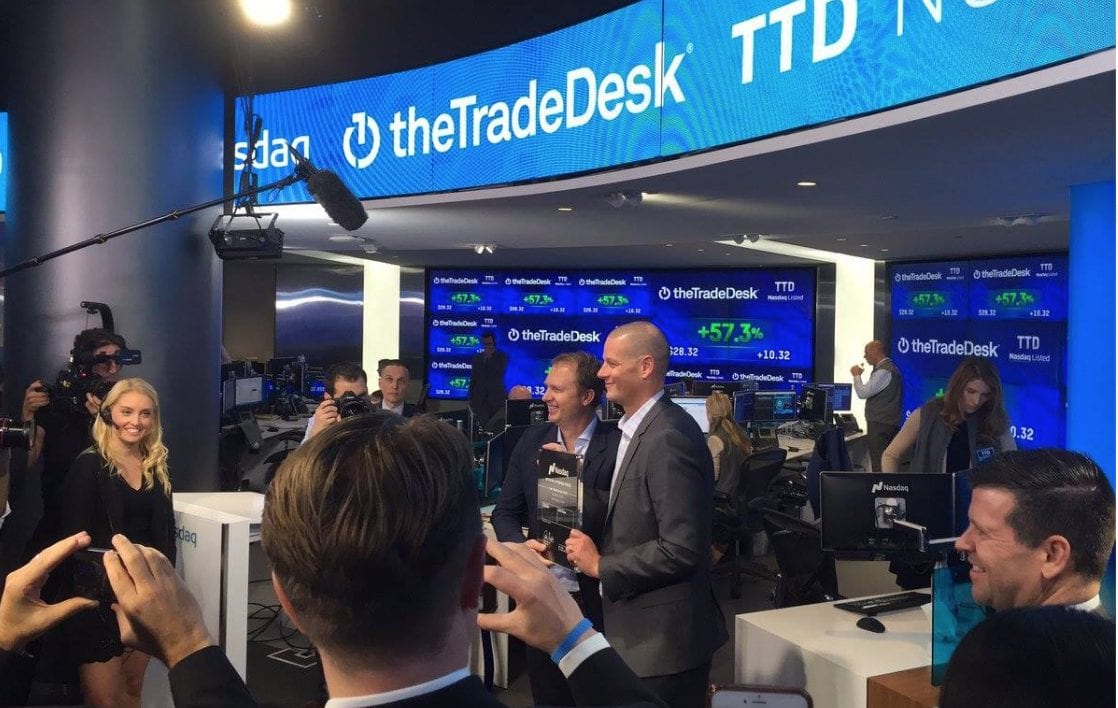
    The office marks one of the first new Asian markets for the company since it publicly floated on the stock markets last year. The company hit the headlines after its IPO was widely considered to have been a success.

  • Global ad revenue on pace to $590b in 2017

    Global ad revenue on pace to $590b in 2017

    Big brand budgets and quadrennial events such as the Olympics, European Football Championship and US presidential election will drive 2016’s global advertising revenue growth to $532 billion.

    The advertising industry is about to turn the corner thanks to the global economy getting back on track, according to a new report released by IHS Markit.

    Advertising revenue will grow 7.1% in 2016 to $532 billion. Strong growth in global real private consumption also buoyed advertising revenue as brands tried to take advantage of heightened consumer spending. Advertising revenue accounted for 0.69% of global GDP in 2016, up from 0.66% in 2015, the report said.

    Top 10 markets

    The top 10 markets make 75% of the global revenue figure. The top 10 markets still account for the lion’s share of global advertising revenue. However, their collective power has dropped due slowdowns in the Chinese and Brazilian economies, which were the rising stars in the top 10 in 2015.

    The top 10 accounted for 76% of global ad revenue in 2015; it dropped to 75% in 2016.

    Four out of the five fastest growing countries in 2016 were in Africa. Ghana and Kenya have been high on the list of many media companies’ expansion plans, and we are seeing growth above 20%. These markets are still growing from a low base, but the sheer size of their populations means they are becoming interesting targets for big brands.

    TV remains number one, but online will overtake by 2020

    TV was the number one medium globally for advertising revenue, accounting for $192 billion, or 36%, of global revenue. Despite the incredible growth of online giants like Facebook, Google and Snapchat, the TV market continues to benefit from big brand budgets. Quadrennial events such as the Olympics, the European Football Championship and the US elections helped keep TV on top.

    However, revenue from online advertising will overtake TV within the next five years. In some countries such as the UK, online already accounts for almost 50% of total advertising revenue and will only keep getting stronger.

  • Turner, Snapchat ink content, ad deal

    Turner, Snapchat ink content, ad deal

    Turner and Snap are expanding their partnership by bringing new brands to Snapchat’s Discover platform, extending live coverage of Turner’s premium sports events, and working with several Turner brands to develop Snapchat shows.

    The deal encompasses content, distribution and advertising centered around Turner’s leading portfolio of networks, programming, events and brands.

    “This deal marks the latest strategic move for Turner to innovate within the digital arena and provide complementary viewing experiences for a younger, mobile-centric audience,” said David Levy, president of Turner.

    “Snapchat is a powerful outlet to directly connect with the millennial generation and perfectly aligns with our portfolio-wide strategy to engage with audiences at every touch point,” said Levy.

    As part of this deal, Turner will work with Snap to develop original shows from its series and brands such as TBS, Adult Swim, truTV, Great Big Story and Super Deluxe.

    Turner’s portfolio will create and produce original content from its popular franchises and networks specifically for Snapchat’s mobile-first audience.

    Turner’s Bleacher Report, the digital sports brand for the millennial generation, will launch a Discover Channel in the United States, comprised of videos, images, animations and graphics covering the top stories in sports each day.

    It will join the CNN Discover Channel, which will expand its offering to feature more daily content than ever before, including in-depth, global news stories hand-curated for the Snapchat community.

    The agreement continues to leverage Snapchat’s immersive Live Stories with expanded coverage of Turner’s premium sports content, including the NCAA Division I Men’s Basketball Championship and the PGA Championship.

    The exclusive access around these premium sports properties brings Snapchatters closer to the action with behind-the-scenes coverage, videos and photos from on-site correspondents.

    Turner and Snapchat will collaborate on advertising sales, developing exclusive and immersive ad experiences that provide brands the space to connect with millennials in a dynamic mobile environment within original shows and Live Stories.

    The two companies will also provide sponsors with creative advertising opportunities on the Discover Channels, offering brands a full-screen, creative canvas for mobile storytelling.

  • Global Advertising Spend Growth to Slow Next Year

    Global Advertising Spend Growth to Slow Next Year

    The latest Consensus Ad Forecast from Warc, the marketing intelligence service, indicates that global advertising spend will rise by 4.5% during 2016 as a whole, before the growth rate slows to 4.2% in 2017.

    With the exception of newspapers and magazines, all major media channels are expected to record adspend growth this year and next. However, the two largest, TV (+1.1%) and internet (+13.0%) are forecast to see their growth rate ease during 2017. The same is true for mobile, though it is still set to be the fastest-growing ad channel over the period.

    Warc’s Consensus Ad Forecast is based on a weighted average of adspend predictions at current prices from ad agencies, media monitoring companies, analysts, Warc’s own team and other industry bodies.

    Current sources include Carat, eMarketer, GroupM, Magna Global, Nikkei Advertising Research Institute (NARI), Pitch-Madison, Pivotal Research Group and ZenithOptimedia.

    All 13 markets covered in the report are forecast to see the amount invested in advertising rise both this year and next, though for eight of these the growth rate will be softer in 2017.

    India is expected to see the strongest annual rise in adspend this year, up 13.3%, with a similar rate of growth anticipated next year. The world’s largest ad market, the US, is expected to post adspend growth of 5.1% this year – buoyed by the presidential election campaigns and the Rio Olympics. US adspend growth is then forecast to cool next year – rising by 2.8% – as the impact of these events is lost.

    Adspend growth by country

                           2016 vs 2015     2017 vs 2016

                          y-o-y % change   y-o-y % change

    India                      13.3             13.4

    China                       7.8              7.1

    Russia                      5.8              6.1

    Spain                       5.8              5.2

    UK                          5.6              4.3

    US                          5.1              2.8

    Australia                   3.8              3.8

    Brazil                      3.3              2.1

    Italy                       2.8              1.6

    Germany                     2.1              1.8

    Canada                      2.0              2.4

    Japan                       1.7              1.7

    France                      1.3              0.8

    Global                      4.5              4.2

    Source: Warc’s Consensus Ad Forecast, November 2016 (www.warc.com)

    Despite the uncertainty surrounding the “Brexit” process by which the UK will leave the European Union in 2017, the nation’s ad market is forecast to record adspend growth of 5.6% this year and 4.3% next; both above the global respective rates.

    All four BRIC markets, India (+13.4%), China (+7.1%), Russia (+6.1%) and Brazil (+2.1%), are expected to post rises in ad expenditure this year and next. France is forecast to record muted growth of +0.8% in 2017, the softest rate of the 13 markets studied.

    All media, barring newspapers and magazines, are predicted to record year-on-year growth in 2017, with mobile expected to see the greatest adspend rise, up 34.2%. Total internet (including mobile) growth is expected to be 13.0% next year, while TV, the world’s largest ad channel by spend, is forecast to post growth of 1.1%.

    Global adspend growth by medium

                           2016 vs 2015     2017 vs 2016

                          y-o-y % change   y-o-y % change

    Mobile                     47.1             34.2

    Internet                   14.6             13.0

    Out of home                 3.4              3.2

    Cinema                      3.1              5.1

    TV                          2.8              1.1

    Radio                       0.4              0.3

    Magazines                  -5.9             -4.5

    Newspapers                 -8.0             -6.1

    Source: Warc’s Consensus Ad Forecast, November 2016 (www.warc.com)

    James McDonald, Senior Research Analyst at Warc, said: “The latest consensus results present a positive outlook for advertising investment at both a global and local level. All 13 markets studied are expected to record adspend growth in the short term, and this despite their contrasting socio-economic environments.”

    “We have identified a common trend among more mature markets whereby increasing investment in internet – particularly mobile – ad formats is driving headline growth. Applying consensus trends to Warc’s adspend data shows that mobile will grow to be the world’s third-largest ad channel by the end of 2016.”

  • Facebook moves to circumvent ad blockers

    Facebook moves to circumvent ad blockers

    Facebook is looking to stop playing ball with ad blockers.

    On Tuesday, Facebook tweaked its desktop website in a way that renders traditional ad blocking useless. The company redesigned its ad formats to improve ad performance and expanded its controls so that users get to see those ads that are relevant.

    In addition, Facebook noted that its desktop users using ad blocking software will now be able to see ads nonetheless. It can do this because the ads are housed in the company’s own ecosystem.

    According to the Facebook’s blog, the social media giant has “introduced tools to help people control their experience, improved how we decide which ads to show and created new ad formats that complement, rather than detract from, people’s experience online.”

    Facebook claims that ads can be useful in finding new products and experiences, but that the way ads are being served is the main problem. The company argues that many users are installing ad blockers to avoid disruptive, slow-loading and irrelevant ads.

    Facebook also noted that some ad blocking vendors are accepting money to unblock specific ads. As such, the company feels that it goes against its company ethos of keeping its services free and using ads to support journalism.

    It’s a bold move by Facebook and obviously aimed at protecting its own revenue base – which is largely ad based. It may only be a matter of time for other social media and internet platforms to follow and find other ways around ad blocking software in the name of good user experience.

    So Facebook has made its move; now, it is up to users who are fed up with online ads to react.