Japanese supermarket giant Aeon has become the first foreign retailer to enter Myanmar since the 2011 transition to civilian rule, a development that could herald change in a retail industry still dominated by traditional markets.
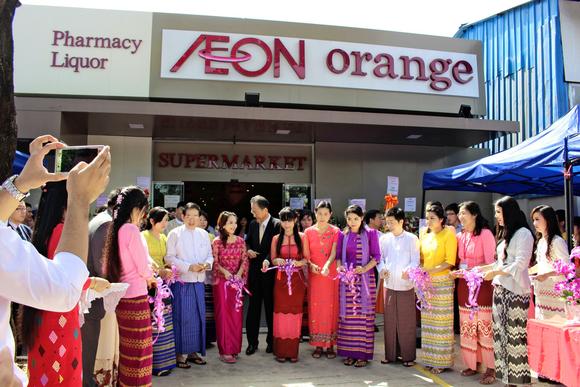
Aeon signage, a familiar sight to Japanese consumers, made its Myanmar debut Friday in a largely middle-class area along a major road in Yangon’s North Okkalapa district. The store packs some 8,000 products into a relatively compact 613 sq. meters of sales-floor space. The lineup includes about 80 items imported from Japan, including selections from Aeon’s Topvalu private brand. About 70% of the products are imported from Thailand or elsewhere, with the remaining 30%, mainly fresh foods, coming from Myanmar.
A slice of Japan
Upon entering the store, the first thing that catches the eye is a refrigerated case featuring neatly wrapped packages containing three or four slices of melon or watermelon, priced at 600 kyat to 800 kyat (47 cents to 63 cents).
“Foods from Japan like cup noodles can be eaten quickly and easily,” a worker at a beverage plant noted. The 24-year-old praised the low prices, as well as the store’s thoughtfulness in offering small servings of fruit that can be polished off before they go bad.
Refrigerated products are a rare sight in Myanmar supermarkets, since quality control is difficult. Produce is typically sold by the piece. Refrigerators are also relatively uncommon in households, so if a customer buys a watermelon, for example, it is usually eaten all at once. The Aeon store offers small packs of sliced fruit, meat and fish, giving customers the option of Japanese-style shopping — buying only as much as they need, when they need it.
Another peculiarity is prepared foods such as boxed meals, which are almost unheard of in Myanmar supermarkets or convenience stores. Ahead of the supermarket opening, Aeon set up a central kitchen in Yangon, where about 10 Myanmarese staffers cook food tailored to local tastes. A lunch box with curry, rice and salad costs 1,280 kyat, while rice balls with pork or other fillings go for 550 kyat. By comparison, a noodle dish from a local vendor typically costs around 800 kyat.
Aeon announced in August a joint venture with Creation Myanmar Group of Cos., a local company which operates 14 supermarkets in the country under the Orange brand. The venture, Aeon Orange, aims to open 10 or so stores in five years. “This is a milestone in transplanting the Japanese values of convenience, security and safety,” Aeon Orange President Yoshimitsu Kawato enthused.
An industry in transition
Modern retail is still a work in progress in Myanmar. Local player City Mart Holding, established in 1996, runs about 40 supermarkets in the country. But these stores serve mostly upper- and middle-class consumers in urban areas. Most people still turn to traditional public markets, known as zei. Modern retailers such as supermarkets account for just 10% or so of the retail industry.
Aeon aims to lure the zei crowd with such draws as the affordable, high-quality Topvalu brand. “Three towels cost 1,800 kyat,” said one shocked shopper. “Even though they’re high-quality Japanese products, they’re cheaper than what’s sold at regular stores.”
Aeon’s Southeast Asian business has suffered from something of a slump in Malaysia, a mainstay market, in recent years. “Myanmar is the market we’re focusing most on,” said President Motoya Okada, citing its “unquestionable” potential and rapid growth.
Research firm Euromonitor International sees Myanmar’s retail market expanding from $11.5 billion in 2015 to $17.5 billion by 2020 amid the rise of the urban middle class. City Mart plans to double its store count within three years, while Thai conglomerate Central Group is reportedly mulling a foray into the country. Competition over this rapidly modernizing growth market will likely be fierce.
Reform underway
Myanmar’s new government has accelerated efforts to open up the country’s economy. The retail industry, which was closed to foreign participation in 2002 in the name of protecting domestic companies, is among the clearest examples.
Aeon’s entry into the market has still met with backlash from Myanmar’s retail industry, which fears that foreign enterprises could throw around their financial weight to crush local businesses.
“We think about protecting domestic companies, but the benefits to consumers are important, too,” argued Aung Naing Oo, director general of the Directorate of Investment and Company Administration. “We welcome Aeon’s entry into Myanmar.”
The country still does not permit foreign involvement in trade. Aeon’s imports are handled by its local partner, Creation Myanmar. Opening up trade licenses to foreign businesses is the biggest key to expanding the retail industry, some argue.
Infrastructure remains an issue as well. The lack of refrigerated trucks and distribution facilities makes it difficult to get seafood and agricultural products from outlying areas to big cities. Though Japanese companies including Kokubu Group started building temperature-controlled warehouses outside Yangon last year, only a few have been completed. A boost to demand from Aeon’s presence would encourage infrastructure construction, a Kokubu spokesperson said.