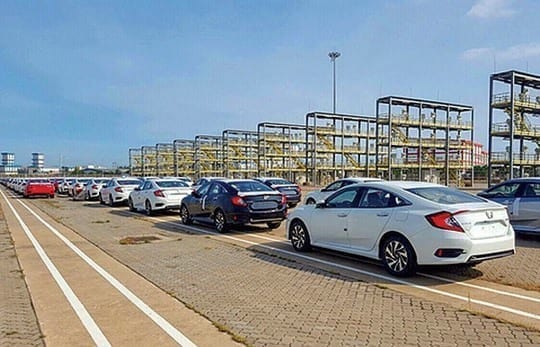
In an interview with regional media, he said Thailand should benefit from joining both trade blocs as the RCEP’s centre points are China, Japan and India, while the TPP is spearheaded by the US and Japan, with Thailand’s automotive industry among the potential gainers for exports to the huge TPP markets.
The RCEP is the extended trade bloc of the AEC, with a combined economy worth US$2.6 trillion (Bt83.8 trillion).
Incalcaterra said the AEC, which ushered in a new era at the start of this year, would lead to more effective flows of capital and trade in services, in addition to the freer flow of goods.
However, he said trade in services was more difficult due to non-tariff barriers, but the situation should now continue to improve as member countries hope to achieve their liberalisation goal in 2025.
Within the AEC area, he said, the “single window” facility for cross-border trade had lowered transaction costs, while global supply chains had benefited from cost savings in the area’s single production base.
However, the economist said Asean countries needed more political will to further integrate the member states and boost foreign direct investment from outside the region, while implementing structural reforms to boost auto and other industries, as well as infrastructure investment projects using the public-private partnership model.
Regarding the TPP, he said, the 12-nation trade bloc should complement the RCEP of the Asean countries plus their partners – China, India, Japan, South Korea, Australia and New Zealand – as more free trade was better for the region.
“In the AEC, Thailand is among those at the forefront with a head start due to its large consumer market, big auto industry, et cetera, hence many Thai firms can take advantage [of the opportunities],” he said, adding the country’s political challenge has, however, hindered the economy in the past one or two years.
In addition to Thailand, he said, other Asean countries such as the Philippines and Indonesia were moving towards joining the TPP trade bloc over the next two years.
In the case of Thailand, there are clear benefits in joining the TPP in addition to the RCEP, he added.
At present, Singapore, Vietnam, and Malaysia are already members of both the RCEP and the TPP.
For this year, Incalcaterra said Thailand’s economic growth rate would likely remain the lowest among Asean countries, with HSBC projecting 3.3-per-cent expansion.
China’s slowdown will affect Thailand and Malaysia significantly, due to the two countries’ large share of exports to China, where growth this year is projected to be less at 6.7 per cent, against 7.1 per cent in 2015, he said.
On the US Federal Reserve’s interest-rate hike – the first in nine years – the economist said the move would create short-term volatility, but the gradual cycle of rate adjustments would not lead to a major disruption.
Meanwhile, Hai Pham, HSBC’s chief executive officer in Vietnam, said there was plenty of room for intra-trade growth among Asean economies, which currently represented only 20 per cent of their total trade, compared to more than 60 per cent among members of the European Union.
He said cross-border investment was another high-growth area for Asean companies, citing Thailand’s Berli Jucker and other firms as examples of Asean firms investing in Vietnam’s retail and electronic-goods sectors.
For Vietnam, GDP growth is projected to be around 6-7 per cent this year, but the challenge is for local businesses to step up their efforts to meet the challenges presented by the AEC, as many are still not ready to take on increased competition.
The CEO also expects more consolidation of companies in Vietnam in 2016, due to the coming into effect of the AEC.