Retail News CRM

Tag: aia

  • Tesla Sold 32,165 China-Made Vehicles In May

    Tesla Sold 32,165 China-Made Vehicles In May

    U.S. electric vehicle maker Tesla sold 32,165 China-made vehicles in May, including 22,340 for export, the China Passenger Car Association (CPCA) said on Thursday.

    That compares with 1,152 vehicles sold and none exported in April. The Tesla factory halted work for 22 days beginning late March to comply with a city-wide lockdown in Shanghai.

    The plant, which manufactures Model 3s and Model Ys, reopened on April 19 and resumed exports on May 11 but has struggled to get production back to pre-lockdown levels.

    Tesla’s Shanghai factory produced 33,544 vehicles in May, up 212% from April, the association added.

    China’s BYD delivered 114,183 cars in May. Electric vehicle maker Li Auto delivered 11,496 and Xpeng Inc 10,125.

    CPCA also said passenger car sales in May in China had totalled 1.37 million, down 17.3% from a year earlier.

    June sales should be 10% to 20% higher than a year earlier, CPCA secretary general Cui Dongshu told reporters. Demand from earlier months, suppressed by lockdowns that have now eased, would support June sales, Cui said.

    The world’s biggest auto market is recovering from its worst monthly drop since March 2020 after China’s efforts to stamp out COVID-19 outbreaks across multiple cities disrupted supply chains and dampened demand.

  • The trend for personalisation in retail continues with much hype, but limited success

    The trend for personalisation in retail continues with much hype, but limited success

    This apparent failing owes much to a disconnect between the retailers view of personalisation, and what the individual customer perceives – and wants – as a personalised buying experience. It’s a balance that the retail sector has to redress, if the industry is to fully benefit from the potential gains of true personalisation – which can be quite considerable.

    According to research conducted by the Boston Consulting Group (BCG), personalisation is key to increasing the rate at which retail organisations can convert occasional shoppers into regular customers, and increasing the lifetime value of those customers.

    Many retailers assume that simply because an individual looks at an item, they automatically want it. Crude attempts at personalisation based on this kind of assumption include putting someone on a remarketing list, then pestering them with discount offers for goods they may have simply glanced at out of curiosity.

    Clearly, the fundamental principle of personalisation (as understood by customers) is being misinterpreted by many retailers. And the message that their marketing is giving to consumers is breeding frustration and a lack of respect – hardly the intended result.

    In a truly personalised journey, power resides with the customer, who can decide whether or not they receive personalised advertising, the nature of the content they see, and the products they are able to access.

    Some retailers do appreciate this distinction, and take steps to customise their buyer experience in a manner more appealing to their consumers. The tailoring brand Savitude for example, requests minimal data from its customers, yet uses this information to produce outfits cut to suit the customer’s body shape, their individual preferences, and even the occasion they plan to attend.

    The tailoring analogy extends to current trends in consumption, which look for sustainability in the form of minimal purchases of curated goods, designed for longevity. The price tags associated with commodities like this may be higher, but consumers are increasingly prepared to part with their money if the products and services they get are specifically attuned to their needs.

    This is the kind of personalisation that customers want: a personalised service on their terms, with responsible data gathering, their consent requested from the outset, transparency, and clarity over how their information is put to use.

    How do you then quantify personalisation and put observation into practice? There is a small percentage of organisations getting it right, though many retailers are unclear what steps to take and which capabilities to build, in order to generate and sustain a truly personalised experience for their customers. Find out about the methodology here.

    From a generic standpoint, top-level retail organisations use a variety of tactics, such as personalised merchandising, loyalty schemes, and reward programmes. They use mobile, paid display, and paid search marketing to frequently activate more channels.

    Their technology stack typically includes infrastructure that enables predictive algorithms (which help retailers to make personalised product recommendations and offers), and to access integrated customer data in real time (which helps in developing deep insights into how customers behave, and enables rapid response).

    Get access to some recommendations on personalisation in retail with a free case study here

    Day 2 at eTail Asia highlights an all-star panel discussion on “How can you improve, personalise and simplify the customer experience, adding value through each journey?”

    With powerhouses such as Adidas, Flipcart, and Luxasia representing the speaker line-up, audiences are guaranteed to not only learn from the best of their category, but also get the unique opportunity to cross-learn from relevant case studies, all in the convenience of a single location.

     

  • Vietnam aircraft fleet to quadruple in 20 years

    Vietnam aircraft fleet to quadruple in 20 years

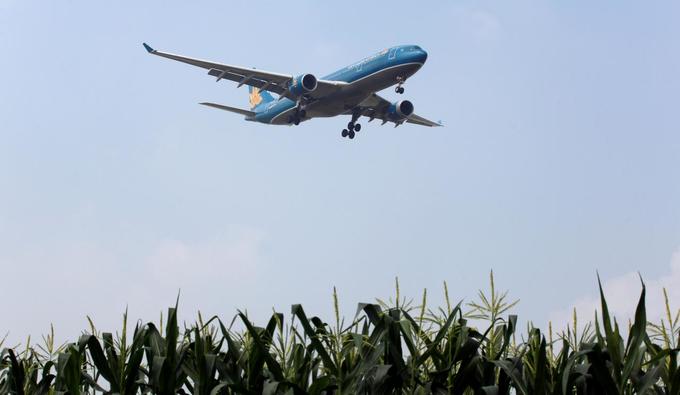
    Vietnam’s aircraft fleet, at 200 now, will quadruple by 2038 as air travel demand increases and the market sees new players.

    These figures were cited by Darren Hulst, aircraft manufacturer Boeing’s marketing director for China & Northeast Asia, at a recent press briefing.

    The current number of aircraft in the country is set to double in the next two years. Single-aisle aircraft are set to be the main type used for Vietnam’s domestic and regional flights, Hulst said.

    He noted that aviation growth has been rapid in Vietnam for several years now. In 2009, all Vietnamese airlines provided 800,000 seats a month, but by this year, the figure had reached 3.3 million.

    In the last five years, the number of passengers taking flights has tripled and the number of aircraft doubled, he added.

    Southeast Asia will need 4,500 new aircraft by 2038, and Vietnam is set to account for a large portion of that demand, Hulst said.

    Vietnam now has six domestic carriers and three companies that have applied for aviation permits.

    Last year, Vietnam’s 21 state-run airports served 103.5 million passengers, up 11 percent year-on-year, and the figure is set to rise to 112 million this year, according to the Airports Corporation of Vietnam.

  • Afternoon Tea Tearoom opens first Hong Kong store

    Afternoon Tea Tearoom opens first Hong Kong store

    Japanese tearoom chain Afternoon Tea Tearoom will open its first branch in Hong Kong this Saturday to offer a Japanese-style casual afternoon tea experience in a tourist hotspot.

    The tearoom is located in K11 Musea in Tsim Sha Tsui and offers sweets and a variety of foods such as sandwiches and pasta, plus selected teas and drinks.

    The firm is offering a training program in Japan for the Hong Kong staff of its partner Tearoom (HK) Limited to learn the company’s concept, menu and way to serve customers.

    “Hong Kong is a culturally diverse society and people here are familiar with afternoon tea culture,” said Ivy Company, Sazaby League company president Ryuhei Tsukada.

    “We are grateful to have an opportunity to offer our quality sweets and foods in the city. Our Hong Kong team and Japan team will work together closely to provide the best services to customers, providing them with a rich but casual and relaxing afternoon tea experience.”

    “We are happy to see a popular Japanese brand join our dynamic food and beverage market,” said Investment Promotion associate director-general Dr Jimmy Chiang. “Hong Kong people love Japanese food culture, and I am confident Afternoon Tea Tearoom will draw a good following among food lovers who look for nothing but the best.”

  • Top young Hong Kong fashion designers revealed

    Top young Hong Kong fashion designers revealed

    This year’s top young Hong Kong fashion designers have been revealed, capping off the Centrestage festival.

    Three winners of the 2019 Hong Kong Young Fashion Designers’ Contest (YDC) were chosen from a final pool of 16.

    Champion Wilson Yip received a monetary reward together with a one-month internship working in the studio of Japanese fashion designer Mihara Yasuhiro, sponsored by Sun Hing Knitting Factory.

    Yip’s prizewinning “Forgetful Still” was a whimsical collection inspired by the aesthetic of absentmindedness. Yip also took the Best Footwear Design Award.

    Designer Louis Chow was named first runner-up for his collection “Already But Not Yet”, while the award for second runner-up and new talent was given to Enzo Chan for his “Since 1996”.

    The judges assessed the top young Hong Kong fashion designers’ works based on creativity, originality, market potential, craftsmanship, use of fabrics and overall aesthetics, and offered expert feedback to each of the participants. VIP Judge Mihara Yasuhiro had particular praise for the winning piece, saying that Champion Wilson Yip “managed to paint fashion over the backdrop of everyday life, using elements of daily wear and injecting them with novelty and creativity”.

    The YDC has been organized by the HKTDC for more than four decades with the objective of nurturing and promoting young fashion talent. In 2012, to further promote the international visibility of local Hong Kong designers, the HKTDC launched fashionally.com, an online platform that showcases the work of local labels and talents to link them with global industry insiders and opportunities.

  • Goodyear Unveils New Tyre Range For Cars And SUVs

    Goodyear Unveils New Tyre Range For Cars And SUVs

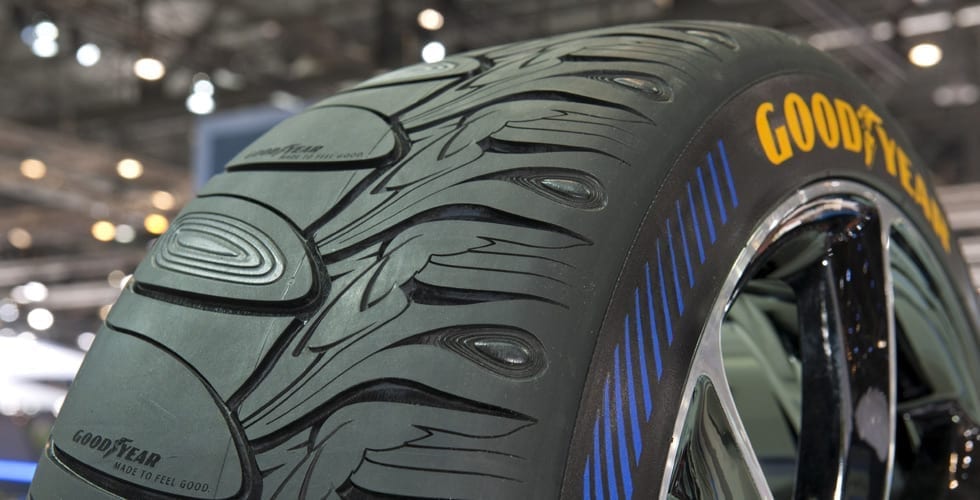
    Goodyear has unveiled its new tyre range- Assurance DuraPlus 2 and Wrangler AT SilentTrac for the Indian market. The Assurance DuraPlus 2 range is designed for small and mid-sized passenger cars while the Wrangler AT SilentTrac is developed for SUV and is suitable for off-roading and rough surfaces. The Assurance Duraplus 2 range has been developed using a strengthened TredLife Technology which is optimized for better fuel efficiency and lesser tyre noise. Goodyear is also claiming it to last for 110,000 km under ideal driving conditions.

    The Wrangler AT SilentTrac is designed to enhance the rugged character of an SUV along with offering a smooth ride. It uses the latest DuraWall technology that helps the tyre to resist cuts and tears which often cause damage to the tyres when off-roading. The shoulder blocks have also been improved compared to the previous range and the tread pattern have been designed to reduce the road noise.

    Commenting on the unveil of both products, Rajeev Anand, Chairman and Managing Director, Goodyear India said, “As a pioneer in tyre technology, Goodyear has always been at the forefront of innovation, and continues to push itself to offer a wide portfolio of new offerings that cater to different market segments. We constantly challenge ourselves to develop better products and empower our consumers with a superior driving experience”

    The Goodyear Assurance Duraplus 2 is available in 13-inch to 15-inch rim size makinf it ideal for hatchbacks and compact sedan while the Wrangler is AT SilentTrac is offered in 15-inch to 17-inch rim size, making it ideal for compact and mid-size SUVs.

  • Hang Seng Index Registers Sharp Weekly Losses

    Hang Seng Index Registers Sharp Weekly Losses

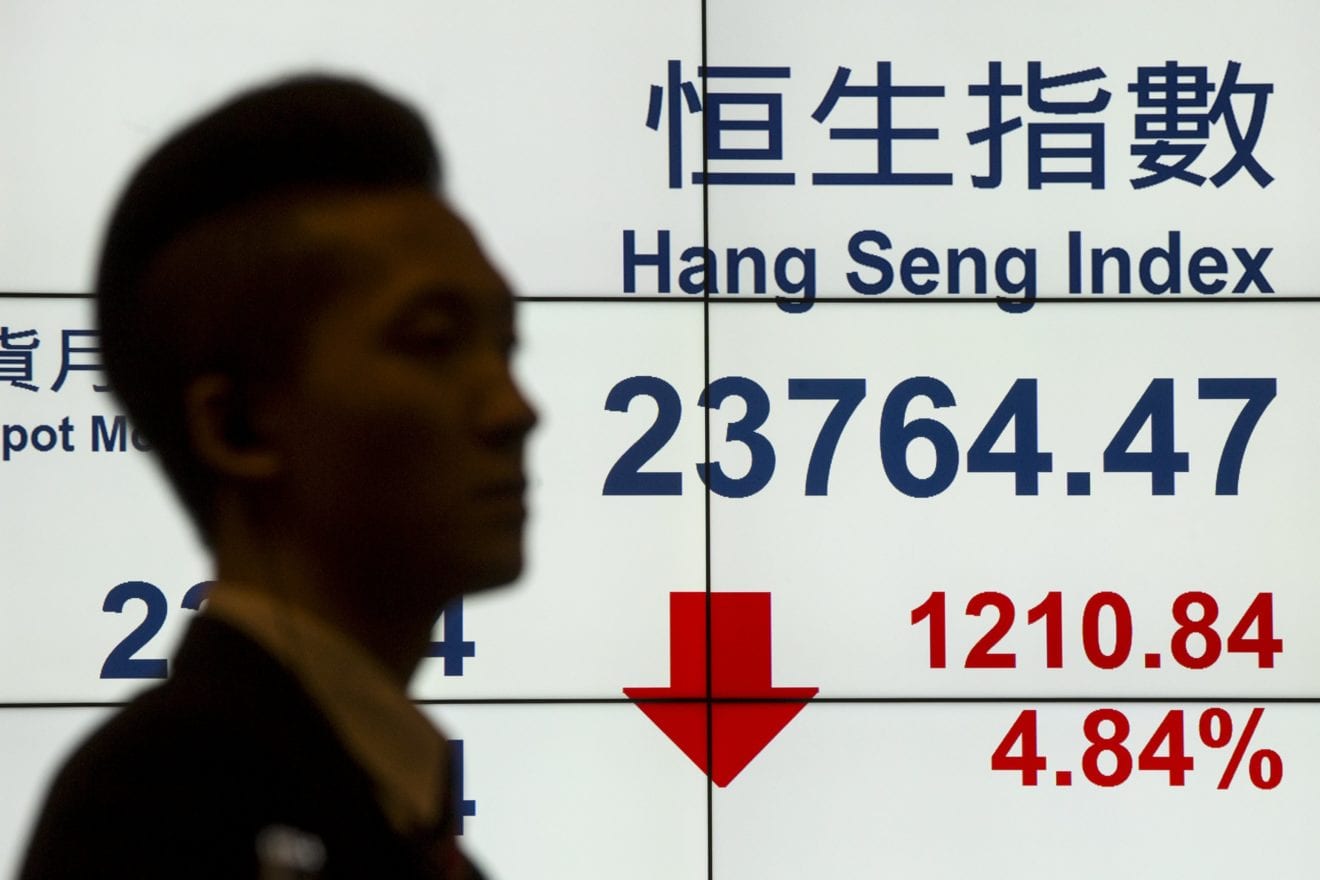
    Hong Kong shares continued to move lower on Friday with the fifth successive daily Hang Seng retreat and sharpest weekly decline for close to three months as confidence deteriorated further.

    US equity markets were unable to make any significant impression on Thursday with marginal losses in the S&P 500 index and weakness in Asian markets. Oil prices were subjected to choppy trading conditions with slight net losses.

    There were further concerns surrounding the Chinese economic outlook with fears that stronger data in March and April would not be sustainable. Sharp declines in mainland Chinese equity markets also had an important impact in undermining Hong Kong confidence.

    Hong Kong retail sales data, released after Thursday’s market close was weaker than expected with a 9.8% annual decline in the year to March, the 13h successive decline with domestic demand subdued and weakness in international arrivals. There were some hopes that a weaker yuan in trade-weighted terms and recent dollar losses would help improve competitiveness and cushion the retail sector from further selling pressure.

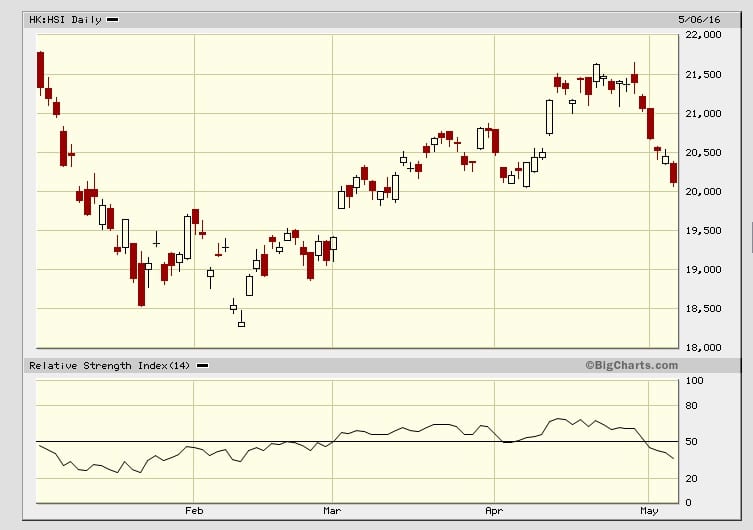
    After opening significantly lower the Hang Seng index moved steadily weaker during the morning session with lows close to 20,150 ahead of the break. Buyers were unable to make any impression during the afternoon session and there was fresh selling late in the session. The index closed with a loss of 339.95 points and 1.66% at 20109.87, the weakest close since the second week of March.

    There were daily losses of over 2.00% for the finance and property sectors and the utilities sector also edged slightly lower despite gaining defensive support. HSBC and AIA dipped significantly lower during the day. The China Enterprises index fell 1.80% for the day, also the fifth successive retreat.

    Friday’s US employment data will be important for global markets with a particular focus on the dollar, which will influence regional markets next week. China’s trade and international reserves data is scheduled over the weekend, which will have an important impact on confidence surrounding the Chinese economy and equity markets with any decline in exports undermining sentiment.

    Hang Seng Daily Chart

    hangseng daily chart 06-05-16