Tag: AMD

  • Taiwan Pitches Global Chip Alliances as Market Heads for 1.5 Trillion Dollars

    Taiwan Pitches Global Chip Alliances as Market Heads for 1.5 Trillion Dollars

    Taiwan President William Lai told tech executives in Taipei that international chip partnerships will anchor an industry projected to exceed 1.5 trillion dollars this year.

    Foreign semiconductor leaders continue to pour capital into the island, led by Nvidia’s annual procurement and investment topping NT$3 trillion ($94.84 billion). Micron Technology has committed more than NT$1.4 trillion to local operations, while Advanced Micro Devices pushed its research spending in Taiwan past NT$300 billion.

    TSMC’s Overseas Buildout

    Taiwan Semiconductor Manufacturing Co is matching domestic research with heavy spending abroad to insulate buyers against supply shocks. The world’s largest contract chipmaker announced an additional $100 billion commitment to its Arizona facilities in July, while its plant in Kumamoto, Japan, continues on schedule.

    In Europe, TSMC expects its Dresden fabrication facility to begin commercial chip production before the end of next year. That site will supply automotive and industrial customers across the European Union.

    For consumer electronics makers and device brands across Asia, the dual strategy offers reassurance. Taiwan is retaining cutting-edge wafer fabrication and packaging on home soil while duplicating mature and specialized capacity in Western markets to guarantee steady silicon delivery during regional crises.

    State Support for Next-Gen Tech

    Taipei plans to back corporate spending by funding core infrastructure, including power generation, water supplies, land access, and computing capacity. State research backing will focus on silicon photonics, quantum computing, and artificial intelligence robotics.

    US Undersecretary of State for Economic Affairs Jacob Helberg told attendees via video link that concentration without resilience creates systemic vulnerabilities. He pointed to the Pax Silica framework, an alliance designed to secure technology supply lines among trusted trade partners.

    Discussions continue this week as the Semicon Taiwan trade exhibition runs through Friday at the Taipei Nangang Exhibition Center.

  • Samsung rumored to begin mass production of 3nm chips next week

    Samsung rumored to begin mass production of 3nm chips next week

    Right now there are only two independent foundries that are able to manufacture cutting-edge chips. The companies are TSMC and Samsung Foundry. Independent foundries take chip designs created by other firms and build the actual chips off of that design. Both TSMC and Samsung are working on building chips using their 3nm process nodes. The smaller the process node used, the larger the number of transistors found inside a chip.
    This is important because the more transistors employed in a chip, the more powerful and energy-efficient that chip can be. Every two years or so, the process node gets smaller and more transistors fit inside an integrated circuit. This is the famous “Moore’s Law” that you’ve heard about, named after Intel and Fairchild semiconductor co-founder Gordon Moore. Remember, this is not an actual law and as smaller and smaller components are being built, this “observation” no longer can be fully counted on to double the transistor count every other year.
    Still, over time, you can see how “Moore’s Law” has forecast the incredible increase in processing capabilities over the years. Let’s take the iPhone X, which was released in November 2017 powered by the Apple A10 Bionic chipset. The latter carried 4.3 billion transistors in each chip. Now let’s move ahead to the 2021 iPhone 13 series which sports the A15 Bionic chipset. The A15 Bionic contains 15 billion transistors, up 27.1% from the 11.8 billion transistors employed by the A14 Bionic chip.
    So now Samsung and TSMC are battling for supremacy in the business of building chips for third-parties. TSMC is number one in most metrics and its customer list includes top tech firms such as Apple (its number one customer), MediaTek, Nvidia, Qualcomm, and others. But it appears, according to ExtremeTech, that Samsung will soon beat out TSMC by starting mass production of chips made using its 3nm process node next week with TSMC starting 3nm mass production later this year.
    Additionally, Samsung is going to use a new transistor structure on its 3nm chips called GAA or gate-all-around. With this structure, the flow of current is controlled by gates that contact the transistor on all four sides. TSMC will continue to use the FinFET structure which has been in place since the 22nm process node debuted. TSMC will finally scrap FinFET for GAA when it starts shipping 2nm chips in 2026.
    Samsung’s GAA design is called Multi-Bridge Channel Field Effect Transistor (MBCFET) also known as nanowires. This is one of only two different gate-all-around designs currently available with the second one known as GAAFET or nanowire.
    The report cites a major Korean news agency that says Samsung is expected to make a major announcement about its 3nm chip production shortly. It also notes that the move to gate-all-around from FinFet will reduce the area of a chip by 45% to help deliver a performance bump of 30% while reducing energy consumption by 50%. However, there is a big problem. Samsung was reportedly getting yields of only 10% to 20% at 3nm meaning that the vast majority of its 3nm chip dies cut from a wafer could not pass quality control.
    Back in February, a report indicated that Samsung’s yield on 4nm production was only 35% resulting in Samsung losing some business from chip designer Qualcomm. The latter supposedly moved some of those orders to TSMC. However, if Samsung Foundry is about to announce the start of high volume manufacturing (HVM) at the 3nm process node, one could come to the conclusion that Samsung Foundry has improved its 3nm yield.
    Speaking of 3nm, TSMC’s major customers such as AMD, Apple, Broadcom, Intel, MediaTek, Nvidia, and Qualcomm, have started to queue up for 3nm capacity. And next on the horizon, of course, is the 2nm process node that both TSMC and Samsung are working on. Another name is expected to join TSMC and Samsung on the list of  cutting-edge foundries. Intel Chief Executive Pat Gelsinger has announced that the American company will regain process leadership from Samsung and TSMC by 2025.


  • Tesla Launches New Model Y and Model 3 With AMD Chips

    Tesla Launches New Model Y and Model 3 With AMD Chips

    Tesla had launched the new Model S and Model X which were equipped with AMD RDNA 2 based GPUs that deliver performance that’s comparable to the PlayStation 5 (PS5). And now, as revealed by a leak from its test program in Europe, it has also launched new models of the Model Y and Model 3 which have the very same chip powering the infotainment screen. This is true for models that have been manufactured in China. This is particularly true for the performance edition of the Model Y in China.

    Now, this is interesting as authorities in the US have opened an investigation into Tesla’s implementation of triple-A games that operate from the main infotainment panel facilitated by this AMD GPU that packs 10 teraflops for computing power. Tesla has even said that it will be pushing out a software update in the US to disable this feature.

    But it looks like Tesla is going ahead with the implementation of this feature in markets outside of the US. And considering the global semiconductor shortage, this chip must have been hard to procure as both Sony and Microsoft can’t get enough for the PlayStation 5 and Xbox One Series X – so Tesla could’ve gone for something not as powerful but it is motoring ahead.

    In addition to this chip, these new cars also come with a new 12-volt battery system that will be susceptible to fewer failures. Tesla’s have been prone to battery issues which is why this is a welcome change and will make the Tesla experience more reliable.

  • Tesla working with AMD to develop chip for self-driving car

    Tesla working with AMD to develop chip for self-driving car

    Electric carmaker Tesla is working with Advanced Micro Devices to develop its own artificial intelligence chip for self-driving cars, citing a source familiar with the matter.

    AMD spin-off GlobalFoundries Inc Chief Executive Sanjay Jha said his company is working directly with Tesla. GlobalFoundries, which fabricates chips, has a wafer supply agreement in place with AMD.

    Tesla isn’t completely going it alone in chip development, according to the source, and will build on top of AMD intellectual property.

    More than 50 people are working on the project under Jim Keller, a longtime chip architect and the head of Autopilot hardware and software of Tesla, according to the report.

    AMD shares were up 2.2 percent in extended trading.

    Tesla, AMD, and GlobalFoundries did not immediately respond to requests for comment.

  • AMD Ryzen processor box art revealed by Thai retailer

    AMD Ryzen processor box art revealed by Thai retailer

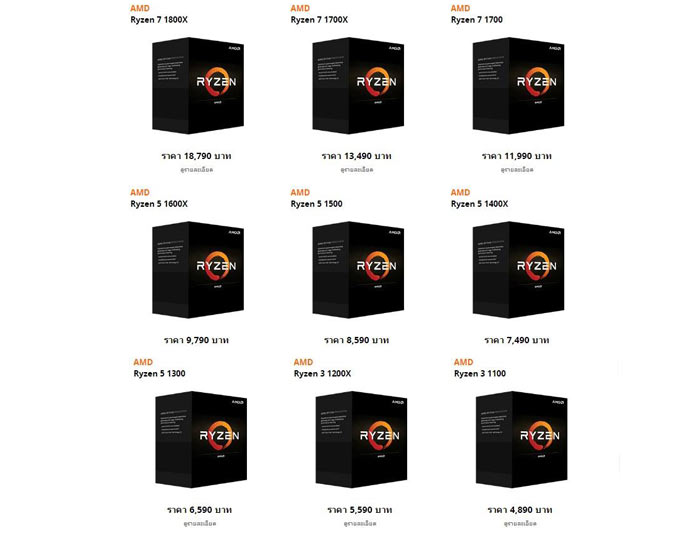
    Another day, another AMD Ryzen leak / rumour / news morsel… or two. Particularly interesting today we see what is claimed to be an AMD Ryzen box art matrix from Thailand. The web images don’t only show the products which will be soon on sale but the prices, in Thai Baht naturally. In a similar vein a Belgian online retailer has let slip its prices for the AMD Ryzen 7 range of CPUs.

    Looking at the single box art close-up we have available, above, via WCCFTech, the box design is rather simple and mainly black. Just because these have appeared on a Thai retailer site doesn’t mean they are representative of what AMD will ship either. It’s hard to know if the retailer images are overcompressed or just shoddily put together as placeholders, maybe by the retailer itself.

    Perhaps more important than the box images, if they are genuine, is another price indication at this time. Looking over the nine CPUs and prices in Thai Baht we see a price range from the Ryzen 7 1800X at 18,790 Baht (£430), down to the Ryzen 3 110 at 4,890 Baht (£112). Its possible to click through the above image matrix on the Thai retail site and get more details. You can find a full set of these pictures in the source article, one is included below for reference.

  • Telcos should follow teenagers’ digital lifestyle

    Telcos should follow teenagers’ digital lifestyle

    Only 12% of teenagers feel service providers understand their lifestyle and offer services to match it, according to a study from Amdocs.

    Conducted by Vanson Bourne , the study surveyed 4,250 respondents aged 15-18 from the United Kingdom, United States, Canada, Brazil, India, Germany, Russia, Mexico, Philippines, and Singapore.

    Among those polled, 30% report experiencing bad customer service from their CSP over the past year, and 46% say they will not use that CSP again. A third of respondents then shared this information with families and friends.
    Findings also show that 43% of teenagers believe their smartphone makes them smarter and “cooler”; 52% check their social media accounts first thing in the morning; and over 30% say they would probably not meet someone again if they lacked a Facebook or WhatsApp account.

    Almost half of respondents say they prefer using emojis (47%) and posting photos (45%) to sending emails as emojis express how they feel more clearly than words.

    Teens require constant internet connectivity, with respondents saying they are more likely to feel anxious and alone if separated from the internet (56%) than when separated from their family (52%. The value of internet access is so significant that the majority (55%) strongly believe fast internet access to be a human right.

    A majority stream movies (53% streaming; 17% downloading), TV (51% versus 11%) and music (47% versus 29%); and they are typically doing so for free with less than a third saying they ever pay for any content.