Retail News CRM

Tag: asoa

  • AirPods Pro 2 as a hearing aid device

    AirPods Pro 2 as a hearing aid device

    Not to be outdone by the new AirPods 4 with ANC, Apple decided to upgrade the AirPods Pro as well, so that it can set them apart from the cheaper standard AirPods in an easier manner. What was Apple to add that the AirPods Pro didn’t already have?

    Well, register the AirPods Pro 2 as a hearing aid device with the FCC, of course! That’s right, the AirPods Pro will be approved as a hearing aid by the FCC this fall, and Apple will send a software update to unlock the feature.< Leveraging the power of AI, Apple will set apart noises from speech, emphasizing what you'd want to absorb if you are hard of hearing. Apple will soon push an update announcing a hearing test availability for the AirPods Pro, after which they will be able to take over as a personalized over-the-counter hearing aid for up to moderate hearing loss. The certified hearing test coming to iOS 18 and AirPods Pro 2 will take about 5 minutes and involve hearing a system of tones with different frequencies to determine your hearing loss scale slot. As usual, Apple has developed the AirPods Pro hearing aid feature with the help of clinical studies that examine a massive amount of real-world data, like it did when it introduced the ECG function on the Apple Watch, so it will probably work even better than advertised, negating the discomfort of carrying two types of hearing devices with you.

  • Instagram now lets you lock down your Posts and Reels for close friends only

    Instagram now lets you lock down your Posts and Reels for close friends only

    When navigating the Instagram landscape, the ability to share Stories and Notes exclusively with close friends has been a perk for a while. However, Instagram has upped its game by testing stories with multiple audience lists. In other news, Instagram’s latest feature allows you to take it a step further by restricting your posts solely to your inner circle.

    The Close Friends feature is expanding its territory, now including feed Posts and Reels. This enhancement allows users to share more intimate content with a smaller, more trusted audience, fostering a sense of privacy and connection.

    To take advantage of this feature, simply tap the Audience button while crafting your post, choose Close Friends, and hit Share. If you haven’t already created a Close Friends list, follow these quick steps:

    • Tap your profile picture in the bottom right to head to your profile.
    • Hit the top right, then go to Close Friends.
    • Select “add” next to those you want on your list, or use Search.
    • For removal, tap “remove” next to their name.
    • Save changes by tapping Done at the bottom.

    Just so you know, no notifications go out when you tweak your list. Posts or Reels shared with Close Friends will have a green star icon, so your friends and you, for that matter, will know when you are part of a Close Friends list. Oh, and it is worth noting that no one can request to be added to your Close Friends list.

    Bid farewell to the days of sharing your every post with the entire follower list. Now, your Instagram feed has the potential to transform into a haven of posts from a more tightly-knit community, as users can reciprocate this gesture.

    Previously, Instagram kept it binary—public or private, no in-between. This shift is noteworthy, especially considering that Facebook has long allowed users to tailor post visibility to specific groups on their friends list, be it close friends, acquaintances, or those you’d rather keep your posts away from.

    In the ever-evolving Instagram universe, Meta, the parent company, has been on a roll, providing creators with more ways to monetize their content. Beyond this, the app keeps rolling out frequent updates, such as the recent ability to add song lyrics to Reels, ensuring its massive user base of over 1.2 billion stays engaged and satisfied.

  • Gas stations still unable to supply normal volumes

    Gas stations still unable to supply normal volumes

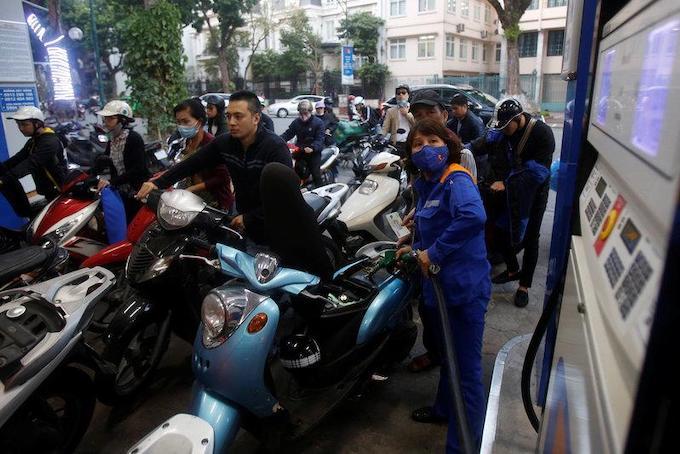
    Many gasoline stations in Ho Chi Minh City continue to face a shortage of stocks. In the last two days, a gas station in Thanh Xuan Ward in HCMC’s District 12 claimed to completely run out one time and had been rationing sales the rest of the time. Its employees said supply has been in small quantities at a time.

    Many gas stations on national road 1A in District 12 have put up signs saying they are out of fuel and re waiting for tankers to bring stocks.

    A number of stations in districts like Go Vap and 7 and Thu Duc City have also put up such signs frequently.

    Le Van My, general director of Hoc Mon Trading Joint Stock Company, which owns 11 gas stations and 21 retail agents in the city, said supply is low now.

    Each of the gas stations used to be allocated 5,000-10,000 liters a day, but are now getting only 1,000-2,000 liters, and sometimes as low as 700 liters.

    Tran Duy Dong, director of the Ministry of Industry and Trade’s domestic market department said: “This week and next week, key enterprises will receive bigger volumes of imports, making up for the reduced supply by Nghi Son Refinery. In around 10 days, market demand and supply will be balanced”.

    Nghi Son has been provided with short-term financing to resume operations, but crude oil has not arrived yet and so it is still operating at 55-60 percent of capacity, he revealed.

    On March 15, it will return to full capacity, he said.

    It will take major suppliers another 30-45 days to receive imported fuel.

    The Dung Quat Oil Refinery has increased its capacity from 103 percent to 105 percent since the Lunar New Year holiday in early February. The ministry wants it to operate at the maximum capacity possible.

    By Feb. 1, more than 205,000 cubic meters of imported gasoline and diesel had landed in Vietnamese ports.

    More are on the way. Petrolimex will get 180,000 cubic meters this month, PVOil, 66,000 cubic meters and Hong Duc, 80,000 cubic meters.

    Though Dong expects supply and demand to be balanced in the next 10 days, distributors expect the shortage to continue because it is still difficult for Vietnamese oil refineries to operate normally when the import of crude oil is slow and there is a global shortage due to the Ukraine crisis.

    In the domestic market, not only gas stations but also distributors and importers have suffered severe losses.

    My said his company racks up losses of several hundred million dong (VND100 million = $4,300) a day.

  • Yum China opens Digital R&D Center to craft digital strategy

    Yum China opens Digital R&D Center to craft digital strategy

    Yum China Holdings announced the opening of its Digital R&D Center with three sites in Shanghai, Nanjing, and Xi’an. The inauguration of the Digital R&D Center represents an important milestone for the Company’s strategy to build a dynamic digital ecosystem comprised of 1) the Digital R&D Center, 2) joint venturing, and 3) third party collaboration, to provide a solid foundation for Yum China to further develop its brands and businesses, accelerate expansion and capture market opportunities.

    The Digital R&D Center will consolidate and expand dedicated resources to develop new solutions and services using technologies in big data, artificial intelligence (AI), middle office and digital SaaS to drive end-to-end digitalization. The Digital R&D Center will bolster Yum China’s in-house digital capabilities across various functions, such as:

    • Consumer-facing: to improve Super Apps, mini programs and membership programs to provide higher quality service and customer experience.
    • Store operations: to upgrade systems and tools for more efficient operations and decision making, such as our digital tools for restaurant general managers, “Pocket Manager” and “Super Brain.”
    • Smart delivery: to further optimize delivery order queuing, trade zones, and rider routing.
    • Supply chain management: to enhance food safety and streamline operations from farm to fork.

    “Digitalization is one of the key enablers behind Yum China’s resiliency and long-term development as we move toward our next milestone of 20,000 stores,” said Joey Wat, CEO of Yum China. “The Digital R&D Center is an important part of our investment strategy as we apply cutting-edge technologies to digitally transform stores and drive operational excellence.”

    “Evolving consumer behavior, such as increased off-premise dining, and the Company’s accelerated development, place more demand on our R&D capabilities,” said Leila Zhang, Chief Technology Officer of Yum China. “We believe the establishment of the Digital R&D Center will significantly strengthen Yum China’s internal digital capabilities and support sustainable business growth by using advanced technology for real life applications.”

    As a pioneer of digitalization in the restaurant industry in China, Yum China launched a digital program several years ago. With the establishment of the Digital R&D Center, the Company will have more dedicated resources in its restaurant operations for building topnotch digital infrastructure. The Company will continue to cooperate with external partners such as scientific research institutions and other industry leaders to implement leading edge technology.

    Yum China has earmarked $1-1.5 billion of investment over the next five years in digital and technology. As an integral part of this initiative, the Company plans to invest approximately $100-200 million and to employ up to 500 staff in the Digital R&D Center to support the company’s growth over the next five years. The Digital R&D Center in Shanghai, Xi’an and Nanjing will be able to tap into the large talent pool at the top universities in these cities. With additional resources, the Company will further enhance our digital capabilities, as well as accelerate innovations and implementation.

    This press release contains “forward-looking statements” within the meaning of Section 27A of the Securities Act of 1933 and Section 21E of the Securities Exchange Act of 1934. We intend all forward-looking statements to be covered by the safe harbor provisions of the Private Securities Litigation Reform Act of 1995. Forward-looking statements generally can be identified by the fact that they do not relate strictly to historical or current facts and by the use of forward-looking words such as “expect,” “expectation,” “believe,” “anticipate,” “may,” “could,” “intend,” “belief,” “aim,” “plan,” “estimate,” “target,” “predict,” “project,” “likely,” “will,” “continue,” “should,” “forecast,” “outlook,” “look forward to” or similar terminology.

    These statements are based on current estimates and assumptions made by us in light of our experience and perception of historical trends, current conditions and expected future developments, as well as other factors that we believe are appropriate and reasonable under the circumstances, but there can be no assurance that such estimates and assumptions will prove to be correct. Forward-looking statements are not guarantees of performance and are inherently subject to known and unknown risks and uncertainties that are difficult to predict and could cause our actual results or events to differ materially from those indicated by those statements. We cannot assure you that any of our expectations, estimates or assumptions will be achieved.

    The forward-looking statements included in this press release are only made as of the date of this press release, and we disclaim any obligation to publicly update any forward-looking statement to reflect subsequent events or circumstances, except as required by law. All forward-looking statements should be evaluated with the understanding of their inherent uncertainty. You should consult our filings with the Securities and Exchange Commission (including the information set forth under the captions “Risk Factors” and “Management’s Discussion and Analysis of Financial Condition and Results of Operations ” in our Annual Report on Form 10-K and subsequent Quarterly Reports on Form 10-Q) for additional detail about factors that could affect our financial and other results.

  • Continental Restructures Technology Unit, Downsizes Board

    Continental Restructures Technology Unit, Downsizes Board

    Continental’s tyres business and the ContiTech division, focused on rubber technologies, will become independent group sectors, while its Automotive Technologies branch will split into five business areas including a new focus on smart mobility and user experience.

    German car parts maker Continental announced plans for a restructuring that will combine from the start of next year business activities around connectivity, mobility, and high-performance computers, it said on Thursday. Its tyres business and the ContiTech division, focused on rubber technologies, will become independent group sectors, while its Automotive Technologies branch will split into five business areas including a new focus on smart mobility and user experience, a statement said.

    The restructuring is a further step by Continental to reorganise its business after spinning off its powertrain unit Vitesco in mid-September.

    Continental will combine business activities around connectivity, mobility, and high-performance computer

    “Mobility of the future is sustainable, automated and connected,” Chief Executive Nicola Setzer said in a statement. “We are thus making the most of the potential presented by our unique strong technology position in all of these fields.”

    As part of the restructuring, management board members Helmut Matschi and Frank Jourdan will step down, nearly three years before the end of their contracts. That will shrink Continental’s board to five members from Jan. 1.

  • Google Maps is giving out potentially fatal directions to mountain climbers

    Google Maps is giving out potentially fatal directions to mountain climbers

    When Apple launched its own mapping and navigation app in iOS 6, the goal was to replace Google Maps on the iPhone. But Apple Maps was such a fiasco that just weeks after the launch, CEO Tim Cook apologized for Apple Maps’ shortcomings and suggested that iOS users turn to alternatives like Google Maps, Waze, and other navigation apps until the issues were fixed.

    One particular mistake put Apple Maps users in real peril and led Inspector Simon Clemmence of the Victoria Police in Australia to call the app life-threatening. It turned out that the directions that the app provided to at least six people driving their vehicles to Mildura took them through the Outback with temperatures as high as 115 degrees. The area is lousy with poisonous snakes and cell reception is spotty.

    The problem was that Apple Maps had Mildura 43 miles away from its actual location. Australian cops put out a warning telling iPhone users that drivers who used the app to get to Mildura ended up driving for over 24 hours without food, water, or cell service. One person had to walk over 24 hours before finding cellular connectivity for his handset. Apple Maps has been greatly improved since and now it is Google Maps’ turn to disseminate potentially deadly directions.

    At the end of last week, the John Muir Trust and Mountaineering Scotland, the organizations that watch over mountain climbing, hill walking, snow sports, and similar activities in Scotland, released a warning. The organization expressed concern that climbers and hikers were using navigation apps to get directions to Scotland’s highest mountain named Ben Nevis.

    It seems that Google Maps is giving directions to hikers that could be lethal. At least that is the opinion of Heather Morning, Mountaineering Scotland’s mountain safety adviser. Morning says that “For those new to hill walking, it would seem perfectly logical to check out Google Maps for information on how to get to your chosen mountain…even the most experienced mountaineer would have difficulty following this route (from Google Maps).”

    Morning adds that “the line goes through very steep, rocky, and pathless terrain where even in good visibility it would be challenging to find a safe line. Add in low cloud and rain and the suggested Google line is potentially fatal.” Both organizations wish to speak to Google about removing any life-threatening routes. However, Google has reportedly yet to respond to appeals from John Muir.

    A Google spokesperson did comment about the possibly life-threatening directions and said, “We built Google Maps with safety and reliability in mind, and are working quickly to investigate the routing issue on Ben Nevis and surrounding areas.”

    Google said that it examining the issue and said, “To help both novice and experienced hikers more easily find trails that suit their level of expertise, we’re now updating our driving routes to take people directly to the visitor center, where they’ll be able to speak with staff about the best trail to take.” But the directions to Ben Nevis are not the only directions from Google Maps that could end up killing someone who follows the app’s directions.

    Mountaineering Scotland’s Morning states “Modern navigation technology brings some amazing advantages for hill walkers, but this example is clearly not one of them. Walkers and climbers with even a little experience will know to read information from a map, whether digital or paper, and if they are looking for downloadable routes know to use reputable sources and check several sources to ensure the information they are accessing is the right route for their level of experience and ability.”

    She goes on to say that “…especially on Ben Nevis, many people are not aware of where to get reliable information and may quite naturally assume that Google Maps, which got them from their home to the foot of the mountain, can carry on and do the job right to the top. This is not the case.”

    A couple of paragraphs ago we hinted that there is another possible fatal set of directions offered by Google Maps. According to Mountaineering Scotland,  a route shared by Google Maps to Scotland’s An Teallach mountain “would take people over a cliff.”

  • Shopee scales up Brazil operations, eyes Latam potential – sources

    Shopee scales up Brazil operations, eyes Latam potential – sources

    Shopee, the e-commerce arm of Southeast Asia’s SEA Ltd, is scaling up its operations in Brazil and evaluating the long-term potential of Latin American markets, according to two people with knowledge of the matter.

    Shopee, the largest e-commerce platform in Southeast Asia according to market researchers, launched a small presence in Brazil in late 2019 as a pilot initiative of its cross-border team.

    The company is now growing its presence and moving executives from Southeast Asia to Brazil said the sources who were briefed on the matter but declined to be identified as they were not authorized to speak to media.

    The Singapore-headquartered technology group’s shares surged more than 400% in 2020, taking its market capitalization to $120 billion. It raised close to $3 billion in a stock offering last month.

    On Linkedin, Shopee is currently recruiting for over three dozen positions in Brazil. Pine Kyaw, formerly country managing director for Shopee’s high-growth Vietnam unit, is listed on the job platform as having become Shopee Brazil country head. Kyaw could not be reached for comment.

    SEA Chief Corporate Office Yanjun Wang told an investor call in November that Shopee Brazil, while cross-border driven, was now being used by local sellers.

  • Google brings iPhone support for an important security feature

    Google brings iPhone support for an important security feature

    In the age of digital security, two-factor authentication, or 2FA, is one of the most important lines of defense against a wide array of cybersecurity issues. Recently, Google released an update to let iPhone users take advantage of this tech a lot more easily.

    Need a refresher on what 2FA is? Basically, it’s a security system that requires two different authentication mechanisms to bypass, which are often based on something you know or have, such as a password or security key. Over decades, this technology has been integrated neatly into our lives, as the PIN code on your ATM card, perhaps, or, more recently, as those ubiquitous codes texted to you whenever you do basically anything.

    Several years ago, Google announced a new way of using 2FA, where your phone can act as its own security key, or one of the two factors you need to unlock your account. You might have run into this system if you’ve recently tried to reset your Gmail password from your computer—you were probably able to reset it just by interacting with a notification on your phone. The system is super simple, easy to use, fast, and secure.

  • Ford Partners With Robots Maker Agility Robotics In Mobility Service Push

    Ford Partners With Robots Maker Agility Robotics In Mobility Service Push

    Ford Motor Co said on Wednesday it is partnering with walking robots maker Agility Robotics to assist self-driving delivery vans to drop packages at the doorsteps of people’s homes. Ford’s move into robotics comes as the No.2 U.S. automaker looks to expand into autonomous driving and mobility services. The company, which launched a self-driving pilot with delivery partners including Domino’s in Miami last year, said Agility Robotics’ two-legged robot, Digit, is capable of lifting packages that weigh up to 40 pounds.

    The robot can walk up and down stairs and through uneven terrain, while maintaining its balance after being bumped, Ford said bit.ly/2Jy47T5.

    “It’s not always convenient for people to leave their homes to retrieve deliveries,” Ken Washington, Ford’s chief technology officer, said.

    “If we can free people up to focus less on the logistics of making deliveries, they can turn their time and effort to things that really need their attention.”

    In 2017, Ford bought Argo AI, a Pittsburgh-based self-driving startup, but with spiraling development costs for autonomous cars in recent years, the company and other carmakers have sought alliances and outside investors.

  • ‘Solid’ profit growth for Dairy Farm International

    ‘Solid’ profit growth for Dairy Farm International

    Dairy Farm International Holdings had solid profit growth in the first half despite lower sales in its supermarkets and hypermarkets, says chairman Ben Keswick.

    “While the rest of the year is expected to stay challenging for supermarket and hypermarket activities in Southeast Asia, the group’s other businesses continue to make steady progress.”

    Overall profits increased with strong results from Maxim’s and Yonghui as well as good performances from the health-and-beauty and home-furnishings divisions, more than compensating for the lower earnings in the food division.

    Sales for the period by the group’s subsidiaries of US$5.5 billion were marginally behind last Year’s first half, but flat at constant exchange rates. Total sales, including associates and joint ventures, were 3 per cent higher at $10.4 billion. The underlying net profit was $211 million, up 6 per cent.

    Supermarket and hypermarket sales declined 3 per cent lower at constant exchange rates, and profits fell because of continuing softness in some key markets. Trading continued steadily in Hong Kong, but difficult trading conditions in Malaysia, Singapore and Taiwan resulted in lower sales and profits.

    In Indonesia, better margin management enabled profits to be maintained despite lower sales, while profitability improved in the Philippines even though sales were flat following the closure of a hypermarket.

    Yonghui had 15 per cent growth in revenue and a 57 per cent jump in profit, thanks to higher store numbers and margin improvement from more effective merchandising.

    China underpins growth

    Dairy Farm’s convenience stores performed well. Hong Kong and Macau were ahead of last year, supported in part by a modest increase in tourist numbers. In Singapore, sales were lower as some stores were closed, although earnings benefited as several had not been profitable. Store expansion in Mainland China continued to underpin sales growth.

    In the health and beauty division, good sales and profit growth were achieved in Hong Kong, Macau and Indonesia.

    In Malaysia and Singapore, sales and profits fell as consumer confidence remained low. Mainland China sales were enhanced with successful promotions, and in the Philippines, improved systems following the integration of Rose Pharmacy started to yield positive results.

    In home furnishings, Ikea’s performance was driven by strong sales in Indonesia and Taiwan, despite a soft performance in Hong Kong. Store expansion continues with a fourth Ikea store opening in Hong Kong later this year and a site secured for a second store in Jakarta. Meanwhile, e-commerce activities are showing encouraging results in all three markets.

    In the restaurants division, Maxim’s (which operates Starbucks in Hong Kong and Vietnam, and other food brands across Southeast Asia) delivered a strong performance as its expansion continued. There are now more than 1000 outlets across Greater China and Southeast Asia.

    Dairy Farm last month agreed to take over Rustan’s in the Philippines by acquiring the remaining 34 per cent stake from its JV partner.

    Maxim’s opened its first The Cheesecake Factory in Hong Kong in May, and in July announced the franchise to run American burger-and-fries restaurant Shake Shack in Hong Kong and Macau. The first store opens next year.

    At the end of June, the Dairy Farm group had more than 6600 outlets across all formats, compared with 6548 at the end of last year.

    Meanwhile, group CEO Graham Allan steps down at the end this month after five years of introducing changes that have laid the foundation for growth, says Keswick. He will be succeeded by Ian McLeod, who has had more than 30 years’ experience in retail.