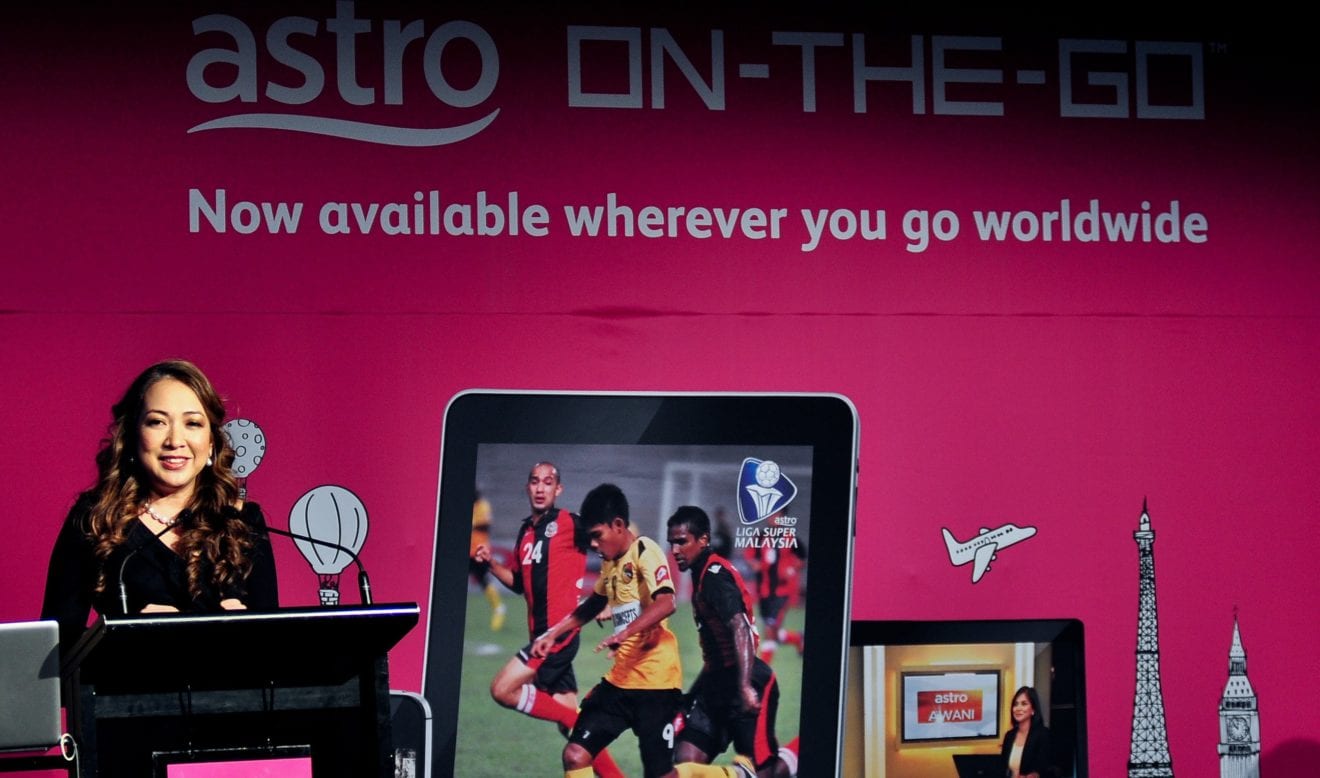
Rohana Rozhan, the chief executive of Astro Malaysia Holdings, has never shied away from a challenge. As a young girl, she was determined not to be outdone by the boys she grew up with. Now, she is engineering an Internet-powered expansion for the pay TV operator.
On March 18, Astro announced the launch of Tribe, its latest digital offering. “Tribe is going to differentiate [us] because it’s going to cater to fan bases,” Rohana said.
Tribe is an over-the-top service, which delivers TV shows and other digital content directly over the Internet. The service debuted in Indonesia in partnership with Axiata Digital Services, a unit of Malaysian telecommunications giant Axiata Group. Astro is looking to launch Tribe in up to three Southeast Asian countries.
In addition to such content as South Korean TV shows and Asian films, Tribe also offers live events, such as sports matches. Tribe is optimized for mobile viewing, so users can watch their favorite shows anytime on their smartphones or other devices.
“I think we have slowly evolved,” Rohana told the Nikkei Asian Review at Astro’s headquarters in the suburbs of Kuala Lumpur.
THE PINK “PIRANHA” Dressed in pink and carrying a glittering pink smartphone, the 53-year-old Rohana cuts a striking figure in her black-paneled office. On the wall is an eye-catching caricature of her as a “Game of Thrones”-like character, complete with a dragon perched on her left shoulder.
Nicknamed “Rohana the Piranha” by the neighborhood boys she grew up with, she is now one of Malaysia’s top female corporate leaders, whose ranks also include Aireen Omar, the chief executive of AirAsia, and Nur Qamarina Chew Abdullah, the managing director of the local unit of Japanese retail giant Aeon.
Rohana has been involved in Astro’s growth from its early days.
The company started out as a direct-to-home pay TV service in 1996 and now has radio stations, magazines and film production companies under its umbrella. A year ago, it partnered with South Korean multimedia retailer GS Home Shopping to enter the home shopping business.
Before joining Astro, Rohana worked for a decade at consumer goods conglomerate Unilever in the U.K. and Malaysia. Before that, she studied accounting and economics at the University of Kent, and later completed the Advanced Management Program at Harvard Business School in 2006.
Although normally an intensely private person, she gave a glimpse of what drives her in her acceptance speech for the Toastmaster’s Golden Gavel Award in 2014.
She described how, as a child, she fought to be treated as an equal among the boys in her hometown in the state of Sabah, on the island of Borneo. “When you are young, you are quite arrogant,” she said. “Thinking arrogantly that I am as good as any boy and as good as my brothers, I couldn’t [accept] that they were sent to the U.K. at the age of 13 to pursue their studies whilst I was actively encouraged to stay at home to look after everyone and to consider becoming a teacher.”
She eventually won a scholarship to study in the U.K.
Rohana was the chief financial officer at Astro when the company was listed in 2003 as Astro All Asia Networks. In 2006, she was promoted to chief executive of the media group’s satellite division, MEASAT Broadcast Network Systems.
For the fiscal year through January, Astro’s revenue rose 5% on the year to 5.47 billion ringgit ($1.4 billion), while net profit climbed 18% to 615 million ringgit.
The company delisted in 2010 following a buyout by reclusive Malaysian billionaire Ananda Krishnan and Malaysian sovereign fund Khazanah Nasional, but it relisted at $1.5 billion in 2012 as Astro Malaysia Holdings. Today, Astro has a market capitalization of 15 billion ringgit.
Astro is now watched in 67% of Malaysian households. “In terms of pay TV market share, we have about a 95% to 96% market share, so we are in a very strong position at the moment,” Rohana said. “In a couple of years, it wouldn’t be a stretch to say that we will be at 80% [of household penetration].”
With the traditional pay TV market all but saturated, Rohana said she expects subscription-free satellite TV to play an increasingly important role in bolstering the company’s domestic business. Astro began offering this service in 2011 via set-top boxes sold separately from its regular services.
The service has proved popular among the growing number of viewers who prefer to pay for only the programs they want to watch, rather than subscribe to bundles of channels.
Rohana said the bulk of Astro’s revenue growth will eventually come from subscription-free satellite services as the company evolves to meet this “piecemeal” style of content consumption.
“We have every intention of growing the traditional business,” Rohana said, “but it’s so much harder now to sustain our share of the customer wallet [and] most importantly, our share [of] our customers’ time.”
In addition to market saturation, the company also has to deal with the fact that the emergence of Internet-based smartphone viewing has significantly eroded TV’s position as the “king of media.”
Management consultancy McKinsey said the availability of OTT often results in consumers canceling their pay TV subscriptions, known as cord-cutting, or else subscribing to a smaller and cheaper bundle of personalized services, known as cord-shaving. Both of these developments spell trouble for a traditional pay TV operator like Astro.

Astro CEO Rohana Rozhan
That’s where Tribe comes in. The new service should help Astro go head-to-head with other Internet-based services and provide the company with a springboard for regional growth.
But the playing field is already a crowded one.
In Malaysia, other providers of OTT services include Telekom Malaysia’s HyppTV, local startup iflix, which has already expanded to Thailand and the Philippines, global player Netflix and PCCW-backed Viu.
Meanwhile, Singapore-based HOOQ, which currently operates in the Philippines, India, Thailand and Indonesia, is planning to enter Malaysia after it launches services in its home market this year. India-based TV channel and content producer Zee Entertainment Enterprises has established itself in Indonesia and Thailand, and is eyeing Philippines as the next step in its Asian expansion strategy.
Nevertheless, Rohana, who has been Astro’s chief executive since 2011, is confident that her company still has room to grow as it prepares to celebrate its 20th anniversary in September. Her hopes for Tribe in this regard are particularly high. “If you look [beyond] Malaysia, if we are going to make it, we have to do original, local language, differentiated programming, and we are going to have to do more of it. If we are going to do more of it, we need to find bigger scale.”
Such tailored content, she believes, is crucial to gaining local audiences. “If you take the Malaysian market, our view is Netflix is a complementary service to us. It is not in direct competition.” She explained that Netflix’s library largely consists of international programming, while Astro offers programs in the languages spoken in Malaysia — Malay, Chinese and Tamil — as well as live domestics sports and other events. It plans to produce local language content for Tribe in other regional markets.
Astro estimates that its viewers spend five hours daily watching its programming, with 80% of that time spent on local language offerings. The company produces TV series, reality shows and films in-house or in cooperation with local vendors. Astro plans to use these existing capabilities and infrastructure as it expands into other regional markets in cooperation with telecommunication providers. “If we do our jobs right, we will not have and pay for the content that Netflix has and paid for. We will focus on what they are not offering,” Rohana said.
She said that understanding shifts in technology and media consumption behavior is crucial to planning a future strategy. “All I need to do is to watch my son. By watching him, you can see how kids move away from that living room experience [of watching TV] with their parents.”
Even in the digital age, however, Rohana’s priorities remain the same. She emphasizes three factors: customers, content and experience. Her time spent at Unilever, she said, has helped her in understanding consumers in-depth. “We’re no longer that young, and with that realization comes a lot of things, [like] consumption and how that shifts, we’ve seen [its] evolution,” she said. “We believe that in order for us to be sustainable, [and] to continue resonating with our customers, the best way is to simply reflect the customer base.”
DIFFERENT STRENGTHS The company’s 4,700-strong workforce reflects the ethnic makeup of Malaysia: Nearly half of its employees are Malay, 25% Chinese and 21% Indians. Almost half of them are under the age of 30, and the workforce is almost evenly divided between men and women, with women making up nearly 40% of the board of directors.
Rohana has sought to make Astro a diverse organization in order to become regionally competitive. “We are quite proud of the fact that it’s not only about gender. We call it diversity and complementarity. Ultimately, my dream for Astro is to basically respect the fact that each of us can bring something to the table.”
For Southeast Asia, the test is to understand the needs of each local market and for Astro to differentiate itself in each one. “It is not a static, one-size-fits-all proposition at all. The reality is we [ask] what do we need to do [and] how do we reinvent ourselves to be part of that conversation [for the next] generation.”