
Tag: baemin

  • Baemin and Coupang Eats Target Olive Young with 30-Minute Beauty Runs

    Baemin and Coupang Eats Target Olive Young with 30-Minute Beauty Runs

    South Korean food delivery platforms Baemin and Coupang Eats are now dispatching couriers with discount cosmetics in roughly 30 minutes. They are using local retail store networks to beat market leader CJ Olive Young on speed.

    Baemin added warehouse outlet chain Off Beauty to its app last week. The partnership covers roughly 4,000 products shipped from 30 outlets across Seoul, Busan and other major cities. Orders arrive faster than Olive Young’s average 55-minute express tier.

    How the Off Beauty Model Works

    Off Beauty buys surplus manufacturer stock, cosmetics in pre-redesign packaging, and near-expiry goods directly from brand owners. This supply chain keeps shelf prices low. In turn, it gives delivery apps a catalog of deeply discounted goods.

    In June, Coupang Eats listed Off Beauty with free delivery for its Coupang Wow subscribers. The discount chain runs about 50 stores today and plans to reach 100 nationwide. That expansion will give couriers more local pickup hubs across metropolitan areas.

    Filling the Gaps Between Meal Orders

    Food delivery platforms suffer predictable order slumps between the lunch and dinner rushes. Cosmetics orders flow in steadily throughout the day. These purchases smooth out rider demand during quiet hours without requiring cold storage or fast expiration controls.

    For couriers, makeup items are light and compact compared to hot meals or grocery bags. Fulfilling a lipstick or moisturiser order costs the same as delivering lunch. Crucially, the inventory does not spoil if a rider hits traffic.

    Taking on the Olive Young Monopoly

    Online channels generated 41.4 percent of South Korea’s cosmetics sales last year, according to government data. CJ Olive Young booked 2.94 trillion won ($2.2 billion) in first-half revenue across its online and offline operations. That gave the chain a 21.5 percent share of the country’s 13.72 trillion won beauty market.

    Back in 2018, Olive Young launched its Oneul Deurim three-hour delivery service from 1,360 stores and urban logistics centres. The service handled 19.35 million orders last year. It also drove nearly half of Olive Young’s total shipments in the first half of this year.

    Mounting Rivalry Across Platforms

    Rapid 30-minute delivery changes the battleground for specialist retailers. Olive Young relies on curated selections, ingredient advice, and AI skin diagnostics. Delivery apps are betting that lower prices and instant drop-offs will win impulse shoppers instead.

    Pressure is building from outside the food delivery sector as well. Other non-traditional competitors are eating into beauty sales across Korea. Online grocer Market Kurly, discount chain Daiso, and fashion marketplace Musinsa, which is opening dedicated beauty flagships, are all chasing market share.

    Whether Baemin and Coupang Eats can take 30-minute cosmetics delivery beyond major hubs hinges on Off Beauty hitting its 100-store target across provincial cities.
  • Baemin robot gets job at Pizza Hut

    Baemin robot gets job at Pizza Hut

    Another day, another Dilly – or so the saying probably goes in Baedal Minjok’s head office.

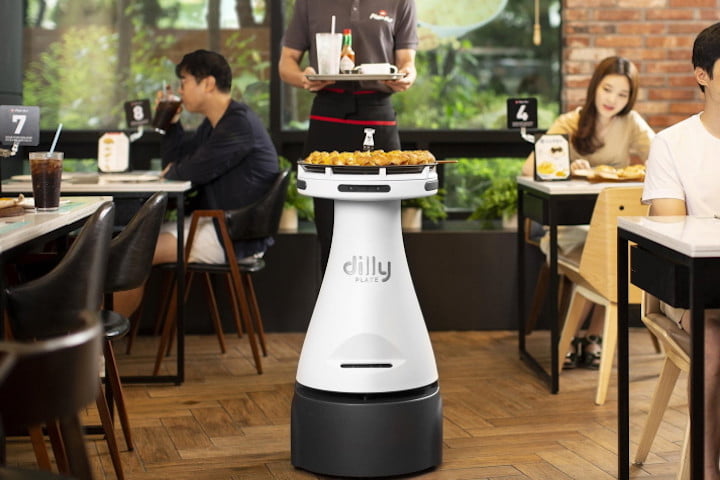
    The food-delivery app’s Dilly Plate robot has started serving up slices at a Pizza Hut restaurant in Mok-dong, western Seoul, according to both companies on Wednesday. Dilly Plate, the new serving robot, is not to be confused with plain old Dilly, the delivery robot that the company has been working on since last year.

    Dilly Plate is a self-driving robot specifically designed for restaurants. Having first started working at the Pizza Hut restaurant on Monday, it will assist human employees in serving pizza for two weeks until Aug. 19.

    Dilly Plate can safely carry up to 22 kilograms (48.5 pounds) at once – a limit that is unlikely to be tested in Pizza Hut – and lasts eight hours on a single charge. The robot uses a 3-D camera and sensors to control its movement. It automatically stops and avoids obstacles and people.

    A spokesman for Baedal Minjok, or Baemin, explained that Dilly Plate can move quickly, but in Pizza Hut, the speed has been limited to a human walking speed for the safety of both customers and pizzas.

    “The store will have people walking around, and there may be emergency situations like collisions if Dilly moves too fast,” he said.

    Dilly Plate was developed by Bear Robotics, a U.S. start-up co-founded last year by John Ha, a former Google engineer originally from Korea. In April, Baemin invested $2 million in the venture in exchange for convertible bonds.

    Dilly Plate is modeled after Penny, a robot that found employment at Ha’s restaurant in California.

    Dilly Plate will be the first server robot introduced in Korea. Before it could begin work in Pizza Hut’s Mok-dong restaurant, Baemin had to map out the store and install it in the robot’s software.

    “We’re looking forward to Dilly’s performance [and hoping it will] unburden human staff from having to carry pizzas,” said Cho Yoon-sang, a senior marketing executive at Pizza Hut Korea. “This way, human servers will be able to focus on providing quality service to our customers. We decided [to hire] Dilly with hopes of enhancing work efficiency and improving customer service.”

    Baemin is hoping that the two-week trial will give more actual data regarding Dilly Plate’s operation, with the goal of introducing the server robot at more restaurants in the future.

    “In terms of the technology, Dilly Plate is already available for mass production,” said a Baemin spokesman. “But mass production is expensive, and we need to know whether Dilly is truly marketable. So the trial is to see whether Dilly Plate offers a real-life benefit to restaurants and their staff.”

    Baemin has been investing in robots since last year, aiming to develop robots that deliver food to consumers’ doors. The original Dilly had its first successful test run at a food court in Cheonan, South Chungcheong, in May. The plan is to gradually expand original Dilly’s boundaries from indoors to outdoors until it is able to fully run on its own on the streets.