Tag: baic

  • BAIC Launches Xingtan 5X SUV from 126,900 Yuan in China

    BAIC Launches Xingtan 5X SUV from 126,900 Yuan in China

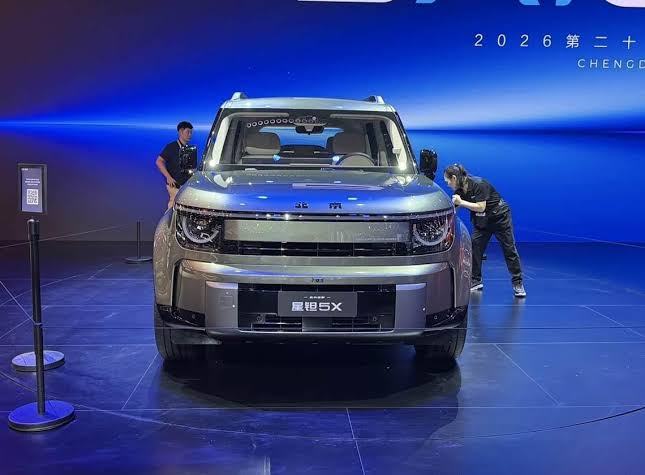
    BAIC Group launched the Xingtan 5X sport utility vehicle on Thursday with a limited-time base price of 126,900 yuan ($18,890) across battery electric and plug-in hybrid powertrains.

    The five-seat mid-to-large model generated 30,208 orders during its 23-day pre-sale run leading up to the official rollout.

    Pricing Structure and Trim Levels

    Beijing Off-road built the Xingtan 5X across seven distinct configurations. Standard guide prices run between 129,900 yuan and 174,900 yuan, reduced by a uniform introductory discount of 3,000 yuan to range from 126,900 yuan to 171,900 yuan.

    Buyers choose between three pure battery electric vehicle (BEV) trims and four plug-in hybrid electric vehicle (PHEV) models. BEV list prices span 129,900 yuan to 159,900 yuan before the discount. PHEV guide prices start at 134,900 yuan and top out at 174,900 yuan.

    Dimensions reflect the boxy utility silhouette popular in China’s recreational segment. The SUV measures 4,865 mm long, 2,000 mm wide and 1,910 mm tall, riding on a 2,875 mm wheelbase under a flat roofline.

    Huawei Hardware and Cabin Systems

    Driver-assistance technology forms the core competitive pitch for the mid- and upper-tier models. BAIC integrated Huawei’s Qiankun ADS 5 Pro package on select variants, which start at limited-time prices of 146,900 yuan for the BEV and 151,900 yuan for the PHEV.

    Vehicles fitted with the Huawei setup carry 27 sensors alongside an in-cabin solid-state LiDAR unit mounted behind the windshield. The suite bundles Highway Navigation Cruise Assist, route-retracing reverse assistance, remote parking and exit-first automated parking. Operating the urban navigation assistance functions requires a paid subscription service.

    Display configurations change across the pricing ladder. Base editions carry a 15.6-inch center touchscreen paired with an 8.8-inch driver instrument screen. Higher-specification models install dual 15.6-inch cabin displays driven by Qualcomm’s 8295P processor.

    Platform Performance and Range Specs

    Pure electric options use an 800-volt electrical architecture driving a single 227 kW rear motor producing 304 horsepower. An 81.9 kWh battery delivers 625 km of CLTC range, with DC fast charging moving the cell from 30 percent capacity to 80 percent in 14.5 minutes.

    Plug-in hybrid grades rely on a 1.5-liter turbocharged petrol engine paired with a 50.4 kWh battery pack. Two-wheel-drive PHEV versions rely on a 200 kW front-mounted motor for 310 km of pure-electric CLTC range. Four-wheel-drive variants bolt on a second 200 kW motor at the rear axle to generate 400 kW of combined motor output, achieving 285 km of battery-only range. These all-wheel editions also add a mechanical rear locking differential, crawl control and 14 all-terrain driving programs.

    Market Rivalry and Brand Headwinds

    Commercial headwinds remain substantial despite the sharp pricing. BYD commands substantial showroom loyalty with its Fang Cheng Bao Tai 7, while Chery aggressively markets its iCar V27 to urban drivers wanting off-road aesthetics. BAIC has struggled to build equivalent consumer cachet in China’s electric vehicle retail sector.

    Squeezing prices below 130,000 yuan pressures component margins throughout BAIC’s off-road division. Supplying costly 800-volt packs and optional LiDAR units inside this price band forces suppliers to absorb steep price cuts to keep the platform viable against higher-volume carmakers.

    The Xingtan launch follows an earlier brand initiative by Beijing Off-road, which unveiled its luxury off-road nameplate Taitan in July before delivering the Taitan 700 to dealerships on August 25. That top-end vehicle established BAIC’s premium rugged design language prior to the Xingtan volume rollout.

    Deliveries across domestic dealership networks will demonstrate whether the 30,208 pre-sale reservations translate into sustained monthly registrations against established domestic rivals.
  • China Records 15 Million Cars with Navigation on Autopilot Features

    China Records 15 Million Cars with Navigation on Autopilot Features

    China counted approximately 15 million passenger cars equipped with Navigation on Autopilot software as of August 2026, according to government academy data released in Beijing.

    Those vehicles account for roughly 25 per cent of the 61 million passenger cars nationwide carrying Level 2 driver assistance systems, reflecting the operational fleet rather than showroom deliveries this year.

    The Fleet on the Road

    Data released at the 2026 World Intelligent Connected Vehicles Conference by the China Academy of Information and Communications Technology showed about 16 million passenger cars in China carried 5G communication terminals as of August, alongside 2 million vehicles with Cellular Vehicle-to-Everything equipment.

    The China Academy of Information and Communications Technology disclosed the operational figures during the conference in Beijing’s Yizhuang area. The Ministry of Industry and Information Technology, the Ministry of Transport, and the Beijing municipal government jointly organized the three-day gathering.

    Hardware installations across the domestic fleet have outpaced urban infrastructure upgrades. Automakers selling in China have turned automated highway driving and urban point-to-point navigation into standard consumer features to protect showroom pricing, forcing suppliers to absorb sensor costs across high production volumes.

    Rewriting Vehicle Standards

    Regulators are moving to codify how these operating systems behave once drivers take their hands off the controls. Guo Shougang, head of the equipment industry department at the Ministry of Industry and Information Technology, released a draft update to China’s connected-vehicle technical standards guidelines for public review on October 21.

    The regulatory framework covers more than 400 existing standards across intelligent vehicles, communications, traffic management, and fleet operations. The 2026 revisions seek to expand safety criteria for core components, standardize system architectures, and set binding rules for operating autonomous driving services commercially.

    For automotive brands and tier-one component makers, the revised rulebook narrows room for proprietary software workarounds. Safety compliance costs will fall heavily on domestic electric vehicle assemblers that have marketed assisted driving capabilities aggressively to private retail buyers.

    Preparing Level 3 Approvals

    Work on the second batch of Level 3 autonomous driving market access pilots is underway, Guo said during the conference. Regulators have not named the participating carmakers, the specific models involved, or the date when commercial sales permits will take effect.

    The current phase builds on early regulatory permissions granted late last year. The ministry awarded conditional Level 3 market access approval to models from state-owned automakers Changan and BAIC in December 2025.

    Those initial vehicles remain confined to designated public test roads and strict operating conditions rather than nationwide consumer use. Regulators will monitor testing outcomes from the first cohort before expanding operational permits to the next group of carmakers.

  • BAIC Motor looks to phase out conventional fuel cars by 2025

    BAIC Motor looks to phase out conventional fuel cars by 2025

    Chinese carmaker BAIC Motor Corp aims to stop selling own-branded conventional fuel-powered cars by 2025, said on Tuesday, amid a major push by Beijing to shift automakers toward electric and plug-in hybrid cars.

    BAIC, which also makes vehicles in partnership with South Korean carmaker Hyundai Motor Co and Germany’s Daimler AG, plans to stop sales of conventional petrol engine cars first in Beijing and then nationwide.

    “Our goal is to stop sales of self-developed conventional fuel-powered cars in Beijing by 2020 and stop their production and sales nationwide by 2025,” the newspaper quoted BAIC Chairman Xu Heyi as saying at a launch event for a new energy car innovation center in Beijing.

    China has set strict quotas for electric and plug-in hybrid cars that come into play by 2019, shaking up domestic and international carmakers in the world’s largest auto market.

    Beijing wants so-called new-energy vehicles (NEVs) to make up at least a fifth of Chinese auto sales by 2025 to reduce air pollution and close a competitive gap between its newer domestic automakers and their global rivals.

    In October, domestic rival Chongqing Changan Automobile Co Ltd said it aimed to stop selling conventional combustion-engine cars from 2025, making it one of the first Chinese firms to commit to a total shift to NEVs.

    Earlier this year, China’s vice industry minister said the country had begun studying when to ban the production and sale of cars using traditional fuels, and predicted “turbulent times” for automakers as they were forced to adapt.

    BAIC Chairman Xu said in October the move to ban traditional petrol engine cars was “challenging” for the firm.