Tag: Bank of Thailand

  • Thailand Post plans B500m upgrade

    Thailand Post plans B500m upgrade

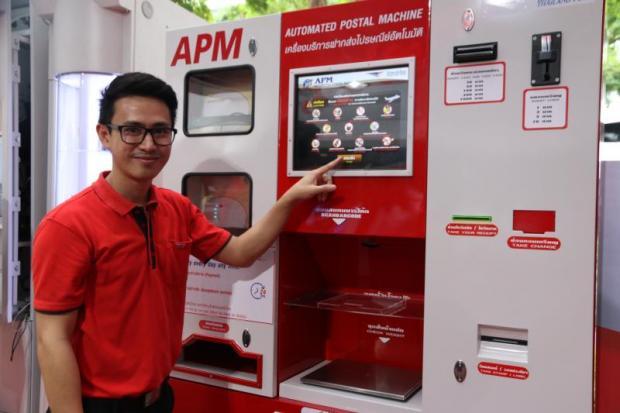
    A Thailand Post staff member shows an Automated Postal Machine — one of several new products and services the agency is offering to enhance e-commerce and to pamper new generation users.

    Thailand Post is spending 500 million baht on upgrading its core information technology (IT) automation systems and distribution centres to boost service innovation for the next-generation of online merchants and digital lifestyle consumers.

    The move is intended to fight back against the influx of no-frills messenger service apps like Lalamove, a Hong Kong-based delivery-matching mobile application, and parcel delivery service providers looking to capitalise on Thailand’s burgeoning e-commerce market.

    Of the total 500 million baht in spending, 300 million will go towards upgrading IT automation systems. The remaining 200 million baht will go to improving flexibility within and across its distribution centres.

    “We’re also in the process of transforming ourselves to become more digital in a drive to improve services and maintain our leadership in the home delivery service market,” said Samorn Terdthampiboon, president of Thailand Post.

    Thailand Post plans to roll out a slew of innovative services over the next seven months.

    For instance, she said PromptPost, a pre-registration mobile app service for high volume parcel delivery, will allow users to reduce the parcel processing time from eight seconds when they employ the service at a post office to two seconds when using Thailand Post’s semi-automated processing counters.

    Mrs Samorn said Thailand Post will soon provide an e-money service called THP Card, which allows people to use a card to pay for all Thailand Post services at its post offices across the country.

    Customers can also top up their cards at Thailand Post locations nationwide.

    She added Thailand Post plans to apply for an operating licence with the Bank of Thailand to provide an e-wallet service in the near future.

    Thailand Post has expanded its cross-border trading and e-commerce services to Indochina, crossing the Cambodian, Laotian and Myanmar borders to reach Chinese consumers.

    Mrs Samorn said Thailand Post is ready to enter Asean Economic Community (AEC) markets following a comprehensive organisational restructuring and the implementation of its enhancement schemes.

    Cross border revenue represented 14% of Thailand Post’s total, boasting bright prospects for revenue growth thanks to the booming business-to-business e-commerce market.

    Up to 37% of cross border revenue comes from its mail delivery service, and 6% from its mail system used to send financial statements and business letters to the retail and financial sectors.

    Mrs Samorn said Thailand Post expects its revenue to grow by 22% to 24.3 billion baht this year. Net profit is expected to reach 3 billion baht this year.


     

  • CBRE Thailand: economy hits development

    CBRE Thailand: economy hits development

    Against an unfavorable economic backdrop, coupled with growing competition in the Bangkok retail market over the past couple of years, developers have been postponing projects, says property company CBRE Thailand in its retail market review for first quarter.

    Affected are mega-projects Bangkok Mall, Central M, EmSphere and Mega Rangsit.

    Instead, says the review, owners have been focusing on renovating and repositioning malls as well as selectively expanding upcountry.

    Newly completed retail supply in Bangkok has begun to slow down, with about 60,000 sqm coming onstream from nine retail developments in the first quarter. None of the projects were big scale, says the report, the largest being the Ratchadapisek Suam Lum Night Bazaar.

    Despite representing a small share of total retail sales, eCommerce has grown rapidly in Thailand over the past year, says the review, posing an up-and-coming risk to brick-and-mortar stores. This will spur growth in online shopping, forcing retail developers to create more attractions to lure consumers to their physical stores.

    “Looking forward, unless domestic demand recovers, we do not expect the delayed projects to start construction any time soon,” says the review. “With the combination of low future supply and the completion of refurbishment in major retail centres, we believe the occupancy rate will bottom out this year.

    “However, rental growth going forward is expected to be limited as competition remains fierce.”

    Meanwhile, domestic demand is still weak. The retail sales index in January, estimated by the Bank of Thailand, was at 200.7 points, increasing by only 0.02 per cent.

    Also, Thailand’s Consumer Confidence Index (CCI) dropped to 73.5 in March, the lowest level in five months, from 75.5 and 74.7 in January and February respectively.

    Thailand’s household debt level continues to be an issue at more than 80 per cent of total GDP, dragging down the spending power of consumers.

    Growing competition in the Bangkok retail market has seen several large-scale projects completed of the past year years, taking the total retail supply to 7.2 million sqm., up nearly 900,000 sqm from the figure in 2014.

    “Not all shopping centres will perform,” says the review, “and we have seen falling occupancy in some of the old or poorly managed malls.”

    First-quarter occupancy was at 92.9 per cent, down 0.3 percentage points from the previous quarter.

    Retail sales in central Bangkok have improved as international tourist numbers have grown, up about 15 per cent from last year.

  • Realty, retail to spur trade NPL

    Realty, retail to spur trade NPL

    NPLs in the property sector are expected to surge by 22 basis points to 4 per cent, while loan demand from this sector is expected to grow by only 3.8 per cent, down by 5.2 percentage points year on year because the property supply is becoming mature.

    However, the highest NPLs still be seen in the commercial and trading sector. TMB Analytics expects bad debt in this sector to expand to 4.45 per cent from 3.9 per cent in 2015.

    Naris Sathapholdeja, senior vice president of the research house, said NPLs in the property sector could result from medium-sized property developers upcountry having trouble selling residential units.

    Meanwhile, community-mall developers have faced less shopper traffic, so occupancy rates for retail space are low as well.

    Earlier, community malls were all the rage, but the economic slowdown has hurt consumers’ purchasing power, and the developers of this type of mall are not big names like listed retailer developers.

    Overall NPLs in the banking industry this year will touch 2.63 per cent, TMB Analytics said, up by 8 basis points from 2015, while lending growth is expected to be 4.1 per cent, slower growth than last year’s 4.3 per cent.

    Business loans should expand by 3.6 per cent, mainly from the construction industry if the government sticks to its announced investment schedule.

    As for the Thai economy, TMB Analytics says private investment will be needed to drive growth in gross domestic product. The research house has forecast GDP growth of 2.8 per cent, but that would require a 3.1-per-cent expansion in private investment and 15-per-cent growth in government investment. Otherwise, GDP growth might be no more than 2.5 per cent.

    Previously, TMB Analytics revised down its projection on GDP growth this year from 3.5 per cent to 2.8 per cent because it was clear the export sector would not return to its former health, so investment was the only hope for the economy apart from tourism.

    The research house has slashed its forecast for the export sector this year from growth of 1.8 per cent to a 4.5-per-cent contraction.

    Thailand will not see double-digit growth in export value any more because countries worldwide have shifted their growth mode from a manufacturing base to a service base, Naris said.

    Low inflation has closed off the chance for the Bank of Thailand to raise the policy interest rate, but the fragile global economy and the strengthening baht might encourage the central bank to reduce the rate.

    “We think if the central bank does cut the policy rate, it should do so in the first half of this year, because the US Federal Reserve will raise its rate in the second half,” he said.