Retail News CRM

Tag: BigC

  • Vietnam electronics retailer Nguyen Kim buys Zalora’s local operations

    Vietnam electronics retailer Nguyen Kim buys Zalora’s local operations

    Zalora, one of Southeast Asia’s biggest online fashion marketplaces, has completed a deal to sell its Vietnamese operations electronics retailer Nguyen Kim, reported Sunday, quoting Zalora Group.
    The subsidiary of Germany’s Rocket Internet has also sold its unit in Thailand to Thai retail giant Central Group, the website said, adding that the value of the deals has not been revealed.
    Last month news website TechCrunch cited multiple sources as saying that Central Group would acquire them for US$10 million each.

    Central owns a 49 percent stake in Nguyen Kim, which has 21 stores around Vietnam, through its subsidiary Power Buy.

    The selloff in Vietnam and Thailand is part of Rocket’s efforts to reduce costs and focus on other markets where Zalora has a better chance to make profits, according to TechCrunch.

    With a presence in 11 countries across the Asia Pacific, including Australia and Indonesia, Zalora’s revenues rose 78 percent last year to around $234 million, but its net loss increased 36 percent to $105 million, it said.
    Last month, the German company, which has been struggling to cash on the Southeast Asian market, sold more than half of its stake in Lazada, which it founded in 2012 to target the regional e-commerce market, to China’s Alibaba for $137 million. Rocket retains an 8.8 percent stake.
    In December Rocket sold off food ordering website Food Panda for an undisclosed price to local competitor Vietnammm after three years of operations, citing financial issues.
  • Central Group sees flat spending in Thailand

    Central Group sees flat spending in Thailand

    As Thai retail conglomerate Central Group suffers a sluggish domestic economy, its owners the Chirathiwat family worry that premium customers are spending overseas rather than at home.

    “The upper class group is still spending money,” Chief Executive Tos Chirathiwat told reporters in Bangkok on Wednesday. “The problem is that they are spending outside of Thailand.”

    In 2015, roughly 7 million Thais travelled abroad, up 9% year on year. Tos said that these outbound travelers spent some 170 billion baht ($4.76 billion).

    “What’s worrying is that the figure is growing at 10% every year, while domestic consumption is expanding at only 2%,” he said. At this rate, the spending leak from Thailand will reach 300 billion baht in five years.

    The number of inbound tourists meanwhile hit a record 29.88 million in 2015, up 20% year on year from a low base in 2014 following political turmoil. But according to Tos spending has not kept pace, rising just 2% last year. He called for Thailand to promote domestic consumption and tourism.

    Central Group is Thailand’s largest retail company with subsidiaries including property development arm Central Pattana. Wearing another hat, Central is itself expanding overseas where operations now account for nearly 20% of group revenue. The company plans to more than double revenue in Europe to 2 billion euros ($2.17 billion) by 2020 — aided by custom from Asian tourists, including China and Thailand.

    Some 10.4 billion baht has been earmarked for renovating five department stores Central has acquired in the region. “We want the stores to be not only a shopping destination but also a tourism destination,” said Tos.

    Central began its shopping spree in Europe in 2011 buying Italy’s La Rinascente chain, which has a 150-year history. Revenue from Europe has been growing an average 40% each year since. This year, it is expected to jump 70% to 51 billion baht as three German department stores acquired in mid-2015, including KaDeWe in Berlin, start contributing.

    Tos said further mergers and acquisitions in Europe are being put off for now. “We have quite a large coverage in Europe now, and there’s a lot of work to do,” he said.

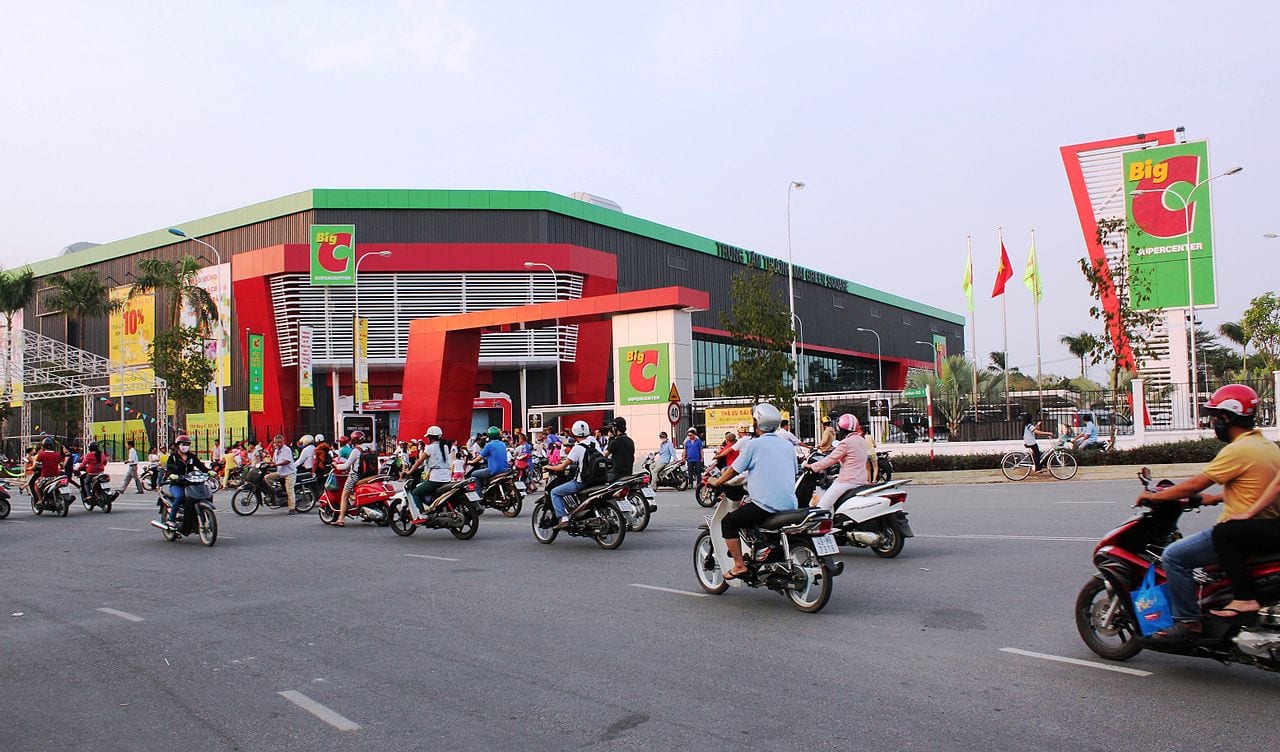
    A more immediate focus is Southeast Asia, particularly neighbors Cambodia, Laos, Myanmar, and Vietnam. In Vietnam, France’s Casino Group is selling off its Big C supermarket chain, and Central already has 25% of Big C in Thailand.

    “We are interested but we have not decided yet whether to join the bidding,” Tos said. “The acquisition will require a substantial amount of money which could be used to acquire something else.”

    TCC Group, the parent company of Thai Beverage, is also reported to be looking at Big C in Vietnam. It recently acquired Casino’s 58.56% stake in Thailand’s Big C for 3.1 billion euros.

    Bidding for Big C in Vietnam is expected to conclude next week. Tos said that if Central acquired the chain, its sales in Vietnam would double from $600 million at present. The company already has two Robins department stores there, and acquired Nguyen Kim, an electronics retail chain, last year.

    Tos said Central has no plans to reenter China after recently exiting. “China was a difficult market,” he said, noting the need for good government connections. “We learnt a lot.”

    Central’s group revenue in 2015 was over 283 billion baht, up 13.5% on 2014. It is targeting growth of 18.9% this year, with international sales contributing the lion’s share of the increase. Revenue from abroad will contribute 24% of the total, up from 18% in 2015.


  • Why are many Thai buyers in the Vietnam retail market?

    Why are many Thai buyers in the Vietnam retail market?

    Berli Jucker Plc (BJC), has taken over the Japanese chain of 42 FamilyMarts and renamed it as B’mart. The Vietnamese retail market recently witnessed a series of mergers and acquisitions (M&A) in which the buyers were businessmen from Thailand.

    In mid-2014, BJC made a deal on buying Metro Cash & Carry Vietnam at $880 million, the biggest affair in the retail sector in Vietnam so far. The deal wrapped up 1.5 years later, in January 2016.

    In early 2015, Central Group successfully acquired a 49 percent stake of the Nguyen Kim home appliance distribution chain.

    Right after French Casino Group announced the plan to sell Big C Vietnam, analysts predicted that Big C chain in Vietnam was likely to fall into Thai hands. Later, BJC stated it was vying for Big C Vietnam.

    This is because, according to Phu, the Vietnamese market promises great potential: while other countries in the world focus on developing the home market, Vietnam has been gathering strength on boosting export, while paying less attention to the domestic market.Vu Vinh Phu, chair of the Hanoi Supermarket Association, who was deputy director of the Hanoi Trade Department, noted that only a few foreign retailers came to Vietnam in the past, but things are quite different now. Nearly all big retailers in the world are present in Vietnam, especially Thais.

    This explains why foreign investors have to spend several months only to find retail premises and penetrate the home market. Meanwhile, a domestic retailer told Phu that it took him three years to do this.

    “Business opportunities will be missed after such a long time,” Phu said, adding that domestic and foreign retailers are in an unequal competition.

    An analyst commented that many Thai businessmen eye Vietnam because Thailand is near Vietnam in geographical position. Thai businesspeople understand Vietnamese consumers’ taste and hobbies.

    “Thai businessmen kicked off plans to penetrate the Vietnamese market a long time ago. And they have been doing this in a methodical way and they have been step by step expanding both production and distribution in Vietnam,” he commented.

    At first, Thai businesses usually organize trade fairs in Vietnam to familiarize Vietnamese with Thai products.

    “I believe that 100 percent of families in Hanoi and HCMC use Thai products, from washing liquid to knives,” he said, adding that Thai products are present in every Vietnamese family.

    Phu commented that though Thai is less strong than Japanese and South Korean; therefore, they have been ‘waging guerilla warfare’ when attacking the Vietnamese market.