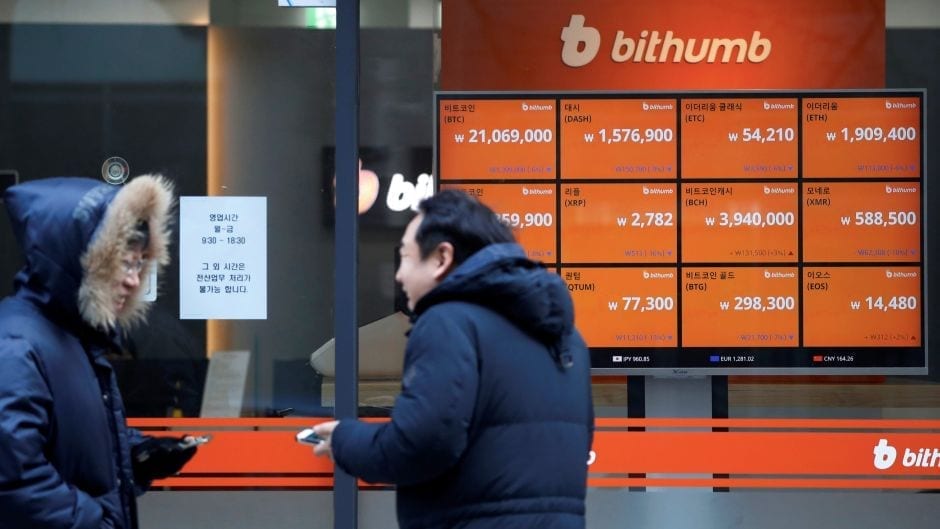
Tag: bithumb

  • Hackers steal $30 million in cryptocurrency from Bithumb

    Hackers steal $30 million in cryptocurrency from Bithumb

    Bithumb, one of the largest cryptocurrency exchanges in Korea, was hacked on Wednesday, causing the exchange to lose more than $30 million worth in cryptocurrencies.

    “We noticed that between last night and today early morning, about 35 billion won [$31.5 million] worth cryptocurrencies have been stolen,” Bithumb said through an announcement on its website on Wednesday. “Cryptocurrency deposit/withdrawal and Korean won withdrawal service will be halted for time being and until services are thoroughly reviewed.”

    “We are still checking on which currencies have been leaked, but so far, we discovered that the hacked coins include Ripple,” said a spokesperson from the exchange.

    According to the Bithumb spokesperson, 100 percent of the coins and tokens traded through the exchange are stored in offline cold wallets.

    “This loss will be compensated by Bithumb’s own reserves, and all the assets of our customers are securely saved in Bithumb’s cold wallets, hence all assets are completely safe and secure,” the company said in the announcement.

  • Bithumb Founder and Former CEO Daesik Kim Returns to Disrupt the Payment Industry

    Bithumb Founder and Former CEO Daesik Kim Returns to Disrupt the Payment Industry

    Daesik Kim, the founder and former CEO of Bithumb—the world’s largest cryptocurrency exchange—is returning to the payments industry as the Chief Cryptocurrency Officer of Bezant, a payment protocol and cryptocurrency for the digital entertainment and e-commerce sectors.

    Bezant has already raised US$6.28 million in its private token sale, and is targeting a total ICO of US$40 million. Kim, who oversaw the day-to-day operations of Bithumb, including an all-time high daily trading volume of over US$6 billion (as of January 13, 2018), will drive business, product, strategy, and partnerships at Bezant.

    Kim, COO of Bezant, said, “Digital entertainment and ecommerce are expanding faster in emerging markets such as Southeast Asia, more so than in the US and China over the next four years. Developed markets are dominated by a few incumbents that charge high commission fees, offering limited payment options, which are plagued by high exchange fees, bank charges, and payment delays.”

    Bezant utilizes a private blockchain network which enables fluid payments and makes microtransactions secure, reliable, transparent, and cost-efficient. This protocol avoids the common problems associated with cryptocurrencies leading to higher fees and slower transaction speeds.

    “With 600 million people in Southeast Asia, a large majority of which are unbanked, Bezant aims to disrupt digital payments and content distribution by applying blockchain and cryptocurrency to eliminate these barriers for buyers and sellers. Bezant’s protocol will minimize transaction fees, provide a decentralised rewards mechanism for sellers to build customer loyalty, establish a transparent rating system on sellers, and enable customers to make borderless payments using their local method,” Kim added.

    Bezant features an experienced development team with product and software engineers from well-known companies such as Ebay, Naver, and Kakao Corp. Bezant has also attracted high-profile advisors and global business development leaders who bring their expertise from the cryptocurrency, payments, digital content, and finance industries to the company.

  • Bitcoin drops as South Korea moves to regulate cryptocurrency trading

    Bitcoin drops as South Korea moves to regulate cryptocurrency trading

    Currently, many cryptocurrency exchanges (including South Korean ones like Kucoin) allow trading with little more than your name and an email.

    Bitcoin appeared to find a bottom on Friday, rebounding to $15 000 after moves by South Korea to curb speculation and protect retail customers took the cryptocurrency down more than 8% on Thursday.

    “The government had warned several times that virtual coins cannot play a role as actual currency and could result in high losses due to excessive volatility”, the country’s government said in a statement.

    Those new regulations would include prohibiting anonymous trading accounts and could give authorities the ability to shut down exchanges, Reuters said. Among other concerns, unmasking bitcoin traders would open up owners to taxation, a significant concern now that bitcoin has increased in value exponentially. The virtual currency plunged more than 10% to below $14,000 on Thursday morning in Asia, according to CoinDesk.com, and continued to fluctuate through the day.

    As part of what appears to be a series of updates created to improve oversight of industry practices, the government will also seek to bar banks from issuing new virtual accounts to cryptocurrency exchanges.

    Mati Greenspan, a Tel Aviv-based analyst at investment firm eToro, said it would be too early to gauge the impact of the rules, but they sounded “ominous”. Demand is so high that prices for the unit are around 20 per cent higher than in the United States, its biggest market.

    The country is also home to Bithumb, one of the world’s biggest bitcoin exchanges.

    In comparison, about 11% of Americans polled by student loan comparison website LendEdu in September said they either now own or have owned virtual currencies in the past, while 17.2% said they would invest in bitcoin in the future.

    South Korea may also stop local companies from providing settlement services for virtual currency transactions.

    In a case highlighting the risks of cryptocurrency, a Seoul virtual currency exchange declared itself bankrupt last week after being hacked for the second time this year.

    So far, China is the only country in the world to have totally banned bitcoin exchanges.

    Seoul-based Youbit said it was filing for bankruptcy after hackers stole almost a fifth of its clients’ holdings.