Retail News CRM

Tag: black friday

  • Black Friday crushes Singles’ Day Chatter in Southeast Asia

    Black Friday crushes Singles’ Day Chatter in Southeast Asia

    Bigger is not always better – or so retailers are discovering following the conclusion of the biggest shopping extravaganzas.

    While Singles’ Day hit a record US$25.3 billion dollars in sales, it was Black Friday and Cyber Monday that dominated social media chatter in Singapore, Malaysia and Indonesia.

    Meltwater, a global media intelligence company, tracked online reactions in the lead-up to – and during – Singles’ Day, Black Friday and Cyber Monday and found that over eight in ten conversations (82.92%) online were focused on Black Friday and Cyber Monday.

    “The rise of Singles’ Day in recent years has been astronomical, breaking records every year and drawing interest from around the globe. While it’s clear that Chinese consumers are spending and talking about Singles’ Day, this massive spend and conversation in China seems to have translated poorly to other markets in Southeast Asia. Black Friday and Cyber Monday still prevail, highlighting the fact that these markets have yet to be fully penetrated by the Chinese phenomenon,” said Neil Brennan, Area Director, Meltwater Japan and South East Asia.

    Meltwater tracked online perceptions across Facebook, Twitter, Instagram, YouTube, blogs, forums, message boards and review sites from 28 October to 28 November 2017.

    Indonesia generates maximum buzz

    Regionally, Indonesia led the way driving the highest volume of online chatter with 88.6% of conversations centered around Black Friday and Cyber Monday.

    Out of the three markets monitored, Singapore generated the most social media buzz for Singles’ Day, accounting for 22.14% of the conversations, followed closely by Malaysia at 21.97%.

    Share of Voice Regional Singapore Malaysia Indonesia
    Singles’ Day 17.08% 22.14% 21.97% 11.4%
    Black Friday & Cyber Monday 82.92% 77.86% 78.03% 88.6%


    Alibaba for the win

    Conversations across all countries typically revolved around finding good deals and offers from specific retailers. It is noteworthy that Alibaba was a major source of online chatter thanks to its record breaking sales figures. Lazada, backed by Alibaba, also drew a considerable amount of chatter following their Singles’ Day push. The largest trending topic in Indonesia was Taman Anggrek, a famous mall located in Jakarta, known for being one of the biggest in Southeast Asia.

    Trending Keywords Black Friday & Cyber Monday Singles’ Day
    Regional
    1. Sales
    2. Amazon
    3. Best Buy
    1. Alibaba
    2. Lazada
    3. China
    Singapore
    1. Black Friday Sales
    2. Free Shipping
    3. Amazon
    1. Lazada Sale
    2. Taobao Buying Guide
    3. Qoo10 Deals
    Malaysia
    1. Amazon
    2. Black Friday Sales
    3. Cyber Monday Sales
    1. Alibaba
    2. Singles’ Sale
    3. China
    Indonesia
    1. Amazon
    2. Best Buy
    3. Black Friday
    1. Taman Anggrek
    2. Singles’ Sale
    3. Alibaba


    How the platforms stacked up

    A majority of the conversations took place on Twitter, Instagram and online forums. Twitter emerged as the top platform contributing to more than half of all conversations about Singles’ Day and over 85% of chatter on Black Friday and Cyber Monday.

    # Top Three Platforms – Black Friday & Cyber Monday
    1 Twitter – 86.51%
    2 Instagram – 6.81%
    3 Forums – 6.53%


    # Top Three Platforms – Singles’ Day
    1 Twitter – 57.92%
    2 Instagram – 29.67%
    3 Forums – 11.68%


  • Alibaba And Singles Day Make Black Friday Look Small And Show The Future Of Retail

    Alibaba And Singles Day Make Black Friday Look Small And Show The Future Of Retail

    Singles Day may be an invented holiday, but Nov. 11 in China gives an indication of how retail will evolve globally over the next decade. And Alibaba is the company to watch. The numbers posted by e-commerce giant Alibaba on Singles Day — a holiday created as an antidote to China’s Valentine’s Day, which has caught on big time — in 2017 are mind-boggling. Alipay, the company’s payments system, processed $25B of payments, more than four times what the entire U.S. spent on Black Friday weekend and Cyber Monday in 2016.

    That is 1.5 billion individual transactions, 325,000 orders per second, at the day’s peak. Cainaio, the logistics company owned by Alibaba, processed 812 million delivery orders. The opportunity for brands is clear, and Alibaba said 167 companies each generated more than $15M in sales, 17 companies surpassed $75M, and six companies surpassed $150M.

    But as important as the numbers Alibaba posted was the way it posted them, because this gives an insight into how the worlds of online and physical retail will intertwine. “More than $25B of orders in one day is not just a sales figure,” Alibaba Chief Executive Daniel Zhang said in a statement. “It reflects how merchants and consumers alike have now fully embraced the integration of online and offline retail.”

    Ahead of Singles Day, Alibaba, founded by Chairman Jack Ma, sent an army of technicians across China to help more than 600,000 independent retailers — mom-and-pop stores, convenience stores and independents selling everything from clothes to hardware  — upgrade their computer systems.

    Those stores were able to sell goods through one of Alibaba’s online platforms, Tmail.com, and now serve as delivery and storage centres for goods sold on Alibaba. Wikimedia Commons Alibaba Chairman Jack Ma Convenience stores use an Alibaba app that helps manage these sales and deliveries, but also gives store owners advice on what they should be stocking to maximise profits and how their wares should be displayed. This is part of Alibaba’s wider effort to have deeper links into the world of physical retail.

    It is also working on the conversion of 100,000 retail stores into Alibaba-linked smart stores. If customers go into a shop and cannot find a product, they can find other stores nearby that might sell it, or have it delivered at home. “Alibaba plans to use these retailers to reach the elderly and children, who largely aren’t engaging with Tmail online,” said Henry Mason, managing director of consumer insights firm Trend Watching.

    “This move demonstrates that the future of retail is not a simple battle between online and offline. It is far more nuanced than that. As Alibaba in China and Amazon in the U.S. have noted, a purely online presence is not enough. “Because despite the proclamations of many online-obsessed, future-focused trend watchers, there are still hundreds of millions of consumers who aren’t pressing Amazon Dash buttons or using WeChat to order toilet paper via drone delivery on a daily basis.”

    Courtesy of Trend Watching Henry Mason Alibaba also has a chain of department stores called Intime, which double as fulfilment centres. Alibaba’s Singles Day numbers also highlight how smartphones will play an increasing role in retail, both online and offline — 90% of the payments Alibaba took were from mobile phones. “In major Chinese cities you hardly see cash machines anywhere,” Value Retail Chairman Scott Malkin said. “You pay for goods using your phone everywhere, whether it is at the street food stall or in the store.”

    Of course, the innovations being pushed by Alibaba will not be replicated exactly in other markets. The company has the advantage of working in a market which, because of the rapid pace of economic development and recent political history, does not have the pre-existing infrastructure and methodology of Western countries. “If you don’t have legacy companies like Marks & Spencer operating then you can go straight to what people want,” Malkin said. Its methods will not be adopted wholesale, but the way Alibaba is creating a platform that connects physical stores and online retailing is a development that will surely be replicated around the globe.

  • Singapore stores going big for mega Black Friday sales event

    Singapore stores going big for mega Black Friday sales event

    Stores are upping the ante for Black Friday, the sales extravaganza that begins on Friday (Nov 24).

    The yearly American shopping affair has gained traction in Singapore and both online and bricks-and-mortar stores are pulling out the stops to attract consumers to their offerings.

    Country chief executive of Courts Singapore Ben Tan said: “Black Friday is one of the biggest shopping events of the year and a great platform to offer shoppers and bargain hunters unbeatable deals in both the online and offline space.”

    He added: “This year, our Black Friday promises to be bigger and better with discounts ranging between 12 per cent and 90 per cent off the recommended retail price, across IT, electrical and furniture products, and we plan for this annual sales event months ahead as an integral part of our retail calendar.”

    Courts began participating in Black Friday in Singapore in 2013, and signs advertising the event went up at its Tampines megastore on Thursday.

    Other stores are lengthening their sales period to give customers more time to shop and spend.

    All Robinsons stores will open at 7am on Friday and close at 1am on Saturday, instead of its normal opening hours of 10.30am to 10pm.

    When Robinsons opened at 7am last Black Friday, queues had already formed outside its store at The Heeren before dawn. Robinsons then said the turnout was “overwhelming”.

    Robinsons said the turnout last Black Friday was “overwhelming”, with queues already forming outside its store at The Heeren before dawn. 

    This year, Robinsons offers will last till Sunday, though the stores will resume their normal operating hours on Saturday.

    A spokesman said: “Preparation for this Black Friday Sale has taken us around six months. We have also added more cashier counters and installed additional fitting rooms to cater to the expected increase in customer traffic across all three Robinsons stores.”

    Other retailers are extending their sales periods to before Black Friday. For example, a Wing Tai Retail spokesman said: “Following overwhelming response to our offers last year, we are extending our main sale from two days to four days – so from Thursday to Sunday.”

    Wing Tai’s brands here include G2000, Topshop, Topman and Dorothy Perkins, and the spokesman added that this year, Fox Kids and Baby will enter the fray for the first time.

    Other stores participating in Black Friday for the first time include beauty firm Fujifilm Astalift. Fujifilm Asia-Pacific’s life science brand manager Joyce Foo said that the company plans to mark its first year by giving customers “a very attractive discount of 25 per cent storewide with a minimum purchase of two products”.

    Other industry players are expanding their Black Friday discounts to the offline space. Harvey Norman, for instance,has lined up hundreds of offers across all of its departments at all its bricks-and-mortar stores, in addition to its website.

    Some, however, are choosing to limit their promotions to their websites despite their bricks-and-mortar presence.

    Managing director of Gain City, Mr Kenny Teo, said: “We are running Black Friday specials on the Gain City website as we believe there is more traction for this campaign via e-commerce.”

    He said that for the home-grown electronics chain, “more people are willing to purchase bigger ticket items such as washing machines and refrigerators on our e-commerce website. This is in stark contrast to many e-marketplaces which tend to see smaller cart values and smaller ticket items being sold”.

    Pure e-commerce players want a slice of the pie too, with retailers such as Qoo10, Lazada and Beauty Carousel making more products available for the promotional sales period. Ms Cindy Leong, assistant manager of sales and marketing at Beauty Carousel, said: “We have expanded the categories for the Liberta Armpit Care Range, now covering all needs from head to toe.”

    However, not everyone is taking part in the sales frenzy, such as furniture giant Ikea.

    An Ikea spokesman said: “Low price has always been a part of the Ikea offer and we aim to provide a wide range of well-designed, functional home furnishing products that are affordable to as many people as possible.”

    He explained that the store constantly strives to reduce prices yearly, saying: “This way, we are able to offer low prices all year long, and will not participate in one-off discount events.”

    For those looking to snap up the best Black Friday deals, the Wing Tai Retail spokesman gave some advice.

    “Shop early. Very often, you get the best selection and offers on the first day of the sale.”

    Beauty Carousel’s Ms Leong went further, saying: “We recommend that consumers act fast to secure their purchases as products may sell out within seconds.”

  • More online super sales for Asia online market

    More online super sales for Asia online market

    While the US formulated online super sales, such as this week’s Black Friday, Asia has adopted the concept with a vengeance.

    In fact, China has increasingly been exporting Alibaba’s Singles Day (11.11) event, which this month racked up a massive US$35 billion in sales. November is the favoured month for this new consumer mania, offering the Singles Day, Black Friday and Cyber Monday sales.

    Both Black Friday and Cyber Monday themselves have been catching on in the Asia Pacific, growing by 29 per cent last year, according to global payments company WorldPay.

    It says that despite forking out $17.8 billion on Singles Day last year, Chinese consumers still went hunting Black Friday bargains, with overall spending on the day up by 37 per cent from the previous year. In Hong Kong, the rate of growth was 32 per cent, and in Singapore 21 per cent.

    While retailers are among the biggest Black Friday winners, new WorldPay data suggests this year could also be a great opportunity for savvy APAC businesses in the travel and digital sectors. In Hong Kong, spending with travel and airlines saw a 30 per cent surge last year, with Singapore figures up 20 per cent as travellers jumped online to search for flight and hotel deals.

    Not just retailers

    Shoppers are also increasingly seeking out bargains for digital content such as subscriptions, e-books and on-demand box sets. Black Friday spending in this sector last year grew 62 per cent in Hong Kong and 14 per cent in Singapore.

    Not just retailers can benefit from Black Friday, but also a range of e-commerce businesses, says WorldPay Asia Pacific GM Phil Pomford.

    “While Black Friday and Cyber Monday have typically been the realm of retailers, a more diverse range of businesses are now recognising they can also take can take advantage of this special online opportunity.

    Shoppers during this time are highly engaged, proactive and looking for a wide range of online deals, so the potential to reach new customers and strengthen brand loyalty is huge, regardless of sector.

    “E-commerce businesses should set themselves up for success by ensuring their websites are prepared for heavy traffic, and offer simple payment options to drive shopping-cart conversions. They might also consider following the example of Amazon and kickstart Black Friday deals a week early.”

    Black Friday online sales surpassed $3 billion last year and are expected to rise this week, says Adobe Digital Insights, as buyers seek to avoid long queues and lost hours in retail stores.

    In Southeast Asia, Google searches for “Black Friday” have surged over the past five years, and 12 months ago major offline/online retailers like Robinsons, Sephora and Zalora offered generous discounts for the event.

    “Many industries rely on this event to make up a large portion of their fourth-quarter sales, in particular toys and games,” says Euromonitor International senior toys and games analyst Matthew Hudak.

    ‘Sure to jump on’

    Digital campaign company RTB House says Black Friday last year attracted 106 per cent more people to online stores, with 204 per cent more transactions.

    “We anticipate conversion rates surging this time,” says RTB House Southeast Asia country director Chandra Kuncara. “Customers who missed out on Singles Day will be sure to jump on this event.”

    He says personalised retargeting is an important selling tool during Black Friday. With AI technology and deep-learning algorithms, marketers can highlight most-desired products for each individual customer.

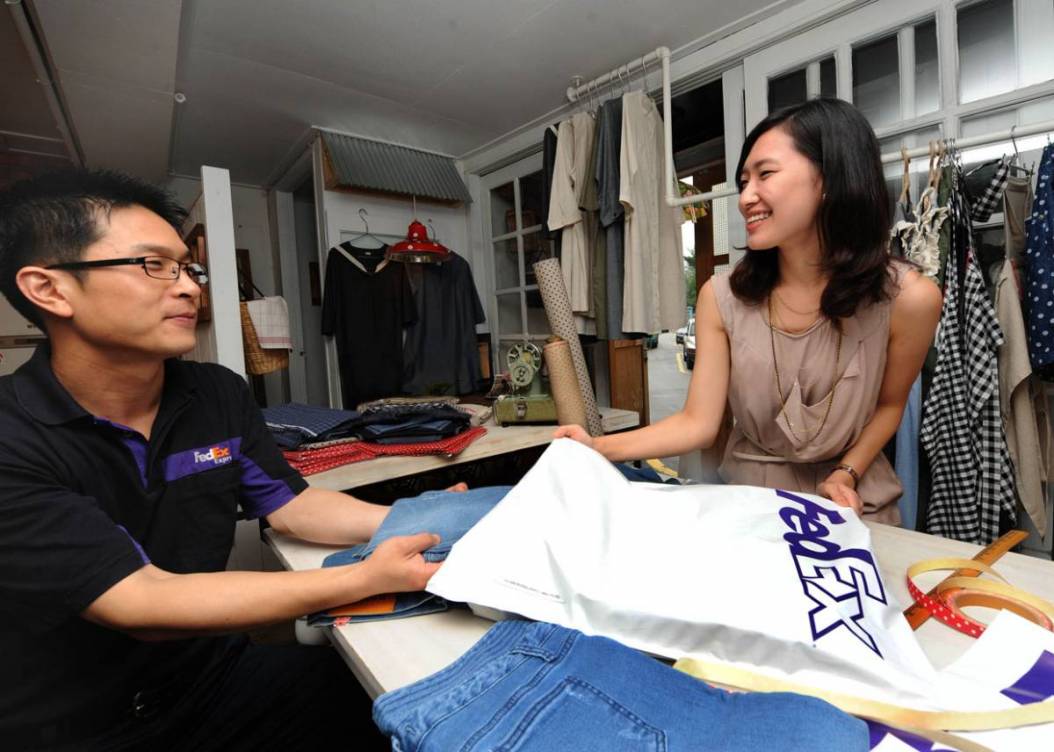
    More purchases mean more packages being shipped, and international courier service FedEx is again expecting to handle a record number of packages over the peak holiday shopping period, which starts on Monday and runs to December 24. This year it is expecting 380 to 400 million packages.

    The growth of cross-border e-commerce is turning the peak shipping season into a global phenomenon, says FedEx. For instance, 37 per cent of Singles Day purchases in China last year were from international brands or merchants. Cross-border shopping is expected to make up 20 per cent of e-commerce sales by 2022, led by Asia Pacific.

    “While an online purchase takes just a few clicks, logistics providers are working hard behind the scenes powering every moment,” says FedEx Express AsiaPacific president Karen Reddington. “Our business is the backbone of the e-commerce market.”

    Meanwhile, while shoppers scramble for Black Friday bargains this week, outdoor retailer REI is closing its 154 US stores for the third consecutive year, offering its nearly 12,000 employees a paid holiday. It is truly going against the tide by also putting a hold on online orders.

  • Black Friday bargain hunting to benefit more than just retailers

    Black Friday bargain hunting to benefit more than just retailers

    Worldpay, a global leader in payments, has predicted that Black Friday and Cyber Monday mania will continue this year, but with a wider range of businesses expected to get in on the online action. Although the shopping event has traditionally been the realm of US retailers, the shopping event grew by 29% in Asia Pacific last year.

    Despite forking out $17.8bn on China Singles Day, Chinese consumers were still hunting Black Friday bargains, with overall spending on the day up by 37% compared to the previous year. The event is also growing fast in Singapore and Hong Kong, at a rate of 21% and 32% respectively.

    While retailers are among the biggest Black Friday winners, new data from the payments processor suggests this year could also be a great opportunity for savvy APAC businesses in the travel and digital sectors. In Singapore, spending with travel & airlines was up 20%3 compared to 2015. And in Hong Kong, travel and airlines saw a 30%4 surge, with eager travellers jumping online to search for great flight and hotel deals.

    Shoppers are also increasingly seeking out bargains for digital content such as subscriptions, e-books, and on-demand box sets, with Black Friday spending in this sector experiencing year on year growth of 62%5 in Hong Kong and 14%6 in Singapore.

    Phil Pomford, General Manager for Asia Pacific at Worldpay said based on the data, 2017 seems set to be another solid year for the shopping event and a fantastic opportunity for a variety of e-commerce businesses, not just retailers.

    “While Black Friday and Cyber Monday have typically been the realm of retailers, a more diverse range of businesses are now recognising that they too can take can take advantage of this unique online opportunity. Shoppers during this time are highly engaged, proactive, and looking for a wide range of online deals, so the potential to reach new customers and strengthen brand loyalty is huge, no matter what sector you operate in.

    “E-commerce businesses should ensure they set themselves up for success by making sure their websites are prepared for heavy traffic and offer simple payment options to drive shopping cart conversions online. They might also consider following the example of US retail giant Amazon and kickstart Black Friday deals a week early in order to generate excitement early on.”

  • China’s singles day VS black friday

    China’s singles day VS black friday

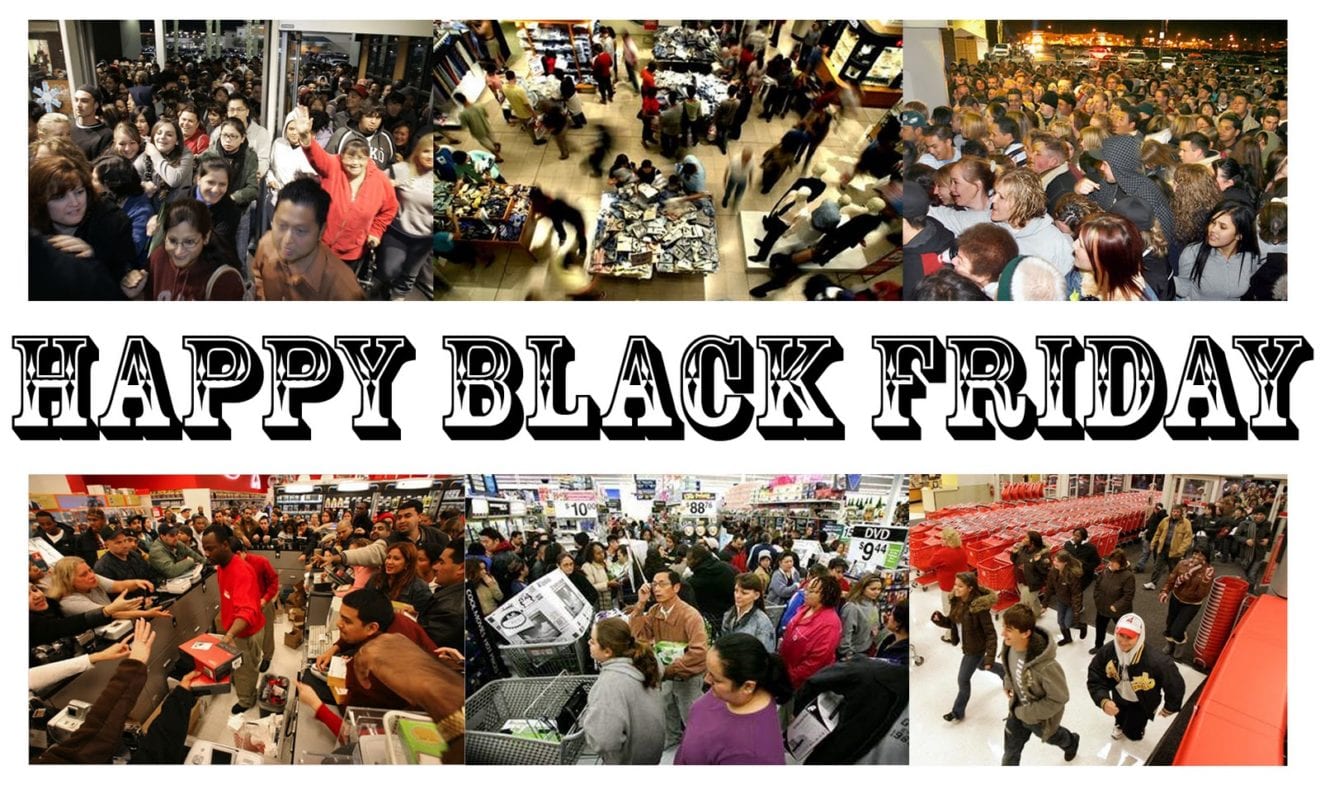
    For the past few years, Black Friday has become a focal point for many US and UK retailers – and for media outlets hungry for images of shoppers bursting into stores in pursuit of posh televisions. The event, supposedly named after the moment when retailers move into profit for the year, has quickly escalated into a four-day shopping festival. But it is not the only game in town – or even the biggest.

    Black Friday falls the day after Thanksgiving in the US (November 23 this year) and is followed up by a long-weekend extravaganza which culminates in the online-focused “Cyber Monday”. It has recalibrated, and brought forward, many consumers’ pre-Christmas shopping plans.

    However, unlike Black Friday, China’s November 11 “Singles Day” is still predominately focused on local consumers and completely dominated by one online retailer – Alibaba. The economic impact of Black Friday is dwarfed by this online one-day retail festival from China. Singles Day has gone under the radar for most of the general public in the West, but in 2016, Chinese shoppers spent an incredible US$17.8 billion in 24 hours on the Alibaba online platform – China’s Amazon equivalent.

    This online sales bonanza shifts more goods than the Black Friday and Cyber Monday sales days in the US combined. Black Friday in the US saw online sales hit a record of just over US$3 billion in 2016.

    Origins

    Singles Day started as an obscure “anti-Valentine’s” celebration for single people in China back in the 1990s. The popular story is that it was started by students at Nanjing University who celebrated their singledom by treating themselves. It takes place on November 11 every year and is sometimes known as “bare sticks holiday”, after the way the date is written (11/11).

    The event is also known as “Bachelors’ Day”, and it’s not hard to see why. China has a surplus of males caused by years of the government’s “one child” policy. By 2020, sociologists expect the gender imbalance to have widened to 35m and by 2030, it is estimated that one in four Chinese men in their late 30s will never have married. That is a big market.

    Black Friday was, of course, initially driven and then “exported” to the UK and other markets by major US retailers, specifically Walmart and Amazon. In China, it was the e-commerce giant Alibaba which adopted Singles Day in 2009, just as online shopping started to explode.

    It has now become a day when everyone, regardless of their relationship status, buys themselves gifts. Alibaba spotted this as a chance for retailers to generate interest and excitement and to boost sales in the lull between China’s Golden Week national holiday in October and the peak Christmas season.

    Like much of the global growth in online sales, Singles Day has been driven by mobile. Nowhere is this more stark than in China where, with 1.3 billion smartphone users, mobile shopping is huge. Around 37 per cent of Chinese shoppers buy products using their phones, compared to the global average of 13 per cent.

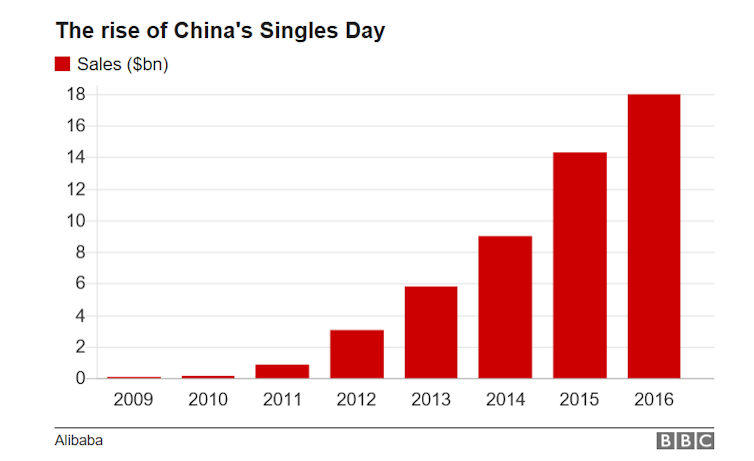
    We’ve seen that Alibaba’s sales numbers for Singles Day are astonishing. And the growth has been too. The chart below shows how Singles Day sales for Alibaba have risen over the past seven years. Last year alone, sales were up 32 per cent on the previous year.

    Alibaba/BBC, Author provided

    According to Alibaba, during the event on 2016 they processed more than a billion payment transactions in total, with 120,000 transactions per second at peak and their distribution system processed more than 657m delivery orders.

    Analysts have predicted this year’s event could see Alibaba rack up sales of US$20 billion despite a slowdown in China’s economy, partly due to it having a broader audience.

    Copy cats

    Of course those kinds of numbers attract the interest of Western retailers too and the 2016 event saw 37 per cent of total buyers purchasing products from international brands or merchants. Companies like US retailers Costco and Macys as well as Britain’s Top Shop and House of Fraser have marketplaces on Alibaba’s Tmall site have already got involved.

    And, for the first time, Alibaba’s 2017 Singles Day festival will bring more than 100 Chinese brands to overseas buyers, offering special promotions targeting over 100m overseas Chinese consumers in Asia and around the world.

    There is one rather sensitive obstacle to the adoption of Singles Day in the UK, however. The eleventh day of the eleventh month is Armistice Day when Britain marks the end of World War I and the nation remembers all those who have died in military service. There will be many who think it distasteful to run a shopping event on that day. However, as David McCorquodale, head of retail at KPMG, pointed out: “Singles Day in China is the biggest promotions day in the world. [The date] will stall its entry to the UK, but not forever.”

    Given the rapid globalisation of most retail trends and the way online retail now allows immediate access to millions of products from thousands of manufacturers, it is indeed impossible to envisage that Singles Day won’t extend it’s reach, in some form, to Western consumers very quickly.

  • More shoppers spend less in Black Friday

    More shoppers spend less in Black Friday

    More shoppers spent less on Black Friday in the US – and more was spent online than ever before.

    Those are the key take-outs from the three day long shopping extravaganza, which is being followed up by Cyber Monday giving Americans a second chance at scoring shopping bargains.

    But perhaps the biggest trend this year was how Black Friday was adopted internationally – even as far away from America as Vietnam, shopping centres were packed with bargain hunters, lured by billboards promising as much as 50 per cent off stock.

    According to data from the National Retail Federation, more than 154 million US consumers shopped last Friday, spending an average $289 – $11 less than last year. Gifts accounted for $214 of that spend.

    “It was a strong weekend for retailers, but an even better weekend for consumers, who took advantage of some really incredible deals,” said NRF president and CEO Matthew Shay.

    Most of the shopping occurred Friday, perhaps reflecting the limited stock of some retail deals.  The NRF said of the consumers who went to physical stores, 75 per cent shopped on Friday, 40 per cent on Saturday and 17 per cent on Sunday.

    And the data showed a continuing migration from offline to online. Last year, 103 million people shopped online and 102 million in stores. This year more than 108 million shopped online and 99 million in stores.

    Adobe released data based on anonymous tracking of 22.6 billion visits to retail websites, showing more than $5 billion was spent online over the holiday weekend – and a record $3.34 billion on Friday. Mobile devices accounted for $1.2 billion of the weekend sales.

  • More retailers open doors for Black Friday sales

    More retailers open doors for Black Friday sales

    If the downtown area seemed like it was more crowded at the weekend, it was because the usual end-of-year sale season came earlier this year for some retailers.

    More brick-and-mortar shops jumped on the Black Friday bandwagon this year in a bid to attract more customers.

    Stores like Robinsons, Courts, Topshop, Topman, Harvey Norman and H&M were out in full force to roll out promotions for what is known in the United States as Black Friday – the day after Thanksgiving.

    All three Robinsons stores slashed their prices by up to 80 per cent. The retailer also brought forward its opening time from 10.30am to 7am.

    Furniture, IT and electronics retailer Courts, which has taken part in Black Friday sales since 2013, offered a priority pass for the first time this year – 280 shoppers who pre-registered could skip the queue and get access to exclusive discounts. The chain also offered discounts of up to 80 per cent at all its 14 outlets and online store.

    Meanwhile, Swedish fashion chain H&M launched a Black Friday collection for the first time, with black as the key colour palette – selected items went on sale from $10.

    Retailers said Black Friday sales helped to increase footfall and sales amid a soft retail climate.

    Wing Tai Retail executive director Helen Khoo said the crowd at some of its stores doubled, compared with normal weekends and Fridays, while sales were between two and four times better than usual.

    A Robinsons spokesman said the turnout was “overwhelming”, adding that some shoppers queued for hours before its stores opened at 7am on Friday. Highly sought-after items included home and electrical appliances, tableware, kitchenware and bedding products.

    Courts Singapore country chief executive Stan Kim said mattresses, TVs, action cameras and smart watches were among the popular items. Black Friday, he added, is gaining momentum as there is growing awareness among consumers with the rise of online shopping.

    He said: “Courts’ online store showed a significantly stronger performance against last year, and our offline stores also benefited from the Black Friday campaign, a testament to the fact that shoppers look to both online and offline platforms alike for great deals.”

    Administrative executive Janet Neo, 29, and her 30-year-old husband spent about four hours in Orchard Road on Friday evening.

    The couple dropped by outlets such as Sephora, Fred Perry and Robinsons for clothes, make-up and bedding material, and saved about $500, thanks to the discounts. Ms Neo said: “The discounts were really worth it. If it wasn’t so crowded, I would have bought more things.”

    Black Friday, an annual American tradition, was coined to describe the day retailers turned in profits and went “into the black”.

    It is usually immediately followed by Cyber Monday, where stores offer further deals online. Some retailers in Singapore, including Robinsons, are expected to take part.

  • H&M celebrates Black Friday with up to 70% off

    H&M celebrates Black Friday with up to 70% off

    Outside of traditional holidays like Christmas, Valentine’s and Mother’s Day, perhaps the most awaited day of the year in the United States, especially for shoppers and bargain hunters, is Black Friday, which is celebrated after Thanksgiving.

    After feasting on turkey with their families, Americans then head out to the nearest shopping center to get the best deals and bargains of the year, as most brands go on sale. And by sale, we mean really BIG discounts on a whole range of items.

    Black Friday is considered the starting point for the holiday shopping season, as Americans buy Christmas presents for their loved ones.

    As an early Christmas treat to shoppers and bargain hunters, international clothing company H&M is bringing the Black Friday frenzy to the Philippines for the first time this year!

    On November 25 to 27, H&M stores in the Philippines will be offering discounts on its new collection, with over 150,000 items sold at 50% to 70% off. Black Friday will be celebrated in the following H&M branches nationwide:

    1. SM Megamall
    2. SM Makati
    3. Robinsons Magnolia
    4. Robinsons Place Manila
    5. UPTown Bonifacio
    6. U.P. Town Center
    7. SM North EDSA
    8. SM Fairview
    9. SM City Clark
    10. Marquee Mall Pampanga
    11. SM City Seaside Cebu
    12. Ayala Center Cebu
    13. Centrio Mall Cagayan de Oro
    14. EVIA Lifestyle Center
    15. SM City Dasmarinas
    16. Festival Mall
    17. SM City Southmall
    18. Robinsons Place Ilocos
    19. Gateway Mall
    20. SM City Iloilo
    21. Abreeza Mall Davao

    All concepts — ladies, men’s, divided, kids, and home — will be part of this promo. Here are some of the items that will be offered at a discount:

  • Online retailer Ymatou expects huge Black Friday sales

    Online retailer Ymatou expects huge Black Friday sales

    Jia Yi, a white-collar employee from Chengdu, the capital city of Sichuan province is passionate about overseas brands and products. She is now considering buying a Coach handbag on the upcoming Black Friday shopping event.

    “The price in the domestic market could reach more than 2,000 yuan ($290), but it is just 848 yuan on the e-commerce platform during Black Friday. It is very cost-effective and I am prepared to buy one,” said Jia.

    China’s cross-border e-commerce has been growing over the past few years. The Shanghai-based cross-border e-commerce site ymatou.com expects the scale of the Black Friday event this year to be 10 times over last year by hiring more than 30,000 overseas buyers.

    The company, which has participated in the biggest retail sales day of the year since 2014, said customers could buy more than 600,000 imported goods from 83 countries, including discounted clothes, shoes, bags, cosmetics, fine jewelry and health care products without leaving the house.

    “There is a trend that consumers from second- and third-tier cities are more willing to buy overseas products. Chinese consumers’ demands have been upgraded as they have diversified and personalized requirements for products and services,” said Zeng Bibo, chief executive officer of Ymatou.

    Zeng added they prefer to buy niche brands from European designers than the mass-market brands in America.

    Black Friday, the day following Thanksgiving Day in the United States, is a busy shopping day with the highest discounts of the year and a major impact on brick-and-mortar retailers, e-commerce players and consumers around the world.

    Ymatou said it is set to ensure that Chinese online shoppers can get the same deals that their Western counterparts enjoy during Black Friday. Buyers can broadcast their shopping process at the online shopping platforms.

    It continues to increase investment in the access threshold of buyers to ensure the authenticity of the goods’ sources. Zeng said they will check the credit status of buyers from time to time, requiring them to offer credentials for long-term living overseas and identifications.

    Furthermore, Ymatou has established an independent logistics company, XLobo, to develop overseas direct mail business.

    XLobo collects and bundles individual parcels at overseas locations and ships them to China as a single consignment. It now owns 15 international logistics centers around the world to ensure the period of direct mail within five days, on average.

    “The number of professional logistics service staff has been doubled. We have expanded the space of warehouses in New York, San Francisco and Osaka, and the investment in equipment and logistics this year has surpassed the total input of last year,” said Zeng.

    It arranges over 90 chartered airplanes each week to transport the goods and other airlines that have cooperative relations with Ymatou will reserve shipping space for XLobo in advance.

    Chinese e-commerce companies, such as Alibaba Group Holdings and JD.com Inc have developed their own cross-border e-commerce businesses.

    Statistics from the China E-Commerce Research Center show that China’s cross-border e-commerce transactions totaled 5.4 trillion yuan ($783 billion) last year, a year-on-year increase of 28.6 percent.

    The generation aged between 20 and 35 old is the major force of cross-border shopping, experts said.

    Cao Lei, director of the China E-Commerce Research Center, said customers need to choose an excellent cross-border e-commerce platform, pay attention to sellers’ reputations or ranking level and customers’ comments, adding they should choose a platform that owns and operates its logistics system.

  • Where to shop in Singapore this Black Friday weekend

    Where to shop in Singapore this Black Friday weekend

    The post-Thanksgiving shopping tradition that’s driving many Americans off the rails at the moment is returning to Singapore this weekend with several retailers here jumping on the Black Friday bandwagon.

    For those who are still keen on shopping even after Singles Day (11 Nov), here’s where you can take advantage of Black Friday bargains in Singapore, both online and offline.

    1. Amazon

    Head on to Amazon’s website from 14 to 26 Nov if you’re looking for great bargains. Be sure to refresh their Black Friday page at 7am every day to discover new deals.

    2. Cotton On

    Now is probably the best time to restock your everyday basics as Cotton On is slashing 30 per cent off its full-priced items if you’re purchasing them online from 24 to 26 Nov. If you’d rather hit their brick-and-mortar stores, be sure to shop at the outlets at Bugis Junction, Plaza Singapura, Bedok Mall and Lot One until 28 Nov. You might walk away with a top as cheap as $10.

    3. Esprit

    Esprit is having a sale online from 24 to 27 Nov, offering 50 per cent off every second piece.

    4. Lazada

    From home appliances, health supplements to electronics, everything has been on sale on Lazada since Singles Day. Their sale ends on 12 Dec. 

    5. Robinsons

    All three Robinsons stores – The Heeren, Raffles City and Jem – will be opened from 7am on Friday (25 Nov), with up to 80 per cent discount storewide.

    6. Timberland & The North Face at Singapore Expo

    Get your adventure gear at a bargain at the Timberland and The North Face sale, happening at the Singapore Expo from 24 to 27 Nov, with discounts up to 80 per cent and 60 per cent respectively.

    7. G2000

    Need new office wear? G2000 is offering 50 per cent off your second piece. This storewide promotion will be available from 24 to 29 Nov.

    8. SaSa

    Need to shake up your beauty regime? SaSa is offering up to 70 per cent off its products storewide for outlets at Bugis Junction, Lot One and Nex shopping malls on 24 Nov. Yes, one day only.

    9. Sephora

    If you’d rather shop for beauty products from Sephora instead, the retailer is offering 20 per cent off all of their products if you buy them online on 25 Nov.

    10. New Balance

    If you’re looking for fresh New Balance kicks, head over to any of the brand’s Experience stores for 20 per cent off your purchase.

    11. Books Actually

    Here’s something for the bookworms. Homegrown books and stationery retailer BooksActually is throwing a 20 per cent off storewide sale from 24 to 25 Nov.

    12. Qoo10

    If you’re an avid Qoo10 shopper, the e-marketplace is not offering discounts, but they are giving away cart coupons priced up to $100 from 23 to 25 Nov.

    13. Shopee

    Online retail site Shopee is having a Black Friday and Cyber Monday (28 Nov) with up to 80 per cent off their items.

  • Forget Black Friday, Singles’ Day is the real retail event to focus on

    Forget Black Friday, Singles’ Day is the real retail event to focus on

    I recently got back from Engine’s Asia offices, where everyone was buzzing with excitement about this shopathon concept.

    This 24-hour shopping day is the Chinese equivalent of Cyber Monday. It started in 2009 by ecommerce giant Alibaba and has evolved into the biggest online shopping day of the year – raking in $14bn in 2015 with mobile purchases accounting for 75% of total sales.

    In the UK, the start of November means that the retail frenzy of Black Friday and Cyber Monday are fast approaching. But as reports this year suggest that Black Friday is no longer the money pit it used to be, it’s time for UK brands to think globally.

    While Black Friday sales are expected to disappoint with just 21% of UK shoppers saying they will be taking advantage of the slashed prices, Singles Day is set to break records with this year’s sales predicted to increase by 50%, with total sales reaching $21bn. That’s almost $1bn per hour.

    With success on these levels, it’s clear that Singles’ Day presents a huge opportunity for UK retailers. Brands like Topshop are already capitalizing on this phenomenon, reporting a sales surge of over 900% on the day in 2015 compared to 2014.

    With over 600 million internet users and 1.3 billion mobile phones nationwide – China’s 468 million digital shoppers equate to 40% of the total global e-commerce spend and a report by OC&C Strategy Consultants shows that in China, over 70% of people are more willing to spend on clothing than before – with a lot of this expected to come through ecommerce.

    Having skipped the PC era, Chinese consumers are savvier, more switched on and demand digital innovations at a level unprecedented in other markets.

    Different apps, such as WeChat, mean that platforms Western marketers might be used to, such as Twitter and Facebook, no longer apply.

    What does this mean for brands looking to tap into the lucrative Chinese market? Investing in ecommerce localisation is key. Adapting and tailoring your digital assets is a base requirement for those looking to appeal to a foreign audience.

    Brands seeking to enter the Chinese market will have to replicate the success of Singles’ Day retailers by understanding and responding to China’s changing demographics namely, its increasing disposable income, emerging middle class and increasingly affluent young population.

    For the event, Alibaba has sponsored a nationally televised gala, which leads to a midnight kick-off. By identifying the right celebrities (David Beckham headlined this year) and a format that fits with Chinese shopping mentality, Alibaba has successfully transformed the shopping event into a media spectacle with an expected viewership of around 200 million (doubling last years’ viewer figures), 10 million of whom will be from outside mainland China.

    This shift underlines a trend identified in a recent report from Cassandra, Engine’s leading provider of youth insights and emerging trends, which illustrates the changing shopping habits of millennials. They increasingly see it as more of an event and communal experience than previous generations ever did.

    This concept from the innovation hothouse of Asia will make brands and retailers eyes water. Agile players will surely be lining up to test and learn from Singles’ Day because discounting during the peak buying season, counter-intuitive though it may seem, is here to stay.

    -Debbie Klein


  • Question mark hangs over South Korea’s discount spree

    Question mark hangs over South Korea’s discount spree

    People love bargain deals. Clearance sales with 80 percent or more off can even lure customers in to buy things they don’t need.

    That’s why retailers offer “door buster” deals when they need to handle rising stockpiles or attract customers during holiday shopping seasons, such as “Black Friday”, the biggest shopping day of the year in the United States.

    On top of seasonal sales and occasional promotions, major South Korean retailers have been holding a series of big discount events since summer to create an intense, promotion-heavy atmosphere through the Christmas season and beyond.

    The discount binge has indeed given a fillip to consumer spending here, but market watchers question its long-term effect as a slowdown in Asia’s fourth-largest economy has led to lower incomes for many people, prompting them to tighten their purse strings.

    Most recently, “K-Sale Day” kicked off last week to run for 26 days nationwide, led by major department stores and outlets that hope to grab shoppers’ attention ahead of the original Black Friday.

    It came just a month after “Korea’s Black Friday”, a nationwide shopping campaign initiated by the government during the first two weeks of October to jack up the stagnant domestic consumption.

    The government-led event even overlapped with “Korea Grand Sale”, during which retailers knocked down prices from early September to mid-October to woo back both domestic consumers and Chinese travelers during the long-haul national holiday.

    One of the main reasons for the deluge of sales is the summer slump following the outbreak of Middle East Respiratory Syndrome (MERS) in late May, which poured cold water on domestic spending and dented tourist numbers.

    More fundamentally, however, the seemingly never-ending sale is seen as an early sign that South Korea is heading into a recession.

    “Although the domestic economy has long grappled with sluggish consumption, the government is ever more concerned about weak spending after exports showed signs of slowing,” Ko Ga-young, a researcher at LG Economic Research Institute, said.

    “Exporters in the manufacturing sector had propelled the growth until the 2008 global financial crisis, but their prospects remain bleak due to slowdown in the Chinese economy and tougher global competition in the low-end manufacturing sector.”

    Although policy makers had expected that low oil prices and record-low interest rates would boost the economy this year, the fallout from the MERS outbreak prompted the government to lower its 2015 growth forecast from 3.8 percent to 3.1 percent in June.

    The discount events, held both online and offline, did not create much buzz like Chinese e-commerce giant Alibaba’s “Singles Day”, which recorded a blockbuster $14.3 billion in sales on Nov. 11, but the steep discounts did serve as the spending trigger for pent-up demand in a short period of time.

    According to the data compiled by the industry ministry, the 22 retailers that joined the Black Friday Korea campaign saw their sales rise 20.7 percent on-year to 719.4 billion won (US$634.9 million) during the two-week period.

    While the government touted its “successful effort” in reviving the consumer sentiment, the market remained skeptical over the growth from last year’s low base during the extended holiday season.

    “Large department stores and discount chains face an unfavorable business environment because massive sales events and permanent discount policy produced a limited effect despite last year’s low base,” said Nam Sung-hyun, a researcher at Kiwoom Securities.

    Unlike a one-off factor like the viral disease, market watchers worry that the tight labor market and rising household debt could continue to discourage people from spending on concerns over their unstable future.

    The youth jobless rate reached the highest level in 15 years at 10.1 percent in June with more college graduates landing at temporary positions, while the average consumption propensity dipped to a record low 71.5 percent in the third quarter, according to Statistics Korea.

    “The consumption propensity is expected to further decline because households are managing their spending schedule in line with the bleak long-term growth prospect and extended life span,” Ko said.

    Brick-and-mortar shops face an even dimmer outlook as more consumers are hunting for bargains from online marketplaces abroad.

    Traditional retailers not only have to compete with each other but also counter challenges from international online marketplaces stealing their customers with easier delivery and transaction procedures.

    “As more consumers learn they can easily buy products at a much cheaper price via online vendors, offline shops are more frequently conducting discount events to retain their customers,” said Jun Mi-young, a professor at Seoul National University and co-author of Trend Korea 2016.

    “The experience of buying foreign brands at discounted prices has created a healthy dose of cynicism about department stores’ pricing policy.”

    According to U.S. No. 1 retailer Walmart’s Black Friday advertisement, South Korean tech giant Samsung Electronics’ 55-inch HDTV was discounted to $498, less than half prices for similar models sold at Korean department stores.

    Some deals even raise questions over whether retailers set a higher price from the beginning to look like they are giving discounts.

    Lotte Department Store’s K-Sale Day promotional leaflet shows that the price of German kitchenware maker Henkel’s five-star knife block set was reduced from 550,000 won to 229,000 won.

    Sounds like a good deal. But you can buy the same product below 200,000 won at several online shopping malls on any given day. The desperate efforts to grab customers with lower prices, however, come at a price.

    As sales start earlier and last longer, they become less important and easier for consumers to ignore. When every day is special, none is.

    “I used to wait for the discount season to buy off-season clothes or other things at cheaper prices,” Lee Su-jin, a 35-year-old office worker in Seoul, said. “These days, I use mobile applications to buy refurbished products or find good deals at overseas websites.” While the discount pricing strategy is useful in driving traffic and sales for a short term, marketing professionals worry repeated sales could negatively affect the retail industry in the long run.

    To survive in the borderless digital commerce world, they advise brick-and-mortar shops to come up with differentiated services to increase customer loyalty.

    “As the rise of digital shopping has become an inevitable trend in the retail industry, offline sales channels should seek ways to provide better in-store experiences and quality service,” Jun said. “Squeezing margins is not a sustainable business model.”

    Experts emphasize the government’s role in setting a long-term policy to manage the record-high household debt and steer the economy clear of such economic uncertainties as China’s slowdown and market jitters over a U.S. rate hike.

    “The government should control the pace of the household debt growth so it does not rise faster than the income growth, which could further contract spending,” Ko said. “Structural reforms are also needed to foster new value-added service sector for healthier growth.”


     

  • FedEx prepares for eCommerce boom

    FedEx prepares for eCommerce boom

    FedEx Asia Pacific is predicting a record breaking Singles Day in Asia this November 11.

    “Due to the huge popularity of the occasion in recent years, China’s State Post Bureau anticipates that this year will see a maximum of 140 million packages being handled per day on the days immediately following Singles’ Day – an increase of 40 per cent compared to the same period last year,” said FedEx in a statement.

    “The rise of eCommerce is particularly pronounced in our region, and this translates into ever-increasing volumes of shipments at this time of year,” said Karen Reddington, president, FedEx Express Asia Pacific.

    “Our strategic investments, operational strength of our network, and more than 17,000 dedicated team members across the region – backed by more than 300,000 of their colleagues worldwide – are poised to deliver a holiday season to remember.”

    Globally, FedEx is also expecting record volumes on the US’ Cyber Monday (November 30) and the first two Mondays in December, when the company expects to move more than double its average daily volume.

    It expects a record-breaking 317 million shipments between Black Friday (November 27) and Christmas Eve – a 12.4 per cent increase over last year’s peak seasonal volume.

    FedEx says it has added 7000 delivery vehicles to its fleet and added 30 aircraft to its fleet over the last year. Across its network 55,000 package handlers, drivers and other support positions have been added to help meet the peak demand.

    FedEx Express is the world’s largest express transportation company, covering more than 220 countries and territories.a

  • Black Friday Campaign Provides Shopping Catalyst in South Korea

    Black Friday Campaign Provides Shopping Catalyst in South Korea

    South Korea is trying to stem a drop in retail spending by replicating an American shopping tradition — Black Friday.

    More than 34,000 stores, including three-quarters of the country’s department stores, slashed prices by as much as 80 percent in the Korean version of bargain-oriented Black Friday through Oct 14. The two-week campaign was launched by the Korean government in an effort to offset sales lost to online commerce and to attract shoppers from neighboring China and elsewhere back into stores.

    In Korea, stores already hurt by online shopping were dealt another blow by the Middle East Respiratory Syndrome, or MERS, this year, which led to an 12 percent drop in revenue at department stores in June and another 6.5 percent decline in August. In July, sales were up very slightly, at 0.7 percent, from a year earlier as Koreans shopped ahead of the summer holiday season.

    The MERS virus has infected 186 people and killed 36 since the outbreak on May 20. It scared away tourists, reducing the number of foreign visitors by 53 percent in July, and another 27 percent in August, from a year earlier.

    Though the fallout from MERS subsided after the government declared July 28 that the virus was no longer a concern, the number of foreign tourists still continued to decline, and was down 3.8 percent in September from the previous year.

    For department stores, that has created a bleak situation, as Chinese tourists in particular are important for strong sales. So the government stepped in, figuring a western-style Black Friday campaign — which has become a seasonal retail driver in the U.S. with bargain-basement deals the day after Thanksgiving — would help stimulate interest in going back into stores in Korea.

    Sales jumped. For the two weeks through Oct. 14 at three major department stores — Lotte, Hyundai and Shinsegae — sales rose 24 percent from a year earlier, according to the finance ministry. Korean discount stores including E-mart, Home Plus and Lotte Mart reported a 3.6 percent revenue increase in the same period. The ministry estimates the overall upswing in retail sales to add about 0.1 percentage point to this year’s growth, forecast at 2.7 percent by the Bank of Korea.

    “It’s a relief, albeit temporary,” said economist Lee Jun Hyup at Hyundai Research Institute, a Seoul-based private think tank focusing on the economy. “An upturn would be meaningful in that the campaign lifted consumer spending in the weeks following the national Chuseok holiday, when people tend to cut down on shopping.”

    South Korean policymakers have been trying to expand the economy with temporary consumption tax cuts on cars and home appliances. Meanwhile, exports — which account for about half of the nation’s economic output — fell every month this year.

    Seoul’s plan is to host similar retail campaigns in the future. If successful, this could redirect local consumers back to Korean malls, which lose about 800 billion won ($707 million) every year during the peak shopping period of November and December to U.S. retailers such as Amazon.com Inc., said Lee Hyoung Ryoul, the finance ministry director in charge of organizing the event.

    In South Korea, the jicgoojok — literally, a tribe of direct buyers — increasingly buy goods from overseas online retailers at much better prices than offered at local stores. The trend is a challenge to Korea’s retailers, which have enjoyed agreements with manufacturers that allow them to charge a premium for foreign and domestic products with little concern for competition.

    A report by the Korea Customs Office last year showed that some import goods sold through exclusive dealerships including wine, lipstick, cheese and car tires were as much as 9.2 times more expensive in Korea than they were overseas.

    Unlike the U.S., where retailers control prices and offer discounts to clear out inventories ahead of the Christmas shopping season, Korean department stores often lease space to vendors without control over inventories. To stem the retail decline, the government would have to include more manufacturers and not just retailers in future Black Friday events, Lee at HRI said.

    While early results show the shopping event was successful, the discounts were limited. Most foreign brands in the high-end category, such as cosmetics and jewelry, didn’t participate, unless they were featured at select shops. Home-appliance stores directly controlled by Samsung Electronics and LG Electronics also weren’t part of the sales, according to the finance ministry.

    Still, some had their own sales — Tommy Hilfiger Kids at Lotte’s headquarters store was offering some items at a 30 percent discount last week in an event separate from the nationwide Black Friday.

    Some shoppers were disappointed that the discounts weren’t deeper — especially as they had been heavily promoted.

    “This is not much different from usual sales department stores regularly hold,” Shin Ji Hye, a 37-year-old mother said while taking a break from shopping for her toddler daughter in downtown Seoul. “I have seen some discounts on women’s clothing floors but most of them offered 10 percent. I think I will go back to online malls and wait for the real Black Friday in the U.S.”