Tag: Blackmores

  • Kirin to buy Blackmores in $1.88 billion cash deal

    Kirin to buy Blackmores in $1.88 billion cash deal

    Japanese drinks giant Kirin Holdings has agreed a $1.2 billion buyout of Australian vitamin maker Blackmores, furthering a diversification push while offering the struggling target’s shareholders a neat exit.

    The deal makes good on a plan by Kirin to broaden its business beyond alcoholic drinks as a growing interest in health raises expectations of tougher regulation.

    It also throws a lifeline to Blackmores shareholders after years of soft returns. The company grew from Australia’s first health food store nearly a century ago into a national success story as it capitalized on Chinese appetite for imported health supplements.

    But COVID-19 containment ended the “daigou” boom, where Chinese consumers bought goods abroad to carry home, and the firm has been struggling to recover sales since. Before the Kirin deal, Blackmores shares traded at one-third their value in 2016, the height of the daigou craze.

    “When you’ve spent 57 years at a business, you don’t want to see the business suffer, and you want to see the business successful,” said former chairman Marcus Blackmore, son of the firm’s founder and its top shareholder with 19%.

    “I have no doubt in my mind that Kirin will deliver on that promise to me,” added Blackmore, 78, in a phone interview.

    Kirin, which makes about half its sales from alcoholic drinks, including top Australian beer brands like Tooheys, said it would benefit by joining a pharmaceuticals unit based in Japan with an already large Australian footprint.

    “In the health sciences area, Kirin is strong in Japan while Blackmores has a strong presence in Australia, China, and Southeast Asia,” Kirin Senior Executive Officer Takeshi Minakata told a Tokyo news conference.

    “The combination of the two companies will enable us to supplement each other’s coverage in areas that have not been covered so far.

    The news pushed Blackmores shares up 23% to A$94.26, their biggest single-day gain, and just short of Kirin’s A$95 purchase price as investors considered the deal final while allowing for dividends that might be paid, which would be subtracted from it.

    “Higher interloping bids are possible, but we think the odds are low given our A$80 stand-alone assessment of Blackmores’ intrinsic value,” said Morningstar analyst Shane Ponraj in a client note.

    Kirin shares fell as much as 3% as analysts wondered if it overpaid.

    “The deal just looked a bit expensive and Japan generally takes M&A negatively. A little surprised it isn’t down more.” said Mio Kato, founder of LightStream Research, who publishes on the SmartKarma platform.

  • Blackmores’ international sales soften during first half

    Blackmores’ international sales soften during first half

    The chief executive of vitamins group Blackmores says people will keep spending on vitamins and health supplements they consider crucial, but are becoming more discerning about when and where to buy as cost-of-living pressures rise.

    Alastair Symington says there’s a noticeable shift in the different channels from which vitamins purchases are being made, with value-oriented consumers hunting for special deals and the lowest price.

    “We are seeing a little bit of shifting out of the traditional pharmacy,” he said.

    Mr Symington said in the first weeks of February, the volume of sales across the board hadn’t waned, but Blackmores was closely monitoring buying patterns, anticipating that some consumers could start buying fewer items and stick to core purchases.

    “We haven’t seen volumes coming down yet,” he said.

    Blackmores shares dropped 6.7 percent to $79.06 by late afternoon on the ASX on Thursday after a subdued first-half profit. The group generated net profit after tax of $25.5 million for the six months ended December 31, down 1.4 percent from a year earlier. Revenues fell 1.6 percent to $338 million.

    The share price had rallied in the previous four months, gaining 35 percent from $63.71 in mid-October.

    Blackmores shares hit $200 in 2016 when the “clean and green” status of Australian vitamin companies fuelled an extraordinary jump in demand from consumers in China, and triggered a buyout of Australian rival Swisse by China-based Health & Happiness.

  • Blackmores registers strong growth, momentum expected to continue

    Blackmores registers strong growth, momentum expected to continue

    Vitamin producer Blackmores has seen group revenue rise 12.8 percent in Fy22 to reach $649.5 million with growth across the company’s three major brands.

    This delivered a rise in underlying operating EBIT profit of 19 percent to $56.6 million, with margins expanding 1.1 points to 53.4 percent.

    CEO Alastair Symington said the company had delivered a strong result in a year impacted by the Covid-19 pandemic, increased input costs and significant supply chin disruptions.

    Symington said: “The resilience of our business model, together with the strength of our brands and distribution channels have enabled the group to respond to these challenges to deliver top line growth along with further margin expansion.

    “We recorded growth across all three brands – Blackmores, BioCeuticals and PAW – and all markets for the first time in the last four years.”

    Symington said the company’s focus on product innovation and investment in its brands, as well as selling and marketing spending up 4.6 percent, had delivered revenue growth of 12.8 percent.

    “This has enabled Blackmores to deliver a 22.6 percent increase in underlying net profit together with a 33.8 percent lift in full year dividend to shareholders to 95 cents per share fully franked.

    “Importantly this strong set of financial results has also been delivered alongside the implementation of improvements in our workplace health and safety and further commitments delivered as part of our ongoing sustainability agenda.”

    During the year Australian sales were up 2.7 percent, international sales up 31.7 percent and China sales up 10.6 percent along with an 11.2 percent rise in EBIT to $16 million.

    Blackmores ended the year with newt cash of $82.2 million.

  • Blackmores believes China’s diagou market is past its peak

    Blackmores believes China’s diagou market is past its peak

    The boss of Blackmores says the vitamins and supplements giant is not really relying on Chinese “daigou” shoppers anymore as it gains more market share in Indonesia and Thailand, while the huge opportunity of densely-populated India will be a slow burn.

    After delivering the company’s latest results on Thursday, chief executive Alastair Symington also said customers should not expect a price war with Blackmores’ competitors as too many discounted promotions led to “a lack of differentiation between brands”.

    It also means lower margins for the business, which wants to maintain its premium positioning in the market, highlighting its superiority with things like the ethical sourcing of fish oil.

    The company booked a 9.6 percent rise in underlying net profit for the first half, with earnings margin growth in Australia and New Zealand of almost 18 per cent credited to “strategic pricing and operational improvements”.

    Mr Symington said the results were ahead of expectations in all markets despite volatile and uncertain trading conditions due to the pandemic.

    Blackmores’ overseas business is leading the charge, with revenue up about 50 percent.

    Mr Symington said 110 percent growth in the massive market of Indonesia was particularly pleasing, driven by consumers snapping up vitamin D and zinc on the back of clinical evidence these improve immune health – a key consideration amid lockdowns.

    Growth in Thailand of 40 percent was also a highlight, he said, but Australian consumers were still behaving very cautiously and there had been a “stuttery start” to sales this calendar year, with ANZ revenue dipping 1.2 percent.

    But Blackmores has its eyes on a very big prize – India – where it launched in September in partnership with Amazon India.

    The company recently entered a distribution partnership with Udaan, India’s largest business-to-business e-commerce platform, expanding the reach of its products to independent pharmacies in at least 10 metro cities across the continent, which is home to well over one billion people.

    “There’s a lot of promise in that India business,” Mr Symington said.

    Mr Symington says growth areas include ‘healthy ageing’ products targeting concerns such as joints, digestive health and anxiety in pets, and sleep and beauty.

    On China, he said the daigou market – whereby visitors send goods back home – would not return to the loft heights seen in 2016 and 2017, when dedicated stores offering resellers in-demand products and delivery services popped up around Australia.

    Blackmores recorded an 8.5 per cent lift in revenue to China in the first half, “driven by continuous improvements in e-commerce fundamentals … partially offset by a 7 per cent decline in the corporate daigou channel”.

    “We’re not really relying on that (diagou market) moving forward,” Mr Symingto

  • Blackmores launches into India

    Blackmores launches into India

    Australian-based and internationally loved natural health and dietary supplements company Blackmores has announced its launch into the Indian market, reaching local consumers in association with Amazon India and other major eCommerce platforms before expansion to traditional retail in key cities.

    Primed for a post-COVID wellness boom, India is a focus growth market for Blackmores given their focus for natural health. Currently, Blackmores operates in 12 other markets across Asia-Pacific and has the ambition to connect 1 billion consumers globally to the healing power of nature by 2025.

    Backed by almost 90 years of research and science, Blackmores’ high quality and innovative product range has been specifically formulated for the discerning Indian consumer to meet their specific lifestyle and dietary preferences, including vegetarian requirements.

    “Blackmores is passionate about connecting people to the healing power of nature. We choose the most nutrient-rich ingredients to ensure our products are high quality, efficacious and adhere to some of the most rigorous safety standards in the world. We know that Indians are passionate about natural health too, and we are excited to be a part of their journey to lead healthier and happier lives,” said Mr Alastair Symington, Chief Executive Officer of Blackmores.

    The initial launch products for Indian consumers include Blackmores Shine Power™ D3 for healthy bones and immunity, Blackmores Glucosogreen 1500 for joint health, Blackmores Blue Light Defence for eye health, and Blackmores CoQ10 150mg for heart health. Additional tailored and innovative products will be rolled out over the coming months. The products are customized to the needs of Indian consumers helping them to take charge of their health and wellbeing.

    The launch was unveiled at a virtual event hosted by Blackmores alongside senior executives of Amazon India. The launch also coincided with a visit from Australia’s Minister for Trade, Tourism and Investment, the Hon Dan Tehan MP, to India, where Mr Symington has been invited to participate in a panel discussion at Austrade’s Australia-India Business Exchange (AIBX) 2021 Business Leaders Forum on Friday 1 October.

    “It’s a pleasure to launch Blackmores, one of Australia’s leading and most trusted natural vitamins and dietary supplements brands, in India. Blackmores with its legacy of almost 90 years in natural healing is a great example of Australia’s clean, green and safe manufacturing reputation. Indians are passionate about natural and holistic health, and we hope that iconic Australian brands such as Blackmores are part of their journey to lead healthier and happier lives,” said Sam Freeman, Trade and Investment Commissioner at the Australian Trade and Investment Commission.

    “We are delighted to associate with Blackmores, a trusted natural health company for their launch in India. We are excited to offer our customers with an opportunity to explore their products from the comfort and safety of their homes,” said Nishant Raman, Category Leader, Amazon India.

    “We look forward to building a successful partnership with Blackmores as we work towards a common goal of connecting Indians across the country to the healing power of nature,” said Ankur Dayal, CEO of Primarc Pecan, Blackmores’ local eCommerce distribution partner.

    Blackmores is the leading natural health brand in not just Australia, but also in several other Asian markets. Its innovative and efficacious range includes vegetarian formulations, as well as products targeted to age, gender, and specific health functions to give people everywhere the choice to make living well each day a natural way of life.

  • Blackmores stumbles on China costs and fish oil shortages

    Blackmores stumbles on China costs and fish oil shortages

    Blackmores CEO Richard Henfrey is wrestling with supply constraints for some ingredients and a more competitive market in China.

    Blackmores is grappling with shortages of ingredients such as whey protein and fish oil, and competition in China is becoming more fierce but chief executive Richard Henfrey says the long-term growth projections for the vitamins maker are robust.

    Blackmores shares tumbled more than 15 per cent in early trading on Thursday to $135 as the company said it was working with ingredients suppliers to shorten lead times in its supply chain and that profits from its China business had grown by 4 per cent as it bumped up investment and spent more on expanding its in-country presence in China.

    Mr Henfrey said Blackmores still expects solid growth in the second half of 2017-18, after generating a 20 per cent per cent rise in net profit after tax to $34.2 million.

    He said on Thursday that Blackmores was a more consistent business now after going through extreme volatility in the past couple of years and it would be some time before it was able to repeat the stellar full-year profit of $100 million notched in 2015-16. “That was the gift year,” he said, when booming demand from China fuelled extraordinary profit growth.

    Cost-cutting inside the business and a reduction in discounts to customers enabled Blackmores to generate a 20 per cent rise in bottomline profits, with revenues up 9.3 per cent to $287.4 million. The company lifted its first half dividend by 15 per cent to $1.50 per share, to be paid on March 22.

    But the soft Australian retail market is expected to crimp growth in the second half, while Blackmores is also wrestling with some supply constraints. “We’re working with our suppliers to shorten lead times,” Mr Henfrey said. Whey protein and fish oil were two specific areas where there had been constraints.

    The China market is becoming a tougher market in which to compete, as different players step up their efforts to gain a bigger share of the market as Chinese consumers flock to “clean and green” products from countries like Australia.

    “It’s becoming a more competitive space,” Mr Henfrey said. China sales were up 27 per cent. But Mr Henfrey said profits from China grew 4 per cent as more investment was made in bolstering the in-country presence. Blackmores was also hit by an increase in doubtful debts provisions in China of $2.8 million.

    Blackmores has a new distribution centre at Bungarribee in western Sydney which went into full overdrive in December after a staged ramp-up. “We’ve finished building out the technology in there,” he said. But it was at the start of the supply chain where headaches emerged. “It’s at the other end of the chain,” he said.

    Mr Henfrey, who took over from long-serving chief executive Christine Holgate in August 2017, said sales revenue in Australian and New Zealand slipped marginally to $121 million as more sales which had previously been emanating in Australia from entrepreneurs buying up in local retail stores and then selling them online in China, shifted across to direct sales online in China by Blackmores itself. But EBIT from Australia and New Zealand was up 19 per cent to $26 million.

    Blackmores shares had almost doubled in the past six months from $87 in late August 2017 to $160 on Wednesday before the fall on Thursday.

    This was on renewed optimism returned about Mr Henfrey’s strategy of ensuring a more consistent and reliable Blackmores with a focus on lifting investment returns with tighter management.

    Lofty gains

    Blackmores shares reached the lofty heights of $220 in early January 2016 on the strength of enormous appetite from Chinese buyers for “clean and green” vitamins brands.

    It was largely driven by the Chinese entrepreneurs buying up large volumes of vitamins from Australian supermarkets and big box outlets such as Chemist Warehouse, and then selling them online on e-commerce sites in China.

    But then regulatory uncertainty resulted in a pull-back. Chinese tourists and exporters changed their buying patterns and the Australian market became much more competitive, with high levels of stock left in warehouses, which blunted the speed of replacement orders.

    Rival Swisse was acquired in two tranches for a total of $1.7 billion in 2015 and 2016 by a company now called Health & Happiness, which changed its name from Biostime International.

  • Blackmores, Kalbe join forces in new Indonesian venture

    Blackmores, Kalbe join forces in new Indonesian venture

    Australian Ambassador to Indonesia Paul Grigson has welcomed the new partnership between Australian company Blackmores and Indonesias Kalbe that will allow new vitamin products to enter the local market.

    Blackmores will initially supply eight products in Indonesia through the joint venture, the Australian Embassy here said on its official website on Saturday (Sept. 3).

    Ambassador Grigson said while the two companies shared many values, it was the small differences between them that had generated the creativity needed for such a partnership.

    “Blackmores experience shows the importance of Australian companies choosing the right local partner to do business in Indonesia,” Ambassador Grigson added.

    The Blackmores – Kalbe partnership was sealed during Indonesia Australia Business Week in November 2015, when 360 Australian businesses travelled to Indonesia to build collaborative partnerships with Indonesian companies and explore investment opportunities.

    Blackmores CEO Christine Holgate has thanked the Indonesian Government and Australian Embassy for their support in finalizing the partnership.

    “We will be launching with eight products and will have 25 products by the end of the year,” Holgate informed.

    She explained that Blackmores had chosen to partner with Kalbe as it was a major supplier of pharmaceutical products and has an institute to train people in natural health care products.

    She hoped that Blackmores would be able to leverage Kalbes training processes and its strong representation in shopping centers throughout Indonesia where it has health centers giving advice on natural health products.

  • Blackmores spreads wings in Indonesia

    Blackmores spreads wings in Indonesia

    Blackmores chief executive Christine Holgate is in Jakarta today to launch the company’s expansion into the Indonesian market.

    The Sydney-based vitamin and supplements company has been operating in China, Singapore, Malaysia and Thailand for some years but has held back from the Indonesian market as it searched for the right partner.

    It has now partnered in a joint venture with Indonesia’s Kalbe Farma, one of the largest health care companies in South East Asia.

    “We will be launching with eight products and have 25 products by the end of the year,” Ms Holgate said yesterday.

    “It is quite a complex registration process in Indonesia compared with Australia. But we are used to the different Asian markets where it can take six months to a year to get registered.”

    She said Blackmores had chosen to partner with Kalbe as it was a major supplier of the nutritional supplements market in Indonesia.

    “It’s a market worth around $2 billion in Indonesia and it’s growing really fast,” she said.

    “The country has one of the fastest growing middle classes in the world and it’s predicted to be the third biggest economy in the world by 2030,” she said.

    She said Indonesians were increasingly interested in more Western versions of natural health products. She said Kalbe had a strong “common shared sense of purpose” with Blackmores including having an institute to train people in natural health care products.

    She said Blackmores would be able to leverage Kalbe’s training processes and its strong representation in shopping centres throughout Indonesia where it has health centres giving advice on natural health products.

    Ms Holgate has been in Indonesia for the past week at the Australian-Indonesian dialogue which is aimed at boosting trade between Australia and Indonesia. Federal Trade Minister Steve Ciobo has been negotiating a free trade agreement with Indonesia, reviving a process which stalled in 2013.

    Ms Holgate said only 2 per cent of Australia’s trade was done with Indonesia and added there were business opportunities in areas such as health, education and financial services. She said Australian companies needed to negotiate partnerships with Indonesian companies to expand into the market.

    Blackmores’ business in Indonesia was “not going to be a huge overnight.”“But you need to plant seeds to grow trees and this is an important next step in our history of growing in Asia.”

  • Risk takers and growth makers look to China

    Risk takers and growth makers look to China

    With a theme of risk takers and growth makers it was inevitable that anecdotes about Australian business and China would feature heavily at The Australian Financial Review Business Summit, presented by BHP Billiton.

    China presents risks that are beyond the pale for boards of directors of most S&P ASX 200 companies and for many influential equity fund managers.

    Insurance Australia Group’s decision to pull the plug on a $1 billion investment in China said a lot about risk aversion on major company boards. The Telstra decision to not invest $1 billion in the Philippines suggests that capital will not be deployed in China even though the country wants to open up its telco market to competition.

    Risks in China that are rarely found in Australia include sudden regulatory changes, the blatant stealing of intellectual property and government decisions tied to China’s increasingly aggressive foreign policy.

    But the growth opportunities on offer in the world’s fastest-growing economy are so extraordinary that many smaller companies believe the rewards far outweigh the risks.

    That was the clear message from a range of speakers and panellists on the first day of the Financial Review Business Summit in Melbourne on Tuesday.

    Power of social media

    The most stunning anecdote came from Richard Henfrey, chief operating officer of Blackmores, the vitamins company which has stormed the Chinese market thanks to its “clean and green” image.

    Henfrey says sales of a Blackmores Vitamin E cream were running at about 3000 tubes a month when Chinese film star, Fan Bingbing, was photographed with a tube in her handbag.

    The photo was shared on social media and within weeks sales of the cream soared to 100,000 tubes a month. Today sales are running at about 500,000 tubes a month and still growing.

    Henfrey says the incident highlighted the power of social media in China. Blackmores has not had to pay the film star any money for her public endorsement of the product.

    But when asked by Chanticleer about the expansion of other Australian companies in China, Henfrey expressed surprised that others had not followed in the footsteps of Blackmores.

    He says other Australian vitamins companies had not invested in people and infrastructure inside the country.

    Blackmores has 25 people in its office in Shanghai and Henfrey is confident that staff numbers will grow to more than 100 within a year. He says Australians need to get over their fear of investing on the ground in China.

    In carving out a profitable niche in the Chinese vitamins market, Blackmores has had to navigate through tricky government regulations.

    Its success is partly due to bypassing tough government regulations in relation to medicines. Many of its vitamins are classified as food rather than medicines and this has helped to clear the way to its sales success.

    Its products are sold in about 10 per cent of the 50,000 pharmacies in China.

    Free trade zone a catalyst

    Henfrey says the establishment of the Shanghai Free Trade Zone had delivered a significant increase in sales because Blackmores could now used bonded stores to directly import products not covered by local regulations.

    This carries a strong message for other companies in Australia pondering expansion into China. The Shanghai Free Trade Zone, which was established on a pilot basis in 2013, presents growth opportunities for financial services companies.

    These opportunities were outlined in a recent paper by Jeff Schubert on behalf of the Australian Chamber of Commerce in Shanghai.

    However, the focus of discussion at the summit on Tuesday was in relation to food, tourism, education and property transactions.

    The enormous opportunities for Australian food companies in China were laid out in compelling presentation by Shaun Rein, managing director of China Market Research Group.

    Rein meticulously dissected the major drivers of consumer demand in China ranging from the impact of pollution on shopping habits to the shift in luxury purchasing habits from Louis Vuitton bags to international travel.

    He provided several embarrassing examples of international firms that had attempted to crack the Chinese market with ill-thought through advertising campaigns that showed a total misunderstanding for local consumer culture.

    Rein says CMR research showed that Polo Ralph Lauren totally missed the mark with its ads featuring blonde American models. These turned off Chinese buyers who thought the clothes would not fit.

    GAP made the same mistake by using a male model with tattoos, which are normally associated with Triad gangsters.

    He says one high-profile global manufacturer of fast moving consumer goods had made a grievous error by lowering its production standards in its Chinese factories with the inclusion of carcinogens banned in the United States.

    Pollution huge issue

    Pollution, according to Rein, is the single biggest issue transforming shopping habits in China. The air in Beijing and to a lesser extent Shanghai is often so toxic that it has forced an increasing number of people to shop online.

    Rein says that switch in consumer behaviour has not necessarily been reflected in the retail sales numbers published in China. He says traditional retail sales measures underestimate the strength of demand.

    Rein said research by CMR of people in China with a minimum of $10 million in assets showed that at least 60 per cent were making preparations to leave China, partly because of the fear that the pollution problem would get much worse.

    Pollution, says Rein, is one reason why Chinese do not trust products made in their own country. It is this distrust which is driving the demand for Australian beef, dairy and honey products.

    Raymond Yeung, a senior economist, Greater China Economics with ANZ Banking Group, told the summit that consumers now accounted for more than half of economic growth in China. He agreed with Rein that tourism presented a good opportunity for Australia.

    Australia must welcome Chinese tourists

    About 5 million Chinese visited Japan last year, about 6 million visited Korea but  only 1 million visited Australia.

    Simon Henry, the co-chief executive and founder of the top international real estate website in China, Juwai.com, says he is horrified at the low number of Chinese tourists visiting Australia.

    Juwai.com facilitated an estimated US$4.2 billion ($5.5 billion) in Chinese international real estate purchases in the 2013 calendar year, according to Henry.

    Henry’s contribution to the discussion related mainly to China’s insatiable appetite for foreign real estate. He has not found any lessening in demand despite the gradual decline in China’s economic growth.

    Demand for foreign property, according to Henry, has risen from $US5 billion in 2010 to $US52 billion in 2015. He says demand will reach $US220 billion by 2020.

    He says there are only two assets that are trusted by China’s “mum and dad” investors – gold and property. That is why the recent stock market gyrations had no impact upon demand for property.

    Yeung from ANZ provided a sobering assessment of the likely Chinese response to the possible election of Donald Trump as president of the United States.

    He says it is no surprise that China’s international priority over the past two years has been the One Belt, One Road infrastructure strategy. This policy focuses on Chinese investment in infrastructure in about 65 countries, most of which are to the west of the country.

    In fact that One Belt One Road strategy presents partnership opportunities for Australia’s major construction and engineering companies based on the experience of General Electric.

    John Rice, vice chairman of GE, told Chanticleer that GE did a deal at the end of last year in Pakistan which involved a Chinese electric power company, Chinese financing and a gas turbine from France.

    “The EPC was a Chinese company we have done business with for 20 years – Harbin – so we can bring partnerships we have established over decades in some cases to bear to win deals along the One Belt, One Road,” he said.

    “It was good for GE, good for the customer in Pakistan and good for China.”


  • Blackmores cuts the ribbon on Bondi store amid mad China scramble

    Blackmores cuts the ribbon on Bondi store amid mad China scramble

    Blackmores chairman Marcus Blackmore admits he had no idea just how much the opening up of China would turbocharge sales of his company’s vitamins, creams and supplements.

    The ASX-listed natural health business has been showered with awards this year while booming sales have seen the stock light up the local sharemarket.

    Around 80 per cent of our products are sold through pharmacy in Australia and they give fantastic advice.

    Christine Holgate, Blackmores

    Shares in Blackmores, of which Mr Blackmore owns 24.5 per cent, have surged from $32 in January to around $189, giving the company a market value in excess of $3 billion.

    “It has been an unbelievable year,” Mr Blackmore told Fairfax Media at the unveiling of the company’s first retail store in Australia.

    Advertisement

    “It is beyond any expectations. We’ve been in China for four years but we had no concept of what China would deliver.”

    At a recent dinner in Shanghai Mr Blackmore met a man from Guangzhou who runs three hospitals treating 20,000 people a day with traditional Chinese medicine.

    He said that China’s long history of using traditional medicines means customers in that market are much easier to win over.

    “Chinese people have a very clear understanding of the philosophical values of natural health,” he said.

    Blackmores floated on the ASX 30 years ago, and for most of that time the company sold 3000 tubs of vitamin E cream a month. In November 2015 the company sold 800,000 tubs of vitamin E cream.

    For the three months to September 30, Blackmores reported a 64.7 per cent increase in sales to $162.2 million and a 161.5 per cent increase in profit to $22.6 million.

    Mr Blackmore said “things come in threes” and the opening of Blackmore’s first Australian retail store at Bondi Junction Westfield caps off the trifecta.

    The other two things brightening the vitamin king’s mood happened last week.

    Last Thursday Blackmores boss Christine Holgate was named chief executive of the year by CEO Magazine, and on Friday federal trade minister Andrew Robb awarded Blackmores the health and biotechnology exporter of the year award.

    New store boosts connection

    Ms Holgate said the Bondi store is not about building a retail presence across Australia but is intended to help connect with Blackmores customers.

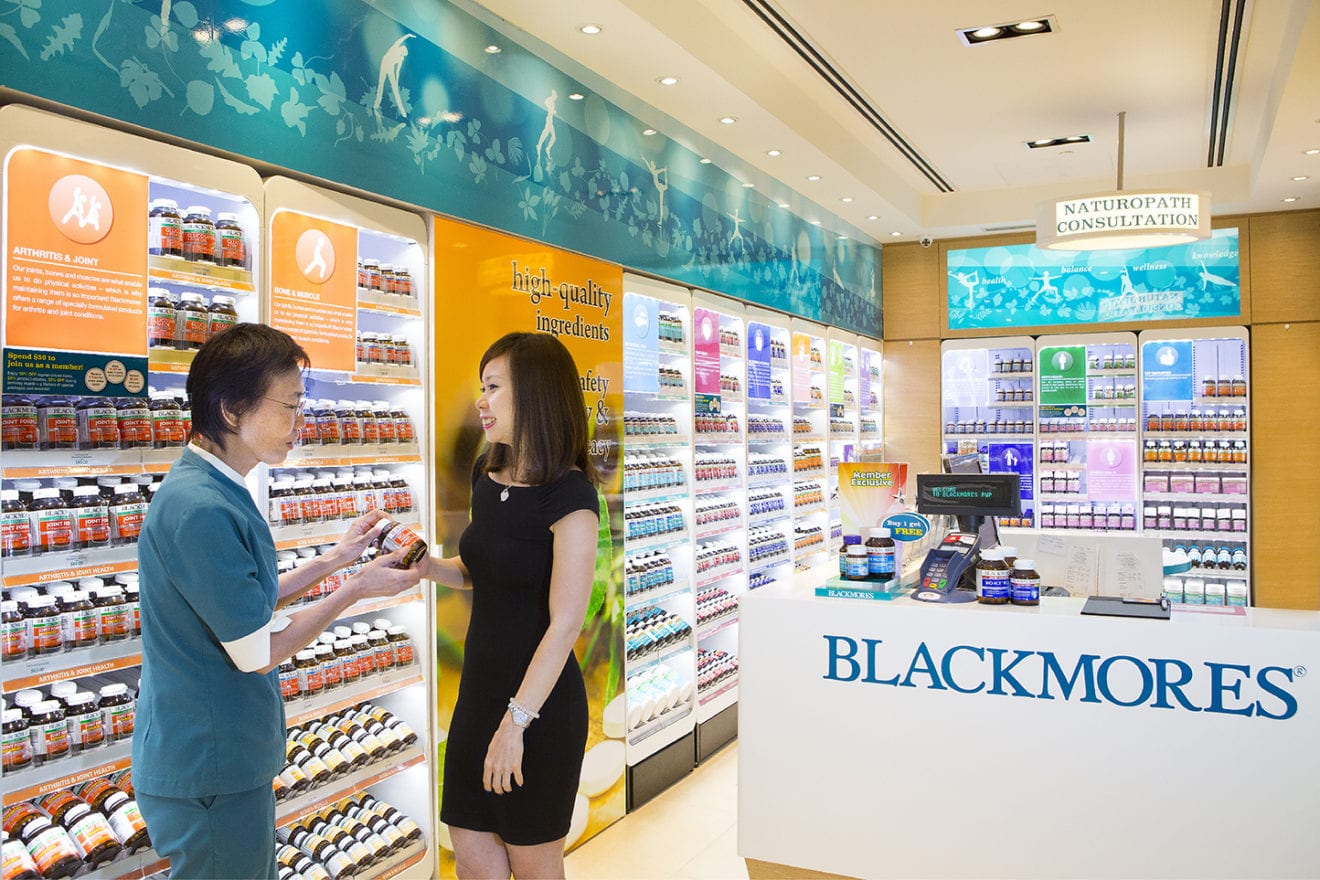
    “We are not going to become retailers, we partner with pharmacy. Around 80 per cent of our products are sold through pharmacy in Australia and they give fantastic advice,” she said.

    “What this allows to do is to bring our products and our therapies much closer to the consumer and enables us to listen to the consumer and better understand their health needs.”

    While Ms Holgate is trying to deepen ties with her local customers, the big issue she has is satisfying voracious Asian consumers.

    In the past six months Blackmores has increased it production capacity by 60 per cent. The company has hired 100 extra people but has now run out of office space.

    In November, which Mr Blackmore believes was “probably a record month”, Blackmores produced 2.7 million bottles of product. It will have capacity to produce 4.2 million bottles a month in April next year.

    “The things that keep me awake at night are: availability of raw materials, availability of raw materials, and availability of raw materials,” Ms Holgate said.

    In some product lines there is a natural brake on boosting production immediately. For example, evening primrose oil, a market dominated by Blackmores, comes from a plant harvested once a year.

    In other cases Blackmores is constrained by its strict quality criteria.

    Ms Holgate is loath to put the brand name at risk by compromising even slightly on quality.

    “I’m sure I could give you a lot more sales, but not at the quality levels we want,” she said.

    Last month Blackmores inked a joint-venture deal with dairy group Bega Cheese to supply infant formula and other nutritional products to Asia, opening a range of new opportunities for both companies.

    Ms Holgate said the company actually uses a dairy rival, New Zealand’s Fonterra, as a case study for an internal quality workshop.

    Fonterra has been embroiled in a number of dairy food scandals including the 2009 melamine crisis in China and the false botulism alert, which prompted a massive product recall, in 2013.

  • Blackmores, Sanger to open stores on JD.com

    Blackmores, Sanger to open stores on JD.com

    JD.com says it has secured partnerships with Australian brands Blackmores, a leading Australian natural health company, and Sanger Australia, the Australian meat sales and marketing business of the Bindaree Beef Group.

    Both brands will open stores on JD.com’s direct sales channel and will use the company’s same-day delivery services. Sanger Australia will also leverage JD.com’s cold chain logistics network to ensure that its meat products are delivered fresh to Chinese customers from Australia.

    The announcements follow the successful launch in late June of a dedicated Australian Mall for authentic imported Australian products on JD.com’s cross-border platform, JD Worldwide. Since its launch, dozens of Australian brands have successfully sold their products to Chinese consumers through Australian Mall. The most popular product categories in the first two months of the program include health  care, baby care products and fresh food.

    “We’re pleased to be working with leading Australian brands to build winning eCommerce strategies for this market and help them take advantage of our large and growing base of upwardly mobile Chinese consumers,” said Carol Fung, VP of JD.comand president of JD.com’s FMCG Business Unit.

    “Blackmores is a long-time partner, and we are very excited to be expanding the range of their outstanding healthcare products available to our rapidly growing user base. With demand for Australian fresh produce growing exponentially, the addition of Sanger Australia’s world-class beef to our platform is an outstanding development for our customers.”

    Blackmores Asia MD Peter Osborne said his company has been working with JD.com since 2013.

    “Our increased engagement is testament to our strong relationship and commitment to growing our China business. Working with JD.com not only ensures we get our products to consumers quickly, but will also enable us to initiate targeted and specialised marketing campaigns leveraging JD’s data analytics capabilities.”