Retail News CRM

Tag: Bossini

  • Bossini reports Bossini $12m interim loss

    Bossini reports Bossini $12m interim loss

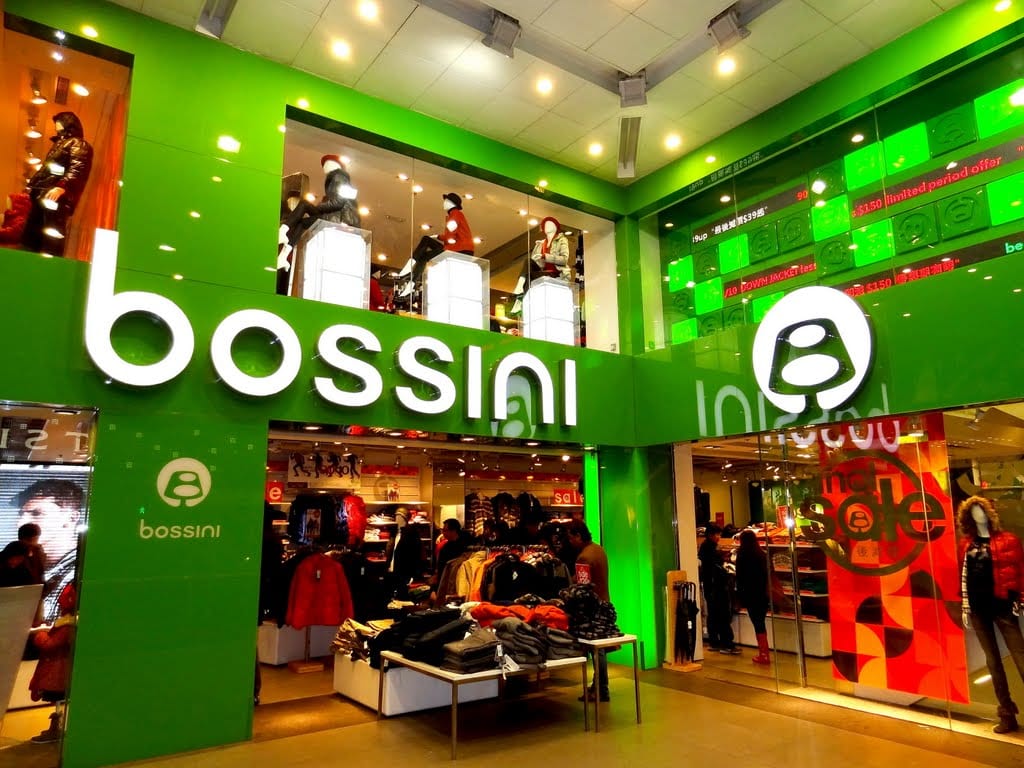
    Apparel brand Bossini International Holdings remains optimistic despite a slip in revenue and profit turning to loss for its six months to the end of December.

    It says growth is projected to continue rising in emerging markets and developing economies, supported by a favourable global financial environment and a concomitant recovery in advanced economies.

    “The regional picture is particularly encouraging as expansion in Mainland China and other parts of Asia remains solid, reflecting the strength of a broad-based upturn that saw global growth reaching its strongest rate since 2011. Mainland China is spearheading this long-overdue regional expansion, its economy having grown following two years of decline.

    “Hong Kong’s apparel retailing industry seems to have bottomed out after shrinking for consecutive years. Nonetheless, various downside risks remain evident, including geopolitical tensions, sudden capital outflows, policy indecisiveness and a sharp adjustment in Mainland China.”

    Bossini’s revenue for the six months fell by 5 per cent to HK$974 million (US$124 million), with gross profit slipping 1 per cent to $512 million.

    The group’s operating loss was $10 million with a -1 per cent operating margin, down from a positive 2 per cent a year earlier. Loss for the period attributable to the owners was $12 million, a switch-around from a $17 million profit 12 months earlier.

    Economic backlash

    Bossini says it weathered economic backlash from the China government’s “one trip per week” policy, more in-depth travel instead of retail shopping, and changes in tourist buying patterns. These factors hit retail sales in Hong Kong and Macau, which accounted for more than half of the group’s consolidated revenue.

    The drop in profit attributable to the owners was mainly because of the decrease in the profit derived from the retail and export franchising business in the Hong Kong and Macau segment. There was a 5 per cent drop in overall revenue and a 2 per cent decline in same-store sales for the period. However, same-store sales rebounded in the second quarter, particularly in China and Taiwan.

    Gross margin improved by two points to 53 per cent.

    Same-store sales in Hong Kong and Macau and Singapore declined by 4 per cent, an improvement over a 6 per cent decline the previous year, and 8 per cent (no change) respectively. Same-store sales in Mainland China and Taiwan grew 9 and 5 per cent (both had 2 per cent declines previously).

    Overall, same-store sales slipped by 2 per cent, an improvement on the previous period’s 6 per cent decline.

    At the end of the six months, the group had a presence in 29 countries and regions with  total 940 stores, the same as at June 30. The number of directly managed stores dropped by two to 282, while the number of franchised stores was 658, up two.

    Hong Kong/Macau remained the group’s core market and major contributor to the total revenue. A new outlet lifted the overall total number of stores to 41 while the export franchising business added five stores to the global network, taking the total to 656 across 25 countries.

    Mainland China had 166 stores (down two) comprising 164 directly managed stores and two franchises. Two non-performing stores in both Taiwan and Singapore were closed, giving both markets 16 outlets.

    During the six months, the group continued to launch its “on-the-go” collection to ride on the athleisure trend.
  • Downhill slide for Bossini International

    Downhill slide for Bossini International

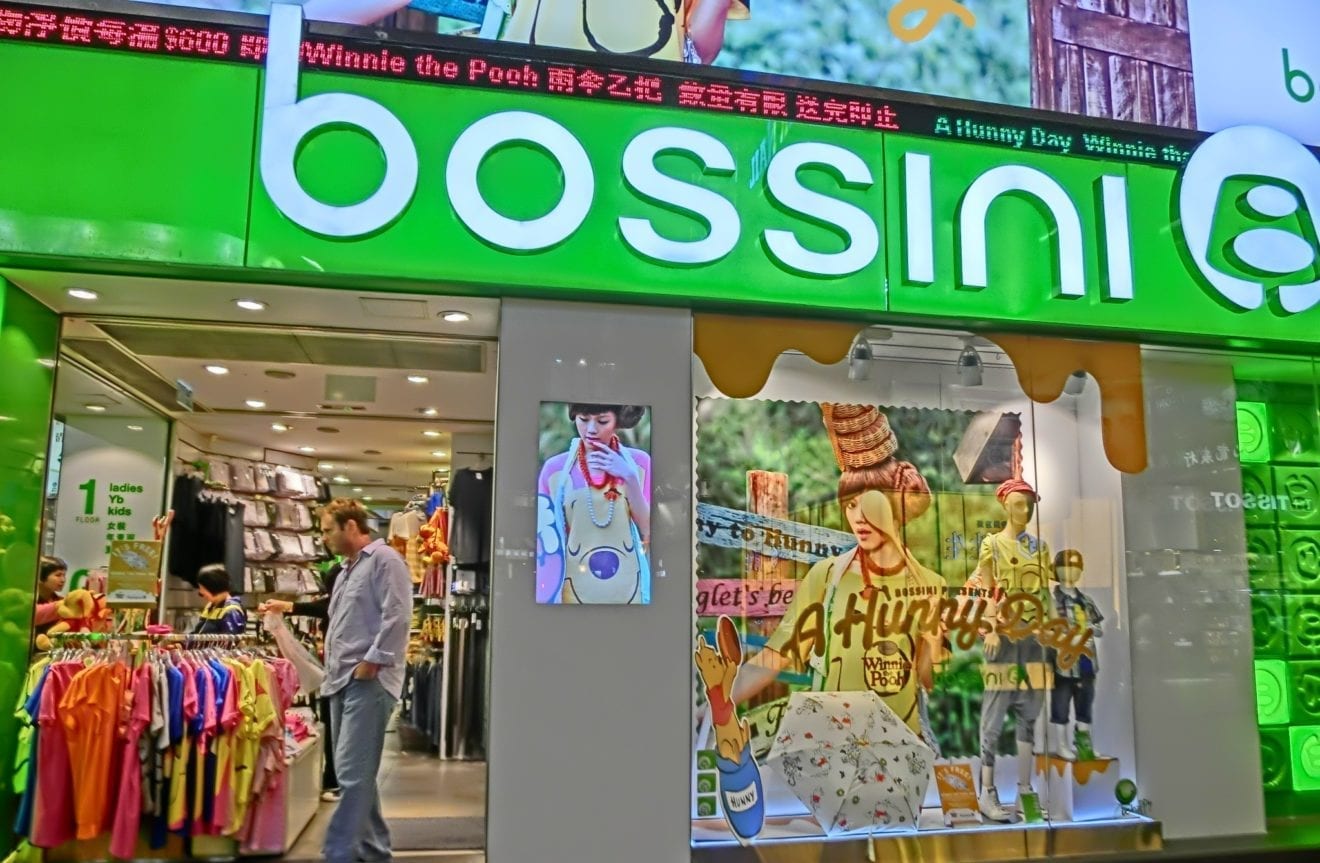
    “Severe” competition in core markets and continuing weak consumer sentiment have shredded profits for apparel company Bossini International Holdings for its fiscal year to the end of June.

    It was hit hardest at home in Hong Kong, where despite more positive business sentiment the its retail business continued to languish.

    Strong growth continued, however, in the wider Asia-Pacific market in the face of widespread concerns about growing protectionism, a rapidly aging society and slow productivity growth, says the company, which saw its overall revenue and gross profit drop 13 and 8 per cent respectively.

    Same-store sales declined 8 per cent for the year while there was a 5 per cent drop in gross profit.

    The group’s revenue for the year was HK$2 billion (US$256 million) compared to $2.3 billion last year. Gross profit dropped to $1 billion from $1.1 billion, with the gross margin rising three points to 51 per cent.

    Operating profit for the year was $10 million, EBITDA was $42 million (down from $356 million) and profit attributable to owners of the company was $5 million, compared to 4292 million the previous year.

    At the end of June, the group had a presence in 30 countries and regions with a total of 940 stores (down from 947) comprising 284 (2016: 280) directly managed stores and 656 (667) franchised stores.

    The Hong Kong and Macau market held its position as the major contributor to group revenue, with 40 stores, two down from the previous year.

    Non-performing stores in Singapore and Taiwan were consolidated, the portfolio reducing to 18 (21 the previous year) and 63 (70) respectively.

    Meanwhile, Bossini is celebrating its 30th anniversary with campaigns and events throughout this year, and launched its On-the-Go collection that targets the expanding market for travel and outdoor apparel.

  • Bossini profit warning issued

    Bossini profit warning issued

    A “significant” drop in Bossini profit attributable to its owners is expected for the year to the end of June.

    Its board says the group expects only a small profit close to breakeven, compared to the profit attributable to the owners of HK$292 million (US$37 million) for the previous year.

    It says reasons for the decrease include a non-recurring gain of about $265 million on the disposal of property in the previous year, and a drop of about 13 per cent in revenue from the $2 billion of the previous year, attributable to continuously weak consumer sentiment and “severe competition” in core markets.

    This information is based on a preliminary assessment only, says Bossini, with its audited annual results to be announced in late September.

  • Retail woes a boost for Hong Kong indie fashion

    Retail woes a boost for Hong Kong indie fashion

    High-end international brands have long held court alongside local Hong Kong indie fashion designers – who are now enjoying greater visibility in the city’s vibrant retail market.

    The city’s deep-rooted love of luxury has seen names like Gucci and Hermes open multiple stores in the city – stores that have co-existed with a stable of local apparel brands, such as Giordano, Baleno, Bossini and Esprit.

    By 2014, consumers’ tastes had diversified and fast-fashion overseas brands began descending on Hong Kong. The arrival of names like Topshop, American Eagle, H&M, Zara and Mango added yet more to the mix in Asia’s favourite shopping destination. Now that shop rents are finally becoming more affordable, independent fashion retailers are increasingly making their presence felt.

    Structural change

    In a report by commercial real estate firm CBRE, Joe Lin, executive director, retail services at CBRE Hong Kong, said that the city is undergoing a period of structural change.

    “Over the previous decade, high-street shop landlords have reaped the benefits of strong demand from luxury retailers and massive rental growth.”

    Lin noted that in the past 12 months, luxury retailers have adjusted their leasing strategies to save costs. “Landlords have become more realistic on rental negotiations, enabling more mid-range brands to tap into prime locations at relatively affordable rental levels.”

    The trend has opened the door for mid-market brands to expand, and for the rise of independent labels.

    “More independent stores are coming back to the market, streets, malls, and even some up-and-coming revitalised buildings in the traditional industrial districts, such as Lai Chi Kok and Kwun Tong,” said Lin. “They modernise the decoration and with the decent F&B outlets that draw good foot-traffic to these areas, independent retailers also benefit from this new trend.”

    Refined taste

    British fashion designer Elizabeth Lau established The Refinery in 2014 after moving to Hong Kong with her husband. Lau said she saw an opportunity to “curate for individuals” in Hong Kong by introducing unique fashion, accessories and lifestyle brands from around the world.

    Her first store, at the creative and design hub PMQ in Central, found a steady following, and in January 2016, The Refinery opened a second retail outlet in Tai Koo.

    Fashion edit

    Partners in fashion Genevieve Chew and Jacqueline Chak, an accountant and architect respectively, launched Edit in Central in 2012 as a concept store stocking emerging brands. They later created their own in-house label, which is described as “one part eclectic femininity and the other relaxed ease.” Their collections are worn by fashion personalities such as Yasmin Sewell, Margaret Zhang and Amanda Strang. The partners have also designed uniforms for Hong Kong’s new boutique Tribute Hotel in Kowloon.

    Fé Valvekens is another career-change entrepreneur who found her fashion foothold in Hong Kong. German-born Valvekens is a qualified engineer who founded fashion label A Day with Fé, blending daywear with yoga wear. Her PMQ store in Central also holds yoga and fashion styling workshops

    Quality indie labels

    Building on her established career in fashion, US expat Jamie Dredge co-founded Polkadot Boutique on Hollywood Road, Central, in 2011. After moving to Hong Kong two years earlier, Dredge spotted a gap between high-end luxury designers and mass-market clothing in Hong Kong.

    Her idea was to offer quality, well-designed womenswear and accessories from indie labels in the US, as well as supporting upcoming local designers.

    “We still have our local-based designers, but are also working with hot new labels out of Los Angeles and New York,” she said. Examples include Yumi Kim and Blank NYC Denim from New York, Veronica M from Los Angeles, and Hong Kong’s What the Frock?!.

    Being an independent retailer in Hong Kong has its challenges, said Dredge. Rents remain high, especially for smaller operators who don’t have the negotiating leverage of a famous brand. The demise of free print lifestyle magazine HK Magazine, which folded last year after 25 years, closed one door for independents to build a profile – and paid advertising is expensive.

    “We now have to work harder on our social media channels – and be more creative in our promotions,” Dredge said.

    On the other hand, word-of-mouth networking is an advantage in a city as close knit as Hong Kong.

    Pop-ups and collaborations

    One of Polkadot’s strategies is to host events where customers can meet the designers for a social night out, which might involve hair and makeup as well as fashion. One of the “biggest perks of Hong Kong” is the willingness of businesses to collaborate with each other, Dredge said.

    “Hong Kong is great for doing pop-up events and collaborations, which get the customers involved,” she said.

    It also illustrates how a physical boutique can still be successful, despite the challenges of online shopping.

    “People still like to feel the clothes, to try them on, to talk to the designer,” she said.

    “A lot of our garments are unique, and many of them exclusive. Our customers aren’t walking around seeing other people dressed the same, and that’s why they come to us.”

    -HKTDC

  • Some bright future for Bossini International

    Some bright future for Bossini International

    Overall revenue fell 11 per cent for apparel retailer Bossini International during the first half of its financial year.

    However, its interim results to December 31, showed an improvement in gross margin – by four points to 51 per cent, attributed to more effective sales and marketing strategies. Profit for the period attributable to the owners increased by 20 per cent.

    The Hong Kong and Macau market, the Mainland China market and the Taiwan market showed signs of having bottomed out, says the company, with same-store gross profit level after a period of negative growth for more than a year.

    With a footprint across 28 countries, the group says it is still optimistic in the long run, adding 16 shops during the half-year.

    Its revenue for the six months was HK$1.022 billion (US$131.6 million), down 11 per cent from HK$1.146 billion in the same period a year earlier. Gross profit slipped 4 per cent to HK$519
    million.

    For directly managed stores, same-store sales in Hong Kong and Macau fell 6 per cent, a slight improvement, and Mainland China and Taiwan stores performed similarly, declining by 2 per cent. Same-store sales in Singapore dropped by 8 per cent compared to per cent in the previous first half. The group’s overall same-store sales slipped 6 per cent.

    At December 31, the Group had 952 stores, up five from six months earlier. Directly managed stores grew to 287 from 280, while franchised stores dropped by two to 665.

    The group continued its strategy of working with licensing partners to strengthen brand recognition and boost sales. Three licensing programs were launched in the first half of the financial year, working with Disney and Universal Studios.

  • Property sale boosts Bossini International profit

    Property sale boosts Bossini International profit

    While expecting a leap in profit because of a special circumstance, clothing retailer Bossini International Holdings had a “significant” decrease in revenue for its latest year of trading.

    The group reports an expected jump in profit ranging from 147 to 157 per cent for the year ended June 30, mainly because of a gain of about HK$267 million (US$34.4 million) on the disposal of a macau property and a leaseback arrangement.

    Excluding that gain, the group predicts a drop in profit of between 75 and 85 per cent compared with the previous year, attributed mainly to a drop in revenue resulting from fewer tourists in Hong Kong and Macau, and a strong Hong Kong dollar.

    Other factors were weak local consumer sentiment, an unseasonably warm winter and intensified competition in several core markets.

    Bossini’s audited annual results are expected to be announced late next month.

  • Bossini profit decimated

    Bossini profit decimated

    Fast fashion retailer Bossini has warned shareholders its profit for the six months to December 31 will be down by between 80 and 90 per cent.

    Based on the comparable trading period to December 31, 2014, when Bossini reported a profit  of HK$665 million, that suggests a profit in the range of $66.5 million to $133 million.

    In a profit warning issued to the Hong Kong stock exchange, the company says the profit plunge “was mainly caused by the significant decrease in revenue and gross profit attributable to (i) less visitors and strong Hong Kong dollar which led to less consumption from them in Hong Kong and Macau, and (ii) weak local consumer sentiment, unseasonal warm winter weather and intensified competition in several core markets where the group operates”.

    “As the company is still in the course of preparing and finalising its interim results for the six months… the information… is only based on a preliminary assessment on the information currently available.”

    The full financial details, including the final Bossini profit, will be revealed in late February.

    While Bossini is not the first Hong Kong based retailer to warn of or report profit declines, most of the others are operating in the luxury end of the market, where sales of watches, jewellery and luxury fashion goods and apparel are down by up to 20 per cent year on year.

    But Bossini has no exposure to that market – its business is based on selling t-shirts and casual clothing at low price points.

    Data from GfK shows the number of Mainland Chinese visitors to Hong Kong in 2015 – up until November, at least – rose by 37 per cent. As previosuly reported by Inside Retail Asia, the issue for Hong Kong retailers is not that there are fewer tourists visiting the city – but there are fewer wealthy tourists visiting the city. So Bossini, and other retailers targeting the lower end of the market, are not managing to capture the imagination of the more profilgate shoppers now coming to the territory.

    Even more puzzling is that Bossini has been one of the few retail brands to stand out over the last 12 to 18 months as bucking the broader retail trend.

    In September, the company revealed its results for the year to June 30, reporting a mere one per cent decline in sales to HK$2.523 billion, and a three per cent decline in gross profit to HK$1.264 billion with gross margin down one per cent to 50 per cent. Profit attributable to shareholders fell nine per cent.

    “During the fiscal year 2014/15, despite facing challenging retail conditions in Hong Kong and Macau, its segmental business, which includes the export franchising operations, registered record-high sales with flat same-store sales growth for the directly managed stores,” the company said at the time.

    “The operations in mainland China, Taiwan and Singapore all experienced improvements in segment results, resulting from the continuously improving shop productivity and stringent cost control measures. Mainland China segment achieved six per cent same-store sales growth and also recorded nine consecutive quarters of positive same-store gross profit growth. Taiwan segment saw a same-store sales growth of seven per cent, representing seven consecutive quarters of positive same-store sales growth.”

    In the half year to December 31, 2014, Bossini reported a revenue increase of four per cent year-on-year to HK$1,319 million (then US$170,056,190) and gross profit for the period under review was HK$665 million (then US$85,737,200).

  • Bossini strong in retail storm

    Bossini strong in retail storm

    Apparel retailer Bossini has weathered Hong Kong’s retail downturn by achieving strong growth offshore.

    The Hong Kong based company has revealed its annual results in the year to June 30, reporting a mere one per cent decline in sales to HK$2.523 billion, and a three per cent decline in gross profit to HK$1.264 billion with gross margin down one per cent to 50 per cent. profit attributable to shareholders fell nine per cent.

    “During the fiscal year 2014/15, despite facing challenging retail conditions in Hong Kong and Macau, its segmental business, which includes the export franchising operations, registered record-high sales with flat same-store sales growth for the directly managed stores,” the company said.

    “The operations in mainland China, Taiwan and Singapore all experienced improvements in segment results, resulting from the continuously improving shop productivity and stringent cost control measures. Mainland China segment achieved six per cent same-store sales growth and also recorded nine consecutive quarters of positive same-store gross profit growth. Taiwan segment saw a same-store sales growth of seven per cent, representing seven consecutive quarters of positive same-store sales growth.”

    Bossini ended the year with a presence in 35 countries and regions and a store count of 938 (down 24). Of those, 257 were directly managed stores and 681 were franchised.

    One factor in the group’s improved operational efficiency was a small reduction in inventory turnover timetable from 84 days to 83.

    Looking forward, CEO Edmund Mak said the group will benefit from lower production cost if US dollar remains strong versus Renminbi.

    “Besides, it is estimated that rents will fall in certain areas in Hong Kong as retailers are generally suffering from sales downturn, which could help partially offset the group’s ongoing difficulties. The group will be proactive in taking stringent measures to control costs, including rental costs, and continue to improve shop productivity. The group aims to remain flexible and responsive to changing market conditions.”

    Mak said Bossini sees grounds for “considerable optimism” in its overseas operations.

    “Therefore, we will focus more on expanding operations outside Hong Kong and Macau, in order to achieve a more balanced portfolio. Furthermore, we will continue to expand kids’ line, particularly in Mainland China, while launch co-branded and licensing programmes of clothing and accessories via partnerships that reinforce the core brand value ‘be happy’, striving to build “bossini”’s reputation as a vibrant, valued and competitive go-to brand.”

  • Bossini bucks the blues

    Bossini bucks the blues

    Hong Kong fast fashion chain Bossini has reported a modest boost in sales in the half year to December.

    Group revenue increased by four per cent year-on-year to HK$1,319 million (US$170,056,190) and gross profit for the period under review was HK$665 million (US$85,737,200)

    Gross margin was slightly improved, up by one percentage point to 50 per cent. And the group reduced its inventory turnover by a full week – from 99 days to 92 days.

    In its earnings statement, the company said the result was achieved “despite challenging economic and political factors”.

    “Record-high sales were registered in the Hong Kong and Macau retail operation, an achievement with 22 consecutive quarters of positive same-store sales growth. A milestone was achieved for mainland China operations as our efforts to increase shop productivity and adopt stringent cost control measures in the preceding financial year helped us to achieve a turnaround in operating profit and achieve seven consecutive quarters of positive same-store gross profit growth.”

    Bossini said Taiwan also recorded an improved performance, helped by ongoing efforts to enhance shop productivity and implement cost-control measures, which led to the fifth consecutive quarter of positive same-store sales growth.

    “During the six months under review, the group maintained a cautious approach to expansion in the face of ongoing global uncertainty. The group had presence in 35 countries and regions worldwide as of December 31. The overall store count decreased by 13 against the previous year to 949, of which 268 were directly managed and 681 were franchised.

    CEO Edmund Mak said that although the US economy is expected to follow a stable growth trajectory in the year ahead, growth in mainland China is expected to slow further.

    “The apparel retailing sector remains highly competitive throughout the region. Nevertheless, the group is confident in pursuing the appropriate strategies to mitigate external risks.

    “We will focus on continuing to streamline productivity in our existing stores, enhancing both efficiency and our overall services in order to provide memorable and vital shopping experiences which reinforce our dynamic and energetic brand image.

    “In mainland China, Taiwan and Singapore, meanwhile, we will continue to implement best practice solutions which have proven successful in our Hong Kong operation. We will also continue to expand our footprint in export markets which show good potential for growth and to partner with well-known brands to launch co-branded and licensed clothing and merchandise that extends and enhances our brand visibility and stature.”

    Mak concluded: “Going forward, the group will continue to create appealing, competitive and quality everyday wear that drives sustainable growth, profitability and customer satisfaction. With a firm focus on our “be happy” core brand value, we will continue to strengthen our competitive edge and endeavour to enhance the value we offer to our shareholders.”