Retail News CRM

Tag: broadband

  • New Zealand’s Woosh Wireless enters administration

    New Zealand’s Woosh Wireless enters administration

    New Zealand wireless broadband provider Woosh Wireless has entered voluntary administration after burning through more than NZ$100 million ($67.7 million) in cash since it was founded.

    The operator has appointed local advisory and investment firm KordaMentha as administrators for the proceedings. The first meeting of creditors will be held early next month.

    Woosh was founded in 1999 and bought out by California-based Craig Wireless for $5 million in 2011.

    The company sold its fixed line network to rival Slingshot last year, and sold one of its three spectrum blocks – a 70 MHz lot of 2300-MHz spectrum – to Spark New Zealand for NZ$9 million in April.

    A KordaMentha partner said the company will be mindful of customers who rely on Woosh Wireless for their broadband services, particularly in remote areas in rural parts of Southland, where there is a strong concentration of subscribers.

  • Thailand’s AIS launches prepaid broadband

    Thailand’s AIS launches prepaid broadband

    Thailand’s AIS has launched the nation’s first prepaid fixed broadband service, introducing a 15Mbps speed plan for a 500 baht ($14) monthly top-up fee.

    AIS has set a target of becoming Thailand’s second largest broadband player by 2019, citing comments from a senior executive at the company.

    The operator launched commercial fixed broadband services in April last year and had 450,000 subscribers as of December. AIS plans to increase this to 1 million by 2018 and 2 million by 2019.

    In order to achieve its growth ambitions AIS has allocated 7 billion baht to extend its fiber network to cover 24 provinces this year, and a further 10 billion baht to expand this to 40 provinces in 2017.

    Meanwhile rival Jasmine International, whose subsidiary Triple T Broadband operates landline broadband services under the 3BB brand – has retaliated by slashing the price of its 50Mbps plans to 700 baht per month, from 2,500 baht.

  • Demand for inflight broadband in APAC hits new heights

    Demand for inflight broadband in APAC hits new heights

    Airlines in Asia-Pacific are seeing soaring demand for inflight broadband service, with a majority of passengers in the region expecting to have such services onboard, a new survey said.

    The survey, conducted between August 2015 and March 2016, garnered respondents from more than 9,000 passengers in Asia, Australasia, Europe, and Central and South America who had taken a short, medium or long haul flight in the past year and carried at least one personal device onboard the aircraft.

    According to the survey, conducted by Inmarsat and market research firm GfK, nine out of ten respondents from the region say the availability of onboard connectivity would influence their choice of airline, while over two thirds are willing to pay for the service.

    Meanwhile, 54% and 57% of Asia Pacific passengers would choose inflight broadband as a preferred service in short-haul and long-haul flights, compared to only 16% and 18% choosing traditional in-flight entertainment (IFE) as their preferred onboard service.

    Business flyers are even more likely to recognize the value of paying for high-speed onboard connectivity than vacationers, with 74% of business travelers surveyed indicating they are willing to pay more for faster inflight broadband compared to 62% of leisure travelers.

    The survey revealed that 64% of passengers felt that in-flight broadband can deliver all of their onboard entertainment needs. This highlights an opportunity for airlines to use in-flight broadband to increase ancillary revenues, as the majority of passengers are willing to pay for the service, with 68% of passengers under 34 years old and 55% of passengers over 45 years old willing to pay for unlimited internet usage during a flight.

    When it comes to the quality of the inflight broadband service, passengers are most concerned about reliability (that a connection does not drop out or cut off), availability (that the connection is available throughout the flight), and speed of the connection.
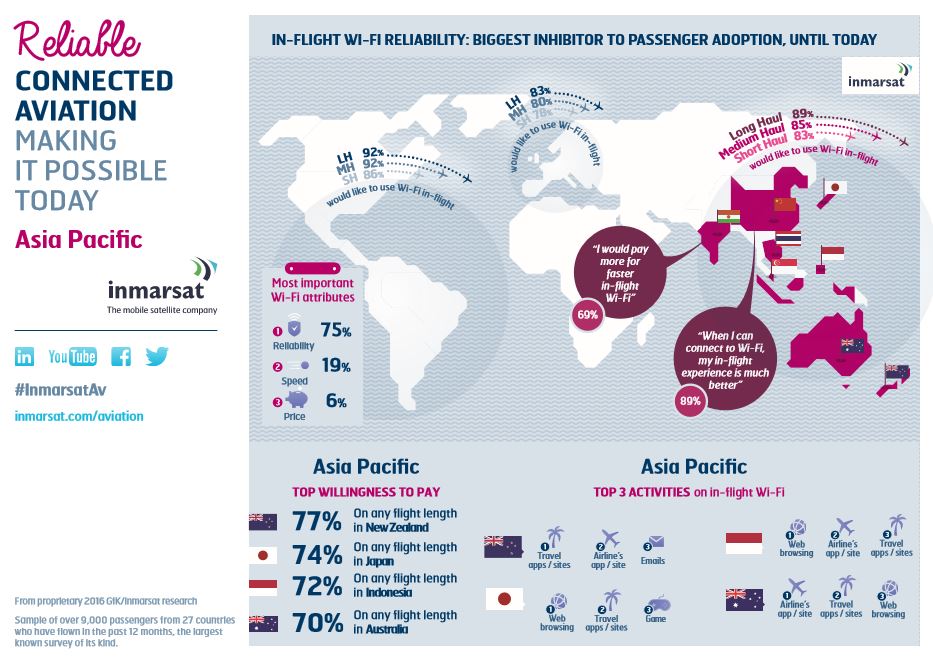
    Inflight WiFI reliabilityThe survey showed that quality is even more important than price in Asia Pacific, as passengers are prepared to pay more for a quality service. Some 72% of flyers in Asia Pacific would prefer not to use broadband that is of poor quality with 62% stating they would pay more for faster in-flight broadband

    “Our survey has highlighted a growing appetite for fast, reliable and consistent broadband in the air, with more than half of Asia-Pacific passengers preferring in-flight connectivity over a meal or traditional IFE,” said Bill Peltola, Asia Pacific regional director at Inmarsat Aviation.

    “Although three-quarters of Asia Pacific flyers would like to try onboard broadband in the future, only 3% of aircraft operating in Asia Pacific today offer the service, highlighting the potential for airlines to use it as a differentiation point to attract more customers.
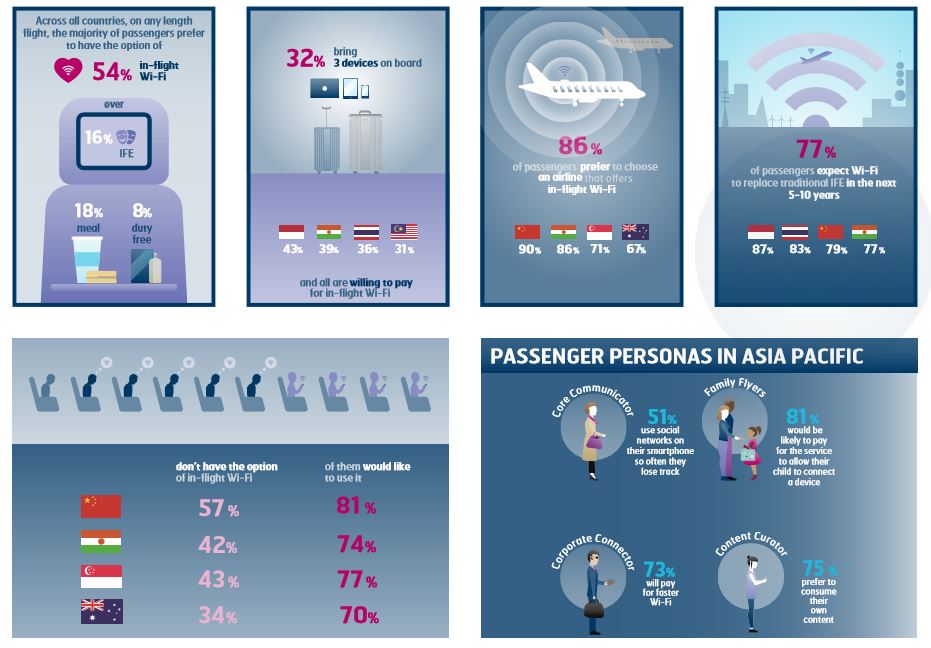

    The inflight broadband connectivity survey

  • TOT to take charge of Thai rural broadband project

    TOT to take charge of Thai rural broadband project

    Thai state-owned operator TOT has been instructed to go it alone in a project to build a national broadband network connecting 30,000 villages across the nation.

    TOT will take sole responsibility the project to bring broadband to the majority of Thailand’s villages that currently lack broadband connectivity.

    Initially the government had planned to have TOT and CAT Telecom jointly oversee the 15 billion baht ($427.5 million) project, but the ICT ministry decided that given TOT should take control of the project due to its existing extensive infrastructure.

    CAT has been told to focus on further investment in international internet gateway infrastructure to support the government’s policy of promoting Thailand as a digital hub for the Asean region.

    Construction of the network is expected to be complete by May 2017. The state will use the network to provide free broadband connectivity in public places in all villages, while TOT plans to offer at least 20Mbps plans with affordable tariffs.

    The national broadband project is expected to be partly funded from private sector investments. It forms part of the government’s five year master plan that aims to improve Thailand’s telecom infrastructure to lift the minimum standard for broadband speed across the nation.

  • M1 rolls out machine-to-machine platform for corporate customers

    M1 rolls out machine-to-machine platform for corporate customers

    Users can manage connected devices from their phones. The member of Singapore’s telco triumvirate boosted convenience and ease of access for its corporate customer-base as it launches its advanced M2M platform, M1 Connect.

    According to a statement by M1, the platform will enable customers to access, track, and manage all their connected devices from any authorised computer or mobile phone.

    Through the platform, M1 also says the users will be able to set and change business rules, perform device troubleshooting and obtain detailed reporting of all M2M activities.

    M1 said they have also partnered with technology providers for this project.

    “M1 has partnered multiple technology providers, including Aerolion Technologies, Napier Healthcare Solutions, Quantum Inventions, and Parametric Technology to introduce customised solutions to meet the needs of Singapore’s transport, retail, healthcare, and security industries,” the statement said.