Tag: C-Lab

  • Korean start-ups also shine at CES in Las Vegas

    Korean start-ups also shine at CES in Las Vegas

    Industry big boys aren’t the only companies exhibiting at this year’s Consumer Electronics Show (CES). Over 1,200 start-ups have set up at the event’s Eureka Park, reserved for smaller companies, to capture the attention of consumers and possibly become the next unicorn (a start-up valued at over $1 billion).

    Of the start-up companies from Korea, those that developed through the “Israeli start-up” model have grabbed the most attention from the media. The model refers to companies with a weak capital base that grows with investment from other IT companies or venture capital firms. Many Korean start-ups that took part in CES this year got investments from IT giants such as Naver or Kakao.

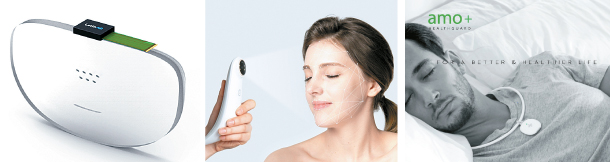
    Augmented reality (AR) and virtual reality (VR) company LetinAR is one of the hottest start-ups. LetinAR produces smart glass lenses that makes use of “Pin Mirror” technology. The company incorporates the pinhole effect, which makes vision clearer by looking through a small hole, and applies it for use in VR and AR.
    LetinAR also created a lens that provides vision of up to 80 degrees. While humans can see up to 150 degrees, existing products are typically limited to 50 degrees.

    “The 80-degree vision is like looking at a 120-inch TV from a meter away [3.28 feet],” said Choi Kyung-on, a director at the company. “If our product becomes commercialized … we will be able to release smart glasses the size of large conventional glasses within three years.”

    While smart glasses got a lot of headline in 2013 with the introduction of Google Glass, the product failed due to the difficulty of developing a lens with a wide-viewing angle.

    Meanwhile, beauty artificial intelligence (AI) start-up lululab won the CES Innovation Award in the biotech sector for its AI skin care assistant Lumini.

    The device analyzes skin conditions such as its wrinkles and pores and provides product information and recommendations personalized for a user.

    “[Users] can use personalized AI skin analysis service without the help of a store employee,” explained Choe Yong-joon, CEO of lululab.

    The company was born in Samsung Electronics’ start-up incubator, C-Lab.

    AMO Lab is another promising start-up from Korea. The company, which got investment from Naver last September, specializes in products that improve users’ quality of sleep.

    The company recently developed AMO+, a device worn like a necklace, which sends out minute electrical signals to the body to improve sleep.

    According to recent test results, users’ parasympathetic nervous systems became active when wearing the device.

    “We are currently discussing collaboration with U.S. and European companies after prototype development,” said Kim Min-kyu, CEO of AMO Lab.

    WELT, another alumnus of Samsung’s C-Lab, gained attention for releasing a smart belt in collaboration with French luxury brand S.T. Dupont. WELT’s smart belt can be used for two months with a single charge and provides basic health information.
  • Samsung to take eight C-Lab start-ups to CES

    Samsung to take eight C-Lab start-ups to CES

    Samsung Electronics will introduce eight in-house artificial intelligence (AI) start-ups at the Consumer Electronics Show (CES) 2019 to take place next month in Los Angeles, the company said Wednesday. All eight start-ups are under Samsung’s C-Lab, an in-house incubating program that allows employees to embark on a one-year project to realize a business idea. Samsung will organize an independent booth to present their products and services at the four-day exhibition scheduled to take off on Jan. 9.

    All eight of the projects use AI as a core part of their business.

    For example, the mobile app SnailSound uses AI technology to remove background noise and provide clear human voices in a tailored way based on the app’s test results of the user’s hearing abilities.

    Another app called Medeo uses AI to select the best shots in a video while it is being shot.

    Prismit is an AI-based news app that shows news articles of the same topic automatically aligned in the form of a timeline.

    The list also includes Girin Monitor Stand, which helps to correct posture while sitting in front of computer screens, and the Alight desk light, which adjusts light in the best way to enhance one’s concentration.

    The Perfume Blender suggests the best perfume recipe based on a user’s preferences and also comes with a device to make the personalized perfume.

    As well as the eight in-house start-ups that are currently working under Samsung’s C-Lab, eight groups that have already graduated from the scheme will take part in CES 2019 to set up booths of their own.

    Among them, three have earned awards from this year’s CES. Since the program’s launch in 2012, C-Lab has produced 36 spin-offs that now conduct business as start-ups outside of Samsung.

  • Samsung opens its incubation

    Samsung opens its incubation

    Samsung Electronics is opening up its internal incubating program, C-Lab, to young entrepreneurs from outside the company, and it plans to help 300 of them over the next five years. It will incubate 200 internal start-up projects during the same period, bringing the total to 500 by 2023. Expanding support to start-ups is part of Samsung’s massive 180-trillion-won ($158-billion) investment plan announced in August.

    “There were lessons learnt during our last six years running C-Lab inside the company, so we suggested sharing our experience and know-how externally as a way to contribute to solving the problem of youth unemployment,” said Lee Jai-il, vice president of the company’s Creativity & Innovation Center, at a press event held Thursday at Samsung’s R&D center inside Seoul National University.

    Started as an internal program to encourage young staff to freely suggest new ideas, C-Lab has produced substantial results.

    Of a total 230 ideas suggested to C-Lab, 78 eventually became a Samsung product or service while 36 people who had those ideas quit their jobs to establish start-ups of their own.

    Some went as far as to set up offices in Silicon Valley or show their products at the Consumer Electronics Show.

    “Another thing I noticed working with 200 C-Lab teams is that there is a type of person more suited than others to do innovative work,” said Lee. “When it comes to realizing their own idea, these people have a tendency to completely immerse themselves in that task and I believe these are the type of people that will lead this country’s future.”

    Opening the one-year program up to outsiders, Samsung will select 20 external teams every year, mainly in their early stages.

    It already has chosen 15 teams this year and they are working inside the R&D center, which the company built in partnership with Seoul National University last November.

    The center looks more a co-working space, not the typical feel for an office at Samsung, which has a reputation for a hierarchical and inflexible corporate culture.

    Several groups were having discussions inside meeting rooms while smaller groups of three to four worked on laptops on random tables in open spaces.

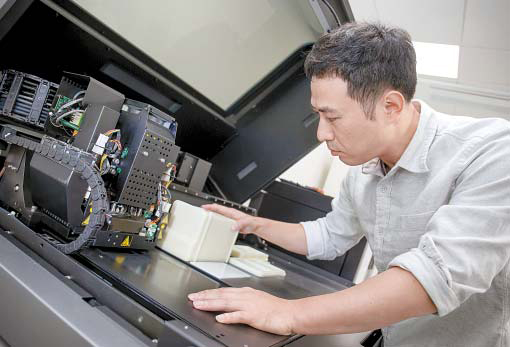
    The building also has a space equipped with 3-D printers and laser cutters to create prototypes.

    There’s a cafeteria that serves three meals a day on the fourth floor, and across from that is a meeting space that offers a wide view of trees in the campus.

    A Samsung staffer said they tried to create “a soft and cozy space fit for young start-ups.”

    All the facilities in the building are offered for free for a year to C-Lab teams. Other advantages include financial support of up to 100 million won and mentoring from various experts from Samsung.

    “What I’m looking forward to, even more than the infrastructure and financial support, is the possibility to find collaboration points with existing Samsung services or businesses and possibly find new service ideas we couldn’t think of before,” said Jinu Kim, CEO of the mobile app Liner, which is one of the 15 external C-Lab teams.