Retail News CRM

Tag: corruption

  • Gojek Co-founder And Ex-education Minister, Nadiem Makarim, Detained In $121 Million Corruption Probe

    Gojek Co-founder And Ex-education Minister, Nadiem Makarim, Detained In $121 Million Corruption Probe

    Former Indonesian Education Minister and co-founder of the ride-hailing company Gojek, Nadiem Makarim, has been detained and named a suspect in a corruption case. The case involves allegations of malfeasance concerning laptop procurement. Makarim will be held for 20 days while the investigation progresses.

    Makarim’s Role in the Alleged Corruption

    Makarim served as the Education Minister from 2019 to 2024 and is accused of misconduct in the procurement of Google’s Chromebook laptops for his ministry and students. According to Nurcahyo Jungkung Madyo, the lead investigator, Makarim is believed to have misused his ministerial authority for personal enrichment or the benefit of a company, in violation of Indonesia’s anti-corruption laws. The damages from this case are estimated to have cost the state around 1.98 trillion rupiah (US$121.85 million).

    Before his detention, local media reported that Makarim stated, “I did not do anything. God will protect me, the truth will come out,” as he was leaving the prosecutor’s office for the detention house. No comment has been received from his legal representative.

    Procurement Specifications and Meetings with Google

    Prosecutors claim that Makarim had issued a directive in 2021, specifying procurement conditions that only the Chromebook laptop could meet. Furthermore, it is alleged that Makarim had six meetings with representatives from Google Indonesia prior to the selection of the Chromebook. Google Indonesia, however, declined to comment on the case involving Makarim, emphasizing that it operates with resellers and partners to provide its technology, and government agencies transact with them, not directly with Google.

    Gojek and the Investigation

    In July, the attorney general’s office conducted a search at the offices of Indonesian tech firm GoTo Gojek Tokopedia as part of the investigation. GoTo’s director of public affairs and communications, Ade Mulya, clarified that Makarim’s duties as education minister, including the procurement of Chromebooks for the ministry, were never related to GoTo’s operations. Makarim had withdrawn from Gojek in 2019 when he was appointed minister. In 2021, Gojek merged with the e-commerce startup Tokopedia to form GoTo Gojek Tokopedia, becoming Indonesia’s largest tech company.

    Questions & Answers

    Who is Nadiem Makarim?
    Nadiem Makarim is the co-founder of ride-hailing company Gojek and former Indonesian Education Minister.

    What are the allegations against Makarim?
    Makarim is accused of corrupt practices in the procurement of Google’s Chromebook laptops for his ministry and students. He is alleged to have misused his ministerial authority for personal or company enrichment.

    What is the potential cost of the alleged corruption?
    The estimated damages from the case are around 1.98 trillion rupiah (US$121.85 million).

  • Vietnam’s corruption-prone public sector to receive 7 pct pay rise next year

    Vietnam’s corruption-prone public sector to receive 7 pct pay rise next year

    Vietnamese lawmakers have approved a 7 percent pay rise for workers in the public sector, an area critics say is prone to corruption due to low official salaries.

    The basic wage in the sector will be raised to VND1.39 million ($61.20) a month from July next year from the current VND1.3 million.

    In Vietnam, the minimum monthly pay for civil servants and public employees is calculated by multiplying the basic wage with a coefficient determined by qualifications and experience. The coefficient for a new subdistrict-level civil servant with a bachelor’s degree, for example, is 2.34.

    Vietnam’s government has 2.8 million people on its payroll, according to local media.

    Many in the public sector have been complaining for years that their earnings are too low. In May last year, Vietnam raised the minimum wage in the sector by 5 percent, the first hike in three years. It received another 7.4 percent bump last July.

    Economists have blamed low wages in the sector for increasing levels of corruption.

    At a conference last year, experts also said the current wages for many officials only cover 60 percent of basic living costs at best, but most still manage to afford nice houses and cars.

  • South Korea prosecutors to indict Lotte chairman, father and brother in corruption probe

    South Korea prosecutors to indict Lotte chairman, father and brother in corruption probe

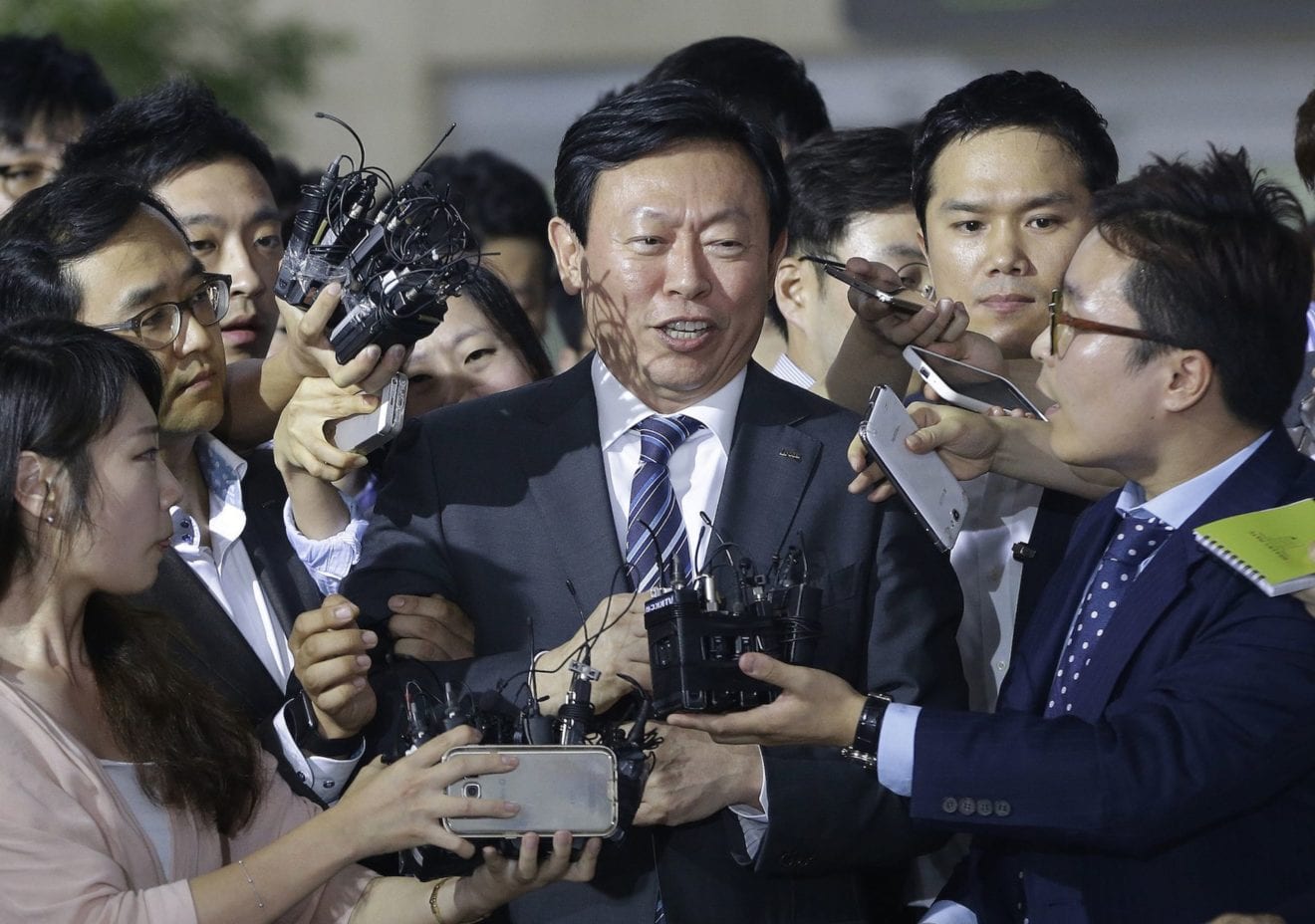
    South Korean prosecutors will file charges on Wednesday against Lotte Group’s chairman, Shin Dong-bin, father and brother alleging they committed offences such as embezzlement and breach of trust worth hundreds of millions of dollars at the family-owned conglomerate, as reported on Tuesday.

    Closing a wide-ranging probe into corruption that has convulsed Korea’s fifth-largest conglomerate, prosecutors will announce the results of their investigation into the retail-to-chemicals group on Oct. 19, a prosecution source with direct knowledge of the matter told Reuters.

    The person, who requested anonymity as he was not authorized to speak to the media, declined to comment on whether Shin, 61, will be indicted.

    Shin’s father, the 93-year-old Lotte Group founder Shin Kyuk-ho, and his brother Shin Dong-joo, will also be charged with offences such as tax evasion and breach of trust.

    A Lotte Group spokeswoman declined to comment.

    The probe has constricted management at Lotte, a household name in Korea, since it flared into public in June, derailing plans for billion-dollar deals and freezing expansion of a group with assets worth 103 trillion won (US$92 billion). It also served as the backdrop to the apparent suicide of a leading executive at the group.

    While Shin would be charged with embezzlement of about 50 billion won and breach of trust involving about 175 billion won, he would not be arrested.

    Last month the Seoul Central District Court turned down prosecutors’ request for an arrest warrant for Shin after he appeared at a court hearing, saying it didn’t view detaining the executive as necessary.

    Once indicted, appeals processes could mean Shin potentially faces trial in court for many months.

    A spokesman for the Seoul Central District Prosecutors’ Office could not be immediately reached for comment.


  • A bonfire of the Swiss watches

    A bonfire of the Swiss watches

    Ever since the Chinese government cracked down on “gift giving” as part of its anti-corruption campaign, Swiss watch exports have taking a beating.

    Here’s the trend, courtesy of a UBS European luxury note out Wednesday:

    As the analysts note, that slump follows a more than 100 per cent rise in the value of Swiss watch exports over 2010 and 2011.

    Ground zero for the demand destruction, meanwhile, is Hong Kong. And it’s there that UBS got some insight on the scale of the downturn from three major retailers:

    We recently met three Hong Kong/ China watch retailers: Hengdeli, Oriental and Emperor Watch & Jewellery. All three companies commented that current trading remains tough, and there is not expected to be any significant recovery this year. Destocking continues as retailers reduce replenishment rates on weaker brands and adjust inventory price mix. More store closures are also ahead with the only silver lining that there appears to be a little more room for rent reductions in Hong Kong of ~10%-40%.

    Recent company commentary has continued to be weak: Swatch reported H1 results on 21st July. Organic sales declined -12.5%, with multi-brand retailers cautious to re-order or cancelling orders. CEO Hayek commented that own retail was better than wholesale and retail in Hong Kong has potentially bottomed out with sales between +10% and -10% depending on the stores. Local Hong Kong retailers, however, do not see the same trends. These results again confirm the difficult market conditions, and follow Richemont reporting April sales -15%.

    Unsurprisingly, for a market where the perception of scarcity underpins all value, the likes of Richemont have even taken to buying back inventory. According to UBS, the new Cartier CEO has specifically looked to clean out high end inventory from the Hong Kong market. This, we’d argue, is quite something. (Or at the very least a new asset purchase idea for QE?) From UBS:

    We estimate that Cartier watches declined -25% in H2 to March 2016 (~€240m) decelerating from closer to a -10% decline in H1. How much of this was “negative sales” due to the buy in is unclear. A rebasing of stock levels in the channel remains key for a medium term reacceleration. Stock levels have been high in the channel in the industry notably in Greater China.

    Hong Kong retail sales figures for watches, jewellery and clocks, meanwhile, registered a 26 per cent year-on-year decline in July following a 20 per cent decline in June:

    A comparable trend can also be seen in the diminishing number of visitor arrivals to Hong Kong from the Chinese mainland:

    The situation seems to be desperate enough for some Chinese luxury retailers to be breaking lease agreements and closing up shops, says UBS. On the up side, however, mainland sales seem more robust of late than Hong Kong, with Cartier watches seeing growth in the last quarter. Nevertheless, since luxury spending in mainland China is a small portion of the total of Chinese sales (about 25-30 per cent), the improved sales picture there is not necessarily offsetting the slowdown in other areas.

  • Indonesia makes strides in fight against corruption

    Indonesia makes strides in fight against corruption

    A researcher for Transparency International Indonesia (TII) elaborates on findings in the Corruption Perception Index 2015 on Monday. Indonesia ranked 88th out of 168 countries, a better position than a year earlier when it ranked 107.(JP/Wendra Ajistyatama)

    Indonesia has shown improvement in the 2015 global Corruption Perception Index (CPI) survey, released by Berlin-based Transparency International (TI) on Wednesday, appearing in 88th position out of 168 countries surveyed and scoring 36 points compared to 34 in 2014.

    The survey, which measures private sector perceptions of public services, recognizes a score of 0 as highly corrupt and 100 as very clean. The agency released results from the survey in 174 countries on Wednesday.

    Although Indonesia only scored two points higher than last year, the feat helped the country to move up 19 notches in the 2015 CPI from 107th position in 2014.

    TI Indonesia’s program director Ilham Saenong said President Joko “Jokowi” Widodo’s extensive efforts to conduct reforms in state institutions had contributed greatly to Indonesia’s good performance in the 2015 CPI.

    “There has been a sense of confidence measured by the survey in the field of public services, for example in driving licenses and passport-making processes,” Saenong told a press briefing on Wednesday.

    The survey revealed that in 2015 Indonesia performed better than neighboring Singapore, Malaysia, Thailand and the Philippines, which saw their CPI scores and ranks drop compared to last year.

    In the study, Indonesia was the only Asia-Pacific country that saw its score and rank increase.

    In 2012, the country ranked 118th with 32 points, while in 2013 it achieved the same score but appeared in a higher position at 114. In addition, 2014 saw Indonesia score two points higher at 32 and appear in 107th position.

    With a current score of 34, Indonesia only needs six and nine points to achieve the ASEAN regional average score of 40 and the Asia-Pacific average score of 43.

    “We need to work harder in the future because our current score is still far from G20 countries’ CPI average of 54,” TI Indonesia secretary-general Dadang Tri Sasongko said.

    Dadang said that in previous surveys Indonesia’s CPI score had fluctuated as the Corruption Eradication Commission (KPK) was engaged in a standoff with the National Police, but its dustup with the police did not prevent the country from achieving a higher CPI score.

    “Jokowi’s image as a businessman and his good track record very much give hope for business sector actors, in addition to the already good management of the current state of affairs in public services,” he said.

    Dadang added that Indonesia could achieve a higher score if it managed to crack down on corrupt practices involving law enforcement agencies and political corruption.

    “Despite the business community’s confidence in public services now, they also want to see good progress in law enforcement and politics because what they want is legal certainty should they be involved in legal matters in the future,” Dadang said.

    KPK gratuity director Giri Suprapdiono said Indonesia could have earned a better CPI score in 2015 if former KPK commissioners Abraham Samad and Bambang Widjojanto as well as KPK investigator Novel Baswedan had not faced police prosecution.

    He added that politics had also hindered the fight against graft.

    “I can say that we are already on the right track but we still need to work harder and harder. Because it is difficult to see this country free from graft because our politics costs a lot of money,” Giri said.

    In the survey, Denmark came in first position with 92 points, followed by New Zealand with 91, Finland with 90, Sweden with 89, Switzerland with 86 and the Netherlands with 87.

    At the bottom of the list were war-torn Somalia and isolated North Korea with eight points each as well as Afghanistan with 11 points.