Tag: Cushman & Wakefield

  • Retail rents in Causeway Bay are the world’s most expensive

    Retail rents in Causeway Bay are the world’s most expensive

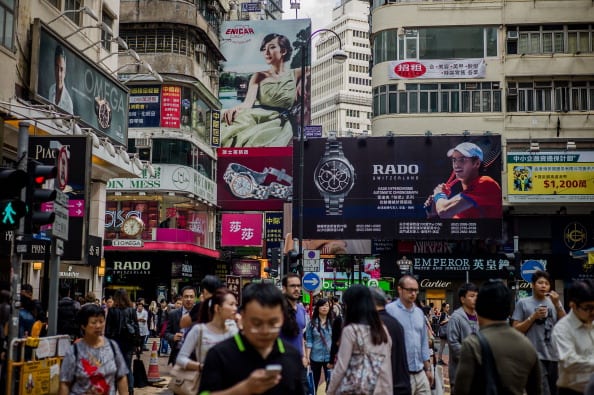
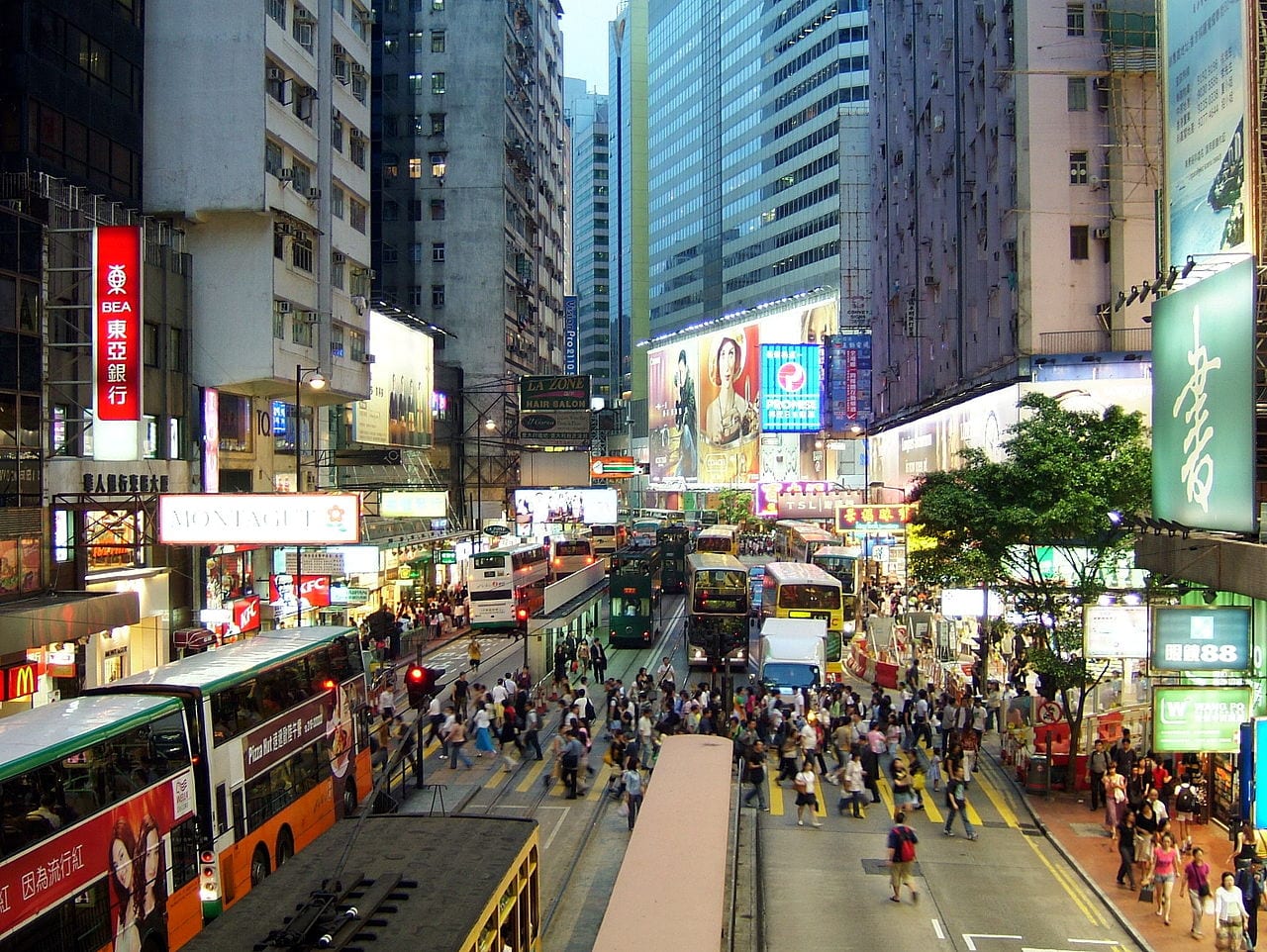
    Causeway Bay in Hong Kong is now home to the world’s most expensive retail space. According to the annual Cushman & Wakefield survey of high-street retail rents, Causeway Bay has overtaken New York’s Fifth Avenue for the top spot, with rents of US$2671 per sqft per year, or €24,606 per sqm per year.

    The calculations were completed during the second quarter of this year.

    What makes Causeway Bay’s performance on the list even more remarkable is that it was achieved as the retail rent market bottomed out after some three years of pressure from falling retail sales in the city. While that decline has turned around into positive growth over the past year, most property industry sources have said retail rents have not yet begun to climb again.

    Third place on the list of the world’s most expensive retail space – and the most expensive strip in Europe – is London’s New Bond Street.

    Of the Asia-Pacific locations, Japan’s Ginza takes sixth place this year, Sydney’s Pitt Street Mall seventh and Seoul’s Myeongdong district eighth. Those places are the same as last year. The only other change in the top 10 was Avenue des Champs Elysees in Paris overtaking Milan’s Via Montenapoleone into fourth place.

    The annual Main Streets Across The World report, celebrating its 30th anniversary, tracks 446 of the top retail streets around the globe and ranks the most expensive in 65 countries by prime rental value using Cushman & Wakefield’s proprietary data.


  • Orchard Road retail vacancy rate free jump

    Orchard Road retail vacancy rate free jump

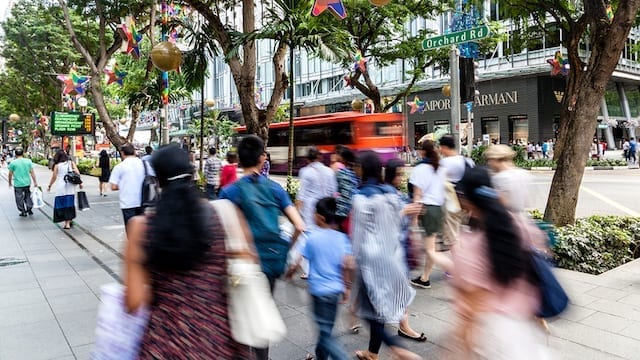
    The Orchard Road retail vacancy rate has dropped to 5.6 per cent in the second quarter.

    According to a report by CBRE, the rate is the lowest in 14 quarters and well below 2016 figures.

    CBRE’s head of research for Southeast Asia Desmond Sim said, “On the back of an improved tourism market, coupled with limited new supply along our famous shopping belt, Orchard Road is still able to attract new tenants.”

    Noting that new-to-market brands still require and demand visible frontages with high footfall, Sim cautioned that there may be vacancies on secondary corridors and secondary floors.

    Meanwhile, senior director of research at Cushman & Wakefield, Christine Li, said, “A two-tier market is forming in the retail segment, as accessible and well-managed malls attract the bulk of pedestrian footfall.

    Retailers and landlords have to continue to reinvent themselves, invest in technology and focus on lifestyle and activity-based experiences to keep pace with the fast-changing retail landscape.”

    This year’s new openings were largely in the food and beverage and fashion categories.

  • Retailers snag prime spots for flagships amid lower rentals

    Retailers snag prime spots for flagships amid lower rentals

    Rising vacancies and plunging rentals in shopping malls may be a headache for landlords, but it is not all bad news for retailers who have taken advantage of lower rentals to snag prime locations for their flagship stores.

    More than 10 flagship stores were set up islandwide last year, noted property consultancy Cushman & Wakefield’s research director Christine Li. This is the highest number since the global financial crisis in 2009, she said.

    The last wave of flagship stores were set up between 2007 and 2009, when Orchard Road was undergoing a makeover.

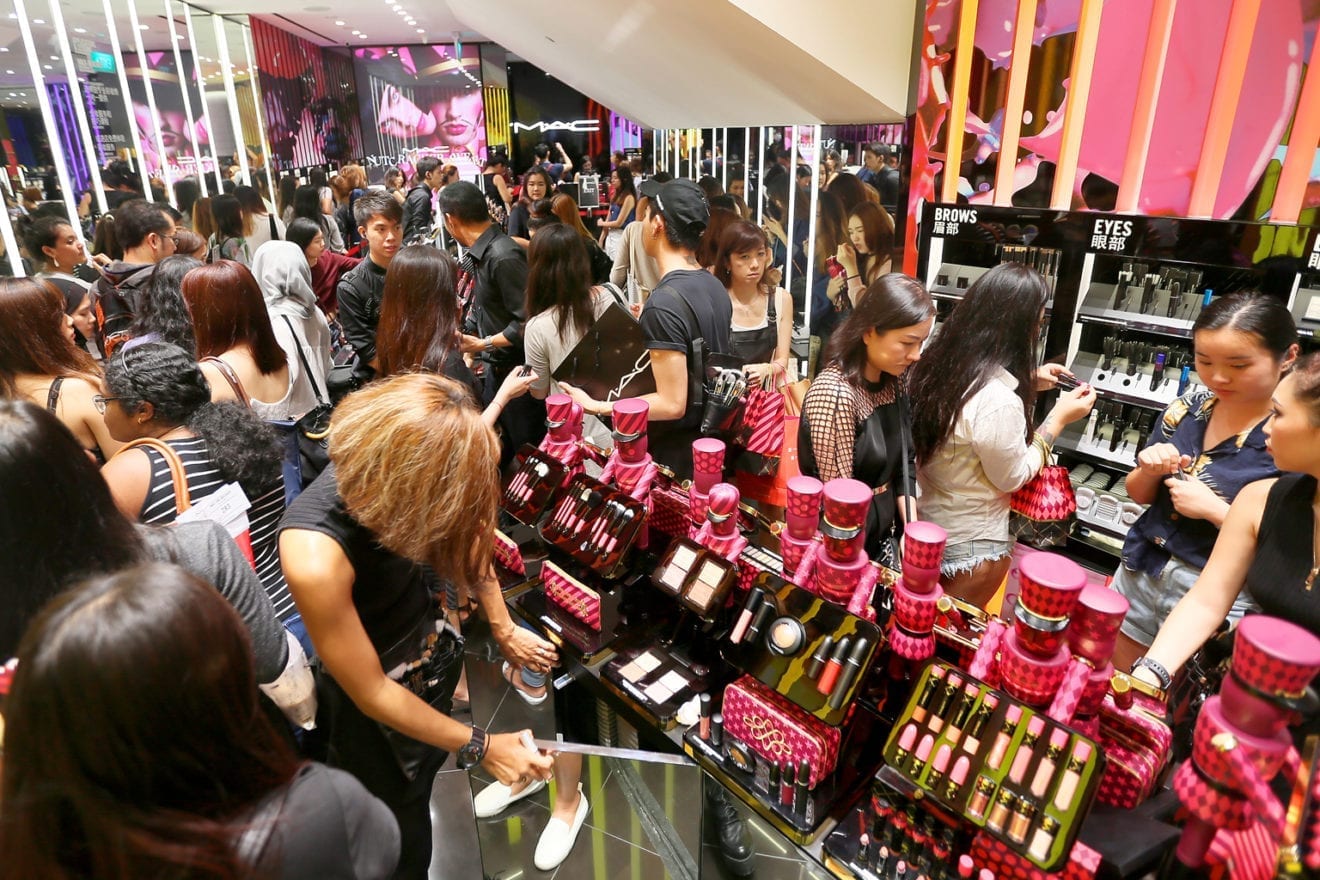
    Last year, cosmetics label MAC and Sephora opened flagships at Ion Orchard, while Japanese fashion retailer Uniqlo unveiled a three-storey store in Orchard Central. Other new flagships include those of watch brand Rolex at Marina Square and German leather goods brand Braun Buffel at Marina Bay Sands.

    Ms Li said: “In the lower rent environment, 2016 saw a ‘flight to quality’ as retail brands that are still optimistic on expansion took this opportunity to upgrade to larger prime retail spaces vacated by previous tenants.”

    • 10 At least this number of flagship stores were set up islandwide last year. This is the highest number since the global financial crisis in 2009.

    She said flagships are strategic, as they reinforce and enhance a brand’s presence and status.

    Uniqlo’s founder Tadashi Yanai said the firm decided to open a flagship in Orchard Road as it sees Singapore as a gateway to not only the markets in South-east Asia but also in the Middle East and Africa.

    “Despite the faltering retail climate in Singapore, Uniqlo’s belief in the potential of this region is what has driven (our) decision to launch the three-storey Global Flagship store here,” he said.

    The islandwide vacancy rate for retail space was 7.5 per cent at the end of last year, up from 4.5 per cent at the end of 2013, Urban Redevelopment Authority (URA) data showed.

    The climbing vacancy rate has, in turn, reduced rental rates. The median rental rate for retail space in the third quarter of last year was the lowest on record, falling to $9.82 per sq ft per month for the Orchard Road area – the first time it fell below $10, URA data showed.

    Riding on the wave of soft rents, French sporting goods retailer Decathlon even secured a 15-year lease for a 35,000 sq ft outlet in Viva Business Park in Chai Chee, which opened in January last year.


  • Office and retail rents slip, but outlook improves

    Office and retail rents slip, but outlook improves

    Challenging market conditions continued to hit office and retail rents in the fourth quarter, although there are signs pointing to a brighter outlook for some landlords.

    Office rents fell by 1.8 per cent from the third quarter to the fourth quarter last year, a far sharper fall than the 1.1 per cent from the second to the third, according to Urban Redevelopment Authority (URA) data yesterday.

    That took the drop in rents to 8.2 per cent for the full year, markedly steeper than the 6.5 per cent decline in 2015.

    “With continual supply pressure in 2017, we reckon rents will continue to soften at least for the first half,” noted Dr Chua Yang Liang, JLL’s head of research for South- east Asia.

    But new office buildings such as Guoco Tower and the upcoming Marina One have enjoyed good take- up over the past year – prompting talk of better prospects ahead.

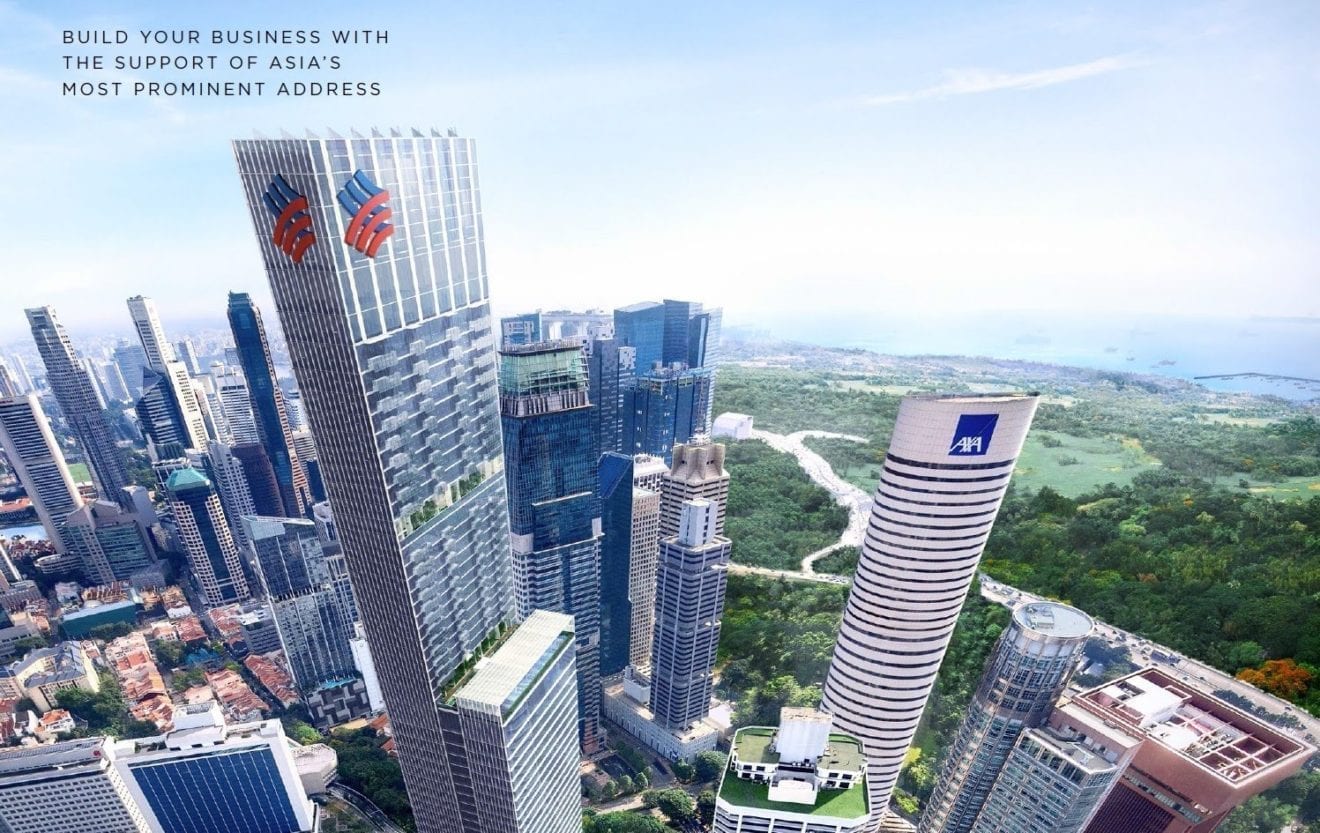
    “Large deals announced in January, such as Facebook taking up prime space at Marina One and co-working operator Distrii leasing in Republic Plaza, further point to signs that the office leasing market is stabilising,” Cushman & Wakefield research director Christine Li said.

    The completion of Duo Tower in Bugis last month helped push office vacancy rates to a four-year high at 11.1 per cent, up from 10.4 per cent at the end of the third quarter.

    Prices of office space, meanwhile, fell by 0.6 per cent from the third to the fourth quarter, taking the full-year drop to 2.8 per cent.

    The retail sector fared slightly better, amid challenges posed by e-commerce and uncertain economic prospects. Rents eased 1.2 per cent from the third to the fourth quarter – better than the 1.5 per cent drop from the second to the third.

    The islandwide vacancy rate for retail space improved to 7.5 per cent at the end of last month, snapping four straight quarters of rising vacancies.

    “The uplift in occupancy was probably supported by the continued opening of flagship stores, along with gyms and large food and beverage clusters,” said Mr Desmond Sim, head of CBRE Research for Singapore and South-east Asia.

    Retail rents fell by 8.3 per cent last year, and JLL expects them to remain weak, amid the 169,000 sq m of retail space which will become available this year.

    Although conditions in the retail sector will remain tough, there have been some changes that bode well for the future.

    “We are encouraged by the introduction of new retail brands and concepts through 2016… This should help to add more colour and vibrancy to Singapore’s cookie- cutter retail scene,” noted Ms Tricia Song, head of research at Colliers International, Singapore.


  • Hong Kong still tops Asian retail rent rankings

    Hong Kong still tops Asian retail rent rankings

    Tokyo’s Ginza has overtaken Sydney into second spot behind Causeway Bay in the latest DTZ/Cushman & Wakefield Asian retail rent rankings.

    The annual Main Streets Across the World report tracks 462 of the top retail streets around the globe, ranking them by their prime rental value.

    Globally just 36 per cent of the markets witnessed an increase in rent rates, a reflection of the growing power of eCommerce and economic challenges in many economies around the world.

    New York’s Upper 5th Avenue, which saw its first decrease in annual rents per square foot since the financial crisis, and Causeway Bay remain more than twice as expensive as the leading street in any other country. So while Causeway Bay rents fell year-on-year, it had no impact on its ranking.

    But DTZ/Cushman & Wakefield says the downward pressure on Hong Kong retail rents is creating an opportunity for some retailers looking to snap up units on prime pitches in good rental terms.

    In Asia, Beijing’s Wangfujing has lept two places into eighth at the expense of Guangzhou’s Ti Yu Zhong Xin District, and Kuala Lumpur’s Pavilion has fallen one spot to 12th. Ho Chi Minh City in Vietnam has jumped two spots to 14th and is now more expensive than Auckland, Nanjing and New Delhi.

    DTZ/Cushman & Wakefield commentators say advances in technology will shape the consumer experience of retail as well as drive the way how people shop and live in the future, placing more pressure on retail rents.

    “We have seen an increasing number of retailers in Hong Kong continually enhance shoppers experience through leisure offerings and differentiate their market positions to maintain competitiveness under the impact of eCommerce disruption,” said Kevin Lam, DTZ/Cushman & Wakefield’s head of business space, Hong Kong.

    Key fact APAC

    “Though we could see that some high street rents were close to the bottom in Q3, eCommerce disruption so far on rents is rather indirect in view of close proximity in Hong Kong.”

    Elsewhere, Chinese brick-and-mortar retailers are facing stiff competition from the growing eCommerce market and the emerging trend is to partner with online-to-offline platforms in an attempt to capture these changing trends in consumer behavior. In parallel, both retailers and landlords are raising the bar on the experience offered to consumers by expanding the food and beverage and leisure offerings.

    Theodore Knipfing, Cushman & Wakefield’s, head of retail, Asia Pacific, says retailers continue to be cautious in their store expansion across the region due to concerns including continued global economic instability, and this will continue well into 2017.

    “When expansion does happen, the focus is typically on quality over quantity. All in all, despite the cautious outlook across the region, major international and regional retailers will have to eye overseas growth, as their respective domestic markets reach saturation point and investors demand results.”

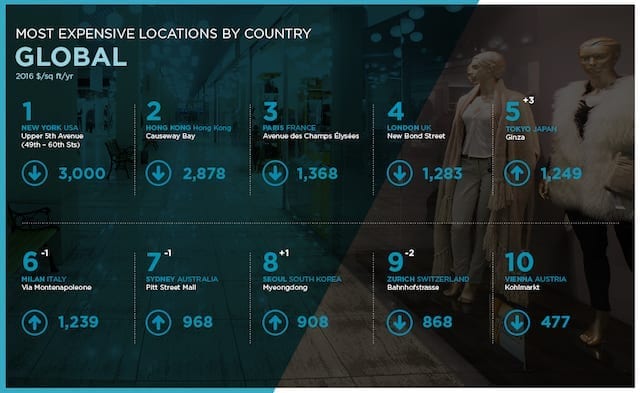
    Most expensive locations by city Pacific chart

    Global rankings

    In the global rankings, the Champs Elysees in Paris comes third followed by New Bond St, London, Tokyo’s Ginza and the Via Montenapoleone in Milan. Pitt St mall in Sydney is seventh followed by Seoul’s Myeongdong district, the Bahnhofstrasse in Zurich and Vienna’s Kohlmarkt.
    global

  • Singapore, Manila rise in retail rent rankings

    Singapore, Manila rise in retail rent rankings

    The data may be a little dated, but Asian cities are holding their own in the retail rent rankings.

    New York’s Fifth Avenue still tops the list with an average rent of US$3500 per sqft per year. Hong Kong’s Causeway Bay is cemented in second place at $2399 and the Champs Elysee in Paris a distant third at $1372.

    (It should be noted, the list ranks the single most most expensive shopping strip in each country, not overall.)

    Data released by Cushman Wakefield this month – albeit more than a year out of date – shows the Philippines making the biggest gain: retail rental rates in Manila’s Bonifacio Global City High St were a mere US$56.40 per sqft per annum, but that is enough to make Manila 51st on the top 65 list – up eight places.

    Singapore’s Orchard Rd ranked 14th – up two places – at $336.80 and Taipei’s ZhongXiao East Rd 20th, up three places, at $273.20.

    The Ginza in Tokyo,  Japan, ranks a modest eighth at $881.90 in a virtual tie with Myeongdong in Seoul, Korea at $881.80.  The Ginza has fallen from sixth in last year’s survey, while Myeongdong has dropped from eighth.

    Cushman & Wakefield stresses that the global rankings focus on high street locations. This excludes mall rental rates – and in cities like Manila, Bangkok and Kuala Lumpur, malls dominate the premium retail landscape, not high street strips.

    Vietnam’s Ho Chi Minh City CBD retail rents are more expensive than in Bangkok at $150.50 for 32nd place, and $125.40 for 35th respectively. Bukit Bintang in Kuala Lumpur, Malaysia, ranked 40th (up one place) at $111.

  • Saigon retail market to be put to the test

    Saigon retail market to be put to the test

    Is there too much retail space in Saigon – downtown Ho Chi Minh City – the commercial hub of Vietnam?

    With more than 1.1 million sqm of retail space, it looks like the Saigon retail market is oversupplied. The closing of Parkson Paragon in the city’s District 7  last month only amplified such concerns.

    But Cushman & Wakefield Vietnam GM Alex Crane begs to differ. He says demand is there if the retail formats are built to meet the market.

    He believes with the population of 10 million, the city is far from overloaded with retailers. The main problem lies in the wrong location or design – and incorrect retail segments.

    “I think the real test will show in the opening of shopping malls in the city center. Let’s just wait,” Crane said.

    The malls he may well be referring to are the upmarket Japanese department store Takashimaya-anchored Saigon Center 2 under completion now in District 1 and The One opposite Ben Thanh market when will be connected to the underground rail network currently at easing stage prior to construction.

    When these malls are operating, it will be easier to evaluate the real positioning of the retailers and the real demand of the market, says Crane, who is optimistic that it is not about the balance of population and retail space, but the practical demand.

    To Sigrid Zialcita, MD of Research Department, the key for shopping malls is to have suitable retailers (for market demand) and logical space designs – as well as market-savvy managers.

    “Joining WTO and TPP is turning Vietnam into a rising star in the retail market,” added Zialcita.

    HCMC’s demand for F&B, household supplies and fast moving consumer goods remains high based on the young population. But retailers entering the market need to conduct careful research to ensure their positioning strategies meet the market.

    While the retail market requires constant change and adjustment to customer demands, globally there is a continuing trend towards ‘one stop shopping’. Vietnamese are increasingly looking to go to places where they can eat, entertain and shop in a modern, air conditioned mall.

    According to data from AT Kearney, Vietnam has been one of the top 30 rising retail markets for foreign investors since 2008. Retail and consumer merchandising revenue has increased considerably between 2011 and 2015.

  • Hong Kong home prices could begin falling next year, says JP Morgan

    Hong Kong home prices could begin falling next year, says JP Morgan

    Hong Kong home prices could fall by 5 per cent to 10 per cent over the next three years, according to JP Morgan, which warned of the risks of an economic slowdown in the city.

    A slowdown marked by falling retail sales and a softening mainland economy would adversely affect home purchasing power and buying desire, said  Cusson Leung, head of conglomerates and property research at JP Morgan.

    Leung told a press briefing on Friday there were a number of factors that could affect the performance of Hong Kong property market, such as credit leverage and capital flow, while adding that he did not see any immediate risk of over-leveraging of real estate or capital outflow.

    The unemployment rate is expected to rise

    However, he raised concerns over a potential slowdown of the city’s economy, linked to the risk of further decline in the mainland China economy.

    “Retail sales are declining and international brands are talking about network consolidation in Hong Kong,” he said. “The unemployment rate is expected to rise.”

    Leung said the impact of the negative factors would become more obvious early next year. “2016 will be a more difficult year when compared with 2015. Home prices could see a decline,” he said.

    While saying that JP Morgan had not yet reached a house view on the degree of home price falls, he said it was possible prices could drop by 5 per cent to 10 per cent a year over the next three years, starting from next year.

    Hong Kong home prices rose 13.5 per cent last year and 8 per cent in the first half of this year, according to the data from the Rating and Valuation Department.

    Leung said home prices were unlikely to see a sharp plunge of 30 per cent in a year unless a crisis or really bad unexpected news hit the market.

    Residential transactions in Hong Kong last month plunged 27.8 per cent month on month to 3,896, according to Land Registry data released on Wednesday, prompting some analysts to predict a modest decline in home prices in the second half of this year. Alva To, senior managing director of real estate services firm DTZ/Cushman & Wakefield, predicted home prices could see a decline of 5 per cent to 10 per cent from current levels this year.

    Leung, however, expects prices to remain stable this year, but begin falling next year.

    Centaline Property Agency said its secondary home price index hit a record high of 146.78 yesterday, up 0.91 per cent week on week.

    The decline in property transactions in the past two months was more related to a slowdown in project releases than the wealth effect from the stock market crash, Leung said.

    His comments came a day after Sun Hung Kai Properties sold out all 328 flats at phase two of its Century Link development in Tung Chung.