Tag: cyber monday

  • Big success for Korean retailers during shopping festivals

    Big success for Korean retailers during shopping festivals

    South Korean retailers enjoyed a big sales boost from annual shopping extravaganza they launched in November to join the world’s major shopping events like Black Friday in the U.S. or Single’s Day in China. According to industry sources on December 2, Lotte Department Store, one of the country’s retail majors saw its sales from Nov. 1 to 29 grow 1.1 percent against the same period last year. Sales of its hypermarket affiliate Lotte Mart also gained 1.7 percent over the same period.

    Home appliance sold especially well during the big sales period, recording a 12.5 percent jump in revenue compared to the same period last year. High-end products were also showed sharp growth – sales of expensive hanwoo or Korean beef soared 25.8 percent on year and luxury fashion items up 9 percent.

    E-Mart., another leading big-box store chain also held a mega sales event in November, slashing prices of nearly 2,000 items worth 300 billion won (US$267.4 million). It sold 180 tons of hanwoo in just four days, doubling sales against the same period last year.

    Online retailers enjoyed even bigger growth in sales through major discount events. G Market and Auction hosted Big Smile Day sales event from Nov. 1 to 11 and their sales transaction amount more than doubled compared to the same period a month earlier.

    11st.com that runs its biggest sales event on Nov. 11 every year said its daily transaction amount on this year’s big sales day reached a record high of 102 billion won. Last year, it recorded 64 billion won through the same event.

    WeMakePrice Inc. also held bargain sales from Nov 1 to 11 this year. It said the transaction amount over the period jumped 77 percent to 230 billion won compared to the same period last year. By volume, it was up 15 percent on year. The company estimated transaction amount to hit a record high of 600 billion won in November.

  • US Cyber Monday online sales to reach record US$7 billion

    US Cyber Monday online sales to reach record US$7 billion

    American consumers were on track to spend US$ 7.8 billion in online shopping on Cyber Monday, up 18.3 percent from last year, according to Adobe Analytics, which tracks 80 percent of online transactions at 100 of the largest retailers in the US. Cyber Monday, which falls on the first Monday after Thanksgiving Day and Black Friday, is considered the biggest online shopping day of the year.

    Last year, it hit a record US$ 6.6 billion in online sales.

    With growing online sales, Black Friday might be stealing Cyber Monday’s thunder. Online sales for Black Friday reached US$ 6.22 billion, up 23 percent compared with last year.

    Smartphone-enabled purchases amounted to US$ 2.1 billion, accounting for one third of the overall sales.

    Figures from Internet Retailer, a publisher of e-commerce news and analysis, predicted that the total amount to be spent over the period between Thanksgiving Day and Cyber Monday will reach US$ 21.6 billion.

    For the whole holiday season, which will last until end of December, online sales could hit a record US$ 124 billion, up by 15 percent from last year, Adobe Analytics said.

    Figures from market research firm eMarketer put overall US holiday online sales at around US$ 123 billion, which accounts for 12 percent of the estimated 1 trillion retail sales for this holiday shopping season.

    According to an annual survey, US consumers will spend an average of US$ 1,007 dollars during this holiday shopping season, up 4.1 percent from last year, the National Retail Federation said earlier.

  • From Cyber Monday to Cyber Week

    From Cyber Monday to Cyber Week

    Cyber Monday is expected to be the largest online shopping day in U.S. history, generating a whopping $7.8 billion in sales. That’s 17.6 percent higher than last year, according to the projection from Adobe Analytics. But the National Retail Federation projects that the number of shoppers taking advantage of online bargains on Cyber Monday – about 75 million – will be 3 million fewer than in 2017.

    Just as Black Friday has evolved into “Black November,” as retailers spread out their discounts, Cyber Monday has turned into “Cyber Week”, which is expected to alter some of its strength as a stand-alone day.

    It has been estimated that more than 164 million people planned to shop over the five-day Thanksgiving weekend. But experts said Black Friday remains the busiest shopping day, with NRF projecting 116 million would shop, both in-store and online, on that day alone.

    Based on Adobe Analytics data, a record $6.22 billion was spent online by the end of Black Friday, an increase of 23.6 percent over 2017’s $5.03 billion.

    Data suggests that consumers are getting more comfortable buying more and bigger ticket items online.

    The average order value of $146 set a new record for Black Friday, up 8.5 percent over last year.

    Many brick and mortar retailers are trying to capitalize on Cyber Monday by offering “buy online, pick-up in store” deals.

    A spokesperson from the NRF said that “Of those [shoppers] that choose to buy items online and pick them up at the store, nearly 70 percent will double their basket size by the time they walk out of the store. So, even on Cyber Monday, retailers will try to use this as an opportunity to bring consumers into their physical stores and cash in on impulse buys.”

  • DHL Delivers Black Friday, Cyber Monday and 2018 Holiday Season

    DHL Delivers Black Friday, Cyber Monday and 2018 Holiday Season

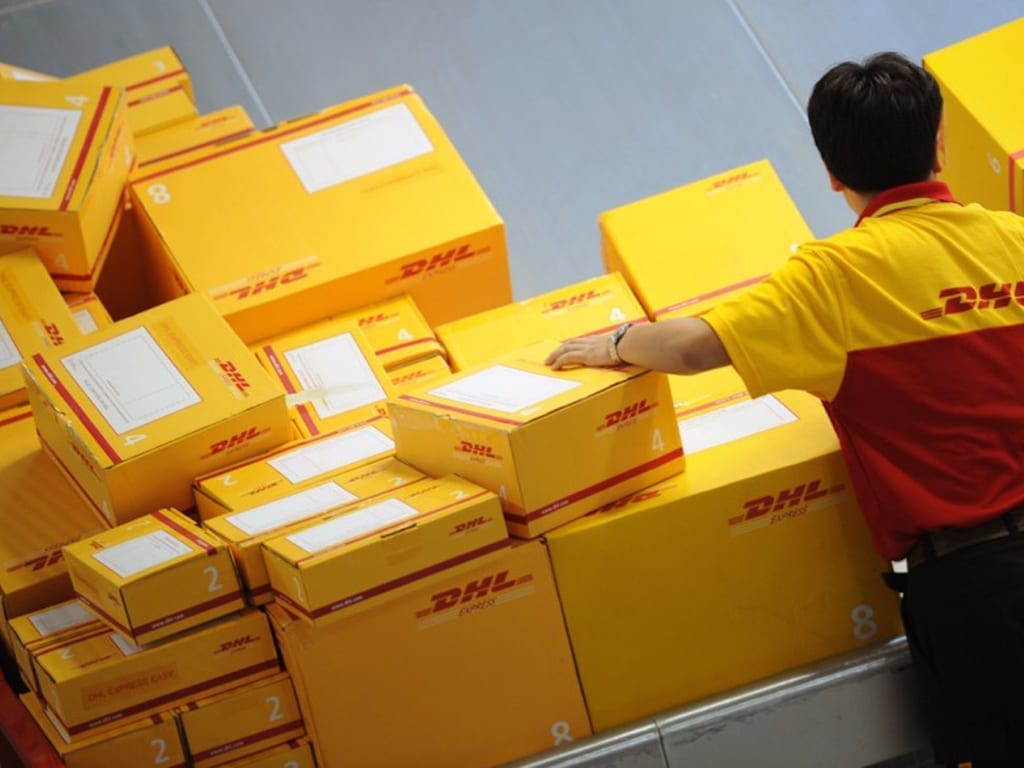
    DHL, the world’s leading logistics company, is ready to deliver Black Friday, Cyber Monday and the 2018 holiday season as e-commerce continues to boom. As the only logistics company with services and capabilities to link the entire e-commerce supply chain, the DHL divisions operating in the United States can expect to handle up to 40% more volume in the peak season versus the rest of the year.

    U.S. retailers are preparing for another record holiday shopping spree, growing more than 4% with total sales predicted to top USD 1.002 trillion this Christmas season1, boosted by promotions such as Black Friday and Cyber Monday. Online sales are expected to accelerate at an even faster clip, growing nearly 17% from last year.

    To boost productivity and meet the surge in volume, DHL is adding more automation and bringing innovative technologies including using collaborative robots in fulfillment centers that help staffers gather the products needed to fill online orders more efficiently, introducing chatbots to answer customer questions more rapidly and adding more automation to its distribution centers to quickly sort and get parcels ready for delivery.

    In New York, DHL couriers will be collecting packages from automated delivery depots and beating the traffic to get them to customers’ doorsteps.

    Says Greg Hewitt, CEO for DHL Express U.S.: “We define peak as the period right after Thanksgiving through to Christmas. We really see volumes go up around the globe at this time. In the U.S., our busiest day of the year for outbound shipments is November 26 – Cyber Monday. Our busiest inbound day will be December 17 – the last Monday before Christmas.

    To ensure shipments arrive on time, Hewitt says, “First think about your product and how to protect it. Ensure you have the right packaging to move through our network. Next, ensure that your staff is accurately portraying content on the shipment’s commercial paperwork and declaring the proper value – if you don’t know how to do this, ask someone in our team. Most importantly, plan early and ship early, in order to beat potential delays due to weather or customs hold-ups. The assurance we can provide is, if it gets to our stations by December 24th, we’ll deliver it. We don’t close our doors until every package is out and on its way to the final destination.”

    DHL eCommerce’s new automated distribution center in northern New Jersey, one of the company’s 19 distribution centers along with three fulfillment centers in the U.S., provides the last mile delivery solution for online retailers. For these merchants, logistics is the back-end support that provides a significant part of the consumer experience. The new center will be launched at the end of the month.

    Says Lee Spratt, CEO for DHL eCommerce Americas: “This season will probably be stronger than 2017. The market is growing at 10-15%. I expect a minimum of 10% growth on peak volumes vs. last year, but wouldn’t be surprised to see it hit 20%. The peaks are Black Friday and Cyber Monday – around these days we see a dramatic increase in orders. The volumes usually show up on the Saturday and Tuesday directly after these days. This is when we need the highest amount of labor in our facilities and our operations at full power. Consumer expectations are high – they want to receive their orders just as on any other shopping day – and this is a defining moment for many retailers in winning and retaining business, so it’s critical that delivery providers meet their commitments.”

    At Chicago’s O’Hare International Airport and John F. Kennedy International Airport in New York, DHL Express workers will be loading American goods onto pallets and freighters for export to consumers in Asia and Europe.

    Says Mike Parra, DHL Express Americas CEO: “Many of our customers are shipping to the UK, Australia and China. These are key trade lanes, but the rest of the world is still important. A large portion of our growth is now coming from e-commerce and our fast-growing retail channel. In line with the growth we’re seeing over the first and final mile, we’ve made recent investments, for example, in expanded facilities in Tucson, Arizona, Ontario, California, and Baltimore, Maryland. We’ve also invested in air capacity – our customers want speed to market for their own customers, so we have invested in new flights to Vancouver, Lima and Bogota.

    “To improve the customer experience, we are also looking at more automation in our facilities, robotic process automation for customs clearance and billing, and chatbots and voice assistants. These enhance the end-to-end customer service experience. You can now opt to speak to someone live or to go through one of our tools that is integrated with Alexa, WhatsApp and other applications to find your package or get other information from DHL Express.”

    At the Port of Miami, DHL staff will be supervising the offload of containers filled with consumer goods from trading partners around the world.

    Says David Goldberg, CEO for DHL Global Forwarding U.S.: “The peak season usually starts a bit earlier for the forwarding industry, as customers reposition inventory to their fulfillment centers in the U.S. ahead of time in consolidated freight consignments. Last year, we saw an extremely strong peak in the fourth quarter, with a capacity crunch in air freight and ocean freight, and rates going up by more than 100% versus previous months. Now, with the tariffs, inventory is getting pushed forward, so the peak has started even earlier and become more elongated. We are seeing tight capacity in transpacific ocean freight, in particular, which is one of the main trade lanes during the holiday season. And air freight capacity has tightened in recent weeks. Both capacity and rates are tight overall.”

    And in Columbus, Ohio, DHL warehouse associates will be working with several innovative technologies that help them make sure that the right products are in every order and get them on the road well in time for Santa’s visit. Vision Picking is among the technologies that DHL is using. These “smart glasses” are an augmented reality tool that provides staff in warehouses with the location of products needed to fill orders; helps reduce pick time and increase order picking accuracy thus providing productivity increases of up to 10%. It also helps reduce employee training time.

    DHL is also working with collaborative robots which can see, move, and work alongside people. Made by Locus Robotics, LocusBots are used in e-commerce fulfillment operations, helping staffers locate products for orders and ferrying them from warehouse aisles to the shipment prep area. With the bots, order pickers don’t have to push carts or carry heavy bins. LocusBots are used in several DHL warehouses.

    Says Scott Sureddin, CEO for DHL Supply Chain North America: “The expectation of next-day or 2-day delivery is compressing order cycle times and challenging everyone in the supply chain to become more efficient and adaptable to change. The first thing our e-commerce customers want is quality and operational excellence with a continuous improvement culture. They also want experts who are leaders with emerging technologies, who can help them to find ways of improving efficiencies and productivity. And they want agile solutions, which will allow them to respond to changes in their market and business needs.”

  • What is Black Friday like in the Philippines?

    What is Black Friday like in the Philippines?

    After Singles’ Day, the annual Black Friday shopping frenzy is back. A decades-old tradition celebrated every year the day after Thanksgiving, Black Friday marks the unofficial start of the Christmas shopping season in America.

    Together with its more recent online counterpart Cyber Monday, the sales have become a major global event over the past few years as online shopping has brought the bargains to the rest of the world.

    So what is exactly Black Friday like in emerging developing countries like the Philippines? What are Filipinos consumers’ expectations?

    Large discounts expected

    Customers will not waste the opportunity to save money on shopping.

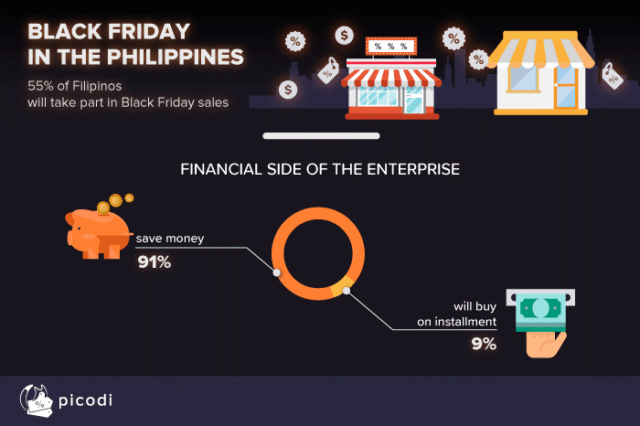
    55% of Filipinos admitted that they’re going to take part in the upcoming Black Friday sales and 91% of shoppers save money prior to Black Friday just to shop on this day.

    Let’s remember that Black Friday sales are usually associated with electronics and housewares which are the best-selling products.

    The remaining 9% declared that they are going to buy on installments.

    38% of consumers are planning to buy 2-3 products, and 36% are going to go on a shopping spree and buy more than 5 items.

    What’s more, 59% of buyers already have an idea what’s going to end up in their baskets. This can be due to the infinite number of guides to what is worth buying and how to find the biggest discounts.

    Black Friday symbolically opens the season of pre-Christmas sales. That is why it is a great opportunity for those who start searching for gifts in advance.

    38% of consumers will take advantage of Black Friday exactly for this purpose—to buy Christmas gifts.

    However, in the Philippines Black Friday is also an occasion to get a present for yourself as it is the intention of 67% of consumers.

    What does an average shopper looks like?

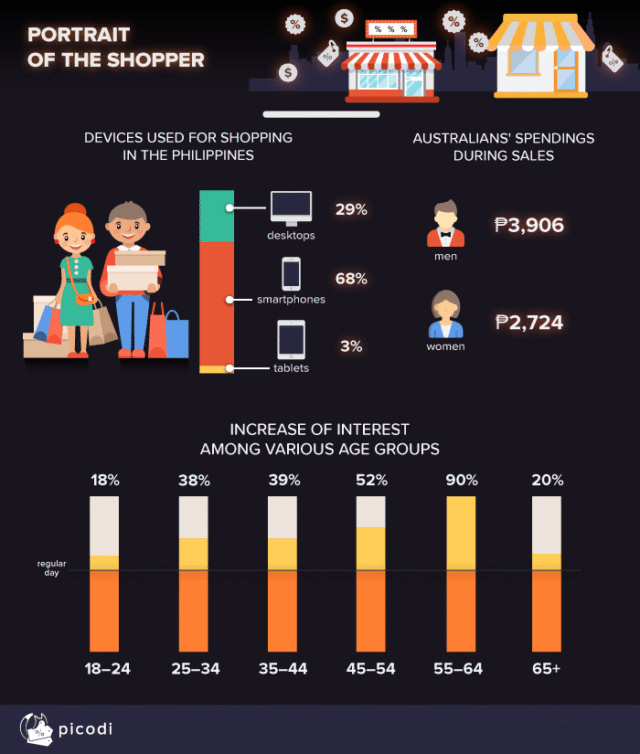
    Spending differences vary by sex. Indeed, an average man will spend more money on sales than an average woman: 3906 PHP and 2724 PHP respectively.

    When it comes to age the biggest interest for Black Friday discounts was among people aged 55-64 and 45-54.

    Statistics also say that mobile devices dominated desktops with 68% of consumers shopping on their mobile phones and 29% on desktops.

  • Amazon seizes half of all online Black Friday sales

    Amazon seizes half of all online Black Friday sales

    Amazon is dominating — again.

    Black Friday sales and promotions have helped the company claim between 45% and 50% of all online Black Friday sales, according to a new report from GBH Insights. GBH called the results “eye-popping.”

    This new number, combined with online sales figure estimates for the same timeframe from other analytics firms, shows Amazon’s sales are well over $1 billion for the last 24 hours or so.

    This heralds another blockbuster holiday for Amazon, with estimates that it will take half of all online sales throughout the holiday. It will need to fend off an aggressive Walmart to do so. Walmart has pumped its resources into its new online offerings to make them more competitive and likely had its most ambitious online Black Friday this year.

    Still, Amazon Prime subscriber growth — in terms of both numbers and how much they spend — sets Amazon up well for the rest of the year.

    “Customers purchased millions of Amazon’s Alexa-enabled devices , and Alexa devices were the top sellers across all of Amazon,” David Limp, Amazon’s head of devices, said in a press statement.

    The Echo Dot, Amazon’s cheapest device with its voice assistant, Alexa, was Amazon’s best-seller globally across all categories — and it was on sale over the weekend for $30, the cheapest it has ever been.

    Other best-sellers included the new Fire TV Stick, the new Amazon Echo, and the Fire 7 tablet, the company said.

    The device sales propelled Amazon to a strong Thanksgiving weekend overall.

    Amazon accounted for 45% of online transactions among 50 top retailers on Thanksgiving and 55% on Black Friday, an analysis by Hitwise found. As of Monday, Amazon was on track to take about half of all online sales over Thanksgiving weekend, according to research by GBH Insights.

    People spent a record $6.59 billion online on Cyber Monday, $5.03 billion on Black Friday, and $2.87 billion on Thanksgiving Day, according to estimates from Adobe Analytics. Given these figures, it’s not hard to make a rough guess about the billions Amazon raked in over the holiday weekend.

  • More online super sales for Asia online market

    More online super sales for Asia online market

    While the US formulated online super sales, such as this week’s Black Friday, Asia has adopted the concept with a vengeance.

    In fact, China has increasingly been exporting Alibaba’s Singles Day (11.11) event, which this month racked up a massive US$35 billion in sales. November is the favoured month for this new consumer mania, offering the Singles Day, Black Friday and Cyber Monday sales.

    Both Black Friday and Cyber Monday themselves have been catching on in the Asia Pacific, growing by 29 per cent last year, according to global payments company WorldPay.

    It says that despite forking out $17.8 billion on Singles Day last year, Chinese consumers still went hunting Black Friday bargains, with overall spending on the day up by 37 per cent from the previous year. In Hong Kong, the rate of growth was 32 per cent, and in Singapore 21 per cent.

    While retailers are among the biggest Black Friday winners, new WorldPay data suggests this year could also be a great opportunity for savvy APAC businesses in the travel and digital sectors. In Hong Kong, spending with travel and airlines saw a 30 per cent surge last year, with Singapore figures up 20 per cent as travellers jumped online to search for flight and hotel deals.

    Not just retailers

    Shoppers are also increasingly seeking out bargains for digital content such as subscriptions, e-books and on-demand box sets. Black Friday spending in this sector last year grew 62 per cent in Hong Kong and 14 per cent in Singapore.

    Not just retailers can benefit from Black Friday, but also a range of e-commerce businesses, says WorldPay Asia Pacific GM Phil Pomford.

    “While Black Friday and Cyber Monday have typically been the realm of retailers, a more diverse range of businesses are now recognising they can also take can take advantage of this special online opportunity.

    Shoppers during this time are highly engaged, proactive and looking for a wide range of online deals, so the potential to reach new customers and strengthen brand loyalty is huge, regardless of sector.

    “E-commerce businesses should set themselves up for success by ensuring their websites are prepared for heavy traffic, and offer simple payment options to drive shopping-cart conversions. They might also consider following the example of Amazon and kickstart Black Friday deals a week early.”

    Black Friday online sales surpassed $3 billion last year and are expected to rise this week, says Adobe Digital Insights, as buyers seek to avoid long queues and lost hours in retail stores.

    In Southeast Asia, Google searches for “Black Friday” have surged over the past five years, and 12 months ago major offline/online retailers like Robinsons, Sephora and Zalora offered generous discounts for the event.

    “Many industries rely on this event to make up a large portion of their fourth-quarter sales, in particular toys and games,” says Euromonitor International senior toys and games analyst Matthew Hudak.

    ‘Sure to jump on’

    Digital campaign company RTB House says Black Friday last year attracted 106 per cent more people to online stores, with 204 per cent more transactions.

    “We anticipate conversion rates surging this time,” says RTB House Southeast Asia country director Chandra Kuncara. “Customers who missed out on Singles Day will be sure to jump on this event.”

    He says personalised retargeting is an important selling tool during Black Friday. With AI technology and deep-learning algorithms, marketers can highlight most-desired products for each individual customer.

    More purchases mean more packages being shipped, and international courier service FedEx is again expecting to handle a record number of packages over the peak holiday shopping period, which starts on Monday and runs to December 24. This year it is expecting 380 to 400 million packages.

    The growth of cross-border e-commerce is turning the peak shipping season into a global phenomenon, says FedEx. For instance, 37 per cent of Singles Day purchases in China last year were from international brands or merchants. Cross-border shopping is expected to make up 20 per cent of e-commerce sales by 2022, led by Asia Pacific.

    “While an online purchase takes just a few clicks, logistics providers are working hard behind the scenes powering every moment,” says FedEx Express AsiaPacific president Karen Reddington. “Our business is the backbone of the e-commerce market.”

    Meanwhile, while shoppers scramble for Black Friday bargains this week, outdoor retailer REI is closing its 154 US stores for the third consecutive year, offering its nearly 12,000 employees a paid holiday. It is truly going against the tide by also putting a hold on online orders.

  • More shoppers spend less in Black Friday

    More shoppers spend less in Black Friday

    More shoppers spent less on Black Friday in the US – and more was spent online than ever before.

    Those are the key take-outs from the three day long shopping extravaganza, which is being followed up by Cyber Monday giving Americans a second chance at scoring shopping bargains.

    But perhaps the biggest trend this year was how Black Friday was adopted internationally – even as far away from America as Vietnam, shopping centres were packed with bargain hunters, lured by billboards promising as much as 50 per cent off stock.

    According to data from the National Retail Federation, more than 154 million US consumers shopped last Friday, spending an average $289 – $11 less than last year. Gifts accounted for $214 of that spend.

    “It was a strong weekend for retailers, but an even better weekend for consumers, who took advantage of some really incredible deals,” said NRF president and CEO Matthew Shay.

    Most of the shopping occurred Friday, perhaps reflecting the limited stock of some retail deals.  The NRF said of the consumers who went to physical stores, 75 per cent shopped on Friday, 40 per cent on Saturday and 17 per cent on Sunday.

    And the data showed a continuing migration from offline to online. Last year, 103 million people shopped online and 102 million in stores. This year more than 108 million shopped online and 99 million in stores.

    Adobe released data based on anonymous tracking of 22.6 billion visits to retail websites, showing more than $5 billion was spent online over the holiday weekend – and a record $3.34 billion on Friday. Mobile devices accounted for $1.2 billion of the weekend sales.