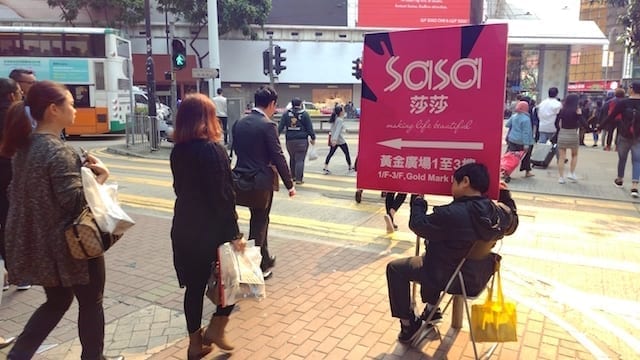
Sa Sa International sales slipped 2.2 per cent in the latest quarter, with same-store sales in Hong Kong and Macau down 3.7 per cent. The company says that while the transaction volume of mainland tourists rose 5.8 per cent in the three months to December 31, transactions by locals fell 5.2 per cent. However the average sale to tourists fell by 6.1 per cent and just 0.2 per cent to locals.
Sa Sa International’s retail and wholesale turnover in markets outside Hong Kong and Macau (including Mainland China, Singapore, Malaysia and e-commerce) increased by 1.3 per cent in the third quarter.
“[Hong Kong] consumer sentiment remained sluggish due to the weaknesses in RMB exchange rate and stock market under the continued shadow of the Sino-US trade war,” said chairman and CEO Simon Kwok in a stock exchange filing.
“In addition, the new e-commerce law passed by the Chinese government in August came into force early this year and made daigou traders more cautious in running their businesses. The group’s sales performance was affected and negative growth was recorded in both retail sales and same store sales in the Hong Kong and Macau markets in November and December.”
Kwok said that since the launch of the Hong Kong section of the Express Railway Link, the Group’s SaSa stores located in the Hong Kong West Kowloon station and the neighbouring Tsim Sha Tsui district have been reporting satisfactory sales performance. However, the increased influx of mainland tourists via the new Hong Kong-Zhuhai-Macau Bridge were mainly sightseeing trippers with limited purchasing power and barely contributed to the group’s overall sales in Hong Kong.
“Nevertheless, the group believes the two mega infrastructure projects will attract more mainland travellers with higher consumption when they are gradually consummated. The group remains optimistic towards the outlook of Hong Kong and Macau markets in the middle to long run under the favourable development of the Greater Bay Area.”
Kwok said Sa Sa International will strengthen promotional efforts to boost traffic and sales in physical stores to offset a decline in the online-driven daigou business.
“Digitalisation and information technology enhancement will be sped up to improve operational efficiency and shopping experience. In addition, the group will seize the opportunities brought by the Greater Bay Area to achieve sustainable business development for the group,” he said.
As aftershocks of the clampdown on Daigous continue to reverberate through the luxury shopping community in China, e-commerce platforms are rising to fill the gap.
The launch of China’s new e-commerce law, coupled with the 928 Daigou crackdown at the Pudong International Airport in Shanghai, has stirred up uncertainty in the global luxury industry.
In fact, LVMH share prices reportedly fell in early October due to fears of a slowdown in Chinese spending.
Earlier this month, Luxury Society attended the live seminar “Reinterpreting the 300-billion Daigou market” hosted by Tencent media.
During a debate, luxury e-commerce platform OFashion’s CEO Xiao Yu and N5 Venture Capital’s founder Xiao Yiwei shared their insights on how luxury buying will likely evolve in the post-Daigou era.
According to Xiao Yu, the estimated Chinese luxury spending in 2018 is 600 billion RMB and Daigou purchases account for half of that, making it an estimated 300-billion industry.
Without Daigou, what is the next best alternative for Chinese consumers looking to buy authentic luxury goods at lower prices?
First, let’s revisit the 928 daigou crackdown in Shanghai’s Pudong airport and take a look at how China’s 300-billion Daigou industry is in danger.
What Happened During The 928 Daigou Crackdown
September 28 2018 marked an important date in the history of Chinese luxury consumption.
In Shanghai Pudong airport, all passengers returning from Seoul were stopped by Chinese customs for baggage inspection.
Seoul has been a classic shopping destination for Daigous to obtain global brands at a discount. More than 100 passengers from same Seoul-Shanghai flight were found guilty of illegal imports.
It was every Daigou’s living nightmare.
One of them relayed the unfolding events through WeChat text messages. Screenshots of this message thread eventually made its way online.
The messages read,
“In the line to pay my fine”
“I was live streaming in duty free shop during the day, but live streaming fine payment during the night (face palm emoji)”
Source: Sohu, A Daigou’s WeChat record of 928 crackdown got popular online.
Whether as a full-time profession or simply a hobby, the Daigou business is one based on relationships.
In fact, the first clients of most Daigous are generally from his or her own social network.
Since Daigous operate in a legal gray area and rely solely on private transactions, customers often have a hard time verifying the authenticity of their purchases.
Needless to say, seeking redress in the case of fraud is difficult or near impossible.
Within the last decade or so, Daigous have become rather ubiquitous.
Chinese netizens often joke on social media that “everyone has a Daigou friend on his/her WeChat”, or “Daigou is our generation’s best marketing guru”.
Rumors of Daigous making a minimum of $100k USD a year and buying houses while still in college flood the internet, making the Daigou profession both a mysterious and highly coveted one in China.
On September 28, however, this all came to a screeching halt.
Within a night, the image of Daigous as self-made businessmen was reduced to that of illegal importers.
Chinese Luxury Consumers Have Changed
The Daigou business flourished in China largely because of strong domestic demand for global luxury products. This demand is quickly changing.
During the seminar, OFashion’s CEO Xiao Yu offered his observations on shifting consumer tastes by analyzing the purchase data of its platform’s 3 million active buyers.
Here are our major takeaways.
1. Chinese Consumers Love Buying “Hits”
The biggest difference between luxury consumers from China and those from mature markets is that Chinese consumers prefer mainstream “hit” items, while mature market consumers also buy a brand’s long-tail (niche) products.
2. Entry-Level Luxury Sells Best
Out of all the luxury product categories, entry-level items with a price range of 2000-5000RMB (430-730USD) exhibit the strongest sales performance.
3. Consumer Tastes Have Diversified
While Chinese consumers concentrated their research on highly famous luxury brands in the past, they are now much more receptive to niche brands.
Bestselling product styles have also shifted from traditional classics like the Salvatore Ferragamo ballet flat, to streetwear brands.
Additionally, Chinese consumers are now searching more about domestic brands compared to four years ago, when most searches were about established global brands.
4. TheLipstick Effect Doesn’t Quite Apply In China
Considered an entry-level luxury product, lipsticks have been selling like hot cakes in the Chinese market recently.
While the “lipstick effect” – a global economic theory that postulates the correlation between beauty product sales and economic downturns – may hold true in many markets, industry professionals have stressed that it might not necessarily be the case in China.
While China might be in the midst of a lipstick craze, experts have noted that lifestyle brands that are inspiring, soulful, and fun, can still rise to the top of the market quickly.
How Platforms Can Rise To The Challenge
Now with the individual Daigou business in danger, it’s time for luxury cross-border platforms to shine.
As the live seminar’s two speakers noted, inefficiency is still a huge pain point in the cross-border industry.
That said, cross-border solutions aiming to improve efficiency would likely to grow fast.
As the luxury buying business faces tightening controls by regulators, consumers are turning to professional buyers, reliable platforms, or buyer’s platforms — a combination of the former two.
Besides established luxury e-commerce platforms such as Tmall Global, JD’s Toplife, Secoo and VIP, platforms that specialize in serving professional buyers are booming, too.
Tmall Global’s Luxury Direct has turned buyers into consultants and made fashion-consulting service a selling point.
The platform’s “About” page reads, “Our buying team takes orders straight from fashion weeks and selects products from brand official showrooms all across Europe.”
OFashion’s app “Buyer Box”, an app targeting professional buyers, has even a CRM (Client Relationship Management) system for users to personalize a client’s order.
Daigou retailer AuMake has inked a deal with pharmacy network Chemsave which will see its own branded products distributed through a network of 150 pharmacies across the country.
The announcement, which follows the listed retailer declaring a trading halt earlier this week, will see Aumake’s own-branded health supplement and honey products distributed initially, prior to further expansion.
Cross promotional marketing will accompany the products, with AuMake’s recently launched live streaming functionality to move into some Chemsave pharmacies.
The listed retailer hopes that the partnership will bolster its credibility of its private label range, while Chemsave is looking to increase its exposure to the Chinese market.
“Aumake is thrilled to have formed this strategic partnership with Chemsave, which is a significant milestone,” Aumake executive chairman Keong Chan said of the deal.
“This partnership with Chemsave allows us to significantly expand the reach of our products across Australia … this is not simply a distribution agreement but a long-term mutually beneficial strategic alliance.”
Chemsave CEO Michael Dixon concurred, saying that the Chinese market represents a lucrative opportunity for its network.
“Over the last year we have had the opportunity otm eet with a number of groups with a view to forming a partnership that will allow us to grow our members’ businesses and increase our presence with the important and influential Chinese consumer,” he said.
The initial terms of the contract are set out across two years, with an option for a further two-year extension if mutually agreed.
Aumake shares rose 10 per cent to 27 cents in early Wednesday trading.
Listed Australian company AuMake has launched the country’s first purpose-built retail hub for China’s growing army of “daigou” shoppers, using live streaming to reach millions of overseas consumers.
The new 430sqm Daigou Hub retail concept is set in the heart of Sydney’s Chinatown, combines state-of-the-art live streaming technology with face-to-face supplier interaction – aiming to build the profile of Australian suppliers and connect them directly with Chinese consumers via the daigou and Chinese tourist markets.
The hub includes a presentation space for supplier demonstrations, cafeteria, several product display locations and an area specifically designed for daigou to live stream their interaction with Australian suppliers to millions of their customers back in China.
AuMake announced the retail blueprint will be replicated across Australia.
The company reported the launch has drawn more than 70 Australian suppliers, a large number of investors, 150 daigou and a live viewing audience from China of 730,000.
“This leading-edge initiative has been the culmination of 12 months of industry consultation with suppliers and daigou, and closely follows recent developments in the retail market in China, which has seen a move away from a pure online marketing model to an omnichannel model which combines engaging offline experiences for customers, coupled with advanced online functionality,” said Keong Chan, AuMake chairman.
Chan said live streaming is fast becoming a key component of the decision making for consumers in China when they look at the brands and products they are going to purchase.
“Being able to see, in real time, suppliers demonstrating their Australian product and interacting with their trusted daigou is the next evolution of their increasing desire to understand the origins of the product they are purchasing,” he said.
“In just two and a half hours today we had a live stream viewing audience of 730,000 people early in the morning in Mainland China.”
The company has a retail flagship on Sydney’s main CBD street, George St, and plans to roll out another retail hub in the city’s inner-west in April and another in either Brisbane or Melbourne later in the year.