Tag: disability

  • Starbucks store in Korea is dedicated to disability inclusion

    Starbucks store in Korea is dedicated to disability inclusion

    Starbucks Korea has added a new location to its chain of Community Stores in the country, reaffirming its commitment to diversity, equity and inclusion.

    The store is Starbucks Korea’s first to focus on a design that creates an inclusive space and what the retailer describes as impactful programming to support members of the disability community in Seoul.

    A portion of proceeds from sales through the store will go to support the local nonprofit Heart Heart Foundation, which advocates for inclusion and awareness of people with disabilities, and support for local artists from the disabled community.

    “It is very meaningful that our store, which is an inclusive space for all, has been dedicated as a new Community Store for inclusion, furthering disability-inclusion awareness in Korea,” said Elena, assistant store manager, who is hard of hearing.

    “I feel very proud as a partner. I hope to create meaningful opportunities to build connections through the many activities we will be launching at our store.”

    Since the opening of the store, Starbucks has employed new partners with disabilities under the partnership with the Korea Employment Promotion Agency for the Disabled.

  • Hiring persons with disabilities in India’s retail sector up by 53 percent

    Hiring persons with disabilities in India’s retail sector up by 53 percent

    Only 36 per cent of disabled persons in India are employed, of which 90 per cent are in the unorganized sector, said a new report by Trust for Retailers & Retail Associates of India (TRRAIN) here on Wednesday. The report – ‘Disability Employment: Indian Retail Changing Equations’ – said that as per Census 2011, the number of persons with disabilities was 2.21 per cent, or 26.8 million of the total population.

    However, the actual number in India could be between 5-10 percent, belying the Census figures, said TRRAIN.

    Around 50 per cent of the disabled population in the country was in the employable age of 20-59 years but jobs remain a problem for them as nearly 46 per cent are illiterate.

    Though 36 per cent are employed, almost 90 per cent have jobs only in the unorganized sector. And mainstreaming them could add around 5-7 to the country’s GDP, the report said.

    It noted that hiring persons with disabilities in the retail sector had gone up by 53 per cent between 2011 and 2018, but there was more scope to employ and mainstream them as there existed a positive correlation between customers and stores manned by the disabled.

    The report said that with 80 per cent jobs in retail ‘customer-facing’, employing the disabled PwDs serves the dual purpose of providing employment and sensitising the society at large about the challenges encountered by the disabled.

    The report was released at the 3rd Retail Inclusion Summit held here by TRRAIN founder B.S. Nagesh in the presence of big names from the retail industry.

    TRRAIN also runs an initiative ‘Pankh’ that trains and prepares disabled persons for employment opportunities in the retail sector.

  • Alibaba develops new technology to help the blind shop online

    Alibaba develops new technology to help the blind shop online

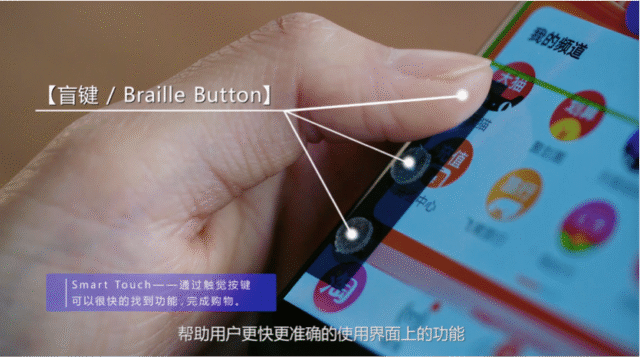
    E-commerce giant Alibaba has developed new technology to make it possible for blind and partially sighted people to shop online, according to an article on Alibaba’s news site Alizila. Alibaba plans to launch Smart Touch, an affordable silicone sheet that goes on top of smartphone screens, later this year. The plastic film includes three mini buttons on each side that sensory-enabled. Pressing on each one will trigger a different command, such as “go back”, “return to homepage” and “confirm”.

    Depending on the app, the buttons can lead to different destinations, such as “My Shopping Cart,” “Tmall Global,” and “Tmall Supermarket” in the Taobao app.

    Smart Touch is a joint effort of Alibaba’s Damo Academy and China’s Tsinghua University to improve the smartphone experience for the blind.
    The technology also has an “ear touch” feature, which gives blind and visually impaired users a simple way to listen to text clearly and privately in public, without the need for headphones. It senses when the users is holding the phone to their ear and automatically routes the sound output from the loudspeaker to the earpiece speaker.

    In October last year, Alibaba added Optical Character Recognition (OCR) technology to the pages of its online marketplace Taobao, an artificial intelligence-driven feature that reads text written on images.

    Before adopting OCR, Taobao’s 300,000 daily active users who are blind or have reduced vision would have used screen-reading software that simply announced “image” as it scanned the page. By early December, OCR was being used to read close to 100 million images per day, Alizila reported.

    “Images are becoming ever more important in the shopping experience,” said Wang Yongpan, algorithm specialist who led the OCR upgrade.

    “A typical product page on the site contains about 40 images, and most product specifications and descriptions are often found within images, rather than typed out in plain text.”

    Yongpan said that while Alibaba has been using OCR for many years in various capacities, the technology’s accuracy in reading images has grown exponentially due to advances in machine learning.

    According to Taobao president Jiang Fan, making the platform more inclusive, user-friendly and a home for creativity is part of its larger strategy.

    “If I had to do one thing this year, that would be to make Taobao simpler and bring [us] back to our original purpose,” he said.

    “Alibaba is famously known by its motto, ‘To make it easy to do business anywhere’.”

    The OCR launch was driven by Alibaba’s “Barrier-Free Lab”, which started with a handful of employees in 2011 and has since grown to hundreds of volunteers, ranging from programmers to user-experience designers.

    Now, similar tools can be seen across Alibaba’s ecosystem, expanding from Taobao to B2C e-commerce site Tmall, payments affiliate Alipay, online delivery platform Ele.me, enterprise chat app Dingtalk, navigation firm Amap, music streaming app Xiami and internet browser UC Web, from desktop to mobile.