Retail News CRM

Tag: DoCoMo

  • NTT DOCOMO GLOBAL & Accenture Pioneer Universal Wallet Infrastructure: A Leap Forward in Digital Trust Services

    NTT DOCOMO GLOBAL & Accenture Pioneer Universal Wallet Infrastructure: A Leap Forward in Digital Trust Services

    NTT DOCOMO GLOBAL and Accenture, two major players in the global tech industry, have recently entered into a partnership to create and grow a Universal Wallet Infrastructure (UWI) platform. This platform is designed to bolster digital trust services across diverse sectors, governments, and geographical locations.

    The infrastructure being developed by NTT DOCOMO GLOBAL and Accenture will permit organizations to issue, verify, and manage digital credentials and tokens associated with identity, payment, assets, and documents. A key focus of the platform is interoperability and compliance, ensuring secure data transfer while adhering to user consent and regulatory norms.

    As businesses and public institutions are under increasing pressure to safely handle data in progressively digital and AI-centric environments, demands for transparency and control over personal data usage are also rising among individuals. By integrating decentralized technologies with current enterprise systems, UWI seeks to address these issues, reducing dependence on centralized data structures.

    Establishing a Trustworthy Digital Environment

    The platform is designed to foster secure, real-time data sharing between organizations, while also facilitating AI-powered services at the network edge. Through enabling users to regulate access to their data, UWI aims to bolster trust and provide organizations with access to consent-based, verifiable information to support their operations, innovation, and customer services.

    Several potential applications of the UWI platform have been identified, encompassing government services aiming to decrease fraud and administrative burdens, employers managing recruitment and workforce mobility processes, and travel and transportation systems seeking to simplify identity verification across borders and service providers.

    Leadership Commentary

    Hiroki Kuriyama, President and CEO of NTT DOCOMO GLOBAL, spoke enthusiastically about the partnership, stating that it would speed up the global implementation of UWI, creating a new basis for digital trust worldwide. He also emphasized the growing importance of effective digital IDs and electronic credentials across national borders, highlighting the platform’s objectives of providing verifiable authentication and innovative trust models on a global scale.

    Atsushi Egawa, Chairman of Accenture, Japan, and co-CEO, Asia-Pacific, Accenture, also expressed optimism about the collaboration. He highlighted the synergies created by combining Accenture’s deep expertise in technology strategy, data, and AI with NTT DOCOMO GLOBAL’s well-established strengths in network infrastructure operations and advanced internet technologies. He believes this collaboration will pave the way for new AI-powered experiences that revolutionize how businesses and customers connect.

    Questions & Answers

    What is the main aim of the Universal Wallet Infrastructure platform?

    The platform aims to establish a secure and reliable digital trust environment, allowing organizations to issue, verify, and manage digital credentials related to identity, payments, assets, and documents.

    How will the UWI platform benefit its users?

    UWI will allow users to control access to their data, thereby increasing trust while providing organizations access to consent-based, reliable information to support their operations, innovation, and customer services.

    What potential applications does the UWI platform have?

    The platform can be utilized in numerous ways, such as reducing fraud in government services, streamlining recruitment and workforce mobility processes for employers, and simplifying identity verification in travel and transportation systems across borders and service providers.

  • NTT DOCOMO and NEC Test Energy Efficiency of AWS Graviton2 for 5G SA Core

    NTT DOCOMO and NEC Test Energy Efficiency of AWS Graviton2 for 5G SA Core

    NTT DOCOMO and NEC Corporation announced the completion of a trial to test the energy efficiency and high performance of AWS Graviton2 processors across key elements of the 5G core network (5GC). The trial demonstrated an average of a 72% reduction in power consumption against incumbent x86 processors using NEC’s 5GC software running on AWS Graviton2. The trial tested performance within a 5GC hybrid cloud environment leveraging AWS Graviton2 and DOCOMO’s on-premises Network Functions Virtualization (NFV) infrastructure.

    These results support the future realization of a hybrid cloud environment for telecommunication networks, which enables mobile operators to provide enhanced disaster-resilient networks to customers.

    AWS Graviton2 processors deliver a major leap in performance and help reduce the carbon footprint of IT workloads through energy efficiency. Traditionally, many telecommunication workloads need to reside on edge infrastructure, which have power and real estate constraints. AWS Graviton2 offers efficiency with very low cost, low power and a low hardware footprint. In this proof of concept, the use of Graviton2 reduced power consumption of 5GC by 72% on average.

    Following the completion of this first phase, the companies will now conduct a second phase trial to test the 5GC network function on AWS Outposts equipped with Graviton2 processors on DOCOMO’s premises.

    “We are delighted to announce that we achieved a significant reduction of power consumption of 5GC thanks to NEC’s advanced, cloud-native 5GC software and AWS’s innovative and highly efficient Graviton2,” said Naoki Tani, executive vice president, chief technology officer and executive general manager of the R&D innovation division of NTT DOCOMO. “We will continue collaborating on the PoC with NEC and AWS for future delivery of environmentally friendly and disaster-resilient 5G network service to our customers.”

    “The significant power reduction achieved through this trial indicates a big step forward in commercializing environmentally friendly, sustainable, next-generation mobile infrastructure. NEC will continue adopting cutting-edge, low-power technologies, such as Graviton2, for its UPF and vRAN domains. We aim to further contribute to building a sustainable society through provision of sustainable virtual networks and the realization of next-generation, low-power mobile infrastructure,” said Atsuo Kawamura, executive vice president, NEC.

    “Like many industries, telecommunications companies want to be able to ensure sustainability operations while maintaining the high-performance and quality of service their customers need and expect,” noted Adolfo Hernandez, vice president and general manager, telecom industry business unit at AWS. “AWS is committed to building a sustainable business for our customers and the planet and is thrilled to see the power savings Graviton2 delivers in telecommunications. We look forward to continuing to work with NTT DOCOMO and NEC to further expand the use of cloud and AWS technologies to advance sustainability and resiliency goals.”

  • Docomo to launch 5G soon

    Docomo to launch 5G soon

    The first phase will include building a non-standalone 5G system based on trials that have already started in 2017, she said, adding that spectrum will be allocated by end of March 2019. Docomo is striving to commercialize 5G services in 2020, just in time for the Summer Olympics in Tokyo.

    “Since the standardization is set, it’s time to consider how to deploy a 5G network. We need to strategically deploy 5G in the necessary areas, with the necessary functions, and with adequate frequencies,” Lan Chen said.

    According to her, the first element of a successfully built 5G network is its ability to adapt to the continuous growth in data traffic and handle new business cases across various industries.

    Docomo started to shift from being a global communications company into a value co-creation company by partnering with key actors in the vertical market. The main driver of this transformation was the daunting challenges mobile operators face across the world, in addition, to need to get ready for 5G.

    In February, the company launched its 5G Open Partners Programme, with more than 1,400 companies already joining the initiative. “Our aim is to use 5G technology to enhance the user experience and use AI technology to expand the market,” Docomo president and CEO said.

  • Docomo Pacific set to launch first VoLTE services for Guam and the CNMI

    Docomo Pacific set to launch first VoLTE services for Guam and the CNMI

    As part of the rollout of the next generation of wireless technology, DOCOMO PACIFIC is preparing to launch the first VoLTE services in Guam and the CNMI.

    VoLTE or Voice over Long-Term Evolution allows customers to place a phone call over your LTE connection instead of the traditional voice network, resulting in high-definition (HD) Voice services providing clearer audio quality.

    VoLTE lets you experience HD Voice calls with minimal background noise, making it much easier and clearer for both people on a call to hear one another. The mixture of voice and data to make calls will produce faster call setup times and quicker connections. Additionally, VoLTE services are less power-intensive than calls being made over a 3G connection, resulting in better battery life.

    VoLTE allows the efficient use of network resources, helping to lower operational costs. With the use of VoLTE, voice traffic is routed over the 4G LTE network used to transmit data, freeing up spectrum for the 5G technology that DOCOMO PACIFIC will launch soon.

    On June 19th, DOCOMO PACIFIC engineers made the first commercial VoLTE call on Guam and the following day they made the first VoLTE call to Saipan. The commercial launch of VoLTE services will begin to roll-out in July 2019 for VoLTE capable devices on DOCOMO PACIFIC’s network. VoLTE services will be an added value to our existing services and will not come at any additional cost.

    “DOCOMO PACIFIC is excited to be the first to bring another innovative service that improves the voice quality of calls for our customers in the Marianas. VoLTE is the future of voice communications and we can’t wait for our customers to have a higher quality experience while talking with family and friends. As we prepare to launch 5G technology soon, VoLTE is another step in our journey to be the technology leader and bring the best and fastest services to our customers,” DOCOMO PACIFIC President and CEO Roderick Boss said.

    In March 2019, NTT DOCOMO was the first to bring 5G to Guam with the opening of the DOCOMO 5G Open Lab Guam. The 5G Open Lab allows worldwide partners including businesses on Guam to test the first 5G environment and co-create practical solutions using 5G.

  • Docomo, Ericsson complete 5G glass antenna trial

    Docomo, Ericsson complete 5G glass antenna trial

    Japanese operator NTT Docomo and glass solution provider AGC Group have collaborated with Ericsson to complete what the companies believe to be the world’s first trial of 5G communications using a glass-embedded antenna.

    The trial used an antenna embedded in synthetic fused silica glass to transmit and receive 28-GHz 5G radio signals.

    Validation testing used a vehicle fitted with multiple antennas and traveling about 30 km/h. Using the antenna, the companies achieved downlink speeds averaging 1.3Gbps within a 100 meter range, and maxing out at 3.8Gbps at 400 MHz.

    The glass antenna prototype has the potential to overcome challenges associated with high-band 5G spectrum being unable to adequately penetrate windows, the companies said.

    It could potentially be attached to window surfaces in buildings, vehicles and railway cars to enable stable, high-speed 5G communications under challenging indoor and in-vehicle conditions.

  • Docomo, Tohoku Uni to use AI for gum disease detection

    Docomo, Tohoku Uni to use AI for gum disease detection

    NTT Docomo and Tohoku University have launched a research initiative to jointly develop a service using AI technology to detect periodontal disease.

    The AI-based service will photograph a person’s gums with a smartphone and analyze gum color and shape, compensating for photo brightness and camera shake, to determine the risk of periodontal disease.

    Docomo said the service combines the operator’s expertise in AI technology with Tohoku University’s expertise in oral diseases and extensive data on medical examinations and research.

    It provides a practical, everyday solution to help users to understand their personal risks by facilitating better communication with dentists and increased examinations aimed at preventing early-stage periodontal disease from becoming serious.

    Docomo and Tohoku University also plan to use their AI technology for the detection of additional oral diseases, such as temporomandibular disorders and oral cancer.

    A device-based tool for determining disease risks is slated for commercial launch by March 2023.

    In Japan, periodontal disease is present in 61% of adults in their 20s, 71% in their 40s and 75% in their 60s, according to a survey conducted by Japan’s Ministry of Health and Welfare in 2016.

    Confirmation of the disease requires going to dental office to be examined, which is often inconvenient for working people.

    The Japanese Society for Oral Health Magazine estimated in 2018 that only 4.3% of people between the ages of 40 and 70 receive examinations and many do not consult dentists until symptoms become severe.

  • Japan bans handset-mobile service bundles

    Japan bans handset-mobile service bundles

    The Japanese government has passed a new bill aimed at reducing mobile prices for consumers and stimulating competition in the mobile market. The new bill includes provisions banning operators from offering bundled device and mobile plans under a single price package.

    The new law, which is due to take effect as early as the third quarter, is aimed at addressing a practice that consumers and lawmakers have complained make it difficult to compare prices between operators.

    Incumbent operators NTT Docomo, SoftBank and KDDI have been under pressure to reduce their mobile charges to help alleviate the financial pressure on consumers. As part of its efforts, the government has been seeking to address the issue of mobile operators offering device subsidies in exchange for relatively high prices for mobile services.

    Responding to this pressure, Docomo last month introduced a simplified fee structure that it says will have the effect of reducing mobile rates by up to 40%, and its rivals are considering following suit.

    The amended legislation also introduces new penalties for companies using misleading sales tactics, as well as a new registration requirement for handset retailers for regulatory purposes.

  • Docomo, Itochu Logistics test IoT for delivery-fleet management in US

    Docomo, Itochu Logistics test IoT for delivery-fleet management in US

    Japan’s NTT Docomo and Itochu Logistics are planning to trial an IoT solution for delivery fleet management in the US.

    The solution uses devices compatible with low-power, wide-area LTE-M technology to track the status of outsourced trucks in their fleets.

    The trial will begin in the United States on May 1, 2019.

    According to the companies, the solution involves placing hand-held, battery- or solar-powered devices in trucks to collect data, such as truck locations and frequency of sudden braking, which will be sent through an LTE network to a dedicated website.

    The solution can also provide temperature, humidity, brightness, etc. data depending on delivery needs, as well as notify customers via email when the trucks approach their destinations.Itochu Logistics USA expects to save time using the solution compared to the conventional method of manually phoning drivers to confirm their locations and estimated delivery times.

    The solution will be tested for its effectiveness in supporting the management and safety of truck fleets at Itochu Logistics USA’s delivery-trick network and logistics system.

    “While most delivery trucks are equipped with GPS devices, the location data typically is available to the owner but not to logistics/transport companies that retain the trucks on an outsourced basis,” the companies said.

    “The solution’s easily deployed LTE-M devices, however, will give logistics/transport companies dedicated access to location and other useful information about trucks operating temporarily in their fleets.”

    The trial is part of the Globiot global-IoT initiative that Docomo launched on July 2, 2018.

    The Japanese mobile giant said it expects the solution will be marketed widely throughout US, Japan, and Asia.

  • Docomo to cut mobile rates by up to 40%

    Docomo to cut mobile rates by up to 40%

    Japan’s NTT Docomo has announced a new simplified mobile service fee structure that the operator says will reduce mobile charges by between 20% and 40%.

    The operator plans to completely separate handset and service fees and unify voice, SMS and data charges in response to criticism that its existing plans have been too complicated and hard to understand.

    The new plans are divided into two categories – a “Gigalight” plan which will charge based on data consumed, and a flat rate “Gigaho” plan for heavy data users.

    Docomo also plans to start offering family discounts of 500 yen ($4.46) per month for contracts covering two family members, and 1,000 yen per month for contracts with three or more members.

    Docomo’s new fee structure is also a response to pressure from the Japanese government on operators to reduce mobile service fees to bring them in line with prices in comparable markets.

    The operator expects that the new fee structure could reduce its income by as much as 400 billion yen ($3.6 billion) per year.

  • Japanese telcos assigned 5G spectrum

    Japanese telcos assigned 5G spectrum

    Japan’s telecom ministry has allocated 5G mobile spectrum to incumbent operators NTT Docomo, KDDI, and Softbank, as well as local e-commerce giant Rakuten.

    The Ministry of Internal Affairs and Communications has approved the allocation of spectrum after determining that the companies’ applications met the conditions of the allocation.

    The four companies plan to invest heavily in 5G, spending a combined 1.6 trillion yen ($14.4 billion) over the next five years. Docomo is planning the largest spend, with goals to invest at least 795 billion yen in 5G over this time.

    The four plan to commence commercial 5G services in 2020, with KDDI and SoftBank planning to commence advertising for its services in March.

    Rakuten Mobile, Japan’s upcoming newest market entrant, meanwhile plans to commence 4G services in October 2019 and 5G services in June 2020.

    The conditions for the allocation of spectrum included commitments to commence services in every prefecture of the nation within two years, and set up 5G base stations in at least half the country within five years.

    According to the report, Docomo and KDDI are each targeting more than 90% 5G population coverage by the end of the five years, while SoftBank is targeting 64% coverage while Rakuten is aiming for 56%.

  • Docomo Ventures invests in Singapore’s Kpisoft

    Docomo Ventures invests in Singapore’s Kpisoft

    NTT Docomo Ventures, a wholly owned subsidiary of NTT Group, has made an investment in Singapore-headquartered cloud-based enterprise management solutions provider Kpisoft.

    NTT Docomo Ventures has acquired shares of Kpisoft through its third-party allotment, the company said. Financial details of the transaction were not disclosed.

    According to Docomo Ventures, the solution provided by Kpisoft is designed to analyze data that exists in EPM, BI, human resources management and other relevant systems within an enterprise on a single platform.  The solution has a function that can automatically distribute the analytical findings directly to individual employees in an action proposal form by using machine learning and natural language processing.

    This enables enterprises to make use of analytical findings on enterprise performance and directly and automatically support the actions of individual employees, the company noted.

    Docomo Ventures further said it has made the investment because it “highly expects” the services and knowhow Kpisoft provides will bring added values to EPM or BI the NTT Group offers.

    Reliance Jio Digital Services acquires Haptik

    Meanwhile India’s Reliance Industries, through its subsidiary Reliance Jio Digital Services, has acquired artificial intelligence firm Haptik for Rs 700 crore ($100 million).

    Reliance Jio will hold about 87% of the business with the rest being held by Haptik founders and employees through stock option grants, according to a company release.

    As part of the transaction, Haptik’s existing major shareholder Times Internet will exit the company.

    Akash Ambani, director at Reliance Jio Digital Services said the acquisition underlines the company’s commitment to further boost the digital ecosystem and provide Indian users conversational AI enabled devices with multi-lingual capabilities.

    “We believe voice interactivity will be the primary mode of interaction for Digital India,” Ambani said in a statement.

    “We are delighted to announce this partnership, and look forward to working with the experienced team of Haptik in realizing this vision for offering greater connectivity and rich communication experiences to the billion+ Indian consumers.”

    Founded in 2013, Haptik is chat based virtual concierge mobile application. It client base includes Samsung, Coca-Cola, Future Retail, KFC, Tata Group, Oyo Rooms and Mahindra Group.

    The Haptik team will continue to drive growth of the business, including the enterprise platform as well as digital consumer assistants.

    “This transaction enables Reliance Jio to leverage Haptik’s capabilities across various devices and touch points in the consumer’s journey. The investment focus is on enhancement and expansion of the platform, with an addressable market opportunity of over 1 billion users in India,” the company said in a statement.

  • HTHKH to buy full control of mobile business

    HTHKH to buy full control of mobile business

    Hutchison Telecommunications Hong Kong Holdings (HTHKH) has arranged to buy out Japan’s NTT Docomo‘s share of its mobile businesses for $60 million.

    Under the agreement, HTHKH will acquire Docomo’s 24.1% interest in Hutchison Telephone Company Limited (HTCL) and its 24.1% stake in Hutchison 3G Hong Kong Holdings (H3GHK), making both companies wholly-owned subsidiaries.

    In an announcement, HTHKH said acquiring full control of its mobile business will increase the value of HTHKH shares, enhance operational efficiency and save costs by eliminating resources expended on shareholder communications.

    The transaction is expected to close on May 31. HTHKH plans to use the proceeds from the disposal of its fixed line business in 2017 to pay for the purchase.

    HTHKH and Docomo have agreed to discuss potential ways of extending their mutually beneficial relationship despite no longer being tied through a shareholder relationship.

    The companies have agreed to enter a consultation and cooperation agreement upon the closing of the transaction to explore the feasibility of collaboration in the field of mobile telecommunications products and services.

  • Docomo to expand overseas 5G trials

    Docomo to expand overseas 5G trials

    Japan’s NTT Docomo has arranged with partners in the US, Israel and Japan to collaborate on 5G trials in Guam, with the aim of verifying 5G-compatible systems and equipment for business solutions.

    Under the collaboration, NTT Docomo will provide the 5G test network, while solution partners will provide 5G-based products and services for use by testing by local field partners.

    These field partners comprise the electricity utility Guam Power Authority, the University of Guam, local wedding services provider ARLUIS Wedding Guam and United Airlines Guam.

    The Guam Power Authority will test 5G VR training solutions provided by Israel’s Humaneyes Technologies, as well as 5G monitoring with AI technology developed by Aegis Systems.

    The University of Guam office of IT will test a 5G AI-based robot system for identifying examinees from PLEN Robotic, and 5G monitoring with AI technology from US-based Smart Home Sentry.

    ARLUIS Wedding Guam will test a 5G multi-screen video live streaming solution from AMATELUS, while the United Airlines Guam Marathon Organizer will test a series of 5G drones, tourism, sports photo upload and 5G robotics solutions.

    Docomo also announced that it has opened a new 5G Open Lab in Guam, its first center outside of Japan for testing and verifying 5G technologies.

    A number of Japanese and overseas companies have already announced an intention use the facility to collaborate on cross-border 5G testing in partnership with Docomo.

  • Docomo trials fiber manufacturing IoT in Thailand

    Docomo trials fiber manufacturing IoT in Thailand

    NTT Docomo and its Singapore subsidiary NTT Docomo Asia have commenced a trial of an IoT monitoring system to improve the manufacturing performance of a synthetic-fibers factory in Thailand.

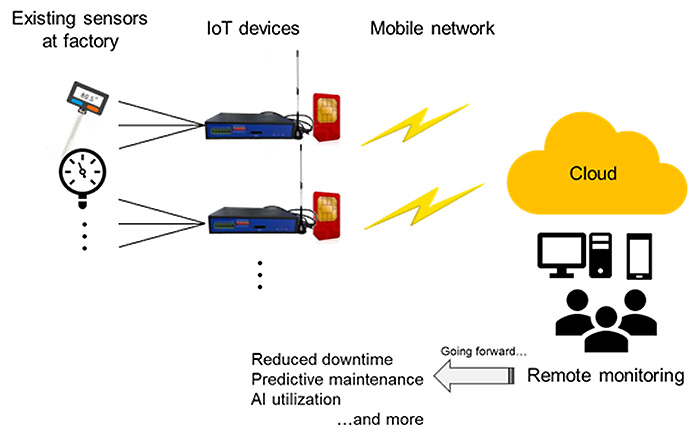
    In the trial, Docomo Asia is deploying the IoT Solution Platform to visualize the operational status of production operations in the Thai factory.

    Docomo said IoT devices equipped with up to 30 different sensors are collecting operational information on the factory floor and then transmitting real-time data to the cloud via a mobile network.

    “Technicians will be able to use PCs, smartphones or tablets to remotely monitor the status of production operations via the platform,” Docomo said in a statement.

    “The IoT Solution Platform enables manufacturers to digitalize their operations and rapidly gather information from factory floors for improved efficiency in production management.”

    It also helps to reduce production downtime by allowing manufacturers to closely monitor the status of their production equipment to detect malfunctions, maintenance needs and so on, the Japanese mobile carrier said.

    NTT Docomo fabric manufacturing IoT trial in Thailand

    Service scheme (Source: NTT Docomo)

    According to Docomo, the platform is already being used by an automotive plastic parts manufacturer and is now being introduced in the textile industry to enable manufacturers to realize more efficient and reliable production operations.

    The trial is part of Docomo’s global IoT initiative launched last July to provide global connectivity, operational support, and consulting to Japanese manufacturers with global IoT operations.

    The trial will be conducted until March 31, and is being conducted in collaboration with Teijin Polyester (Thailand) Limited, a Teijin Frontier subsidiary company that manufactures polyester fibers, filament yarn, chips and more.

    Docomo expects manufacturers of synthetic fibers and other products across Southeast Asia to increasingly adopt the IoT Solution Platform to increase the productivity and quality of their production operations going forward.

  • Docomo invests in semiconductor startup QD Laser

    Docomo invests in semiconductor startup QD Laser

    Japanese mobile giant NTT Docomo, through its subsidiary NTT Docomo Ventures, has invested in QD Laser for an undisclosed amount.

    QD Laser – which was founded in 2006 as an offshoot of Fujitsu Ltd with funding from Mitsui Ventures – develops and manufactures semiconductor lasers, retinal scanning laser eyewear, and other products based on quantum dot laser technology.

    By leveraging its nanocrystal technology, the Kanagawa-based firm achieved mass production of quantum dot lasers capable of operating stably even at high temperature.

    In 2018, QD Laser applied its technology to incorporate a compact laser projector with extremely small output into a spectacle-type device, and commercialized what was claimed to be the world’s first retinal scanning laser eyewear that directly projects an image onto the user’s retina for image display.

    The technology for projecting a direct image onto the retina using a laser does not require the user to focus their eyes to see an image, so it is expected to improve the quality of life of patients with ametropia or corneal opacity and weak-sighted individuals.

    The technology can also be applied for realizing natural-looking augmented reality (AR) that people with normal vision can experience.

    Docomo said it has high expectations for potentials of the retinal scanning laser eyewear developed by QD Laser for resolving various social issues and contribute to creating new services through AR.