Retail News CRM

Tag: DOT

  • Starbucks pilots ‘Green Dot’ AI virtual assistant tool

    Starbucks pilots ‘Green Dot’ AI virtual assistant tool

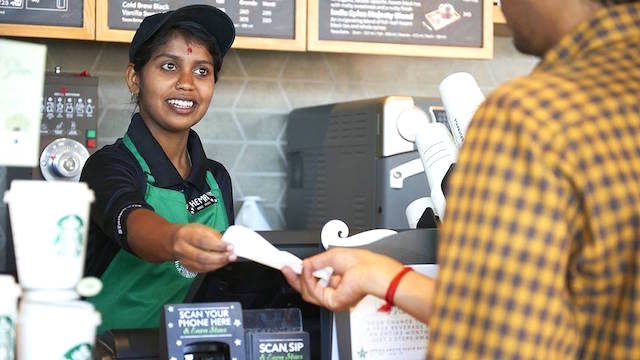
    Starbucks has initiated a testing phase for a novel artificial intelligence (AI)-driven virtual assistant, Green Dot Assist, across 35 outlets in the United States and Canada. This innovative tool is designed to offer immediate, conversational answers to baristas’ queries, thereby eliminating the necessity to consult manuals or conduct online searches for information.

    Green Dot Assist is intended to facilitate easy access to key information, bolster baristas’ confidence and familiarity with products, and ensure smooth workflow. As an example, Starbucks cited how Green Dot Assist could swiftly refresh a barista’s memory about ingredients in a seasonal beverage.

    Starbucks has expressed that this tool aligns with its broader strategy to minimize friction in the workplace and give baristas more time to concentrate on preparing beverages and interacting with customers.

    The AI assistant, powered by Microsoft Azure’s OpenAI platform, is expected to automate technical alerts and staff scheduling adjustments in the near future.

    Following the completion of this trial phase, Starbucks intends to extend the usage of Green Dot Assist to more outlets.

    Questions & Answers

    What is the purpose of Starbucks’ Green Dot Assist?
    Green Dot Assist is an AI-powered virtual assistant designed to facilitate easy access to key information, bolster baristas’ confidence and familiarity with products, and ensure smooth workflow in Starbucks outlets.

    How does Green Dot Assist work?
    Green Dot Assist provides immediate, conversational responses to baristas’ queries, eliminating the need for staff to consult manuals or search for information online.

    What are the future plans for Green Dot Assist?
    Following the completion of its testing phase across select outlets in the US and Canada, Starbucks intends to extend the implementation of Green Dot Assist to more locations. The AI assistant is also expected to automate technical alerts and staff scheduling adjustments in the future.


  • India Targets to Roll Out 6G by 2030

    India Targets to Roll Out 6G by 2030

    At an event celebrating the Telecom Regulatory Authority of India’s (TRAI) 25th anniversary, Prime Minister Narendra Modi said that the country is on track to roll out domestically developed 6G by the end of the decade.

    Currently, India’s 5G developments are still underway. Modi noted that connectivity will determine the pace of India’s growth, making it important for the country to pursue modernization at every level.He called for accelerated 5G network deployments to boost the Indian economy, which is projected to add $450 billion to the country.

    “5G technology will bring positive change in the governance of the country, ease of living and ease of doing business,” Modi stressed. “It will boost growth in agriculture, health, education, infrastructure and logistics.”

    At the same time, Modi announced the country’s first 5G testbeds, which would enable start-ups and industry players to test and validate their products locally and reduce dependence on foreign facilities.

    The Telecom Regulatory Authority of India (TRAI) had recommended a base price for upcoming spectrum auctions. According to sources, the Department of Telecommunications (DoT) is likely to move the 5G spectrum auction proposal to the Union Cabinet for approval next week.


  • TRAI releases consultation paper on satellite gateway

    TRAI releases consultation paper on satellite gateway

    Telecom Regulatory Authority of India (TRAI) has extended an invitation to industry stakeholders to gather inputs on a framework for satellite gateways in India. This will facilitate the launch of satellite communication services in India.

    Prior to this, the Department of Telecommunications (DoT) has requested TRAI to furnish recommendations on licensing framework for establishing a satellite gateway. DoT has requested TRAI to address existing limitations in satellite gateway operations as there is no provision regarding the use of gateway by service providers established by a satellite constellation operator.

    The regulator is called to look into factors and make recommendations on entry fee, license fee, bank guarantee, NOCC charges, and other issues which may concern LEO, MEO and HTS systems.

    TRAI has since released a consultation paper to garner inputs by 13 December.

  • DoT orders telcos to surrender 3.3-GHz spectrum

    DoT orders telcos to surrender 3.3-GHz spectrum

    India’s Department of Telecom (DoT) has instructed operators including incumbent Bharti Airtel to vacate spectrum in the 3,300-MHz to 3,400-MHz range by the end of September so it can be included in a new auction.

    The operator has written to all existing licensees of spectrum in the band to vacate it within six months.

    The 3.4-GHz band is expected to be one of the first frequencies to be used for 5G rollouts globally.

    Other licensees of the band include Reliance Communications – which is selling its wireless assets to Reliance Jio Infocomm, Tata Communications – whose parent company is reportedly looking to exit the telecoms business, and wireless ISP Dishnet Wireless.

    According to the report, Dishnet parent Aircel has already surrendered the spectrum. The operator filed for bankruptcy last month.

    The DoT plans to hold a major auction for spectrum in the 700-MHz, 800-MHz, 900-MHz, 1800-MHz, 2100-MHz, 2300-MHz, 2500-MHz, 3300-MHz, and 3400-MHz to 3500-MHz bands during the next auction.

    The ministry appears to be pressing ahead with the auction despite fears over the perilous financial state of the mobile industry, and against the wishes of operators who had asked for more time to pay off existing spectrum fees and other debts.