Tag: DTZ

  • Hong Kong still tops Asian retail rent rankings

    Hong Kong still tops Asian retail rent rankings

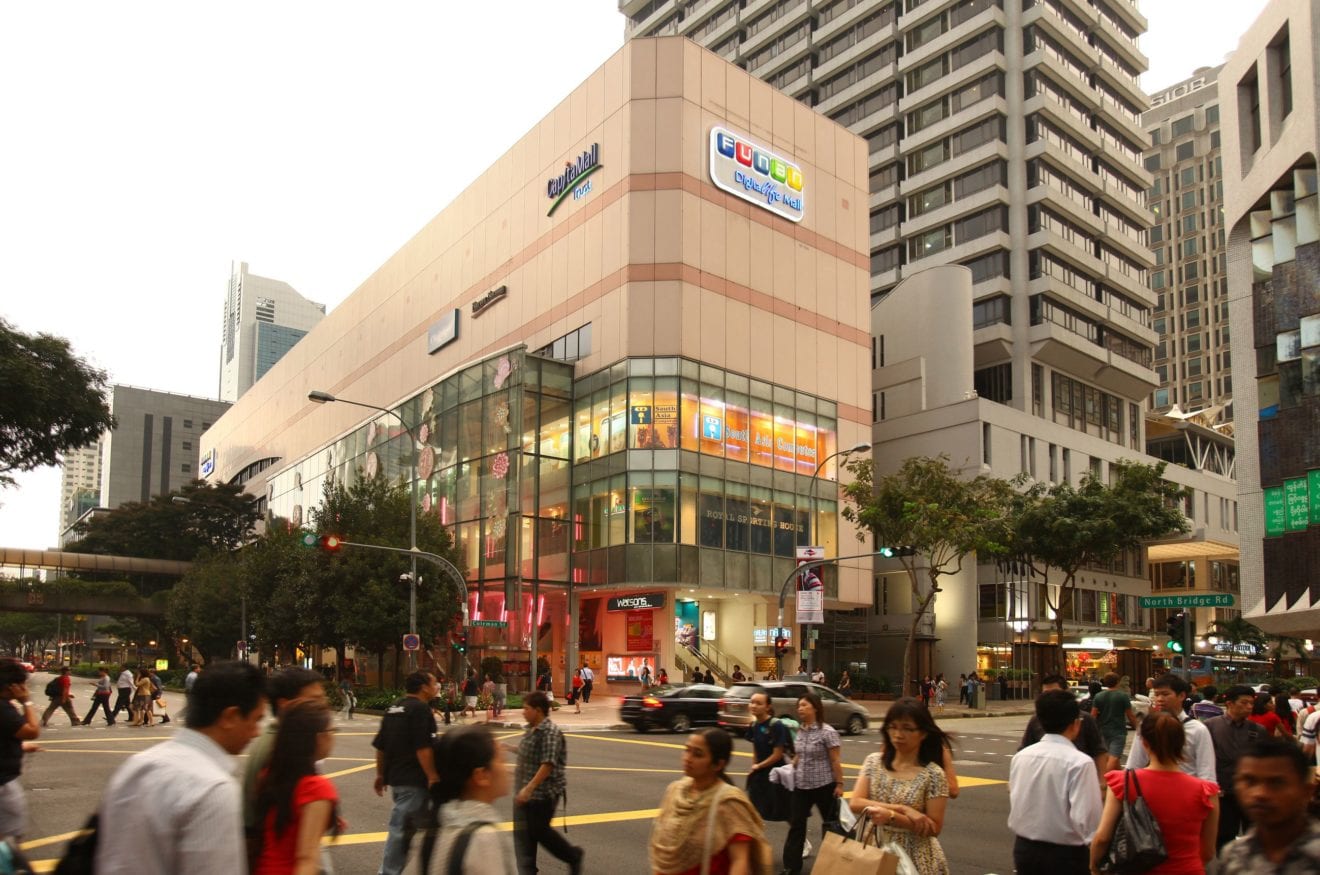
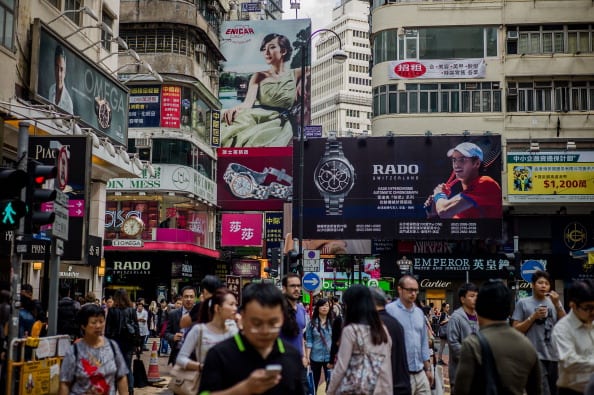
    Tokyo’s Ginza has overtaken Sydney into second spot behind Causeway Bay in the latest DTZ/Cushman & Wakefield Asian retail rent rankings.

    The annual Main Streets Across the World report tracks 462 of the top retail streets around the globe, ranking them by their prime rental value.

    Globally just 36 per cent of the markets witnessed an increase in rent rates, a reflection of the growing power of eCommerce and economic challenges in many economies around the world.

    New York’s Upper 5th Avenue, which saw its first decrease in annual rents per square foot since the financial crisis, and Causeway Bay remain more than twice as expensive as the leading street in any other country. So while Causeway Bay rents fell year-on-year, it had no impact on its ranking.

    But DTZ/Cushman & Wakefield says the downward pressure on Hong Kong retail rents is creating an opportunity for some retailers looking to snap up units on prime pitches in good rental terms.

    In Asia, Beijing’s Wangfujing has lept two places into eighth at the expense of Guangzhou’s Ti Yu Zhong Xin District, and Kuala Lumpur’s Pavilion has fallen one spot to 12th. Ho Chi Minh City in Vietnam has jumped two spots to 14th and is now more expensive than Auckland, Nanjing and New Delhi.

    DTZ/Cushman & Wakefield commentators say advances in technology will shape the consumer experience of retail as well as drive the way how people shop and live in the future, placing more pressure on retail rents.

    “We have seen an increasing number of retailers in Hong Kong continually enhance shoppers experience through leisure offerings and differentiate their market positions to maintain competitiveness under the impact of eCommerce disruption,” said Kevin Lam, DTZ/Cushman & Wakefield’s head of business space, Hong Kong.

    Key fact APAC

    “Though we could see that some high street rents were close to the bottom in Q3, eCommerce disruption so far on rents is rather indirect in view of close proximity in Hong Kong.”

    Elsewhere, Chinese brick-and-mortar retailers are facing stiff competition from the growing eCommerce market and the emerging trend is to partner with online-to-offline platforms in an attempt to capture these changing trends in consumer behavior. In parallel, both retailers and landlords are raising the bar on the experience offered to consumers by expanding the food and beverage and leisure offerings.

    Theodore Knipfing, Cushman & Wakefield’s, head of retail, Asia Pacific, says retailers continue to be cautious in their store expansion across the region due to concerns including continued global economic instability, and this will continue well into 2017.

    “When expansion does happen, the focus is typically on quality over quantity. All in all, despite the cautious outlook across the region, major international and regional retailers will have to eye overseas growth, as their respective domestic markets reach saturation point and investors demand results.”

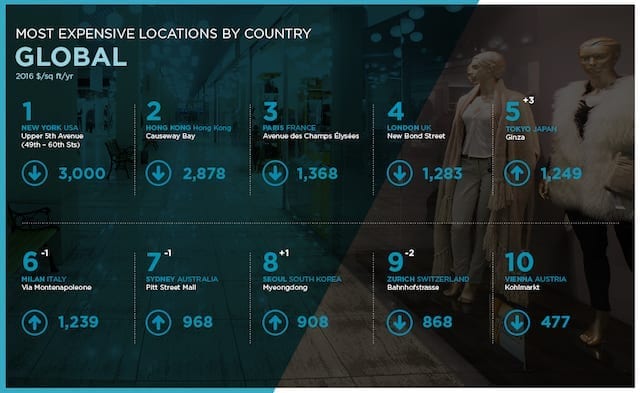
    Most expensive locations by city Pacific chart

    Global rankings

    In the global rankings, the Champs Elysees in Paris comes third followed by New Bond St, London, Tokyo’s Ginza and the Via Montenapoleone in Milan. Pitt St mall in Sydney is seventh followed by Seoul’s Myeongdong district, the Bahnhofstrasse in Zurich and Vienna’s Kohlmarkt.
    global

  • Singapore retail now ‘a tenant’s market’

    Singapore retail now ‘a tenant’s market’

    Singapore retail is now “a tenant’s market”, realtors warn in the wake of official data showing further decline in boath rental rates and occupancy levels.

    According to URA data out today (April 22), retail rents fell by 1.9 per cent in the first quarter of 2016, following a full year decline of 4.1 per cent in 2015. That’s the fifth consecutive quarter in which a decline has been recorded, and the latest figure is higher than the 1.3 per cent of the preceding three months.

    For retail space in the Central Area (which includes the Downtown Core, Orchard and Rest of Central Area), the rental index was down 2.1 per cent quarter-on-quarter.

    Occupancy rates also dipped, falling by 0.1 percentage point quarter-on-quarter to 92.7 per cent in the three months to March 31.

    In the Central Region, vacancies were up at a five-year high of 8.7 per cent by March 31, up from 8 per cent at the end of December. In the key orchard Planning Area, the occupancy rate dropped by 1.2-percentage points quarter-on-quarter to a five-year high of 8.8 per cent.

    “With a subdued retail landscape, landlords are placing greater emphasis on maintaining occupancy levels, more so than maintaining rental values in this challenging period,” commented Lee Na Jia, regional head of research with DTZ.

    “Should landlords be inflexible during rental negotiations, tenants can go elsewhere especially with the relatively large pipeline supply coming on-stream [215,000 sqm of GFA in the middle six months of 2016]. At this moment in time, it can be considered a tenant’s market as they will have more choices,” said Lee.

    “Moreover, declining retail sales, competition from eCommerce and rising operating costs also work against brick-and-mortar retailers. If businesses underperform, they exit the market.”

    Retailers who have recently announced their withdrawal from Singapore include Smoothie King, fashion chain New Look and furniture store Iwannagohome.

    Anthea To, senior associate director of research and advisory with Colliers International, said the continued easing of retail rents is unsurprising, as leasing momentum slowed and vacancies rose.

    “By and large, retailers remained cautious on their real estate requirements in the first quarter of 2016, amid growing economic uncertainties.”

    She noted a 32.4 per cent drop in the number of leasing deals being struck in the last quarter, according to details sourced from URA Realis – to 1725 transactions. That’s the lowest quarterly number since the second three months of 2012.

    Bleak outlook

    Anthea To fears the current economic headwinds might continue to erode consumer confidence in turn leading to a further reduction in discretionary spending in the city state as shoppers fear pay cuts or job losses.

    “Given retailers’ expected cost-conscious stance, landlords would also be more realistic on rental expectations for the rest of 2016. This would weigh down on retail rents in the coming quarters.”

    To expects retailers to respond to the depressed retail market with store network consolidation, greater focuses on eCommerce and customer engagement in-store, and new products, trying to keep their brick-and-mortar stores relevant to an increasingly digital-savvy market.

    “However, not all retailers are focusing on the digital world. Major retail brands are still committed in physical store expansion which allows them to offer more products, services and new shopping experiences under one roof,” said To.

    “While rents in the Central Area are on a downward trend and are under pressure to fall further, some brands are taking the opportunity to optimise their store portfolios and open new flagship stores to strengthen their branding.”

    Colliers expects retail demand will continue to be coming from international lifestyle and fashion brands showing strong interest for flagship and new concept stores, and local players in sectors such as health and beauty, as well as leisure and personal goods.

    Lee Na Jia concluded that Singapore landlords recognise the current market challenges and are more inclined to lowering rental reversion rates to retain tenants. Older malls are also constantly undergoing rejuvenation (such as changing their tenant mix and external facades) to keep up with competition from the new malls.

  • Singapore retail rents fall

    Singapore retail rents fall

    Singapore retail rents are falling according to the latest figures from real-estate company DTZ Southeast Asia.

    Average monthly first-storey rent across the island eased by 1.2 per cent quarter-on-quarter to about S$30.15 (US$22.22) a sqft in the first quarter this year, says the company – the fourth consecutive quarter of decline. This is 7 per cent down on a year ago.

    Headwinds continued in the retail market in Orchard/Scotts Rd, as average monthly first-storey rent there fell 1 per cent to about $37.65 a sqft..

    According to the latest Singapore Urban Redevelopment Authority (URA) statistics, the occupancy rate in the area fell by 2.1 points to 92.3 per cent last year, the lowest since 1996.

    Retailers in Orchard/Scotts Rd are expected to face pressure, especially in the face of regional competition from Bangkok, South Korea and Taiwan, which offer affordable shopping. Cheaper air fares coupled with a relatively strong Singapore dollar made shopping more expensive in Singapore, and also contributed to weaker retail sales.

    In the other city areas, the occupancy rate dropped by 1.6 points to 91.6 per cent, and average monthly first-storey rent fell by 2 per cent to $21.35 a sq ft.

    Rents were also pressured by the relatively large impending supply this year: mixed-use projects slated for completion include OUE Downtown Gallery, Tanjong Pagar Centre and Duo Galleria.

    In similar vein, the occupancy rate in suburban areas fell by 1.4 points to 92.0 per cent, and average monthly first-storey rent subsided 1 per cent to about $31.40 a sqft.

    Service critical

    DTZ director of retail Anna Lee says quality of service has become even more critical for onground retailers.

    “With competition from eCommerce coming at full force, retailers are placing greater emphasis on providing highly personalised services. Many have revamped stores to include private rooms and lounge areas with superior furnishings.”

    An example is the new Tiffany & Co outlet at Ion Orchard. Apart from being the brand’s first street-facing store in Singapore, the two-storey outlet also showcases a private viewing space with custom furnishings. Another example is Dior, which has also had a revamp at Ion Orchard. It now has lounge areas, marble features and luxurious carpets, and has added a personal stylist to provide shoppers with fashion advice.