Tag: durex

  • Durex maker looking for greater penetration in Indonesia

    Durex maker looking for greater penetration in Indonesia

    Reckitt Benckiser is aiming to expand its presence in Indonesia’s consumer market as the British multinational company plans to introduce several new brands.

    “We’re looking for an aggressive product and portfolio expansion. We’ll continue to work on building brands, entering new categories. The products will come in the near future,” Reckitt Benckiser Indonesia president director Ratanjit Das said during a recent interview.

    Das, however, declined to provide details regarding the brands or their expected launch schedule. The new brands will add to its list of 20 brands already being marketed in Indonesia, such as Durex condoms, Dettol antiseptic, Vanish stain remover and Strepsils throat lozenges.

    To deepen its presence, the company will meet head-to-head with its major competitors, namely Anglo-Dutch Unilever, American SC Johnson and Son and Japan’s Kao.

    Das said he was confident in the Indonesian market, citing the country’s relatively higher disposable income on the back of falling inflation and greater media use.

    “Consumers are becoming more and more aware of household products through the media. Therefore they’re ready to spend and more willing to experiment. So in the future, I would say it will be good for the FMCG [Fast Moving Consumer Goods] business, as well as for us,” he said.

    Data from the World Bank show that Indonesia’s GDP per capita rose significantly in the 2004-2014 period. GDP per capita stood at US$3,491.9 in 2014, an increase of more than three times from $1,150.3 in 2004.

    The Boston Consulting Group has also projected that 8 to 9 million people are expected to enter the middle-income bracket every year in Indonesia, until the total reaches 141 million in 2020.

    According to Reckitt Benckiser, the use of digital media has increased, especially social media like YouTube, and has helped the company advertise its products. At present, it primarily uses digital media to advertise its Durex products due to existing restrictions on condom advertising on television.

    Despite the company’s growing preference for digital media, offline activities still dominate Reckitt Benckiser’s marketing activities. For instance, it partners with the Health Ministry and the Indonesia Doctors Association (IDI) in its Healthy Life Mission campaign to introduce Dettol antiseptic at community centers.

    The company currently operates two factories in Cileungsi, West Java, and Semarang, Central Java.

    In terms of costs, Das said the exchange rate remained one of its biggest business challenges as many products were still imported. High logistics costs amid a lack of proper infrastructure are also two items of concern.

    No specific financial details are available regarding the company’s operations in Indonesia. However, its latest financial report reveals that 31 percent of its £719 million ($956.68 million) revenues in the first quarter of 2016 were generated from developing markets, including Indonesia.
  • Condom sales slump as China announces end to one child policy

    Condom sales slump as China announces end to one child policy

    Shares of companies that make nappies, prams and infant formula got a boost on Friday from China’s decision to scrap its one-child policy. But for the maker of a popular brand of condoms, it was not the brightest of days.

    Investors are betting on a bump in sales for companies with baby or child-related businesses after China’s ruling Communist Party announced that all married couples would be allowed to have two children. The economic repercussions travelled as far afield as New Zealand, where the currency of the dairy-exporting country surged.

    Analysts at investment bank Credit Suisse estimated that the relaxed controls would result in an extra 3-6 million babies born annually in the five-year period starting in 2017. China, the world’s most populous country with nearly 1.4 billion people, has about 16.5 million births each year.

    The one-child policy began in 1979 to curb a surging population at a time when extreme poverty was widespread in China.

    The Credit Suisse report said that with the annual cost of raising a child estimated at 40,000 yuan ($6,330), the extra births would translate into an extra 120-240 billion yuan ($19-38 billion) in consumer spending a year, or 4-6 per cent of China’s total retail sales.

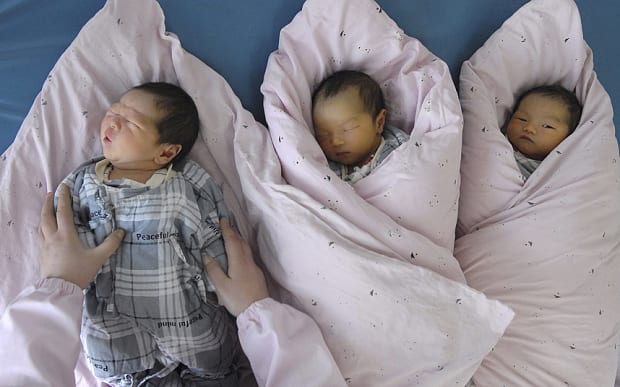
    A nurse takes care of newborn infants at a hospital in Huai'an, Jiangsu provinceA nurse takes care of newborn infants at a hospital in Huai’an, Jiangsu province  Photo: Patty Chen/Reuters

    One of the biggest winners in the financial markets was China Child Care Corp., which makes hair and skin care products for kids. Its shares ended 40 per cent higher on Hong Kong’s stock exchange.

    On the losing side, Japanese condom maker Okamoto Industries Inc., a favorite of Chinese visitors to Japan, slumped 10 per cent in Tokyo.

    Formula makers in Hong Kong and mainland China rose strongly, led by Beingmate Baby & Child Food Co., which jumped 10 per cent on China’s smaller Shenzhen stock exchange.

    Japanese and other foreign brands are popular with Chinese buyers because they’re seen as being authentic and better quality. Those characteristics are prized in China following food and other product safety scandals involving domestic brands.

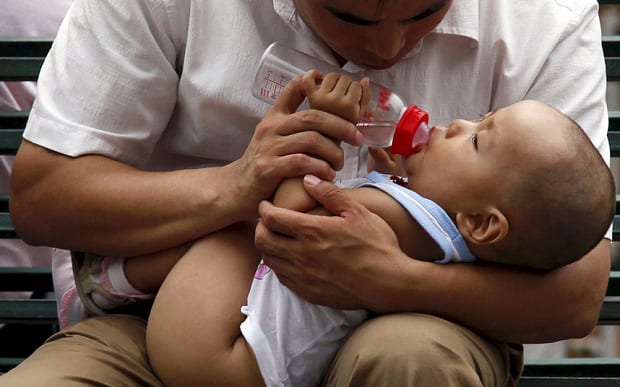
    A Chinese man feeds his baby in central Beijing

    Some cautioned the increase in births may not be as big as predicted because of the expense of raising a second child and other factors.

    “The rush for baby-related stocks may not necessarily bear fruit,” said IG analyst Bernard Aw in a report.

    In New Zealand, the local dollar jumped as high as $0.6772, gaining nearly 1 percent from $0.6699 the day before. The country is a major dairy exporter and its milk powder and formula industry would likely benefit from a baby boomlet in China.

    Some baby stocks started rising Thursday ahead of the official announcement on Chinese state media.

    Goodbaby International, which makes strollers, car seats and cribs, rocketed 7.4 percent on Thursday and followed that up with a 2.3 per cent gain on Friday. Rumours had already been swirling in China that the policy would be adjusted at a meeting on China’s next five year plan that was held this week.