Tag: eclipse

  • Kobo launches improved Elipsa 2E e-ink tablet with magnetic stylus

    Kobo launches improved Elipsa 2E e-ink tablet with magnetic stylus

    Kobo’s new Elipsa 2E easily goes into the large tablets category considering that it has a massive 10.3-inch display. It also features an upgraded magnetic stylus that can be easily attached to the side of the tablet.

    The Elipsa 2E offers an upgraded digital reading and writing experience made from eco-conscious materials. The 10.3-inch glare-free e-ink touchscreen and ComfortLight PRO reduces blue light and eyestrain features that many other eReaders provide to different degrees.

    The tablet has around 32GB of storage and it’s supposed to offer weeks of battery life on a single charge, but that will highly depend on how you use it. It’s fully compatible with audiobooks, so you can switch between reading ebooks to listening to Kobo audiobooks with Bluetooth wireless technology.

    As per Kobo’s statement, the tablet’s exterior is 85% made of recycled plastic, while 10% is made of ocean-bound plastic. The Elipsa 2E can be protected with the eco-friendly SleepCover, which is also made with 97% recycled plastic, including 10% ocean-bound plastic. This is only available in Black and promises to save battery life by putting the tablet to sleep when you close it.

    As mentioned earlier, the Elipsa 2E has an upgraded Kobo Stylus 2 that has been redesigned for better ergonomics. It’s also rechargeable and allows users to write directly on the tablet. You can make highlights, use the eraser on the back, write in the margins, and highlight standout passages with the dedicated button.

    Regarding the price, Kobo Elipsa 2E is now available for pre-order for $400. The tablet can be picked up in stores and online as of April 19 in Canada, the US, the UK, the Netherlands, Belgium, France, Italy, Spain, Portugal, Sweden, Switzerland, Australia, New Zealand, Poland, the Czech Republic, Romania, Singapore, Malaysia, Taiwan, Hong Kong, Japan, and Turkey. The retail package includes the Kobo Stylus 2.

  • Eclipse China to execute big expansion

    Eclipse China to execute big expansion

    Mattress manufacturer Eclipse International is joining with its Chinese licensee Shenzhen Meiting Creation Furnishing to open more than 100 mattress specialty stores nationwide.

    The Eclipse China rollout, which will proceed over the next three years, is anticipated to expand Eclipse’s market share in the country.

    Shenzhen Meiting has been a licensing partner of Eclipse since 2003.

    Eclipse CEO Stuart Carlitz said: “There is a huge appetite in China for US-branded luxury goods, and our portfolio of brands has been so well received by consumers there. These retail stores will take our 15-year partnership with Shenzhen Meiting to the next level.”

    The Eclipse China stores are expected to predominantly appear in major cities in each Chinese province.

  • Panasonic Broadcasts Total Eclipse Live Using Solar Energy

    Panasonic Broadcasts Total Eclipse Live Using Solar Energy

    As Sumatra, Borneo and Sulawesi plunge into darkness during a rare total solar eclipse on the morning of March 9, 2016, Panasonic will deliver a live broadcast of the approximately 4-minute-long phenomenon from Ternate, an island in eastern Indonesia, using its Power Supply Container, a stand-alone photovoltaic power package.

    https://www.youtube.com/watch?v=ahltwzTATjA

    To enable live filming and broadcast from the island, the Power Supply Container will be transported from Jakarta to Dodoku Ali of Ternate. 12 Panasonic HIT® solar modules with high conversion efficiency will generate approximately 3kW of electricity by tapping renewable energy from the top of the container, and store the power in 24 built-in lead-acid storage batteries. The stored energy will be supplied to a Panasonic LUMIX GH4 camera attached to a telescope to capture the spectacular moment. Mobile computers, production and editing equipment, internet connection and other supporting technology will also be powered by solar energy.

    The live broadcast of the solar eclipse will begin at 05:00 AM, March 9 in Ternate (08:00 PM, March 8 UTC) and can be viewed on platforms including Ustream, YouTube Live and Periscope (refer to Annex).

    This will be the third time Panasonic is broadcasting a solar eclipse live. Unlike previous occasions where time and effort had to be spent setting up HIT® solar modules on the ground, the process is significantly more convenient this time round due to the portability of the Power Supply Container and its capability to be assembled quickly and easily with minimal construction work.

    Prior to this live broadcast project in Ternate, Panasonic has developed and introduced the Power Supply Container to other parts of Indonesia. The first container was installed in July 2014 at the National Elementary School Karimunjawa 01 located on a remote island of Indonesia to improve the educational environment for students and teachers. Following its success, a second container was introduced in July 2015 at another elementary school in the mountainous region of West Java Province to enhance both study and water supply conditions.

    Panasonic strives to extend this technology to other areas without electricity to provide stable power supply and mitigate social challenges towards a better life and a better world.

  • March 2016 solar eclipse to attract tourists to Indonesia

    March 2016 solar eclipse to attract tourists to Indonesia

    The rare and beautiful phenomenon of the total solar eclipse, forecast to occur on March 9, 2016, is expected to attract foreign tourists to Indonesia.

    Both domestic and foreign tourists are keen to visit Palembang, Belitung, Bangka, Balikpapan, Sampit, Palangkaraya, Luwuk, Palu, Poso, and Halmahera to witness the total solar eclipse.

    Head of the North Maluku Culture and Tourism Office Samin Marsaoly remarked in Ternate on Monday that dozens of scientists and several tourists from France will visit Halmahera to observe the total solar eclipse and simultaneously conduct research on the natural event that will occur in March 2016.

    “Boarding a special aircraft, the scientists, with a variety of advanced equipment, will arrive in Maba in East Halmahera to conduct a study on the total solar eclipse,” Marsaoly stated.

    He said hundreds of tourists from several countries had also informed the local culture and tourism office of their interest to witness the total solar eclipse in March next year.

    He noted that the culture and tourism office in East Halmahera had made various preparations related to the visit of the scientists and tourists from several countries, such as accommodation, transportation, and the location where they will watch the rare phenomenon.

    Marsaoly said other areas, such as Ternate and Tidore Islands in North Maluku have also attracted many scientists and tourists from various countries to watch the total solar eclipse on March 9, 2016.

    He remarked that some two thousand tourists had already booked hotel rooms in Ternate, and the number is expected to grow to four thousand.

    “The number of foreign tourists visiting Halmahera in North Maluku to watch the total solar eclipse is definitely a blessing for this region as in addition to increasing the number of foreign tourist arrivals, it will also offer the necessary momentum to promote the local tourism potential,” he added.

    In the meantime, Head of the Culture and Tourism Office in Tidore Islands Asrul Sani Soleman stated that several scientists from the United States National Aeronautics and Space Administration (NASA) will also observe the total solar eclipse from the Tidore Islands, North Maluku province.

    Soleman noted that the scientists will observe the total solar eclipse from the Sultanate of Tidore Palace through a special binocular brought from NASA in the United States.

    The scientists have chosen Tidore Islands as the place to observe the total solar eclipse as it will be the ideal location, and they will be able to see the sun for a longer time period compared to other areas in North Maluku.

    He noted that along with the NASA scientists, hundreds of tourists from various countries will also arrive to witness the total solar eclipse at several locations, including Maitara Island, one of the tourist islands of Tidore.

    The tourists, who will come to watch the total eclipse in this area, are using the services of a travel agent from Bali and Jakarta or will arrive by yacht.

    “So far, there are four cruise ships, including from France, the United States, and Switzerland that have confirmed to make a stopover in Tidore,” Soleman revealed.

    The city administration of Tidore Islands has made preparations to welcome the scientists and tourists.

    The administration will also utilize their visit to promote the tourism potential of the area, including attracting investment.

    Siti Norma Mardjanu, the head of the tourism office in Central Sulawesi province, recently remarked in the provincial city of Palu that the local administration will conduct promotional activities regarding the total solar eclipse at numerous international airports in Indonesia.

    She remarked that the promotional activities highlighting the total solar eclipse will be carried out at the international airports in Medan, Jakarta, Surabaya, and Makassar.

    According to Siti, the promotion will not only spread awareness about the total solar eclipse but will also promote the tourism potential of Central Sulawesi.

    Siti said the activities to promote the total solar eclipse will be conducted by the Central Sulawesi provincial administration in December this year.

    Currently, approximately three thousand hotel rooms have been booked by foreign tourists, who want to witness the rare phenomenon in Palu, Luwuk, Ampana, and Poso.

    The total solar eclipse is expected to attract thousands of tourists, and therefore, it will motivate the local administration to develop its local tourism potential.

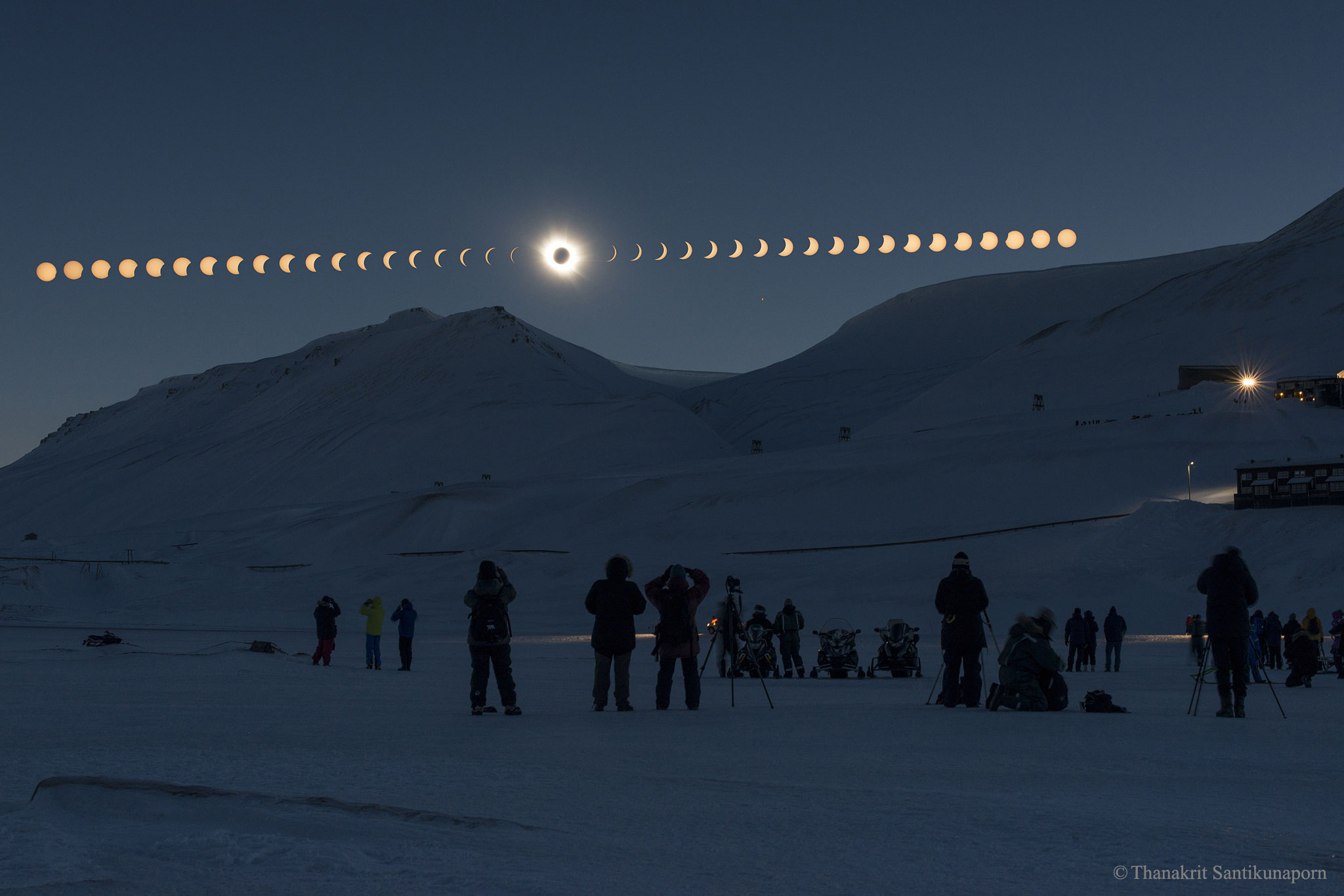
    A solar eclipse occurs when the moon passes between the earth and Sun. A total solar eclipse occurs when the moons apparent diameter is larger than the suns, blocking all direct sunlight, turning day into darkness.

    The total eclipse in March 2016 will occur in the narrow path across the earths surface, with the partial solar eclipse visible over a surrounding region that is thousands of kilometers wide, beginning in Indonesia, and ending in the northern Pacific Ocean.