Retail News CRM

Tag: Emart

  • Korean Retail Giant E-mart Invests $150m For Philippine Expansion: Aims To Enhance Local Shopping Experience

    Korean Retail Giant E-mart Invests $150m For Philippine Expansion: Aims To Enhance Local Shopping Experience

    In a bold move to capture a growing market, Korean discount department store chain E-Mart has announced its ambitious expansion into the Philippines. With a combined investment of approximately $150 million, E-Mart is set to open five new stores across the archipelago over the next few years, targeting the burgeoning middle class and their increasing appetite for affordable yet quality retail experiences.

    Targeting the Filipino Market with Strategic Stores

    Initially, E-Mart plans to establish its presence in major urban centers such as Metro Manila and Cebu, locations brimming with potential customers eager for diverse shopping options. Local market analysis suggests that Filipino consumers are increasingly drawn to retail environments that offer both value and variety — a niche that E-Mart aims to fill with its unique blend of products, from groceries to electronics.

    The decision to invest in the Philippines is not just a stroke of luck; it’s rooted in the company’s successful South Korean model. This version of a “hypermarket” approach has won hearts back home, where E-Mart has over 150 locations. The Philippine economy has shown resilience, making it ripe for the chain’s budget-friendly offerings and expansive range of home goods.

    Creating a Dazzling Retail Experience

    But expanding into a vibrant market like the Philippines involves more than just placing stores. E-Mart has committed to tailoring its shopping experience for Filipino customers, incorporating local products alongside its beloved Korean offerings. This strategy not only caters to local tastes but also fosters a sense of community, turning shopping into a delightful cultural exchange rather than a mere transaction. Imagine snatching up your favorite local snack right next to an imported Korean delicacy—talk about a shopping thrill!

    To bolster its brand awareness, E-Mart is launching an engaging marketing campaign that traverses traditional advertising to digital platforms, ensuring maximum reach among potential customers. Employing social media strategies and local influencers will further elevate its profile, especially among younger, tech-savvy shoppers who dominate the market.

    Facing Challenges with Optimism

    While the Philippines offers a promising landscape for retail growth, E-Mart’s entry will not be without challenges. Navigating bureaucratic hurdles and building a reliable supply chain in a new environment will require deft planning and local insights. However, the chain’s leadership remains undeterred, viewing these obstacles as mere stepping stones toward establishing a lasting legacy in the Filipino retail space. “We are excited to connect with Filipino consumers and be part of their daily lives,” the company stated in a recent press release.

    Looking Ahead: What’s Next for E-Mart?

    The anticipated openings are expected to create a buzz in the local markets, potentially leading to not just retail growth but also new job opportunities for the local workforce. As E-Mart lays the groundwork for its future, the attention will be on how well it integrates into the Filipino retail landscape and meets the expectations of its new customer base. For now, all eyes will be on the first store launch, which promises to deliver both value and innovation, as well as a much-needed upgrade to the local shopping scene.

    Questions & Answers

    What is E-Mart’s investment plan in the Philippines?
    E-Mart plans to invest approximately $150 million to establish five new stores in the Philippines over the next few years.

    Which locations are targeted for E-Mart’s new stores?
    The first E-Mart stores are set to open in major urban centers, particularly in Metro Manila and Cebu, to attract a large customer base.

    How does E-Mart plan to engage with the local market?
    E-Mart aims to tailor its offerings by incorporating local products alongside Korean goods and is launching a comprehensive marketing campaign that includes social media outreach.
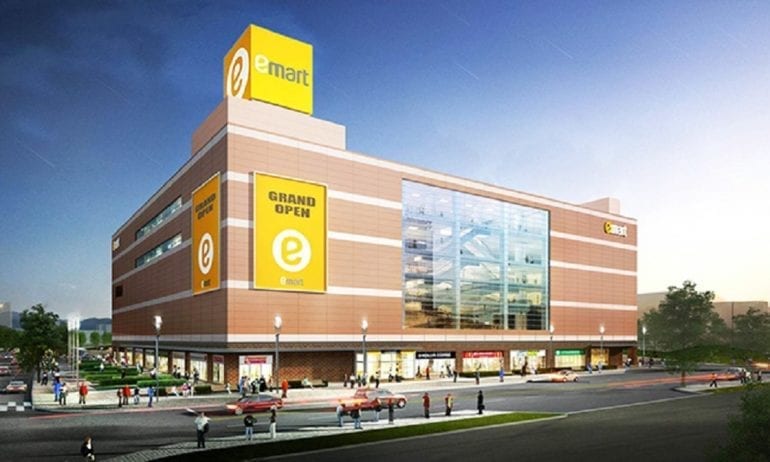
  • South Korean hypermarket Emart to launch in Laos

    South Korean hypermarket Emart to launch in Laos

    Emart, the South Korean hypermarket retailer, will expand into Laos this year through a master franchise deal with U-Dee, an investment entity owned by LVMC Holdings.

    The move follows the company’s announcement earlier this month that it would expand into Cambodia in June.

    The agreement includes opening one Emart discount retail outlet and three hard-discount outlets under the brand name No Brand – Emart’s house label – in Laos later this year.

    Emart operates three Emart stores in Vietnam, four in Mongolia, and 17 No Brand stores in the Philippines.

    The firm intends to open 20 E-Mart locations and 70 No Brand stores in Southeast Asia during the next 10 years.

    LVMC Holdings, originally known as Kolao Group, was founded in 1997 by South Korean businessman Oh Se-young. The group debuted its footprint in the retail market with a local hypermarket chain dubbed Kok Mega Mart in Laos last year.

  • Emart plans 20 more hypermarkets in Vietnam

    Emart plans 20 more hypermarkets in Vietnam

    Emart Vietnam is planning to open two more supermarkets in Ho Chi Minh City – one in Sala Thu Thiem and another in Go Vap District – part of a plan to launch 20 hypermarkets by 2026.

    Emart Vietnam was acquired by Thiso International Commerce and Services Corporation (Thiso), a subsidiary of Thaco Group, last year after the South Korean-born chain experienced difficulties with its expansion ambitions in Vietnam.

    The plans were revealed at an Emart Partners Day earlier this month. Chun Byung Ki, general director of Thiso Retail, reports that by 2026, the chain wants to have 20 locations nationwide and generate US$1 billion in sales, becoming the hypermarket chain with the largest market share in the country.

    The Emart Sala Thu Thiem, which will occupy more than 6000 sqm, will be located in Thu Duc city’s Thiso Mall, while Thiso Retail Hypermarket, Trading and Service Center will house the new Emart Go Vap, which the company describes as the largest supermarket in HCM City.

    Chun said Thaco’s real estate fund and multi-industry ecosystem will enable Emart to expand into other provinces, including Hanoi. An automated pick-up system will debut in Vietnam for the first time, allowing customers to pick up orders efficiently, and a one-hour delivery promise will be guaranteed to customers within a 5km radius.

    Emart is one of the largest retailers in South Korea with locations across the globe. It was founded in 1993 by Shinsegae as the first low-cost retailer in the country. The company opened its first store in 2015 at Phan Van Tri in Go Vap District.

  • Korea’s Emart set to scale back in Vietnam

    Korea’s Emart set to scale back in Vietnam

    South Korea’s largest supermarket chain operator Emart Inc. is pulling out of Vietnam, the second major Asian market after China, in the face of regulatory hurdles.

    The retailer opened its first outlet in Vietnam’s Go Vap district in 2015 and had procured a site at Ho Chi Minh City for a second opening last year. But the project has been delayed due to licensing setbacks, disrupting its plans to open five to six more outposts.

    Emart’s direct foray has proven difficult as Vietnam, like China, prioritizes joint ventures in permitting a foreign business. Emart started operation in Vietnam in 2014 after setting up a wholly-owned local entity.

    A retail industry source said a hypermarket needs at least 10 outlets to have bargaining power with vendors and maintain logistics efficiency. Unable to meet this number, Emart may have concluded it was better to fold the business, the source added.

    The retailer has been rolling back investments in the country. In its 2019 semiannual report, it had vowed to invest 460 billion won ($424.3 million) in its Vietnamese entity through 2022. But it had slashed that amount to 247.8 billion won in the third-quarter report.

    An Emart representative, however, denied the exit rumors and said it was studying other options such as strategic alliance or business partnership.

    Industry observers believe Emart is wary of making the same mistake as in its Chinese operation.

    Emart entered China in 1997 and aggressively expanded its operations, running at one point 26 outlets across the country. But it failed to overcome Beijing’s stiff regulations and saw losses snowball to 150 billion won over four years from 2013.

    In 2016, it found itself caught in the crosshairs of a diplomatic feud over Korea’s decision to build an anti-missile system, a move China vehemently opposed on national security grounds. Emart, along with many other Korean brands, suffered the brunt of Beijing’s retaliatory nationwide boycott on all things Korean. After suffering steep losses, the retail chain in 2017 sold off its remaining five outlets in China to a Thai company and pulled out of the country altogether.

    After scaling back its Asian operations, Emart is expected to focus more on the U.S. market, where Korean brands have been making rapid grounds. According to its regulatory filings, Emart generated 1.28 trillion won in the first three quarters of this year from overseas, up 122 percent from the same period last year and topping last year’s full annual sales of 778.5 billion won.

    Emarts’ robust overseas performance owes largely to its U.S. subsidiary Good Food Holdings, which the Korean retail conglomerate acquired for $275 million in 2018. The Los Angeles-based company owns five upscale food retailing brands, including Bristol Farms, Lazy Acres Natural Market, Metropolitan Market, New Seasons Market, and New Leaf Community Markets, operating mostly in the West Coast.

    Good Food Holdings raked in sales of 1.2 trillion won in the January-September period, up 136 percent from a year ago, on explosive demand for food products among people sheltering at home during the coronavirus outbreak. The company alone was responsible for nearly 93 percent of Emart’s total global sales in the period.

    Emart plans to invest 83.7 billion won through 2022 to expand its U.S. footprint. It is scheduled to launch PK Market, a shop specializing in Asian goods including Korean food, as early as next year in downtown Los Angeles.

  • Emart to shut Pierrot discount-store chain

    Emart to shut Pierrot discount-store chain

    Emart is to shut down its Pierrot discount-store chain to focus on luring customers to its mainstay hypermarkets.

    After significantly falling sales last year, the South Korean giant closed down several Pierrot stores, including the store in Myeongdong shopping district. The company will shut the remaining six stores this year.

    Meanwhile, Emart plans to remodel about 50 out of 160 general merchandise stores this year to offer a larger selection of lower-priced items and high-margin, private-brand products.

    Besides its hypermarkets, Emart operates a range of chains spanning convenience stores, drugstores and home electronics. Emart’s profit fell from 194.6 billion won (US$166 million) in the third quarter of 2018 to 116.2 billion won (US$97.2 million) in the same period last year.

  • E-Mart posts first-ever loss ; restructuring lures

    E-Mart posts first-ever loss ; restructuring lures

    Korean discount chain operator E-Mart has posted its first-ever net loss, amid growing competition from online shopping rivals and e-commerce giants.

    The company’s quarterly results showed a net loss of KRW26.6 billion (US$24.7 million) between April and June, its first negative result since it was spun off from Shinsegae Group in 2011. The loss stands in comparison to a net profit of KRW94.8 billion ($77.7 million) during the same period last year.

    The company says it plans to raise 1 trillion won (US$820 million) by selling assets and will buy back stocks worth some 100 billion won to boost shareholder value.

    E-Mart says it expects its losses will to continue into the next financial period.

    “Online archrivals, such as Coupang Inc and other major e-commerce operators are forecast to expand their food category later in the year,” said Hana Financial Investment expert Park Jong-dae, “which could further weigh down E-Mart.”

  • Seoul to get its first Emart Traders branch next month

    Seoul to get its first Emart Traders branch next month

    Emart, a Shinsegae Group company, will open a new branch of Traders, its big-box warehouse chain, in Seoul next month. It will be the first branch in the capital. The outlet will be located in Wolgye-dong, Nowon District, northern Seoul, with the opening scheduled for March 14. The Wolgye Traders is being built in the parking lot of Emart’s Wolgye store. The warehouse store will be 9,917 square meters (106,746 square feet) in size, with 45,302 square meters of floor area.

    Emart said the annual sales goal for the first Seoul branch of Traders is 140 billion won ($12.6 million). The company is planning to raise the new branch’s competitiveness by offering instant and fresh food at prices that could be 45 to 50 percent lower than the average price at department stores.

    There are currently 15 Traders branches nationwide, and Emart is planning to expand the number to 18 by the end of this year.

  • Shinsegae to launch SSG.com as separate unit

    Shinsegae to launch SSG.com as separate unit

    Shinsegae Group will launch a brand new entity that specializes in e-commerce next month in an effort to become Korea’s answer to Amazon. Titled SSG.com, Choi Woo-jung, vice president of Shinsegae’s e-commerce division, will be the CEO. “[Through the new entity], we hope to maintain the existing SSG.com brand and maximize brand power by raising [people’s] awareness of our professionality in the online market,” the company said in a statement.

    The latest move reflects Shinsegae’s ambition to become the country’s top e-commerce company by gathering its scattered online businesses.

    Shinsegae Group in December spun off Emart Mall and Shinsegae Mall from Emart and Shinsegae. The board of directors in January voted to merge the two new entities.

    It has already been running SSG.com as an e-commerce website that offers access to its various online malls, but it is currently only a customer-facing interface, not a company in its own right.

    SSG.com’s sales goal for this year is 3.1 trillion won ($2.8 billion), which is 29.1 percent higher than the sales recorded by the online platform last year.

    The company hopes to reach its ambition through aggressive marketing, especially on raising the efficiency of delivery services.

    It will make a heavy investment on raising the delivery speed by establishing an additional distribution center in Gimpo, Gyeonggi. It will be the third distribution center, and is scheduled to open in the second half of this year.

    “With the official launch of SSG.com, we are getting ready to become the country’s top e-commerce enterprise,” said Choi in a statement.

    “Instead of just selling goods online, we are also planning to function as a ‘Linker’ by connecting consumers online and offline like [offering them the platform to] share their lifestyles on the internet.”

  • Featured store : SSG Food Market by Emart in Seoul, Korea

    Featured store : SSG Food Market by Emart in Seoul, Korea

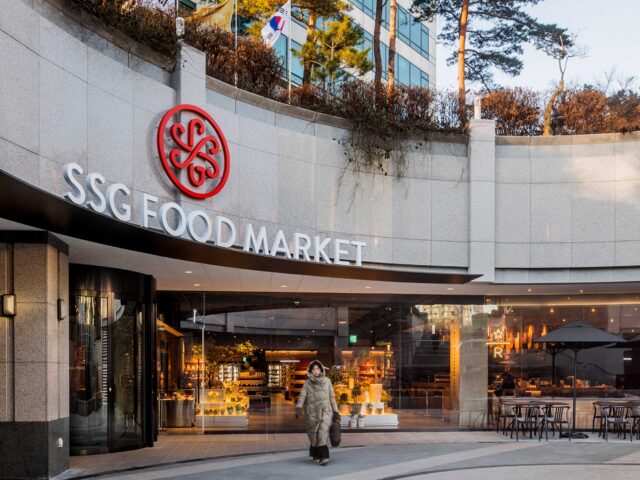
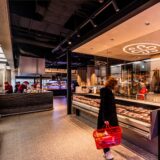
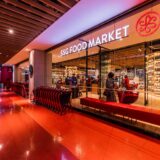
    Nestled in the upmarket suburb of Dogok, Seoul, sits the newly opened reinvention of Emart’s “Star Super”: “the SSG Food Market”, designed by Landini Associates. Emart is the leading business of the Shinsegae group, the largest retailer in South Korea, operating multiple brands including department stores, discount to premium supermarkets, and the mighty Emart hypermarkets.

    The brief was to create a world class premium supermarket and food hall fusion, and Landini Associates were entrusted to redesign every detail of the new store experience. This included: the built environment, naming and identity, furniture and fixtures, signage and communications, ticketing, menus, POS, advertising style guides, packaging and uniforms. In fact every customer touchpoint.

    The result is a modern market, a convenient and accessible food lover’s heaven, where locals can do a daily or weekly shop, or dine in with friends at one of the many in-store restaurants and cafes. Attracting a newer younger audience, whilst rewarding its existing, the SSG Food Market is a community epicentre to meet, eat and shop in, throughout the day.

    The offer

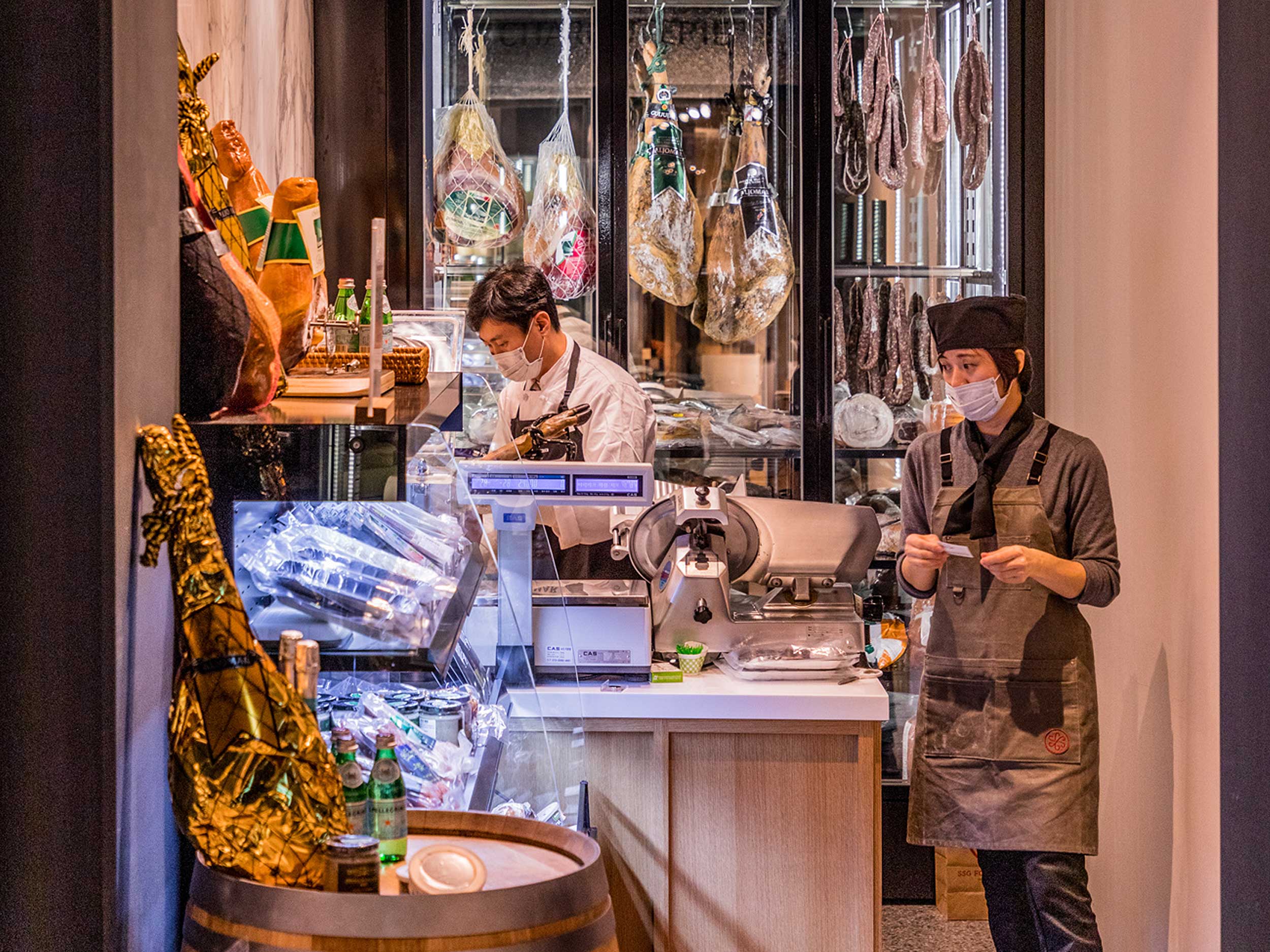
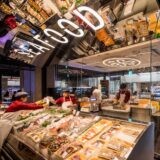
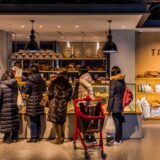
    The reinvention enriched and upscaled the existing food and beverage offer to include an extensive fresh department, vegie butcher serving house-made salads and juices, take home meals, Korean deli, bakery (run by hip San Francisco brand Tartine), fishmonger, butcher, Korean traditional street food, café, 200 seater restaurant, sushi restaurant, specialist cheesemaker, western charcuterie, wine and beer department, coffee roastery, dry goods, florist and homewares.

    The result is a curated selection of quality products, and a onestop-shop supermarket and refined specialist items. In addition the market is a wonderful meeting place to dine with friends and family, further enriching the retail and community experience.

    The design

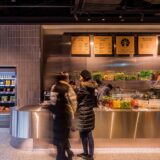
    The offer is made up of both SSG run departments, franchises (such as Starbucks, a premium brand in Korea), and third-party retailers. Ensuring that these were all presented as a tangible whole required the design team to be sensitive to multiple design briefs, whilst ensuring that the customer had a seamless experience.

    Additionally, the site has a low ceiling which created some challenges for the reticulation of services, and multiple entrances, including a pre-trading public access to a subway station through the heart of the store; a gift to residents from Shinsegae.

    Landini’s solution creates a space of intrigue, transparency and exploration by celebrating the food, the people who make it, and its preparation.
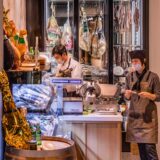
    Specialist departments are visible across the restaurant’s open kitchen and include: Korean Traditional Street Food, Korean/ Chinese Noodles and a grill. All the production is exposed, and chefs work in glazed pavilions serviced by counters showcasing this theatre whilst you order. There are also take home meals in the Korean deli prepared daily in its kitchen, or fresh fish and meat cooked to order at the Grill, to take home, or eat in.
    As always, and especially because the market is in a basement, the lighting plays a key role in Landini’s design. Chiaroscuro, the contrast between light and shade, creates areas of interest and calm, gently guiding customers on a journey of discovery throughout the store. Perimeter departments use pavement lights to create space, and give sense of the world above.

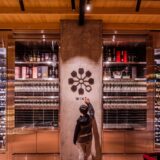
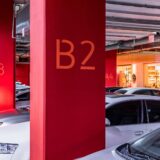
    In the main market hall the interior is paired back, functional yet classic. This “bare bones beauty” of exposed steel beams and concrete bulkheads contrasts with fine marbles, glass and blackened steel, and is balanced by timber fixtures and details. This subtle, considered and classic material palette allows the food to be the hero, and merchandising plays a major role. Long-life departments such as wine and dry-goods have a warmer, more earthy and textural palette, utilising brick and added timber. In the carpark, red floors and walls add vibrancy to the market experience before customers even get out of their car.
    The basement site is located below two high-end residential apartment buildings. Visitors can enter from the sunken courtyard on street level, or via the red carpark inside. SSG has created a residents pre opening pedestrian route through the store, a shortcut to the train station to save locals from the blistering cold in winter. Landini designed a set of messaging icons for this route, also.

    The graphics

    Landini Associates established a tone of voice for the brand to reflect their new food experience. This influenced all store communications including: naming and identity, signage and communications, ticketing, menus, advertising style guides, packaging and uniforms.
    The entire site required an ownable, easy to understand signage and graphic messaging system to reflect the brand’s new established tone of voice. The Landini design team evolved the existing SSG logo mark, developing an adaptation on communications applications to collateral and signage.
    The design is simple, contemporary yet classic; impacting not overwhelming. The palette is one of debossed concrete, timber, black and whites, and complimentary hits of the brand’s colour, red.


  • Emart goes digital in high-tech Uiwang store

    Emart goes digital in high-tech Uiwang store

    Emart is going fully digital with its brand new Uiwang branch that will open in Gyeonggi tomorrow. Innovative features of the Uiwang branch – the first Emart store to open in 30 months – include digital displays instead of paper signs and guide robots that can escort customers to desired products. The Uiwang store will span 9,917 square meters (106,745 square feet) across two basement floors in a commercial building.

    “We will introduce a revolutionary format of offline stores that breaks away from tradition in order to meet the challenges of our fast-changing era,” read an Emart report.

    Going paper-free is a big change that Emart hopes will both appeal to customers and help management.

    Price labels will be digitalized and controlled by a central server in the Uiwang branch, allowing store managers to display and change prices with unprecedented ease and speed. The new store will also install digital signage, or electronic displays, alongside elevators, moving walkways and cashiers instead of paper posters for advertisement and notices.

    “By minimizing paper usage, we can provide consumers with a unique shopping experience while practicing green management and boosting productivity,“ read the Emart report.

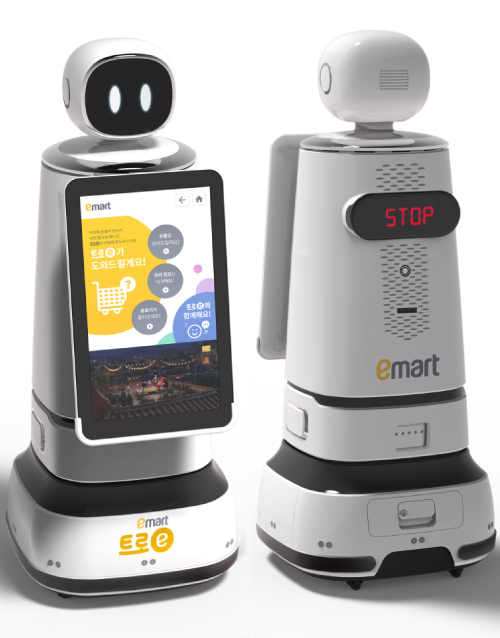
    The new Uiwang store will also be home to Tro.e, an autonomous robot equipped with a 27-inch touch screen that is capable of guiding consumers to desired products and making casual conversation. Like Pepper, a robot the company employed earlier this year at its Seongsu branch in eastern Seoul, Tro.e will only be available for a limited time on a test run at Uiwang.

    Emart developed Tro.e, named after the Swedish word tro, which means trust, together with Future Robot, one of the official robot providers for the PyeongChang Winter Olympics.

    The grocery section of the new store will only be located on the lower floor of the store, while the upper floor will host a variety of affiliated shops including Electro Mart, Pierrot Shopping, Daiz, Boots and a Kakao Friends Store.

    Emart will open a 660-square-meter “Culture Lounge” for customers to read books and purchase beverages.

    “We will continue striving to offer consumers a unique shopping experience with our distinctive products and digital shopping environment,” said a senior manager in charge of development at Emart.

  • Emart’s take on Don Quijote opens in COEX

    Emart’s take on Don Quijote opens in COEX

    Emart’s Pierrot Shopping store has opened inside Coex mall, in southern Seoul.

    Aiming to be a “Fun and Crazy” destination, the 2513sqm two-storey store targets consumers in their 20s and 30s with a diverse range of 40,000 products.

    On basement floor, there is a large collection of alcohol and snacks from Korean and foreign brands, along with wigs, costumes and a discreet space for ‘adult toys’.

    On the first floor, customers will find goods as diverse as leather bags from brands such as Prada and Fendi, fresh food, cordless vacuum cleaners, smoking pipes, fake eyelashes and pet food.

    One curious feature in the store is a smoking room which resembles the interior of a subway train. An information desk and electronic kiosks offer tax refunds for foreign customers.

    A Korean version of Japanese Don Quijote chain, Pierrot Shopping store is designed “to be a place where young people can come to play and look around without a clear shopping purpose”.

    “You can come here to find relief from everyday stress, casually pick up things that look intriguing and buy them just because they’re affordable,” said Pierrot Shopping’s brand manager, Yoo Jin-cheol.

    While other large-scale retailers prioritise space and neatly arranged products so that consumers can easily find what they are looking for, at Pierrot Shopping the aisles are narrow and in some places it’s difficult for two people to pass.

    The staff wear uniforms with “I don’t know where that is either” printed on the back.

    Emart explained the intention was to make consumers venture more around the aisles, make unexpected discoveries and have a“fun experience”.

    Emart will open two more branches of Pierrot Shopping this year with smaller footprints than at Coex; at the Doota Mall and in Nonhyeon, in Gangnam District.

  • E-mart opens 2nd store in Mongolia

    E-mart opens 2nd store in Mongolia

    Mongolia recently got its second E-mart, the discount chain of Korean retail giant Shinsegae.

    Unlike the first store, which has its own building, the second store is renting 5,000 square meters on the first and second floors of the Solo Mall in western Ulaanbaatar.

    The new store sells 12,000 types of goods, with Korean products accounting for 30 to 40 percent. Four out of 10 Korean products at the store are supplied by small and medium enterprises, according to E-mart.

    After signing a contract in July 2016 with Sky Trading, the local distribution unit of Mongolian retail giant Altai Group, E-mart entered the Mongolian market as a franchise receiving royalties for teaching the know how of running the stores.

    The first store posted 42 billion won (US$37 million) in sales IN 2016, 140 percent higher than expected. It chalked up 8.4 billion won from sales of Korean products.

    E-mart attributed the results to the good quality and fresh ingredients of Korean products, because most Mongolian consumers had been unable to buy such products before.

    “Among 20 supermarkets in Ulaanbaatar, E-mart is the only one that offers almost all kinds of products,” a company official said. “The store has attracted middle-class customers.”

    E-mart said it has sent Korean workers to the second store. They are attracting Mongolian customers with rice rolls, pork belly and chicken based on Korean recipes. The store also sells pizza, which has begun winning popularity among Mongolian consumers.

    The company said it also plans to sell sashimi for Mongolian customers who have not been able to taste fresh fish because of the country’s landlocked location.

  • E-Mart China exit confirmed

    E-Mart China exit confirmed

    Thailand’s CP Group has agreed to buy five of the six remaining E-Mart China stores, ending a 20-year presence for the Korean firm.

    Sources in the retail investment banking sector said E-Mart inked an agreement with CP Group to hand over the stores in Shanghai pending approval from Chinese regulators.

    Reports emerged earlier this month that the two parties were in negotiations. Yonhap news agency’s sources said E-mart is in the process of selling off its sole outlet in Xishan by the end of the year.

    Exact details of the sale have not been released, but market watchers said E-Mart will not be able to get the full market value for the stores and will have to settle for much less.

    The net book value of the stores to be sold to the Thai food and agribusiness stands at around 68 billion won (US$59.9 million), with CP Group expected to benefit from economy of scale with the takeover. The company already operates a supermarket chain under its CP Lotus subsidiary.

    “Getting approval from Chinese authorities takes time, and the company cannot reveal details about the contract before then, but internally the goal is to exit China by the end of 2017,” said an E-Mart insider, who declined to be identified.

    E-Mart first entered the Chinese market in 1997, with the total store number rising to 30 at one point yet it had to scale back operations in the face of tough conditions and weak sales.

    Last year the retailer reported losses hitting 21.6 billion won, while total losses in the last four years reached 150 billion won.

    The company, meanwhile, said that it is moving into new Asian markets to compensate for China, where the diplomatic row over Seoul’s decision to deploy a US anti-missile defense system on its soil has hurt sales of South Korean-made products and services.

    E-Mart said that it is making a determined push to expand into the Mongolian, Vietnamese, Laotian and Cambodian markets that offer good growth potential.

    It said a second store in Mongolia will be opened Friday following the first that started operations in July 2016.

  • Alibaba Group promises to redefine retail as it sets the clock ticking for Singles Day shopping festival

    Alibaba Group promises to redefine retail as it sets the clock ticking for Singles Day shopping festival

    Alibaba Group has started the clock on the Global Shopping Festival it will hold on November 11, which is known as Singles Day in the Chinese market where it dominates online shopping.

    The retailer, which trades through marketplace sites including Alibaba.com and TMall, has unveiled its plans for a festival that’s set to include a countdown gala, an eight-hour live streamed fashion show, virtual reality shopping, interactive games and more.

    These are all innovations aimed at enabling almost 100,000 merchants to build their brands, as well as engage with and sell to the hundreds of millions of Chinese consumers it predicts will shop on its marketplaces during the festival.

    Last year’s event, saw goods worth £9.3bn sold via the group’s websites.

    The press launch alone was attended by brands from Macy’s and Costco through to Swisse and eMart. There, Daniel Zhang, chief executive officer of Alibaba Group, said, “11.11 Shopping Festival has become the global retail benchmark over the past seven years, and we have raised the bar again this year to redefine the retail experience for consumers together with our merchants from around the world.”

    Zhang continued, “11.11 has evolved far beyond a 24-hours sales event. From today through November 11, consumers will discover, explore, play, watch, comment, share, recommend and shop across our entire ecosystem with our merchants both online and offline. Leveraging our robust infrastructure, global merchants have been empowered with unprecedented capability to seamlessly engage and serve customers through new technology and new environments.”

    Highlights of the Global Shopping Festival will include a Tmall eight-hour fashion show in Shanghai in which 50 international brands and 160 models will take part. It will be streamed live via Tmall and Taobao mobile apps that viewers can use to pre-order items as they appear on the catwalk.

    Shoppers will be able to use virtual reality to buy, as Alibaba pilots Buy+, billed as the world’s first complete virtual reality (VR) shopping experience. Those who use it will be virtually transported to select retail stores internationally, where they can experience the entire shopping process from product selection to payment, all via VR.

    In the run-up to the event, more than 600 international brands are streaming live broadcasts on Tmall to tell consumers about their brand and the deals and products they’ll be offering on 11.11.

    Katy Perry will headline the 11.11 Global Shopping Festival Gala on November 10.

    The event will link online and offline: Alibaba believes the future of commerce is not online only but will integrate the online and offline experience. A location-based augmented reality mobile, to be released two weeks ahead of the festival, will enable consumers to follow the Tmall Cat across the online and offline retail ecosystem: offline partners include shopping malls in Beijing and Shenzen, Shanghai Disneyland, KFC and Starbucks. Alibaba is also working with more than a million offline shops to present consumers with a joined-up experience.

    The retailer also promises each consumer a personalised shopping experience, thanks to the use of big data that will drive tailored product recommendations, search results, and user-generated content.

    The retailer is also focusing on going global, and aims within 10 years to serve two billion consumers, while supporting 10m small businesses, brands and retailers. The 2016 11.11 Global Shopping Festival includes a ‘buy globally, sell globally’ initiative that focuses on making Alibaba a gateway for international brands and merchants to sell to consumers in China. Meanwhile, it is also piloting approaches to supporting global retailers and brands as they sell beyond China. It is taking its infrastructure, including logistics and payments to Hong Kong and Taiwan – the first steps in its expansion strategy.


  • Vietnam’s retail lures foreign capital because of urban population growth

    Vietnam’s retail lures foreign capital because of urban population growth

    JLL released a brief report on Asian and European retailers ready to penetrate the market of more than 90 million people.The report pointed out evidence of the expansion of foreign retailers in Vietnam’s market.

    At the end of 2014, Berli Jucker Plc (BJC) acquired Metro Cash & Carry Vietnam at the cost of 655 million euros, the largest ever M&A deal at that time, which signaled the penetration into Vietnam’s retail market of Thai groups.

    Shortly after, another giant from Thailand – the Central Group – acquired Nguyen Kim – one of the leading electronics retailers in Vietnam and then Big C.

    In October 2015, Emart – Korean leading retailer – inaugurated a $60 million shopping mall in north Saigon, where another Korean retailer – Lotte Mart – has been successful with 11 supermarkets and expects to increase the number to 60 stores by 2020.

    Most Japanese investors see the success of Aeon in Vietnam as a positive sign for foreign projects. Aeon has opened four trade centers in Vietnam and aims to increase the number to 20 in 2020. By July 2016, another retail giant from Japan –  Takashimaya – opened at Saigon Centre.

    Simply Mart openedthree more stores in Saigon; AuchanSuper – the retail brand from France – also plans to launch another 17 supermarkets by the end of next year in HCM City and 20 stores by 2020 in the north.

    Major fashion brands like Gap, Mango, and Topshop have become the first choice of many young people in Vietnam. In early September this year, Zara opened its first flagship store in HCM City. At the same time, H&M is completing procedures to open its first store in Vietnam early next year.

    According to JLL, a young demographic and high growth potential are the factors attracting foreign investors to Vietnam’s retail market.

    With a population of over 90 million people and 70% of people aged from 15 to 64 and the anticipated annual growth rate of urban population of 2.6% in 2015 – 2020 period, the highest growth rate in Southeast Asia, Vietnam’s retail market is very attractive to foreign investors.

    Increasing disposable income, urbanization rate and living standards have made Vietnam one of the most most dynamic emerging economies in Southeast Asia.

    According to Boston Consulting Group, the upper and middle class in Vietnam are growing at the fastest pace in the region and this number is expected to double from 12 million in 2014 to 33 million in 2020. With income of VND15 million ($700)/month, the consumers of these classes are potential customers for retailers.

    In addition, Vietnam’s e-commerce boom has also contributed to the growth of the retail market.

    A Nielsen report said that that 9 out of 10 consumers in Vietnam (91%) owned smartphones, compared to 82% in 2014.

    Na Son