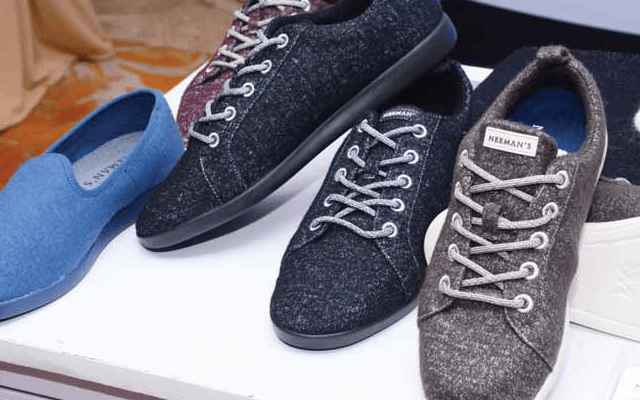
Footwear brand Neeman’s has partnered with The Woolmark Company – the global authority on wool – to launch a range of shoes made from 100 percent Merino wool. The eco-conscious brand showcased its attractive range of men’s shoes in New Delhi.
Neeman’s is India’s first footwear brand to use natural, renewable and biodegradable fibre in its shoes. The brand’s footwear collection comprises joggers (multi-functional, lightweight running shoes), classic sneakers with a modern twist, and simple, yet elegant, loafers in subtle colours, fit for all occasions. Its shoes are suitable to wear throughout the year with the ability to withstand every weather condition.
Celebrating the unique organic inclusion in Indian lifestyle through their exclusive men’s shoes, Taran Chhabra, Founder, Neeman’s explains that it was his own personal struggle to find a shoe that could truly provide all-day comfort. “This led me to look beyond synthetic fibres and my search ended with the naturally versatile Merino wool fibre,” he stated.
Ajay Pradhan, Marketing Manager, The Woolmark Company, India says, “The Woolmark Company is looking at innovative ways to showcase the versatility of the Merino wool fibre and this collaboration with Neeman’s allows us to do exactly that. Merino wool is the world’s most revolutionary natural fibre that’s trans-seasonal, breathable and has a variety of eco-credentials, making it the perfect addition to your wardrobe be it in the form of luxury apparel or innovative. We cannot wait for consumers to try them and experience the natural benefits and versatility of Merino wool.”
The Idea Behind Neeman’s
Neeman’s focuses on two core principles – true comfort and creating a culture of sustainability.
“We are focused on bringing truly comfortable footwear that looks good, feels good and is good for the planet. Today, when the whole world is talking of organic and natural resources, we decided to take undervalued ‘comfort’ for wearers to the heart of the shoe industry and follow nature’s path of environmental sustainability using natural fibres along with recycled and renewable materials,” Chhabra says.
While in the pursuit to understand footwear manufacturing, Taran Chhabra had travelled to many footwear manufacturing hubs around the world and what he saw left him perplexed. He found that footwear manufacturing units use too many synthetic materials like nylons, polyesters and leathers and consume a lot of non-renewable resources like petroleum in the manufacturing process. Apart from this, the industry is responsible for emitting a huge amount of carbon dioxide into the atmosphere.
“According to a recent study, around 10 percent of the carbon dioxide that is emitted in the atmosphere is by footwear units alone. So these things kind of hit me,” he explains.
As a result, while making Neeman’s, he made a conscious decision to remove everything synthetic and unnecessary, and kept only the stuff that was required to actually make shoes. He chose a natural fiber like Merino wool from Australia in-place of synthetic materials. Merino wool is a superfine and lightweight fiber with features like moisture-wicking and breathable, naturally odour resistant and keeps skin cool and dry even in extreme temperatures.
“Merino wool comes from Merino sheep, and all it takes is water, sunshine and grass to raise them. So we are not spending any energy, we are not emitting any carbon dioxide into the atmosphere, we are not using any petroleum based oils and we are preserving our environment,” he says.
Another important component within a shoe is the insole. Traditionally the insole is made of petroleum based foams. Neeman’s also reduced the amount of petroleum based foam with a natural plant-based castor bean oil and recycled rubber.
A Global Brand
The shoes—conceptualised in America and designed in London—are made from the finest Merino wool sourced from Australia. The Merino wool then travels to South Korea, where it goes through a proprietary process of combing, drawing, steaming and being made into a fabric. There, three different type of fabrics are being produced, one for the shoe upper, another for the insole and a third for lining the shoe. Then the fabric travels to China, where a highly specialised women-owned shoe manufacturing unit—which has been in operation for the past 30 years—assembles the shoes. After that the shoes finally reach India to be sold.
Market, Consumer & Retail Strategies
The opportunity for brands like Neeman’s in India is immense. “The Indian footwear market is very vast. India is the second largest in terms of footwear manufacturing and the third largest in terms of consumption. It is just behind China,” says Chhabra.
Operating within the premium range, the brand’s target consumers are the one who seek comfort. Precisely, any male from 26 to 40 years is its target customer. “Just by looking at the consumption rate in India, there is a vast segment that looks at economy range but there is still a major segment that looks at premium range and we fall within the premium segment,” he says.
At present, it is being sold through its website (www.neemans.com). Being a direct-to-consumer, the brand has excellent customer acquisition strategies to share, such as educating its consumers through content on social media. “We plan to travel and organise several demo locations, pop-ups locations within major places where people can come and experience our products,” Chhabra says.
The brand is taking expansion slowly
“We aren’t giving our shoes to outlets for now. The focus is to drive people to our website and help them understand what Neeman’s stands for. So right now we are keeping a very close hold on how and where our product is being represented. Right now our focus is India and then may be to spread Neeman’s to different countries within Asia in the next year,” he concludes.