Tag: exhibition

  • Game of Thrones exhibition flown in for Cityplaza

    Game of Thrones exhibition flown in for Cityplaza

    PCCW Media’s OTT entertainment platform Now E is staging a Game of Thrones exhibition at Cityplaza’s second-floor atrium and centre bridge for a fortnight, starting today.

    The mall promotion has been created in partnership with HBO and heralds the approaching end of the cult TV series hit.

    An Iron Throne has been flown into Hong Kong to become the centrepiece of the Game of Thrones exhibition and eight interactive zones have been set up to recreate scenes from the TV series.

    The final season of Game of Thrones premiers in the US and Hong Kong on Monday (April 15).

    The Now E x HBO Go: Game of Thrones Ultimate Experience’s interactive exhibition zones, each represent classic scenes and characters from the show.

    Mall visitors will be invited to sit on the Iron Throne and take pictures with 3D Stereoscopic Paintings.

    Another exhibition highlight will be Viserion, a six-metre-long ice dragon weighing more than 1360kg.

    Exhibition goers will be able to have photos taken with characters in front of a display wall, or pretend to be a White Walker in an interactive photo zone.

    In another feature of the installation, fans can get their own House Sigil Leather Coasters to represent their favorite kingdoms.

    On arrival at Cityplaza, visitors will each receive a Game of Thrones exhibition passport and receive a limited-edition Four House Sigil sticker by collecting all four stamps at the interactive zones.

  • LG unveils TV that rolls up for storage

    LG unveils TV that rolls up for storage

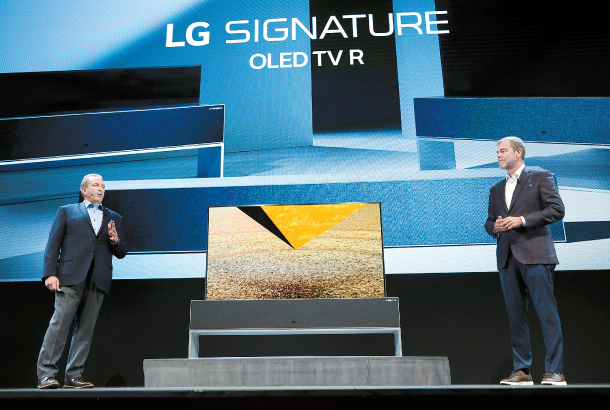
    LG Electronics unveiled the world’s first “rollable” television at the Consumer Electronics Show (CES) 2019 that launched in Las Vegas, United States, on Tuesday. Last year, its affiliate LG Display unveiled a prototype of a 65-inch rollable OLED display panel at the same event. Dubbed the LG Signature OLED TV R9, it uses the same technology, only it comes with an aluminium case at the screen’s bottom that looks like a long tissue box.

    A rolling OLED display was possible because unlike TV panels of the past, OLED screens don’t need backlight to show color, but have molecules that let out light on their own.

    The panel can roll itself up and down from the case so that the television set looks more like a long, rectangular table once the screen is completely inserted. LG boasts that the screen can maintain its color definition even as it rolls itself. R9 won the CES 2019 Innovation Awards in the video display sector.

    LG plans to launch global sales of R9 this year, starting from Korea. Its price was not disclosed, but it will be among LG’s premium television lineups. The advantage of the rollable TV set is that it can be placed in locations like the window side or in the middle of a room. For conventional TV screens, the popular choice was beside or on the walls as they take up space and block the view if installed elsewhere.

    The television set also comes with high-quality speakers and an artificial intelligence software that enhances the set’s performance to adjust definition and sound according to the film or video played. It also recognizes simple vocal commands.

    When the screens are rolled inside the case, R9 can work similarly to an audio set as it can play music via connection to smartphones or other portable devices. It also comes with various modes to use the screen apart from watching movies and TV shows.

    It can function like a huge electronic canvas that shows photos saved in your smartphone. For those who want to create a cozy atmosphere, it has a “Mood” mode that plays a video of a fireplace or displays mood-specific light on the screen.

    LG Display Vice Chairman Han Sang-beom expressed confidence in the panel in front of local reporters on Tuesday at the CES. According to Han, the rollable panel was rolled and unrolled more than 100,000 times during its development process.

    “We’re talking with other clients as well [apart from LG Electronics] for the rollable TV panels,” he said. “My plan is to target the premium market instead of aiming for sales volumes.”

  • Le petit h by Hermès launched in HK

    Le petit h by Hermès launched in HK

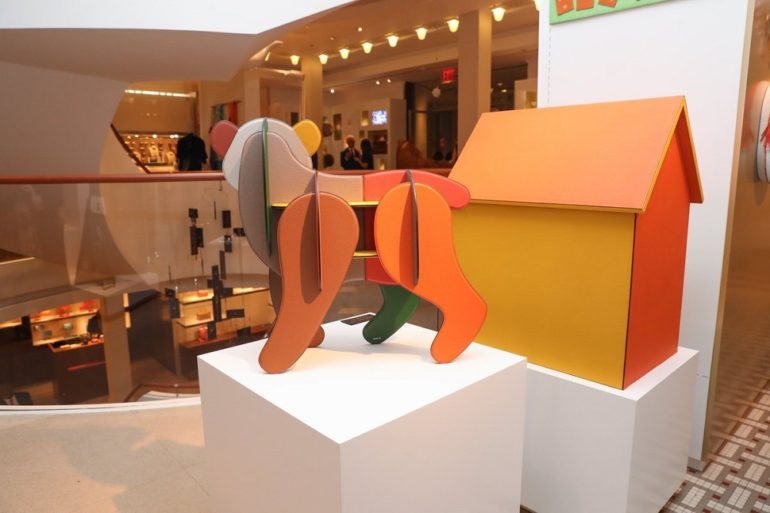
    Hermès presents a workshop of metamorphosis for materials and the invention of forms themed from now on till 9th December in Hong Kong. From a giant elephant pouffe to a target mirror, the Landmark Price’s store is transformed with scenography designed by Hong Kong artist Kevin Cheung. Once upon a time, there was a meeting of materials, their inimitable mix, their singular hybridisation. Petit h shares with upcycling product designer Kevin Cheung a passion for slumbering materials, from bamboo to silk, cashmere and many more.

    The staging is inspired by daily life and everyday objects. A tree and its bubble-like buds unfurl across the three levels of the store where new petit h inventions appear, paying homage to the diversity of Hermès materials and know-how, and to the dreams that take shape during our daily lives.

    Petit h was founded in 2010 by Pascal Mussard, who had the idea of bringing leftover materials from all over the house under one roof and giving them new life through Hermès craftsmanship and know-how.

    Godfroy de Virieu, creative director since January 2018, is now leading the dialogue between artisans, designers and artists from all backgrounds.

    Together, they create dreamlike, playful, poetic and surprising objects from noble materials as either unique pieces or limited editions.

    Petit h permanent home remains in Paris, in the Hermès store at 17 rue de Sèvres, as well as Hermes.com.

    Petit h will be traveling Asia in 2019.

  • KUHO’s flagship store combines fashion and art

    KUHO’s flagship store combines fashion and art

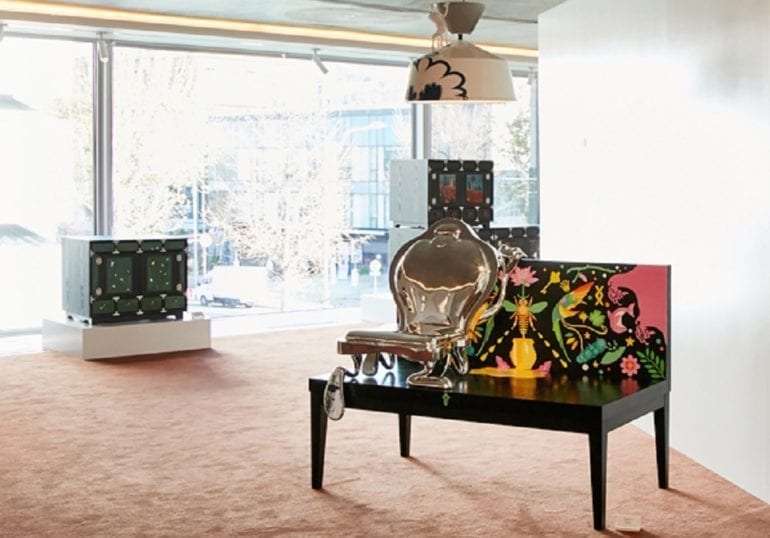
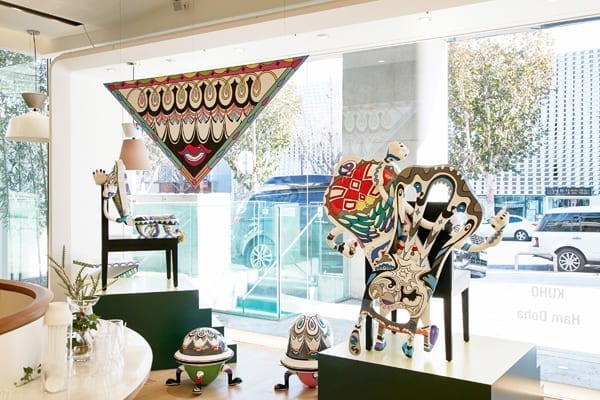
    Samsung C & T’s womenswear “KUHO” showcases the exhibition and collaboration line “Artisan” with Doha, a furniture designer to build its image of a lifestyle brand.

    Ham-Doha Collaboration is held under the theme of “Sentiment” in the showroom on the second floor of the flagship store in Hannam-dong, Seoul, until the 31st of this month.

    Hannam-dong, a lively neighborhood in central Seoul near Itaewon, is becoming a popular spot for all kinds of cultural experiences, including fashion.

    It is in this area full of designer stores and galleries that KUHO, a Korean fashion label, launched its first flagship store, called “The House of KUHO”.

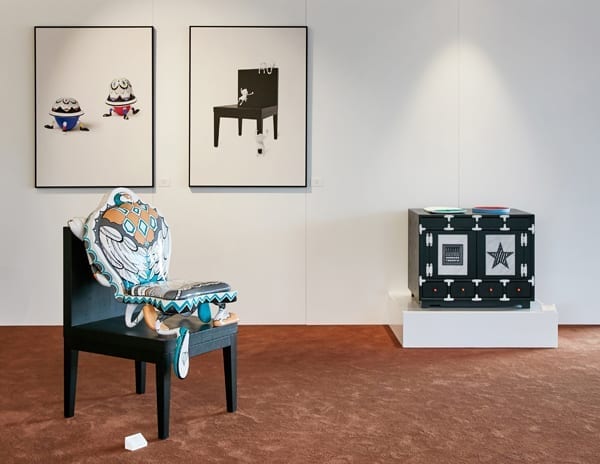
    KUHO introduced ‘Artisan’, an exclusive line to attract young customers. This line is combined with Ham Doha, a famous furniture designer, and artwork with distinctive colors and curves. It has a limited edition including sweatshirts, eco bags, pouches and brooches.

    The exhibition displays 31 works including furniture, lighting, and painting.

    The designer creates a personalized work by projecting the concept of ’emotion’, which is accompanied by all the acts that people feel and sympathize with, in  their interaction feel  furniture.

    Visitors can feel various subjective interpretations about the meaning and expression of the household and change the emotion.

    Park Ji-na, director of “KUHO” said “We have organized exhibitions to share a brand identity that pursues total lifestyle beyond clothing and enhance customer communication. We will strengthen brand identity through the works of Ham designer and Artisan line to deliver differentiated values.”

  • Indonesia Mulls Hosting Coffee Exhibition in South Korea Next Month

    Indonesia Mulls Hosting Coffee Exhibition in South Korea Next Month

    The Ministry of Commerce assesses that there is a significant opportunity for exporting coffee commodity to South Korea. To achieve this, the Ministry of Commerce plans to hold an exhibition in South Korea.

    Arlinda Director General of Export Development at the Ministry of Commerce, said that coffee has become a trend in South Korea, especially among young people. Therefore, this trend can be utilized  by Indonesian coffee businesses.

    “There is a significant opportunity for coffee in South Korea. We plan on conducting coffee exhibition there next month, and we must use that trend to engage the South Korean markets,” she said in Jakarta on Tuesday (04/04/2017).

    According to Arlinda, the youth market in South Korea will be easier to engage in because of their penchant to drink coffee. Therefore, Indonesia must provide the highest quality coffee, including  Arabica coffee that is a mainstay product in Indonesia.

    “The trend in young people there is coffee and tea. A seminar on food and beverage can provide us with information on local youths’ tastes. Our specialty is coffee Arabica, and we actually have 32 kinds. We are working with coffee exporters to increase their exports,” she said.

  • Exhibition industry contributes $6.8 billion to Hong Kong’s economy

    Exhibition industry contributes $6.8 billion to Hong Kong’s economy

    Findings from the latest Economic Impact Study on the contribution of Hong Kong’s exhibition industry to the economy in 2014, released today, contained encouraging news for the industry and for Hong Kong. Overall, the study reveals that the exhibition industry contributed an impressive HK$52.9 billion (US$6.8 billion) directly and indirectly to Hong Kong’s economy in terms of expenditure, equivalent to 2.3% of the city’s total GDP for the calendar year 2014. This represents strong positive growth by comparison with the figures from the previous Economic Impact Study, covering 2012.

    At HK$52.9 billion (US$6.8 billion), the expenditure effects of the exhibition industry in 2014 were up by 29% from 2012, at a CAGR of 13.9%. A significant part of this was contributed by the direct spending of international exhibitors and exhibition visitors, who according to the study tend to spend 61% more per visit than the average overnight tourist visitor to Hong Kong, with their spending focused in the retail, hotel and F&B sectors.

    The Study, commissioned by the Hong Kong Exhibition & Convention Industry Association (HKECIA), also shows that apart from direct economic benefits in terms of expenditure, the exhibition industry also provided equivalent of around 83,500 full-time jobs in the exhibition industry and other service and supporting sectors including hotel, F&B, retail, stand design and construction, and logistics and freight forwarding.

    In 2014, the fiscal benefits (i.e. benefits arising from various government taxes associated with exhibition activities and participants) contributed by the exhibition industry amounted to HK$2.1 billion (US$269.9 million).

    Commenting on the findings, Chairman of the HKECIA, Mr Stuart Bailey said, “We welcome this Study and the results because, once again, it highlights just how important our industry is for Hong Kong. The study shows in great detail the many ways in which exhibitions fuel Hong Kong’s wider economy – for example by spinning off economic benefits and extensive workforce to supporting industries, and attracting high-spending international business visitors to the city. The Study also reveals that overseas exhibition exhibitors and visitors continue to spend more than international overnight tourists. We should put efforts in making them visit the exhibitions in Hong Kong regularly.”

    Mr Bailey continued, “To continue providing Hong Kong with benefits at this level, our exhibition industry needs to remain attractive, efficient and competitive. We must continually be looking for ways of differentiating ourselves from regional competitors, in terms of things like providing premium exhibition space, ample capacity, and exceptional value-added services. I hope our policymakers will take the findings of this Study into account as they plan for the infrastructure and facilities that Hong Kong needs in the years to come.”

    This is the sixth in a series of Economic Impact Studies, which have been carried out biennially since 2004. It was once again conducted by KPMG Advisory (Hong Kong) Limited, a respected independent research consultancy.

    KEY FINDINGS OF THE ECONOMIC IMPACT STUDY 2014:

    Economic impact of Hong Kong’s exhibition industry in 2014 and 2012

    Area Benefits (2014) Benefits (2012) Compound Annual Growth Rate (CAGR)

    Expenditure effects HK$52.9 billion
    (US$6.8 billion) HK$40.8 billion (US$5.2 billion) 13.9%

    Fiscal impact HK$2.1 billion
    (US$269.9 million) HK$1.4 billion
    (US$179.9 million) 20%

    Employment 83,500 FTE 69,600 FTE 9.6%

    Expenditure effects continue to grow due to growing visitor number and expenditure

    Hong Kong’s exhibition industry contributed expenditure effects of around HK$52.9 billion (US$6.8 billion) to the Hong Kong economy in 2014, up by 29% from 2012, representing a CAGR of 13.9%. This was equivalent to 2.3% of Hong Kong’s GDP, up from 2.0% in 2012.

    – HK$52.9 billion (US$6.8 billion) – up by 29% from 2012, representing a CAGR of 13.9%.

    – Direct expenditure covers expenditure by Visitor Personal (exhibition visitors) and Business Related (exhibition organisers and exhibitors) and amounts to HK$26.5 billion (US$3.4 billion).

    – Visitor expenditure remains the largest expenditure segment at HK$16.1 billion (US$2.1 billion) in 2014, representing a CAGR of 22.0% from 2012. It is because of a significant increase in the number of visitors from outside Hong Kong in 2014 and an increase of the average spending by visitors.

    – Visitor personal expenditure spilt between international and domestic spending is around 93% to 7% (the spilt was 92% to 8% in 2012).

    – Retail, hotel and F&B sectors were the largest recipients of director visitor expenditure, accounting for 67% of the total visitor personal expenditure.

    – Business-related (exhibition organisers and exhibitors) expenditure amounts to HK$10.4 billion (US$1.3 billion) in 2014.

    Fiscal impact grows with increased visitor and business spending
    The tax take enjoyed by the Hong Kong Government in 2014 as a result of exhibition activities is estimated at around HK$2.1 billion (US$269.9 million), based on the total expenditure effects of HK$52.9 billion (US$6.8 billion).

    Derived from three taxes:

    – Profits tax: HK$961 million (US$123.5 million)
    – Salary tax: HK$1.0 billion (US$128.5 million)
    – Airport tax: HK$88 million (US$11.3 million)

    Equivalent of 83,500 full time jobs provided by the exhibition industry

    Full-Time Equivalent (FTE) employment amounted to around 83,500 in 2014, representing a CAGR of 6.5%, up from 69,600 in 2012.

    – Around 3,400 FTEs, or 4%, were directly employed by exhibition organisers and venues.

    – Remaining 96%, or 80,100 FTE jobs was provided across various supporting sectors. Amongst this group, around 57% of the FTE jobs created came from retail, hotel and F&B. Other supporting industries such as international transport, stand contractors, advertising and others accounted for the remaining 43%.

    International exhibition visitors and exhibitors contributed more than overnight tourists

    The report showed that international exhibition visitors and exhibitors spent on average 61% more than overnight tourists.

    – International exhibition visitors spent an average HK$12,776 (US$1,642) per visit; international exhibitors spent an average HK$12,829 (US$1,649) per visit; compared to overnight tourists spent an average of HK$7,960 (US$1,023) per visit.

  • CE China makes debut

    CE China makes debut

    Brings together local and international retailers and suppliers.

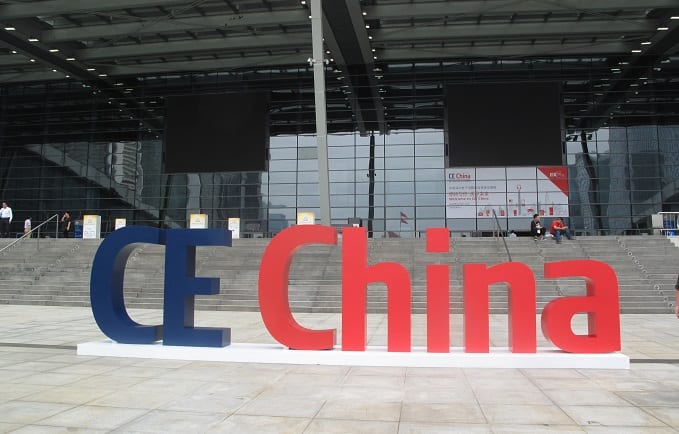
    The CE China exhibition launched in Shenzhen this week, created by the organisers of the annual IFA Berlin exhibition, has brought together retailers including Alibaba and Amazon China with leading Chinese and international manufacturers for a unique exhibition concept.

    There were over 150 exhibitors for the three-day event, concluding today (April 22) across an exhibition area of over 15,000 square metres at the Shenzhen Convention and Exhibition Center.

    According to Jens Heithecker (pictured below), the executive director of IFA at Messe Berlin, this new exhibition is designed to provide Chinese consumers and members of the trade with a local and international experience.

    Jens-Heithecker

    “Welcome to the very first edition of the new CE China trade show and you can see it is a retail brand show – this means we have Chinese retailers as well as Chinese brands and global brands from around the world here in one place. This is the newest show for the Chinese market, but with clear influence to the Asian markets as well.

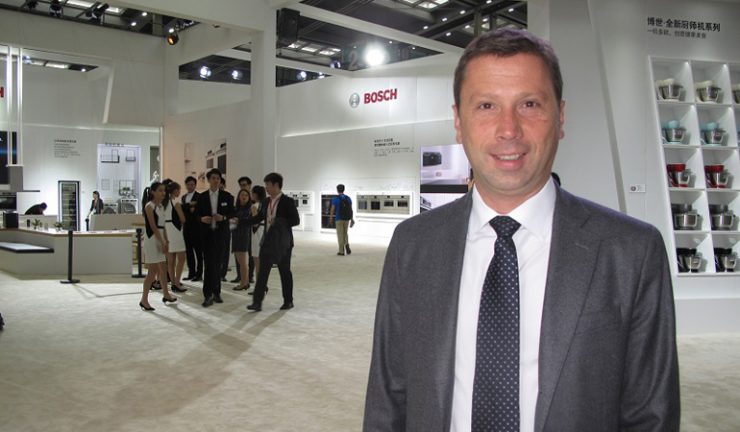
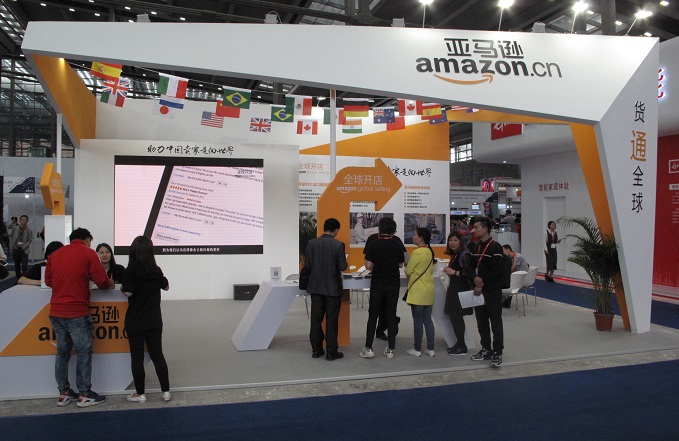
    “We are proud that some of our largest exhibitors the very first year of the show are retailers such as Alibaba, Suning, Gome and Amazon China. In addition to this, from the industry side the dominating booths are from Bosch, Siemens, Karcher, Onkyo emphasising that this is an international show. It is not a trade show with a lot of small booths, it is a brand show that China has not seen so frequently in the past.

    CE China Amazon

    “It is a step for IFA to conquer the Asian market with our own show, but we have also realised in the last couple of months what influence this show has to Berlin. We have much better contact with the Chinese retailers and manufacturers who are better informed about IFA in Berlin.

    “We have also brought the Euronics and Expert buying groups from Europe and they will inform the industry in China that they act differently to other retailers worldwide, the influence is both ways. We bring over international and niche brands that is what the new Chinese middle class is looking for and of course the leading brands worldwide.

    “We have two kinds of trade visitors – the traditional Chinese retailers with central buyers who spread out the products through the shops, but also in this competitive environment of rising online retailers, it is clear that you have to train staff in a better way so the retail shops have better chance to survive.

    “The consumer experience in-store has to be an experience and not only a place to pick up products. And the manufacturers feel as though they need much more brand experience in the retail stores, bringing retailers and manufacturers together to train each other with the newest products for the best sales outcome. That is the basic idea here in China and we look forward to demonstrating how we do it in Europe.

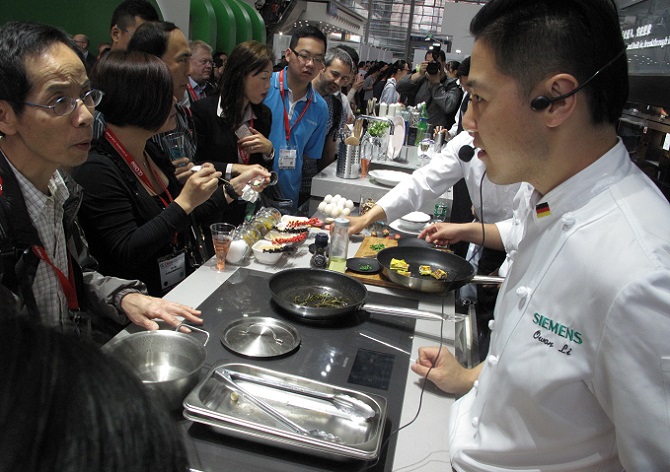
    CE China Siemens

    “The other point, is that here in the region of Shenzhen is the world’s largest hub for the electronics industry which means for all these companies developing, manufacturing and marketing these products they need to understand in a better way to work with international brands and international markets and this is the chance for them to see and learn about at CE China.”

    Dr. Christian Göke, CEO of Messe Berlin added: “As the Asian counterpart of the global IFA trade show, CE China is consciously aligned to the needs of Chinese distributors, and existing retail structures in particular. These distributors are interested in products manufactured by well-known international brands. It will be our task to successfully bring together these companies and distributors at CE China.”