Tag: Fact.MR

  • Trail Camera Market Inching Closer to Wireless Ubiquity, Global Demand to Grow at 3.5% Volume CAGR

    Trail Camera Market Inching Closer to Wireless Ubiquity, Global Demand to Grow at 3.5% Volume CAGR

    The bullish run in the Trail Camera market continues in 2018, with an incremental growth of 18,000 units over 2017According to Fact.MR’s new study, increasing wildlife exploration and rising demand for higher security and surveillance are instrumental in driving sales of trail cameras. The study opines that demand for trail cameras will grow at a CAGR of 3.5% in terms of volume throughout the period of forecast, 2018-2028.

    Technological advancements have significantly transformed the trail camera space, particularly with respect to connectivity and functionality. Possibility of obtaining thumbnail picture with trail camera has been a remarkable step reflecting a technological novelty in the trail camera marketplace.

    Growing proliferation of novel technologies such as Wi-Fi and Bluetooth in the trail camera marketplace are expected to influence the sales of trail camera, in turn presenting a positive outlook of the overall market. The demand for trail camera is being influenced with growing digitalization, as manufacturers continue to focus on researching and developing their products.

    The demand for wireless trail camera is projected to expand at a substantial rate throughout the period of forecast, says the report. As compared to standard trail camera variants, the Wi-Fi variants are expected to account for a relatively higher market share of the overall trail camera market. User friendly features and enhanced convenience continue to drive the sales of wireless trail camera.

    Cellular wireless trail camera products are estimated to largely contribute to the growth of the market. Sales volume of cellular trail camera are estimated to remain resurgent through 2028, dominating the Wi-Fi trail camera variants, according to the report. Fact.MR estimates that the volume sales of cellular trail camera are likely to maintain a 1.5x lead over Wi-Fi trail camera by end of 2028.

    The demand for trail camera with trigger speed up to 0.25 seconds is expected to gain high traction owing to the reduction in delay time while capturing pictures. Faster trigger speeds allow trail camera to capture moving units efficiently, making trail camera with 0.25 seconds trigger speed a valid candidate for forest exploration. However, the report estimates that the sales of trail camera with trigger speeds within the range of 0.25 – 0.75 seconds are expected to be on an upswing in terms of sales volume throughout the period of forecast.

    The report foresees that the demand for trail camera with low glow flash is expected to increase in the forthcoming years. Increasing volume sales of low glow trail camera can be attributed to its efficient picture quality during night, making them a convenient option for enthusiasts to capture wild life activities at night time. Further, the demand for no glow trail camera is also projected to increase at a higher rate throughout the period of forecast, 2018-2028.

    Trade shows, such as the ATA (Archery Trade Association) show, are expected to influence the trail camera market growth by providing a potential platform for manufacturers of trail camera to promote their offerings. Using trade shows as a significant growth platform, manufacturers can enhance their brand visibility. In addition, this aspect continues to influence the demand for technological robust trail camera, in turn contributing to the growth of the trail camera market.

    Sales volume of trail camera is likely to remain concentrated across developed countries in the North America region, particularly the United States. Use of trail camera in commercial buildings for surveillance remains a key determinant of growth in the US, apart from wide life exploration. The report also estimates that the European countries are expected to showcase significant adoption of trail camera in the forthcoming years on the back of growing wide life monitoring and hunting activities. Overall the market for trail camera is expected to follow a positive growth graph, albeit at a modest pace.


  • Airport Retailing Consumer Electronics Market Witnessing a 2x Increase in Consumer Electronics Sales across SEA; India Most Lucrative

    Airport Retailing Consumer Electronics Market Witnessing a 2x Increase in Consumer Electronics Sales across SEA; India Most Lucrative

    The airport retailing consumer electronics market is foreseen to expand at a significant pace with global revenues crossing US$ 1,700 Mn in 2017, according to a new study. Traditionally pervasive as transportation service facilities, airports are now witnessing an influx of retail outlets for consumer electronics products. The shift in customer perspective toward airports as a retail destination continues to influence the growth of the airport retailing consumer electronics market.

    Fact.MR envisages that prospects for consumer electronics in airports are expected to remain promising, with the airport retailing consumer electronics market to grow at a CAGR of 6.3% in terms of value throughout the period of forecast, 2018-2028.

    The market valuation is likely to remain influenced by growing number of airports. Sales of consumer electronics in airports are projected to remain concentrated in the Southeast Asian (SEA) countries, making the region a lucrative market for airport retailing consumer electronics. India is poised to showcase higher market attractiveness in SEA during the forecast period on the back of steady economic development coupled with rising air tourism, according to the study.

    India’s lucrativeness in the airport retailing consumer electronics marketplace is attributed to rising number of air passengers. According to IATA (International Air Transport Association), the air passenger count in India is expected to reach 478 million by 2036. This is expected to present potential opportunities of growth for airport retailing consumer electronics in the coming years. In addition, sales of airport retailing consumer electronics on departure are likely to be on an upswing as compared to sales on arrival in the country. The report forecasts that the sales of airport retailing consumer electronics in India could exceed US$ 250 Mn by 2028.

    Growing sales of accessories are expected to largely contribute to the growth of the airport retailing consumer electronics market, according to the report. Consumer preference for accessories is projected to expand at a higher rate as compared to electronic devices. Against this backdrop, airport retailers are also planning to rent accessories for travellers opting for short trips.

    IATA projects that by 2036, global air passenger traffic is expected to reach 7.8 billion. This indicates that growth of airport retailing consumer electronics market is likely to remain significant in large airports. However, medium size airports are projected to showcase growing demand for airport retailing consumer electronics, says the report.

    Trend of hyper-personalization remains instrumental in driving growth of airport retailing consumer electronics market. With critical airline restrictions apropos to amount of goods to be carried in flight, a new personalised service in the airport retailing consumer electronics space has been witnessed. Airport retailing consumer electronics stores can use customer data from boarding passes, and deliver products to the customer’s destination. This trend is likely to influence growth in revenues of airport retailing consumer electronics in the coming years.

    Advertisements on flyers continue to remain instrumental in driving the growth of airport retailing consumer electronics market. Growing digitalization coupled with product displays on flyers are expected to influence sales of consumer electronics in turn presenting positive growth avenues for airport retailing consumer electronics market. This is likely to translate into increasing product sales across specialty retail stores in airports, consequently making them a key growth platform for airport retailing consumer electronics, says the report.

    As traditional brick and mortar sales are getting impacted due to mega trends such as relentless onslaught of online selling platforms, the physical retailing in airports is thriving. Overall, the airport retailing consumer electronics scenario remains positive and stakeholders can expect an optimistic growth path in the airport retailing consumer electronics market in the forthcoming years.

    The insights presented here are from a research study on Airport Retailing Consumer Electronics Market by Fact.MR

  • Biodegradable Packaging Material Market Remains Highly Fragmented, with Tier 3 Players Collectively Foreseen

    Biodegradable Packaging Material Market Remains Highly Fragmented, with Tier 3 Players Collectively Foreseen

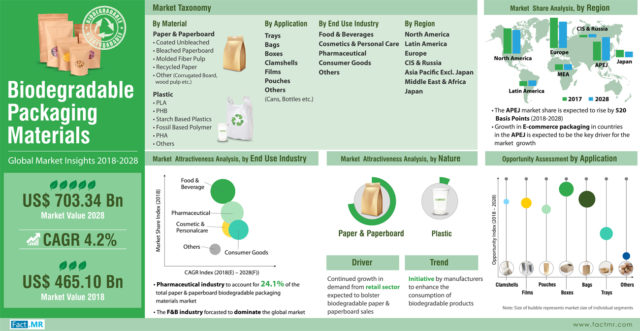
    Biodegradable packaging market witnessed moderate growth during 2013 to 2027, and the status quo is envisaged to prevail over the period of forecast 2018 to 2028, according to new Fact.MR study. Volume sales of biodegradable packaging are foreseen to record a modest 4.2% CAGR through 2028, which is anticipated to equal a market value in excess of US$ 703 billion. The study finds that tier 3 players will collectively continue to account for over three-fifth share of the biodegradable packaging market.

    Biodegradable packaging market is expected to envisage healthy value CAGR of 4.2% during the period 2018-2028, with revenues surpassing US$ 703 billion by 2028 end. The study also opines that the paper & paperboard biodegradable packaging will retain its undisputed dominance in the biodegradable packaging market, as it may account for more than 95% of the total market revenue by the end 2028. The global war against plastic packaging materials is opening an attractive window of opportunities for paper packaging companies, enticing them into entering the biodegradable packaging market.

    A majority of regulatory bodies and international environmental organizations have proposed a ban on single-use packaging materials to mitigate the perilous effects of non-degradable solid waste on the environment. Increasing environmental awareness and consumer inclination towards making sustainable purchases is providing a major boost to the growth of the market.

    Positive effects of the ban on single-use packaging on the biodegradable packaging market are offset by stringent labeling regulations and certification procedures to control false claims about the biodegradability of packaging materials. The market is characterized by the needs to comply with strict quality standards established in various regional markets, which may complicate it for market players to maintain competitive prices of biodegradable packaging solutions.

    Meanwhile, the study finds that leading players in the biodegradable packaging market are adopting strategies to acquire their smaller rivals to consolidate a stronger position in the packaging sector. DS Smith plc – a British paper packaging company – recently announced its plans to acquire its Spanish rival Europac Group for over US$ 2 billion, in order to merge the Western European biodegradable packaging market. Another leading player – Smurfit Kappa Group recently completed the acquisition of Reparenco – a paper and recycling company in Netherlands – for €460 million to expand its European biodegradable packaging capacities.

    An American manufacturer of biodegradable packaging – WestRock Company recently acquired packaging businesses across the world, including Hanna Group Pty Ltd, Plymouth Packaging, Inc., and Schlüter Print Pharma Packaging GmbH, to establish a stronger presence in the market. The company also revealed its plans to acquire KapStone Paper and Packaging Corp., an American paper company, for a total enterprise value of around US$ 4.9 Bn to leverage KapStone’s expertise in biodegradable packaging using kraft paper.

    “Increasing growth of the e-commerce sector and popular trends of online grocery shopping is opening new avenues of growth for players in the biodegradable packaging market. Purchasing decisions of environment-conscious consumers are greatly influenced by sustainable packaging materials, which may create high demand for biodegradable packaging solutions in the coming future. Stakeholders in the biodegradable packaging market are shifting their focus on the dynamic trends in the e-commerce sector while adopting their future business strategies,” says a lead analyst at Fact.MR.

    The study further states that, among all the leading end-user industries in the biodegradable packaging market, food & beverage industry is expected to account for more than 30% of the total market share throughout the forecast period. Increasing demand for packaged food products, convenience foods, and ready-to-eat meals is reflected in supermarket shelves. Leading market players are introducing biodegradable packaging films, trays, and bags to further improve the fresh food experience for consumers while offering numerous environmental benefits.

    Sensing the extraordinary growth opportunities in the biodegradable packaging market for the F&B industry – the Mondi Group recently developed an innovative, paper-based, biodegradable packaging bag for food – Sustainex®, in collaboration with a Polish converter, SILBO. Multifold opportunities for biodegradable packaging in the F&B industry are boosting market players to develop innovative technologies, biodegradable packaging materials, and designs, which is expected to influence the dynamics of the biodegradable packaging market in the upcoming years.