Fast Retailing Co. Chairman Tadashi Yanai said Walt Disney Co.’s new park in Shanghai will help his Uniqlo casual clothing brand expand in China, shrugging off concerns over an economic slowdown in the Japanese retailer’s largest overseas market.
“The opening of the Shanghai Disneyland gives both of us, Uniqlo and Disney, a business opportunity,” Chairman Tadashi Yanai told reporters in Shanghai, where Uniqlo will open a new Disney-inspired concept store. “Our business is getting absolutely no impact” from China’s slowdown, he said.
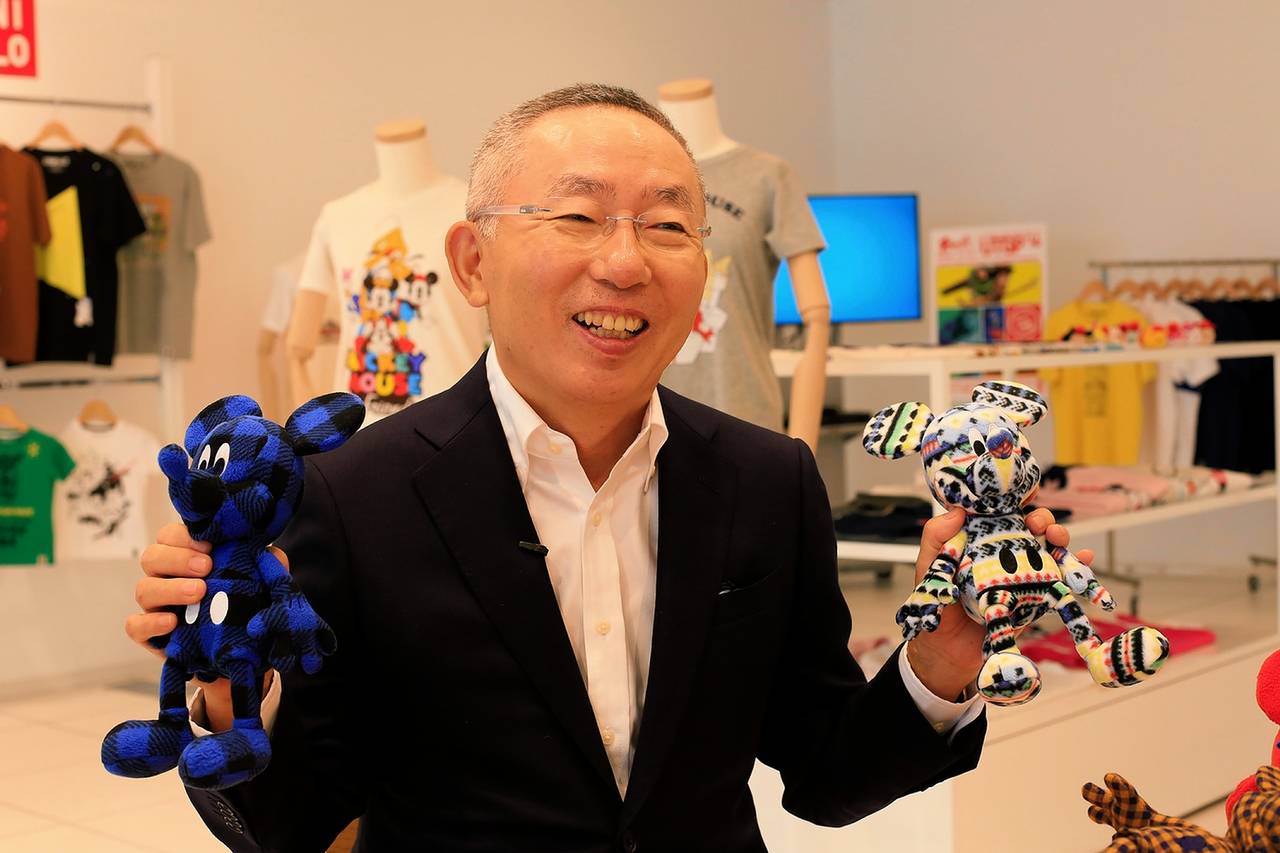
Starting Sunday, Uniqlo will devote an entire floor at its six-story China flagship store in central Shanghai to products jointly designed with Disney. A human-sized Mickey Mouse statue greets visitors to the store, where T-shirts and toys depicting characters such as Tinker Bell, Woody of Disney Pixar’s “Toy Story” animated films, and Darth Vader from the Star Wars movies are on display.
Japan’s richest person, Yanai plans to open 100 stores a year in China as Uniqlo competes with Hennes & Mauritz AB’s H&M and Inditex SA’s Zara to win over consumers in the world’s most populous country. The retailer’s design tie-up comes as Disney prepares to open its $5.5 billion Shanghai theme park next year, its biggest foreign investment and a bet on the country’s booming middle class.
The Disney collaboration should help Uniqlo boost sales in China “as buzz builds around the opening of Shanghai Disneyland,” said Bloomberg Intelligence retail analyst Thomas Jastrzab. “Expanding store-specific limited edition merchandise offerings should help Uniqlo increase regular foot traffic and improve customer loyalty.”
Fast Retailing rose 3.3 percent to ¥46,800 ($388.09) at the close of trading in Tokyo on Friday. The shares are up by 6.3 percent so far this year, compared with the 3.3 percent gain in the benchmark Topix index.
Uniqlo has about 360 stores in mainland China, the most in any country outside Japan, where it has almost 850 shops. The company plans to expand its Greater China network, including mainland China, Hong Kong and Taiwan, to 1,000 outlets.
China is a key market for Fast Retailing as Yanai attempts to turn Asia’s biggest clothing retailer into the world leader, with a target of ¥5 trillion in sales by 2020 from its forecast of ¥1.65 trillion for the fiscal year ended Aug. 31.
Yanai said demand for Uniqlo products will increase amid an economic slowdown in China. Everyday clothes with basic designs and advanced materials that Uniqlo sells at affordable prices fit well as China shifts its focus to consumer purchasing from manufacturing, he said.
“An economic slowdown in China could boost Uniqlo’s sales, particularly as shoppers increasingly look for value-for-money when purchasing clothing essentials such as T-shirts and pants,” Jastrzab said.
China’s apparel and footwear market is highly fragmented, with market leader Bestseller AS, owner of brands such as Jack & Jones and Vera Moda, holding a 1.7 percent market share by value in 2014, according to Euromonitor International. Uniqlo ranks eighth with 0.6 percent, while Inditex is ninth with 0.5 percent and H&M is out of the top 10 with 0.4 percent.
“Our concept of manufacturing is fundamentally different and unique,” said Yanai. “We don’t chase trends, but we would rather want to incorporate fashion into our basic clothes.”