Tag: foreign exchange

  • Yen Traders Brace for Silver Week Intervention as BOJ Decision Looms

    Yen Traders Brace for Silver Week Intervention as BOJ Decision Looms

    Currency traders in Tokyo are bracing for official market intervention around the Bank of Japan’s September 18 policy meeting, eyeing the upcoming three-day holiday for sudden yen buying.

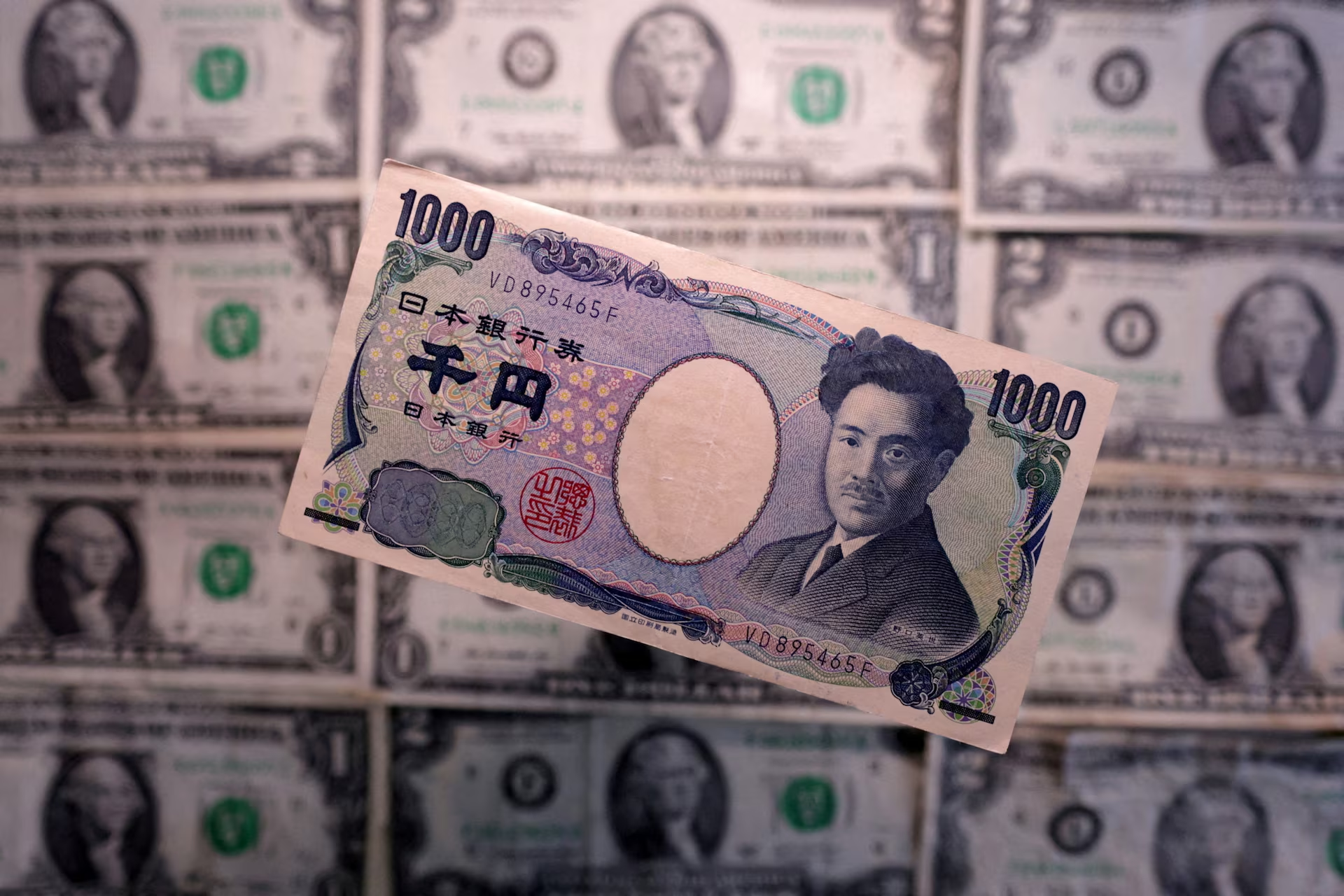
    The Japanese yen climbed 0.5 per cent to 157.99 against the US dollar on Thursday as markets began pricing in an interest rate increase larger than 25 basis points.

    Trading desks expect sharp swings during Silver Week, a long holiday weekend starting immediately after the central bank convenes. Thin liquidity during national holidays gives authorities greater traction when buying yen, echoing April when the government stepped in during an extended break for the first time since 2024.

    Holiday Liquidity and Rate Gaps

    Tokyo deployed a record $96.4 billion over the past month to prop up the currency, backed by coordination with Washington. Japanese Finance Minister Satsuki Katayama and US Treasury Secretary Scott Bessent both confirmed readiness to enter foreign exchange markets without hesitation.

    Hedge funds have nevertheless started rebuilding short bets against the yen. Elevated crude oil import bills and a persistent interest-rate gap with the United States continue to drag the currency down toward the 160 line, where SBI FX Trade president Marito Ueda warned fresh intervention becomes probable.

    Pressures Across Asian Balance Sheets

    For retailers and consumer brands across Asia, rapid currency swings disrupt cross-border supply chains and contract pricing settled in dollars. Japanese store operators face relentless cost increases on imported food and inventory, while regional exporters must recalibrate margins against an unpredictable yen.

    Attention now shifts to the US Federal Reserve’s rate decision days before the Bank of Japan meets on September 18, with traders watching whether the exchange rate tests the 160 level before holiday trading begins.

  • Asian Markets Gain as JGB Yields Slide Ahead of US Jobs Data

    Asian Markets Gain as JGB Yields Slide Ahead of US Jobs Data

    Asian stocks and government bonds climbed on Thursday as investors recalibrated interest rate expectations ahead of crucial United States labour data.

    MSCI’s broadest index of Asia-Pacific shares outside Japan rose 0.5 per cent, tracking modest overnight gains on Wall Street as benchmark sovereign borrowing costs pulled back across major economies.

    Japanese government bonds led the fixed-income recovery ahead of a Ministry of Finance auction of super-long debt. The yield on 30-year Japanese government bonds dropped 10 basis points to 4.065 per cent, retreating from near-record highs, while benchmark 10-year US Treasury yields dipped 0.99 basis point to 4.784 per cent.

    Bond Yields Ease Across the Region

    Relief across regional debt markets followed remarks from Federal Reserve Bank of New York President John Williams, who noted that elevated long-term yields reflect economic resilience while policymakers assess upcoming data. Traders using the CME Group FedWatch tool now price a roughly two-in-three probability of a 25-basis-point rate increase this month, up from 37 per cent a week earlier.

    Economic data from Tokyo offered fresh evidence of domestic momentum. Japan’s services sector expanded in August at its fastest pace in five months, supporting expectations that the Bank of Japan retains room to raise borrowing costs further.

    For retailers and consumer operators across Asia, the pause in yield expansion offers short-term relief on commercial debt and capital expenditure plans. Persistent rate differentials and elevated debt costs have weighed on cross-border expansion financing throughout the region this quarter.

    Currency and Commodity Shifts

    Currency trading remained steady, with the dollar index slipping 0.05 per cent to 99.54. The Japanese yen held its ground at 158.59 per dollar after surging 0.9 per cent in the prior session, while the euro edged up to $1.1589.

    Energy markets softened slightly despite geopolitical friction between the United States and Iran. Brent crude fell 0.44 per cent to $95.21 a barrel and US crude dropped 0.3 per cent to $90.74 a barrel, while spot gold gained 0.32 per cent to trade at $4,400.47 an ounce.

    Market attention turns next to Friday’s US nonfarm payrolls report and an upcoming address by Federal Reserve Governor Christopher Waller.

  • Japanese Retailers Lock in FX Contracts as Weak Yen Hits Profits

    Japanese Retailers Lock in FX Contracts as Weak Yen Hits Profits

    Japanese retailers are overhauling supply contracts and turning to financial derivatives as the yen hovers near 159 per dollar, driving up import costs across food and consumer goods.

    The currency has shed more than 30 per cent against the greenback over the past five years, eroding buying power for domestic store operators that rely heavily on overseas agricultural products, raw materials and finished goods.

    Supermarkets Shift Supply Terms

    Takara MC, which runs 43 supermarkets south of Tokyo, has abandoned monthly price negotiations with overseas suppliers in favour of quarterly and annual agreements. Chief executive Taku Ueno said securing terms for up to a year on imports such as US beef, Spanish olive oil and Italian tomatoes allows the chain to shield shoppers from immediate price increases on store shelves.

    Securing supply deals has grown harder as rival buyers from China and Thailand consistently outbid Japanese grocers for commodity shipments.

    Bankers report that small and mid-sized store operators, which previously absorbed modest currency swings, are now turning to futures, forwards and options contracts to limit their balance sheet exposure.

    Corporate Hedging Stretches Further

    Nitori Holdings, the country’s largest furniture retail chain, estimates that every 1 yen drop against the US dollar reduces its operating profit by roughly 2 billion yen ($12.5 million). While the company has avoided direct hedges to date, it is reviewing forward contracts if currency weakness continues.

    Brokers in Tokyo say hedging volume is expanding well beyond traditional tenors. Daiwa Securities noted that client requests to lock in exchange rates have stretched from the usual few months out to as long as five to 10 years, while Bank of America expanded its Tokyo foreign exchange sales team over the past two years to handle the surge in corporate demand.

    For retailers across East Asia, Japan’s currency predicament shows how sustained foreign exchange weakness can upend long-standing retail pricing models. Competitors elsewhere in the region, operating with firmer currencies, continue to snap up global agricultural allocations that once went routinely to Tokyo buyers.

    Market participants at JP Morgan project the dollar-yen rate will persist in the 155 to 165 corridor, keeping the pressure firmly on Japan’s store operators as contract renewals approach in the coming quarter.

  • Vietnamese Dong Strengthens as Dollar Drops to VND26,330 at Vietcombank

    Vietnamese Dong Strengthens as Dollar Drops to VND26,330 at Vietcombank

    Vietcombank lowered its selling rate for the US dollar by 0.11 percent to VND26,330 on Tuesday morning, reflecting broad softness across international foreign exchange desks.

    The drop in official banking channels contrasted with Vietnam’s parallel market, where the greenback climbed 0.19 percent to VND25,970.

    Divergence in local currency trade

    Commercial lenders adjusted rates as global demand for the dollar faltered. Currency dealers operating in the unofficial market logged modest buying interest, keeping the gap between bank counters and private money changers unusually narrow.

    Vietnamese importers and consumer brands track these daily currency fluctuations closely to price incoming shipments of electronics, packaged goods, and retail inventory.

    Global pressures and trade sanctions

    In international currency trade, the dollar struggled to retain ground against major peers. The euro traded slightly higher at $1.1668, near a three-month high, while sterling gained 0.1 percent to $1.3639, holding near a six-month peak.

    Market participants weighed fresh policy actions from Washington, where US Treasury Secretary Scott Bessent announced an expansion of sanctions against Iran on Monday. Bessent warned foreign entities to sever commercial ties or risk expulsion from dollar clearing networks.

    Ray Attrill, head of FX strategy at National Australia Bank, noted in a podcast that the measures could trigger a modest reversal of dollar weakness seen late last week.

    Traders across Asian financial hubs are watching whether Treasury yield management and the expanded sanctions framework will halt the dollar’s downward drift before the next fixing.

  • Dollar struggles in Asia after lift from US retail sales

    Dollar struggles in Asia after lift from US retail sales

    The dollar was steady on Friday after China’s central bank appeared to have stopped guiding the yuan lower for now, easing concerns that a weaker Chinese currency could derail plans by the US Federal Reserve to raise interest rates.

    The dollar traded at 124.40 yen, flat from late US levels and above this week’s low of 124.21 yen. For the week, it was up about 0.1 per cent.

    Volume in Tokyo was relatively thin, with many businesses winding down for the mid-August Obon holiday. Although there are no public holidays, many people take summer vacations around this time, and some offices close.

    “Company people have gone on their breaks and left their orders with banks,” said Kaneo Ogino, director at foreign exchange research firm Global-info Co in Tokyo.

    Some commercial accounts would sell dollars above 125.50, he added.

    The euro fetched $1.1143, down slightly from late US levels. Still, it was up 1.6 per cent on the week, as the dollar has been hit by speculation that the US might not want a stronger dollar either if China pushes down the yuan.

    The euro got a lift this week as investors unwound euro-funded carry trades in the yuan and other emerging market currencies, which were hit hard by the devaluation.

    Emerging Asian currencies continued to fall on Friday, on track for steep weekly losses, with the Malaysian ringgit skidding to a fresh pre-peg 17-year low.

    On Friday, the People’s Bank of China set the yuan midpoint at 6.3990 yuan to the dollar, slightly stronger than Thursday’s levels.

    The central bank said on Thursday there was no reason for the yuan to fall further given the country’s strong economic fundamentals.

    Beijing’s moves some eased concerns that a cheaper yuan could trigger a “currency war”, or a competition among the world’s biggest economies to cheapen their own currencies to seek a competitive edge.

    US interest rate futures prices edged down and US bond yields bounced back as investors priced in an increased likelihood of a Fed rate hike in September. Solid US retail sales data also supported the case for an early rate hike.

    The dollar index, which tracks a basket of six major currencies, stood at 96.420 , off a one-month low of 95.926 hit on Tuesday.

    Still, market players are not sure how much more the dollar can gain, assuming the yuan could fall further in the face of a slowdown in the Chinese economy.

    “The latest concerns triggered by the sudden policy action may be subsiding a tad. But there is no change in the fact that the Chinese economy is slowing,” said Masafumi Yamamoto, senior strategist at Monex Securities.

    “I think the yuan has become overvalued as other countries tried to cheapen their currencies and it will keep falling, playing catch-up,” he added.

    While most major currencies saw limited moves on Friday, the New Zealand dollar fell after domestic retail sales had the slowest increase in two years, cementing expectations the Reserve Bank of New Zealand will cut rates.

    The New Zealand dollar traded down 0.5 per cent at $0.6535 , down about 1.3 per cent for the week.