Tag: free trade

  • The world’s largest free trade blocs between Japan and EU

    The world’s largest free trade blocs between Japan and EU

    The economic partnership agreement between Japan and the European Union not only forms one of the world’s largest free trade blocs, but also sets digital and copyright rules that will serve as an international template. The EPA will ultimately eliminate EU tariffs on about 99% of imported products from Japan, and Japanese tariffs on roughly 94% of products imported from the EU. It also incorporates wide-ranging regulations on data transfer and intellectual property protection. The aim is to drive the debate on other multinational trade pacts, especially against the backdrop of rising protectionism.

    A centerpiece provision is a ban on governments forcing companies to reveal source code. Chinese cybersecurity legislation that took effect in 2017 empowers the government to request source code from foreign enterprises doing business within its borders. The law also requires “operators of key information infrastructure” to locally store personal information and important data collected and produced by their services in China.

    The Japan-EU trade deal is essentially a rejection of such digital protectionism, instead encouraging the free and secure cross-border flow of data. Companies in participating countries can operate in other members without risking mandatory disclosure of trade secrets.
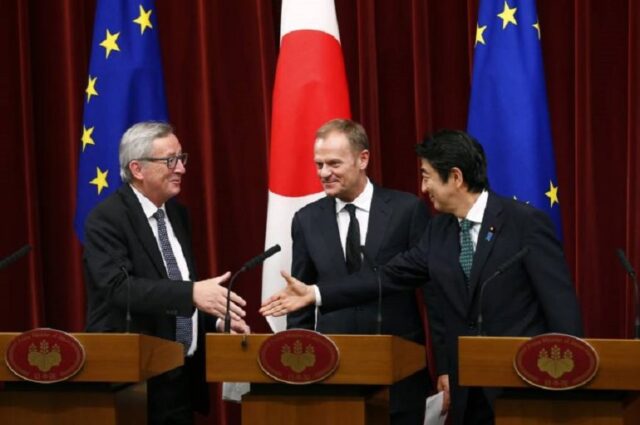
    The trade deal “will become a precedent for the data field, which is becoming increasingly important, and will lay the groundwork for the creation of subsequent rules,” said Keisuke Hanyuda, partner at Deloitte Tohmatsu Consulting.

    Japan, the EU and other like-minded trading partners seek to craft similar rules for the World Trade Organization, which includes the U.S. and China. But speedy rule-making may be all but impossible at a WTO that has been criticized as dysfunctional. The alternative strategy is to first implement high-quality rules for the Japan-EU trade deal, as well as the 11-member Trans-Pacific Partnership, and bring other countries into the fold.

    Japan and the EU agreed not to levy tariffs on the transfer of data between the two sides. Copyrights on literary works will expire 70 years after the death of the author. Alcoholic-beverage and food brands tied to a region of origin will be mutually protected as well. Authorized producers of Kobe beef and Champagne would be shielded from imitations, for example.

    The EPA covers 27.8% of global gross domestic product by 2017’s number, and 36.9% of worldwide trade. The TPP-11 — formally the Comprehensive and Progressive Agreement for Trans-Pacific Partnership — accounts for 13.3% of global GDP. Japan sees the EPA and the TPP-11 together adding 13 trillion yen ($119 billion) to its real GDP and creating 750,000 jobs.

    “On top of the short-view effect of stimulating consumption, the inflow of services and investment from the EU will increase competitive pressures inside Japan, and we can expect the effect of prices going down,” said Junichi Sugawara, senior research officer at the Mizuho Research Institute.

    Tariff elimination is expected to have a significant economic impact. EU exports to Japan could jump as much as 34%, while European companies will save an annual 1 billion euros ($1.15 billion) on duties, the EU estimates. Hopes are particularly high for expanded food and agricultural exports to Japan.

    The EPA lowers tariffs on Camembert and other soft cheeses — something Japan did not do for the TPP-11 — up to a certain quota. Japan will eliminate soft-cheese duties for in-quota imports altogether in year 16. Other items, such as European wine, will immediately become duty-free, resulting in a wider selection and lower prices for Japanese consumers.

    Many see the EPA and its benefits as a counterweight to the Trump administration’s anti-globalism. “This is an act of enormous strategic importance for the rules-based international order, at a time when some are questioning this order,” European Council President Donald Tusk said last July, when the agreement was signed. “We are sending a clear message that we stand together against protectionism.”
  • Australia Expects Free-Trade Deals With Indonesia, Hong Kong This Year

    Australia Expects Free-Trade Deals With Indonesia, Hong Kong This Year

    The Australian government expects to seal free-trade agreements with Indonesia and Hong Kong by the end of this year, its trade minister said on Friday.

    Concluding the two agreements would wrap years of talks, which in the case of Indonesia have dragged on since 2010, stalling along the way as diplomatic tensions between the two sides flared.

    “I think by the end of this year we’ll conclude successfully an FTA with Indonesia, an FTA with Hong Kong,” Trade Minister Steven Ciobo said at a business lunch in Sydney, when asked about the outlook for the next 12 months.

    He gave no further details on timing, though a deal with Indonesia, Southeast Asia’s largest economy but only Australia’s 13th-largest trading partner, could come as soon as next month when Australian Prime Minister Malcolm Turnbull is scheduled to visit.

    Ciobo, who has already sealed Australian trade deals with Peru and with the 11-nation Trans-Pacific Partnership this year, also said United States President Donald Trump’s protectionist rhetoric had made his counterparts elsewhere more willing negotiators.

    Since Trump’s election, there has been a “desire from a number of countries to double down” on trade pacts, Ciobo said, helping him to seal deals.

    He added that he was “hopeful” of also signing Australian agreements this year with the Pacific Alliance, a Latin American trade bloc and with the China-led Regional Comprehensive Economic Partnership.

    A deal with Hong Kong, Australia’s 12th-largest trading partner, has been under negotiation since last year.

    Two-way trade between the pair is worth roughly A$16.3 billion ($12 billion), according to Australian figures, nearly the same as the country’s two-way trade with Indonesia.

  • Vietnam’s retail sector to see M&A frenzy riding on free trade pacts

    Vietnam’s retail sector to see M&A frenzy riding on free trade pacts

    The sector has turned attractive due to the free trade pacts the country has reached, as part of WTO, according to a government report.

    When Vietnam negotiated to join the WTO, it committed to let investors establish 100 per cent foreign-owned retail businesses from January 2015. In addition, the report attributed the increasing number of retail M&A deals to deeper integration of the country through the Trans-Pacific Partnership (TPP) and the ASEAN Economic Community (AEC), which will see tax exemption for thousands of commodities delivered into each member state.

    “Systematic retail chains account for only 25 per cent of the total market share, while it is 33 per cent in the Philippines, 34 per cent in Thailand, 51 per cent in China, 60 per cent in Malaysia and as much as 90 per cent in Singapore,” the report cited.

    The government expects that with the free flow of goods, human and capital resources within the region, Vietnam’s retail market will become more competitive.

    It projects that the market share will touch 45 per cent by 2020, proving Vietnam to be fertile ground for retail investment.

    Thai retailers are probably the most aggressive in building their presence in Vietnam. Central Group made a debut in 2015 with the acquisition of a 49 per cent stake in electronics stores Nguyen Kim, then later in the year, Berli Jucker, whose parent TCC Holding paid for Metro Cash&Carry in Vietnam, announced its keenness to acquire Big C supermarket operations of French player Groupe Casino. Other interested bidders are Singapore’s Dairy Farm and South Korea’s Lotte Shopping.

    “Both of the two new potential investors are financially strong,” said the report, “Dairy Farm is the second largest retailer in Singapore and Hong Kong, owning popular brands of Cold Storage, Guardian, Wellcome Giant and Hero.” Its revenue hit $13 billion in 2014.

    Meanwhile, Lotte Shopping is South Korea’s biggest retailer with $23 billion turnover in the same year.

    According to the report, Japanese retailing firm AEON, which acquired local peers Fivimart and Citimart last year, is also keen on the deal.

    This year might also be strategic for Japan’s 7-Eleven, as the chain is planning to open its first stores in Vietnam in April 2017.

    “Not only foreign retail giants use M&A deals to enter the market, Vingroup has also, through the M&A route, forayed into the retail industry,” the report said.

    The country’s largest homegrown retailer, Vingroup took over Vinatexmart and Maximark in 2015.