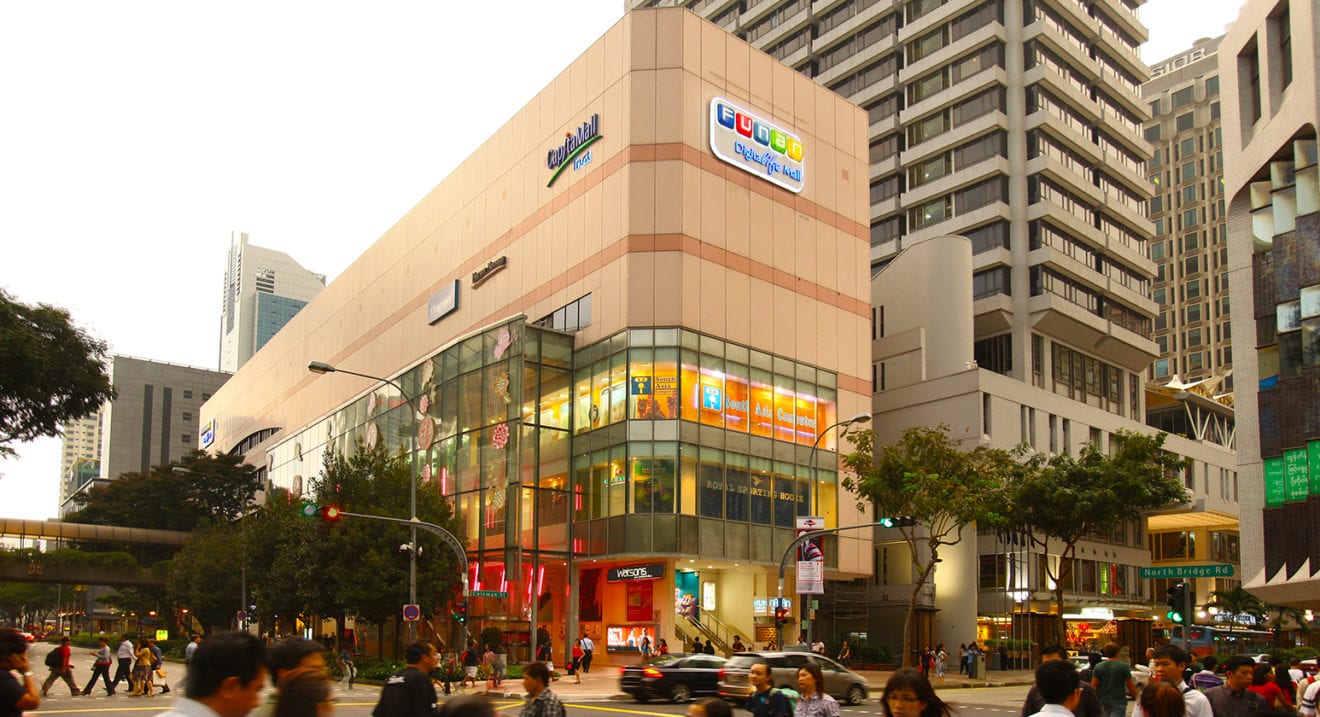
Tag: Funan DigitaLife Mall

  • CapitaLand Mall Trust overcomes ‘soft’ retail market

    CapitaLand Mall Trust overcomes ‘soft’ retail market

    CapitaLand Mall Trust (CMT) has overcome what it describes as a “soft” Singapore retail market to increase its profit and distribution.

    A 3.7 per cent increase in distributable income to S$193.9 million (US$143 million) for the first half-year coincides with a second quarter distributable income of S$97.1 million, a 3.3 per cent increase over the $94 million for the same period last year.

    “Despite a soft retail market, CMT continued to produce steady operational results in the first half,” says CMTML CEO Wilson Tan. “Backed by our portfolio of well-located shopping malls and extensive network of retailers, CMT had year-on-year increases of 3.6 and 2.3 per cent in shopper traffic and tenants’ sales per square foot respectively.

    “As at June 30, portfolio occupancy remained high at 97.9 per cent.”

    CMT’s Funan DigitaLife Mall, which closed from July 1, will undergo a three year redevelopment to become a lifestyle destination in the revitalised Civic and Cultural District, says Tan. Scheduled to be ready in the fourth quarter of 2019, the integrated development will include retail, office and serviced residences. The mall redevelopment is expected to achieve a return on investment of 6.5 per cent.

    For the second quarter, CMT registered higher gross revenue and net property income (NPI) of 7.1 and 6 per cent respectively year-on-year, mainly through a contribution of $14.5 million to gross revenue from Bedok Mall, acquired on October 1, and higher rental revenue from IMM Building, Tampines Mall and Bukit Panjang Plaza after asset enhancement.

    This was partially offset by the divestment of Rivervale Mall in December and lower gross revenue from Funan DigitaLife Mall.

  • What’s In Store For CapitaLand Mall Trust’s Funan DigitaLife Mall?

    What’s In Store For CapitaLand Mall Trust’s Funan DigitaLife Mall?

    The iconic Funan DigitaLife Mall, which belongs to CapitaLand Mall Trust, will be closed officially on 1 July 2016 for redevelopment works that is expected to last for three years.

    The redevelopment will add about 388,000 square feet (sq ft) of space to the mall’s current gross floor area of 482,000 sq ft, leading to a total area of 870,000 sq ft. For perspective, that is almost the size of ION Orchard, one of the newer malls along the Orchard Road shopping belt.

    Currently, Funan DigitaLife Mall is well-known for its focus on the retail of IT products. In its new incarnation, it will become an integrated development.

    Although the redevelopment of properties is a common thing in Singapore, what’s interesting here is that CapitaLand Limited, the manager of CapitaLand Mall Trust, is seeking input from the public to find new concepts for the redevelopment of Funan DigitaLife Mall along the theme of “Play.Create.Live.”

    CapitaLand, together with The Straits Times, are inviting members of the public to submit ideas for their vision of the new Funan DigtaLife Mall to the #BeyondIT digital platform. The idea is to transform the property into a “creative hub” that will include a ‘mall of the future’ that will bring experiential retail to a whole new level in Singapore. The window for submissions will remain open until 31 May 2016.

    Funan DigitaLife Mall is an important asset for CapitaLand Mall Trust, contributing 4.3% of total gross revenue in 2015. As such, the closure of the property for the next three years might have some negative impact on the trust’s revenue stream.

    But, the transformation of Funan DigitaLife Mall is essential given the growing importance of e-commerce among consumers. That might also be the reason why CapitaLand is interested to upgrade Funan DigtaLife Mall into an integrated development that (1) allows people to work, play, and live, and (2) help set a new benchmark for experiential retail in the Garden City.

    Summary

    Will the redevelopment of Funan DigitaLife Mall start a new era for the retail industry in Singapore? And would an increase of more than 80% in floor space for the mall help boost future rental revenue in a significant manner for CapitaLand Mall Trust? These are interesting questions to ponder.

    But, first things first, with the public competition ending on 31 May, we might be able to get our first glimpse of the future of retail in Singapore soon.

  • Challenger Technologies going online

    Challenger Technologies going online

    To maintain its relevance in a fragmented and slow retail market, Singapore-listed Challenger Technologies will launch a new online store concept in April.

    In announcing its results for the full year and fourth quarter ended December 31, the IT products and services provider says the portal, Hachi.sg, will have “significantly” more products, an improved shopper interface and a robust sales platform.

    CEO Loo Leong Thye says that with the weak market sentiment from last year spilling over into 2016, retailers like Challenger have to keep innovating to keep customers and attract new ones.

    While the group’s net profit for the year increased by 22 per cent to $18.3 million, its fourth-quarter profit ballooned by 50 per cent to $7.5 million, year-on-year. This is mainly attributed to higher government grants received and lower operating expenses following the closure of retail outlets in Malaysia.

    During the year, the group also learnt that it will lose its flagship megastore when Funan DigitaLife Mall is demolished to make way for an integrated development.

    Group revenue dipped 1 per cent for the full year – by $2.9 million to $352.2 million, mainly because of lower contribution from retail revenue in Singapore and the absence of revenue after closing its Malaysian businesses in the second half of the year. This was partially offset by higher corporate sales and a writeback of deferred revenue on loyalty program activities.

    Fourth-quarter revenue shrank by $9 million, or 9 per cent, compared to the same quarter the previous year, attributed mainly to lower retail and corporate sales.

    While higher expenses will be incurred to kick-start and grow online sales this year, the online focus corresponds with the overall market trend in the region.

    “The next wave of growth is online, and we are building up to a stronger position by investing our resources and manpower for the next three to five years toward the online business,” says Loo. “Our strong network of offline stores will complement the online business.”

    Incorporated in 1984 and listed in January 2004, the group has a chain of 48 stores in Singapore, plus more than half a million members in its loyalty program.

  • CapitaLand Malls ‘resilient’ to tough times

    CapitaLand Malls ‘resilient’ to tough times

    CapitaLand Mall Trust says its portfolio of “necessity malls” has proven resilient to the challenging economic and retail period of the last year.

    CapitaLand Mall Trust Management (CMTML), the manager of CapitaLand Mall Trust (CMT), has reported a distributable income for 2015 of S$392.0 million, up 4.4 per cent on 2014.

    Danny Teoh, Chairman of CMTML, said CMT has delivered a good set of financial results in 2015.

    “Distribution per unit to unitholders for 2015 increased 3.8 per cent to 11.25 cents, underscoring the underlying strength of our portfolio – made up of predominantly necessity shopping malls connected to or near transportation hubs serving large catchment areas.”

    Teoh says the trust reinforced its leadership position as Singapore’s largest real estate investment trust with the acquisition of Bedok Mall on October 1.

    “In addition, we unlocked value for unitholders with the sale of Rivervale Mall on December 15, where we recognised a gain of about S$72.7 million. Going forward, CMT’s established track record in proactive mall and asset management will ensure that we remain well-positioned to continually create value for our unitholders.”

    Wilson Tan, CEO of CMTML, said tenants’ sales per square foot and shopper traffic increased by 5.3 per cent and 4.9 per cent respectively last year.

    “Portfolio occupancy remained high, registering 97.6 per cent at December 31.”

    Clarke Quay achieved more than 90 per cent committed occupancy for the reconfigured space in Block C. Anchored by Zouk, a world-class dance club, Block C also comprises popular food and beverage (F&B) and entertainment outlets such as DV8 Club, a top notch live Mandopop concert club; Warehouse, a restaurant and bar with live music; Privé Clarke Quay, a new bar concept by lifestyle group Privé Group; Maziga Café & Bollywood Club, an Indian restaurant helmed by the team behind the Punjab Grill; and the highly anticipated Ramen Keisuke Lobster King, the latest offshoot of the well-known ramen chain Ramen Keisuke.

    “Singapore’s largest outlet mall IMM Building further enhanced its shopping experience and increased its total number of outlet stores to 85 with new designer brands such as Outlet by Club 21, Juicy Couture and Cole Haan. It also boosted its F&B offerings with additions such as Dôme Café. We will continue to transform our malls through asset enhancement initiatives and reinforce our relevance to the communities that we operate in,” said Tan.

    CapitaLand Mall Trust owns 16 shopping malls, strategically located in the suburban areas and downtown core of Singapore, comprise Tampines Mall, Junction 8, Funan DigitaLife Mall, IMM Building, Plaza Singapura, Bugis Junction, Sembawang Shopping Centre, JCube, Raffles City Singapore (40.0% interest), Lot One Shoppers’ Mall, 90 out of 91 strata lots in Bukit Panjang Plaza, The Atrium@Orchard, Clarke Quay, Bugis+, Westgate (30 per cent interest) and Bedok Mall.

    CMT also owns 122.7 million units in CapitaLand Retail China Trust, the first China shopping mall REIT listed on SGX-ST in December 2006.

  • Singapore’s Challenger loses flagship store

    Singapore-listed Challenger Technologies, the state’s largest IT products and services provider says it will boost its push towards a digital retail ecosystem and advanced software development initiatives for continued growth.

    Its statement followed news revealed yesterday on Inside Retail Singapore that CapitaLand Mall Trust plans to demolish Funan DigitaLife Mall to build a new integrated development which will open three years later. The mall is home to Challenger’s 53,000 sqft (4924 sqm) flagship megastore.

    “The group is well-positioned to continue bringing value and relevance to its half a million members and established base of corporate customers,” Challenger said in a statement intended to reassure shareholders the store’s closure will not measurably impact on its trading.

    CEO Loo Leong Thye said that Funan’s redevelopment was first mooted by CMTL more than seven years ago. Challenger’s planning had also began then.

    “We relocated our entire back office operations from Funan to our Ubi Link corporate building in 2009,” he said. This was followed by rapid retail expansion, with a total store count at 47 as of 12 December 2015 and three new leases confirmed for the first half of 2016.

    Apart from restarting its retail eCommerce engine in 2014 with a mobile-first revamp coming in early 2016, the group also announced its foray into a digital lifestyle ecosystem by establishing Challenge Ventures earlier this year to invest in digital businesses and services.

    One such service is the group’s existing end-to-end integrated marketing solutions provider, inCall System, which has been injected into CVPL. Another business is eCommerce marketplace Andios, which provides customers a platform to buy or sell their smartphones online.

    “To create the next wave of business growth, CVPL will continue to invest in relevant businesses from outside of the group,” said Challenger.

    To cater for the rapid growth from its digital businesses, the group has plans to establish a logistics hub in Singapore for eCommerce warehousing and fulfilment.

    The group believes the impact from the closure of its megastore is significantly reduced due to the extensive planning efforts over the last seven years.

    “When we first listed on SGX in 2004, our Funan store contributed to 60 per cent of our total group revenue. As of the third quarter of 2015, this number is only about 20 per cent of our total group revenue,” Loo noted.

    “Over the last seven years, many of our members and even tourists have also begun shopping at our heartland mall stores because of proximity convenience. With our mobile-first revamp coming in early 2016, more Challenger customers will switch to shopping with us online. They will enjoy online-only member deals, always-on rebates credited to their eWallets and even same-day express delivery.”

    Loo says the concept of a destination specialist shopping mall is not as relevant as being able to provide a wider range of products for customers to browse on-the-go.

    “We can stock 10 times more products online than at our megastore, creating a mega mall effect for customers to browse and transact on their mobile devices. We need to go where the customers are,” he said.

    “Our physical retail stores will evolve to become more experiential, with our brand partners having better concepts to showcase their products’ capabilities. They will complement our online store, which will serve customers at their own time – not dictated by a mall’s operating hours.”

    The group will keep its physical store expansion options open.

    “Our retail strategy has always been and will continue to see us expanding at suitable locations with reasonable rentals,” Loo said. “We will continue to rationalise our retail store locations, including opening, closing and right-sizing our stores to improve operating performance.

    “I have a big sales target of $1 billion to be achieved in five years’ time,” Loo said. “This is entirely possible because we have scalable business plans to roll out progressively to regional markets.”