Italian fashion brand, Giorgio Armani, has announced the appointment of Giuseppe Marsocci as chief executive officer, effective immediately. Marsocci, a veteran with 23 years at Armani, has served as the global chief commercial officer for the past six years. He will now be filling the significant role previously held by the late founder, Giorgio Armani.
A New Phase for Armani
Giorgio Armani had been a dominant force within the company he founded 50 years ago. His passing in September has led to a reshuffling of the business structure as the fashion house prepares for its next chapter. Marsocci will be responsible for supervising the proposed sale of a 15% stake in the company. High-calibre corporations like luxury conglomerate LVMH, beauty giant L’Oreal, and eyewear leader EssilorLuxottica, among others of similar stature, have been identified as potential priority buyers as specified in Armani’s will.
Marsocci’s suitability for the role was endorsed by Pantaleo Dell’Orco, Armani’s partner and men’s design chief, who said, “His international professional experience, in-depth industry and company knowledge, discretion, loyalty, and teamwork, along with his close relationship with Mr Armani in recent years, make Giuseppe the most natural choice to ensure continuity with the path outlined by the founder.”
Leadership Changes
Dell’Orco, who has assumed the position of the company’s chairman, has concurrently been appointed to chair the Giorgio Armani Foundation, which holds 30% of the voting rights of the business empire. Dell’Orco already controls 40% of the luxury group’s voting rights.
The Giorgio Armani Foundation unanimously proposed the appointment of Marsocci, aged 61. Giorgio Armani’s niece, Silvana Armani, who is currently head of women’s style, will also be appointed as vice president.
Questions & Answers
Who has been appointed as the new CEO of Giorgio Armani?
Giuseppe Marsocci has been appointed as the new CEO of Giorgio Armani.
What are some of the key responsibilities for the new CEO?
Marsocci will be overseeing the proposed sale of a 15% stake in the company and leading the brand into its next phase of development.
Who has been appointed as the chairman of the Giorgio Armani Foundation?
Pantaleo Dell’Orco, Armani’s partner and head of men’s design, has been appointed as the chairman of the Giorgio Armani Foundation.
The fashion world is in mourning following the death of Giorgio Armani, who passed away on September 4 at the age of 91, leaving behind an empire that industry analysts value between 5 billion and 12 billion euros (approximately US$5.9 billion to US$14 billion). Known as “King Giorgio,” the designer had no children to inherit his renowned label.
Legacy in the Hands of Influential Players
According to his will, priority for the estate is to be given to luxury giant LVMH, beauty behemoth L’Oréal, eyewear leader EssilorLuxottica, or another qualified group identified by a foundation he established to preserve his legacy. Notably, this was done in collaboration with Armani’s business and life partner, Pantaleo Dell’Orco. All three companies acknowledged their openness to exploring potential arrangements.
The mention of stake sales and the inclusion of well-known French companies as possible buyers came as a surprise, considering Armani’s longstanding commitment to maintaining control over his fashion group—a brand that continues to retain significant prestige, even amid a global luxury slowdown.
Potential Partnerships Spark Excitement
LVMH, led by billionaire Bernard Arnault, expressed gratitude to be mentioned in Armani’s will. “Giorgio Armani honors us by naming us as a potential partner for the exceptional fashion house he has built,” Arnault stated. He suggested that if a partnership were to materialize, LVMH would be dedicated to bolstering its presence globally.
EssilorLuxottica, closely linked to Armani through commercial partnerships, also indicated a willingness to consider a potential deal. Meanwhile, L’Oréal, which currently holds a licensing agreement with the Armani group until 2050, revealed plans to explore this new opportunity. It’s quite the fashion ‘who’s who’ vying for a piece of the pie, with all eyes on the future.
A Shift in Control and New Directions Ahead
Analysts believe that LVMH is likely the most interested party in acquiring a stake in Armani, emphasizing the strategic alignment between their businesses. They estimate that a stake could be valued between 5 billion and 7 billion euros, and LVMH appears well-positioned financially to proceed if an opportunity arises.
Armani’s will, comprised of two documents filed earlier this year, stipulates that heirs should sell an initial 15% stake in the fashion house within 18 months of his passing. A further transfer of an additional 30% to 54.9% stake is to follow three to five years thereafter, emphasizing a structured approach to the transition of control. Alternatively, an initial public offering (IPO) may be pursued if the heirs prefer different exit strategies.
These provisions are largely binding and could be subject to challenges in court if unmet, according to Italian legal experts. Known for revolutionizing modern fashion with his minimalist approach to jackets and suits, Armani had rebuffed several acquisition attempts over the years, including approaches from Gucci and John Elkann of the Agnelli family.
The Future of Armani’s Vision
Maintaining a firm grip on both creative and operational leadership, Armani has left a business generating stable revenues—an impressive 2.3 billion euros (around US$2.7 billion) in 2024—but one struggling with shrinking profits, now less than 3% of revenue according to Berenberg’s calculations.
The will details various share types with different voting rights, ensuring that the Fondazione Giorgio Armani and Dell’Orco together control a significant 70% of the company. The foundation is committed to holding no less than 30% of the capital, serving as a safeguard of Armani’s founding principles, and is tasked with proposing a successor to lead the group.
While the world waits to see what direction Armani’s heirs will take, one thing is clear: the legacy of Giorgio Armani will continue to influence fashion on a global scale.
Questions & Answers
What are the estimated values of Giorgio Armani’s fashion empire?
The fashion empire is estimated to be worth between 5 billion and 12 billion euros (approximately US$5.9 billion to US$14 billion).
Who are the potential buyers mentioned in Armani’s will?
The potential buyers include luxury conglomerate LVMH, beauty giant L’Oréal, and eyewear leader EssilorLuxottica, with the possibility of other equally qualified groups being considered.
What does Armani’s will stipulate regarding the transfer of ownership?
The will requires heirs to sell an initial 15% stake within 18 months of Armani’s death, followed by an additional 30% to 54.9% stake within three to five years, or to pursue an IPO if preferred.
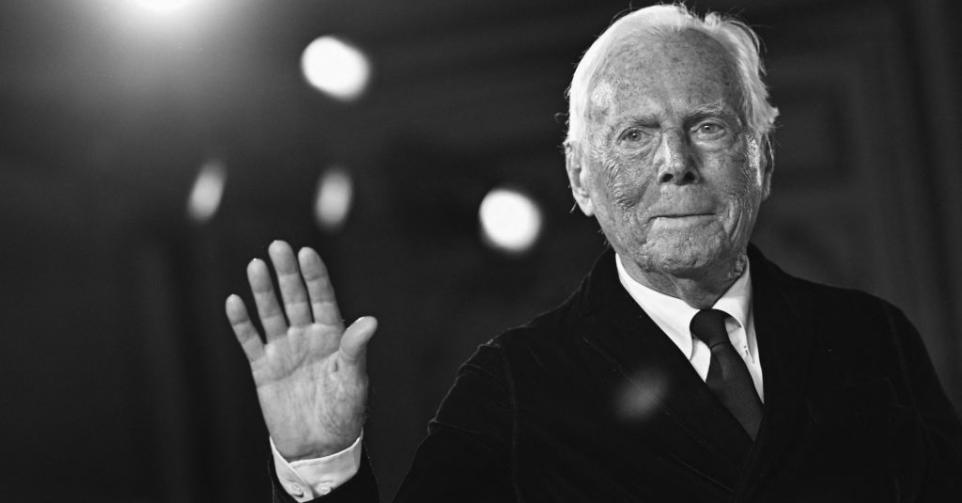
Giorgio Armani, widely regarded as the embodiment of contemporary Italian style and elegance, has passed away at the age of 91. He was often referred to as “King Giorgio”, according to a statement released by his company.
Tributes for an Icon
Italian Prime Minister, Giorgia Meloni, expressed her respect and admiration for the late designer, acknowledging his significant contributions to Italian fashion and his global influence. She praised Armani as an icon and a tireless worker, thanking him for his legacy.
Filmmaker Martin Scorsese recognized Armani as more than a fashion designer, but as a true artist whose timeless designs were crafted to enhance individual elegance.
Fashion designer Valentino Garavani mourned Armani, whom he always considered a friend rather than a competitor. He expressed deep respect for Armani’s immense talent, innovative contributions to the fashion industry, and unwavering loyalty to his unique style.
Donatella Versace echoed this sentiment, stating that the fashion world has lost a giant and Armani will be remembered for his significant contributions to the industry.
Unwavering Legacy
French luxury group LVMH, its chairman and CEO Bernard Arnault, and Kering chairman and CEO Francois-Henri Pinault all paid tribute to Armani. They acknowledged his unique style, successful entrepreneurial journey, and significant contributions to Italian elegance on a global scale.
Fashion industry leaders including Miuccia Prada, Patrizio Bertelli, and Raf Simons all lauded Armani’s enduring contribution to fashion history. They recognized him as a maestro of elegance and creativity, a protagonist of Italian and international fashion, and an inspiration to present and future generations.
Supermodel Cindy Crawford and actors Cate Blanchett, Julia Roberts, and Michelle Pfeiffer expressed their heartfelt sorrow and acknowledged the huge impact Armani had on the fashion and entertainment industries, going beyond just garments to influence lives and culture worldwide.
Further Tributes
Armani’s influence extended beyond the world of fashion. Ferrari and Stellantis chairman John Elkann, along with Moncler CEO Remo Ruffini, praised Armani as a great entrepreneur and a symbol of Italian elegance. They recognized his refined cultural sensitivity and his mentorship.
The National Chamber of Italian Fashion president Carlo Capasa lauded Armani’s role in shaping contemporary fashion and establishing ‘Made in Italy’ as a synonym for excellence.
On a personal note, Armani’s employees and his family said that they are committed to preserving and advancing his legacy with respect, responsibility, and love.
Questions & Answers
What was Giorgio Armani’s impact on the world of fashion?
Armani was an influential figure who redefined the boundaries of contemporary fashion. He introduced a lifestyle concept that was recognised and admired worldwide.
What was the reaction of the fashion industry to Armani’s passing?
The fashion industry has mourned the loss of Armani, with numerous designers, CEOs, and models expressing their respect and admiration for his contributions to the industry and his influence on their own work.
How has Armani’s legacy been remembered by his company and family?
Armani’s employees and family have committed to preserving and advancing his legacy. They have pledged to honor his vision, passion, and dedication by continuing to nurture the fashion house he built.
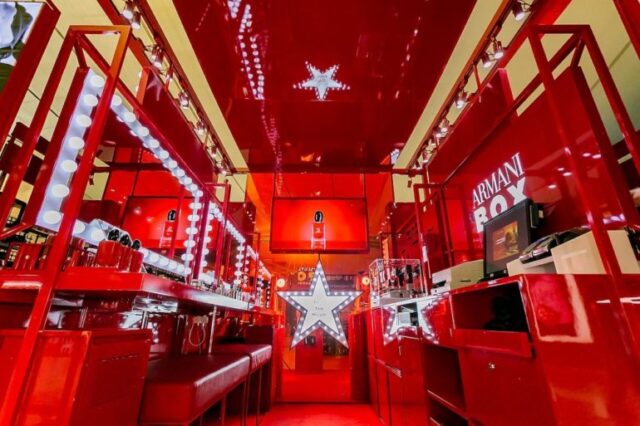
Giorgio Armani beauty announces the opening of its itinerant pop-up store ARMANI BOX in Bangkok Suvarnabhumi Airport in Thailand. The opening of ARMANI BOX BANGKOK was celebrated on February 11th with a ribbon-cutting ceremony and an exclusive event in the presence of influencers from Thailand and China. During the event, the design of ARMANI BOX BANGKOK was revealed: with its hot red walls and black lighting fixtures, it is full of surprises. A giant gorilla, Uri, welcomes visitors as they enter the store: created by Italian artist Marcantonio Raimondi Malerba, the full-sized golden gorilla is a replica of the black one that resides in Giorgio Armani’s home in Milan. “This resin gorilla is a gift that came from a movie set. He’s called Uri”.
It is hard to think about Giorgio Armani without bringing cinematic images to mind. The new ARMANI BOX experience allows the visitor to become a movie star with a series of details to explore: from the Walk of Fame digital handprint, to the backstage makeup stations, as well as a red carpet indicating the way. Visitors can also film their very own screen test, entering a director’s booth and playing with their emotions; portrait photos and videos will be available to keep, share and post online.
The ARMANI BOX is a sensorial and playful immersion in Giorgio Armani beauty’s universe. Visitors can discover product exclusives included a limited edition version of its new lip product Rouge d’Armani Matte #400, and personalize their products with engraving.
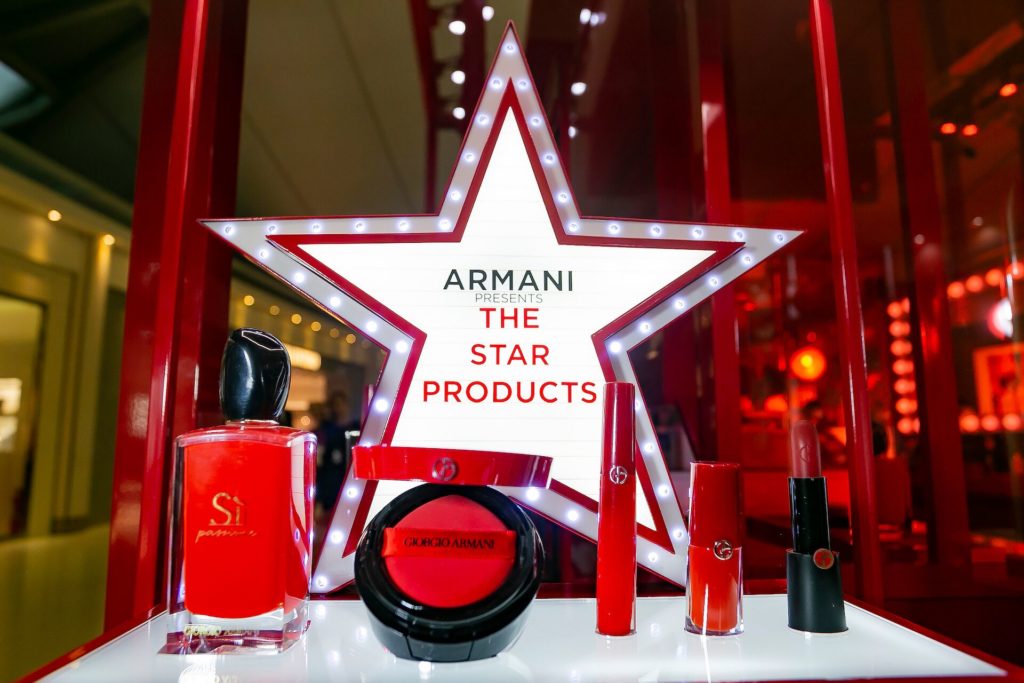
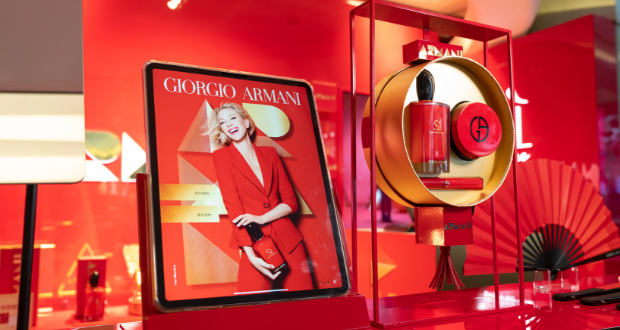
Giorgio Armani Beauty is starting the year of 2019 strong by collaborating with DFS on celebrating Chinese New Year. In January, Giorgio Armani Beauty launched its first Chinese New Year pop-up stores at T Galleria Beauty By DFS, Causeway Bay and T Galleria By DFS, Canton Road respectively. Iconizing the brand’s 3 star products – the legendary Lip Maestro, the iconic My Armani To Go Cushion Foundation and the new bestselling fragrance – Sì Passione, the pop-up stores reflected Armani’s commitment to modernity whilst celebrating the traditional festival with the Asian consumers.
A UNIQUE BEAUTY EXPERIENCE Visitors were able to indulge themselves in a unique Armani Beauty experience under the Chinese New Year festivity. They discovered New Year fortune and recommended Giorgio Armani Beauty products through the in-store digital app, try their luck on the app and receive attractive gifts upon purchase; and completed their memorable experience by getting the exclusive gift set of the 3 star products featuring My Armani To Go Cushion Limited Edition “Cushion Couture”. Customers also enjoyed professional make up consultation by Giorgio Armani Beauty Face Designers.
Giorgio Armani Beauty set up at T Galleria Beauty By DFS Causeway Bay HK 2 768×512
armani beauty
giorgio armani cover
Giorgio Armani Beauty set up at T Galleria Beauty By DFS Causeway Bay HK 768×512
L’Oreal sales in Asia Pacific soared 25.8 per cent on a like-for-like basis in the latest quarter – making it the French-headquartered company’s strongest international market. Sales in the region hit €1.794 billion in the quarter and €5.342 billion year to date, an increase of 23.3 per cent.
“This acceleration in growth is boosted by strong demand from Chinese consumers, and the dynamic sales of the Lancome, Kiehl’s, Giorgio Armani, Yves Saint Laurent and L’Oreal Paris brands,” the company said in a statement.
“In Northern Asia, the key factor remains the strong growth in China and Hong Kong, and in travel retail. In Southern Asia, sustained growth is continuing, particularly in India and Malaysia.”
L’Oreal chairman and CEO Jean-Paul Agon said the company achieved its highest quarterly growth rate for 10 years in the three months to September 30. Worldwide sales reached €6.473 billion, up 7.5 per cent.
“In a beauty market that continues to accelerate, driven by robust growth in skincare, the group maintains its strong momentum, with contrasted performances between the divisions. L’Oreal Luxe is showing dynamic growth, underpinned in particular by its four biggest brands, Lancome, Yves Saint Laurent, Giorgio Armani and Kiehl’s. The active cosmetics division, which continues to post double-digit growth, is being driven worldwide by consumer aspirations for dermocosmetics and the quality of its brand portfolio,” he said.
While the consumer products division is being held back by persistent difficulties in some countries, the L’Oreal Paris and Maybelline New York brands are maintaining strong momentum.
Travel retail globally was a standout for the group, posting growth of 29.9 per cent for the quarter and online sales grew by 38.3 per cent to now account for 9.7 per cent of L’Oreal’s turnover.
High-end fashion brand Giorgio Armani Beauty has launched its first boutique for southeast Asia, at Central Lat Phrao.
Part of the L’Oreal Group, the store stocks Luminous Silk Foundation, Maestro Foundation and My Armani To Go Cushion, as well as the Lip Maestro line. Also available are skincare products and floral fragrances.
On the second floor of Gaysorn Village, the first Jurlique Concept Store in Thailand offers skincare products and treatments including the all-natural creams and lotions for which the ingredients are grown at Jurlique’s organic farm in Australia’s Adelaide Hills.
Spanning 170sqm, the store uses natural materials in its five full-scale treatment rooms.
Also in stock are Pandora’s new necklaces in sterling silver and leather. And, for the first time ever, the collection includes tassels combined with sterling silver inspired by Native American culture, plus handcrafted feather earrings in sterling silver finished with turquoise enamel.
As it celebrates the 10th anniversary of the first Cosmolite case, Samsonite is releasing an exclusive gold/silver limited edition to mark this milestone. It has golden embellishments and special executions.
The pull handle, the zipper pullers and details are accentuated by traces of gold and it has a black embossed lining.
Tmall will this year work with top beauty brands such as Estee Lauder and Lancome to help them surpass RMB 1 billion (US$157.9 million) in annual sales on the platform.
The increased focus on the beauty sector will also see Tmall deliver an updated suite of New Retail solutions so that all merchants can better serve Chinese consumers, the Alibaba Group-owned B2C shopping site says.
Tmall plans to partner closely with about 10 beauty brands in particular, also including SK-II and Olay, to help them break that sales threshold. New Retail initiatives include a new “try-before-you-buy” feature, where users pay a 10 per cent deposit to test a product with the promise of a simpler and faster refund process.
“Our partnership with brands will cover every corner from online to offline,” Tmall president Jet Jing said. “We will be consistently involved in daily operations ranging from product innovation, brand building, channel management, supply chain to customer operations.”
Tmall Supermarket would also expand its one-hour delivery service to more customers, as faster service is also a part of New Retail, Jing said. However, the biggest changes won’t come until the 11.11 Global Shopping Festival, which is typically when Alibaba rolls out its New Retail initiatives.
The initiatives were announced during the Tmall Beauty Awards in Shanghai, where more than 1000 beauty professionals, from both international and home-grown brands, gathered for the annual event. This year, Estee Lauder, SK-II, Giorgio Armani Beauty and Givenchy each took away a “Super Brands Award,” for their outstanding performance in brand influence, marketing creativity and consumer engagement. Newcomer Givenchy on March 1 broke the single-day sales record, selling more than 58,000 lipsticks and generating over RMB 16 million – all in the first 12 hours of the day.
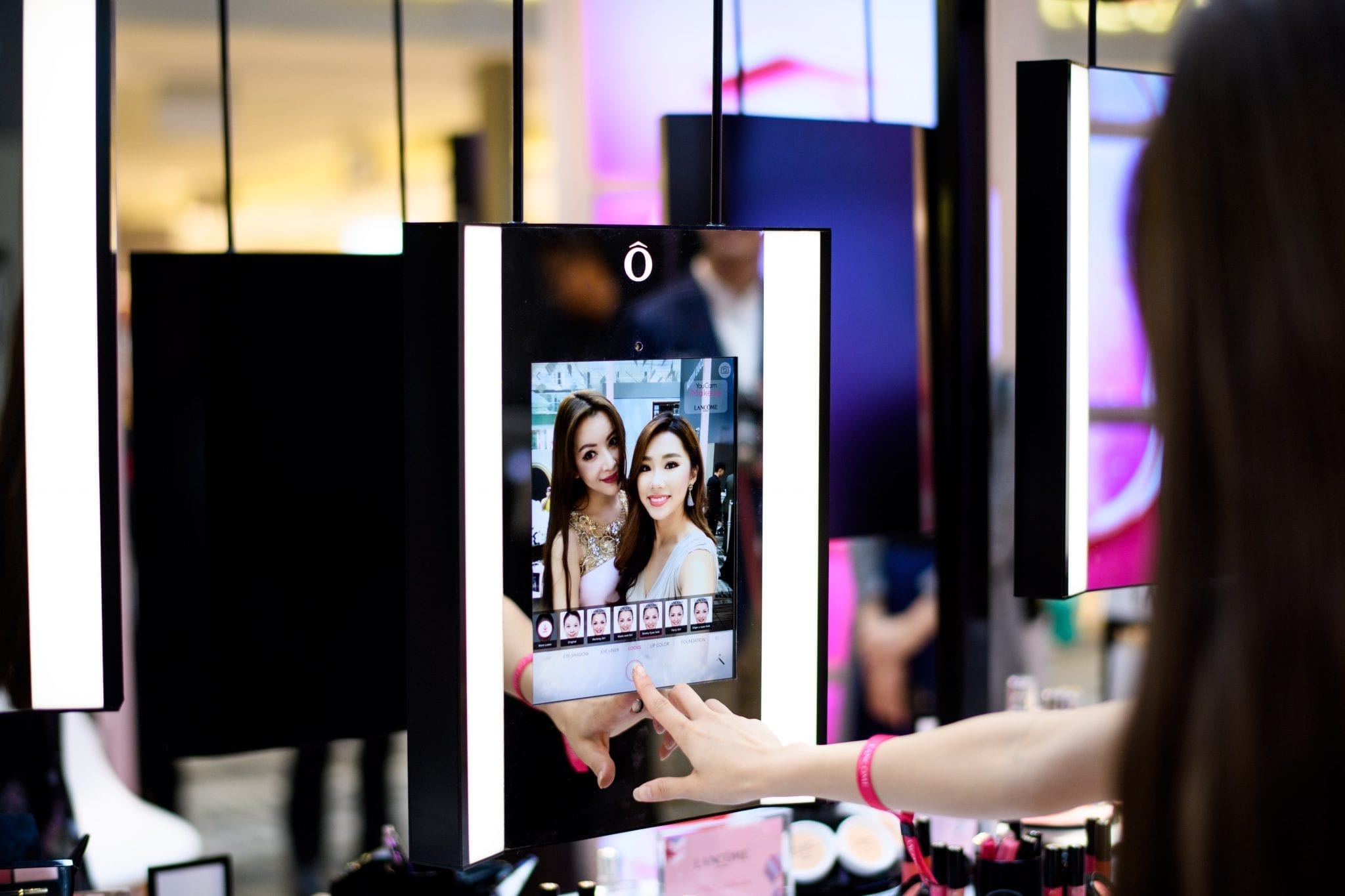
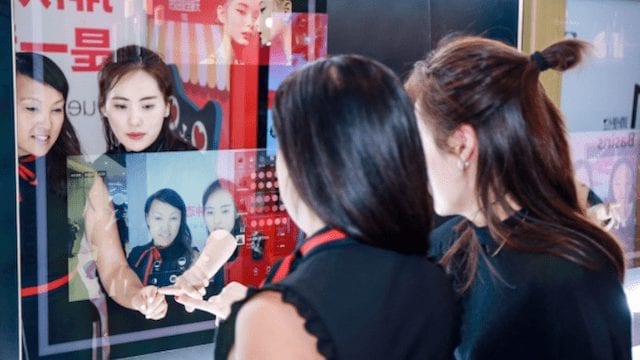
Since launching in 2015, the awards largely have spotlighted New Retail-driven innovations. Featured technology at this year’s awards included the “Cloud Shelf” and the latest iteration of the augmented reality-powered “Magic Mirror,” which allows users to virtually try on new hairstyles, lipstick, eyeshadow and blush. Tmall said it would partner with with French cosmetics company L’Oreal to install Magic Mirrors in 50 of the beauty giant’s physical stores in China.
Tmall hosts more than 3000 beauty brands on its platform, according to a report released by Tmall and Chinese research firm CBNData last year. Some of the newest entrants include LVMH-owned Givenchy, L’Oreal’s Giorgio Armani Beauty and Estee Lauder’s Darphin.
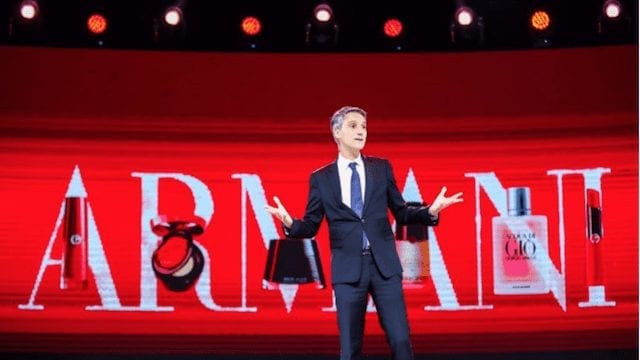
“After two years of very successful acceleration in China, we felt this is the right timing to join Tmall to push artistry and premium-ness of the brand,” said Andrea Yann, GM of the China market at Giorgio Armani Beauty. “Our plan is really to understand from [Alibaba’s] database what are the main beauty concerns of Chinese women to solve their beauty issues, be very personalised still being [seen as] very artistry and premium.”
Andrea Yann, GM of the China market at Giorgio Armani Beauty, speaks on stage.
Younger more focused on beauty
According to a report released by Tmall and market research consultancy Kantar, what they want is a more elaborate skincare regimen. Thirty-five per cent of respondents said they have added more steps to their beauty routines, and therefore are spending more on skincare products and cosmetics. Tmall attributed 53 per cent of the sales of beauty products on Tmall to consumers making more purchases per person.
Beauty consumers in China – the world’s largest and fastest-growing beauty market at $22 billion – are also becoming younger than ever, the report noted. In 2017, users born after 1990 made up over 40 per cent of shoppers on Tmall Global, the site’s cross-border e-commerce channel, overtaking those born in the 1980s as the main consumption force on Tmall Global, the site’s cross-border e-commerce channel.
Consumers born after 1990 like to try new products from new brands and less familiar origin countries, the report said.
Embracing the new
“In China, there’s more willingness to try new products at a faster rate than what you would see in different markets,” said Danielle Bailey, head of Asia Pacific research at digital agency L2.
“It’s not that [Chinese beauty consumers] are less loyal, but their desire to explore is much higher,” she said. “This makes it more challenging for brands to sell to the market, but also creates new opportunities.”
Tmall’s latest report also showed momentum for homegrown brands, particularly for skincare, where they accounted for 56 per cent of sales last year – up from 54 per cent in 2016. However, foreign brands still dominate the cosmetics category with 56 per cent of total makeup sales.
Chinese brands are trying to boost their profiles by launching new prestige product lines or creating new products within an existing line, said Bailey. “It will be interesting to see if local brands can successfully transition to that space. It’s still a bit unclear because Western brands tend to be associated with better quality,” she added.
From a product development standpoint, the pace of innovation in Asia has forced brands in the West to shrink development timelines to stay relevant, said Bailey. Where Western companies may take two years to release a product,” he said, “in Korea, some brands are launching new product every three months.”
Time-to-market is indeed very important for beauty brands, said Ye Guohui, GM of Tmall’s new retail division.
“Conducting market research alone can be very time-consuming, taking up to over a year,” he said. “But brands in China can leverage Alibaba’s data capacities to really shorten that timeline, and accelerate product development.”
Giorgio Armani will launch a flagship e-tail store on TMall to sell its high-end cosmetic products in China, the company announced at the end of December last year. It will also partner with Luxury Pavilion, a subsidiary of TMall featuring luxury brands, to provide customers with first-hand, exclusive sales called “TMall Super Brand Days” this month. It seems that in recent years, Western luxury brands have become increasingly eager to join China’s e-commerce platforms.
So what will the Giorgio Armani-TMall partnership bring about this time? Here are some Jing Daily’s concerns and takeaways:
More exclusivity?
In August when the Luxury Pavilion was first launched, only 17 brands, including LVMH’s Zenith, Guerlain and Rimowa; La Mer; Burberry; Hugo Boss; and Maserati, were invited to participate in the platform’s first-phase sales. As for consumers, the access to the Luxury Pavilion was also invitation-only, which means Alibaba has filtered out customers in advance based on their previous transactions on Taobao. The more one has spent on Taobao, the more likely one will be invited to the Luxury Pavilion. Therefore, even though joining TMall may help Giorgio Armani expand its presence in China, the effort might be limited, given that such an e-tail store will only be available to select luxury consumers. Of course, differentiating individual shoppers is the best way to maximize profits and is in fact quite popular in the industry. But doesn’t this also indicate routine profiling and discrimination from the retailer? Will it be a good policy in the long run?
More convenience?
Western high-end cosmetics brands usually cost more in China due to import tariffs, and sometimes certain brands are not even available in local brick-and-mortar stores, which forces many Chinese customers to turn to daigou (shopping agents), who go abroad to buy goods to resell in China, for cheaper deals and purchases. By launching a flagship store on TMall, Giorgio Armani will make it easier for Chinese customers to order products directly from its authorized e-retail website – otherwise, these Chinese customers might step up their purchases through daigou in other countries or from other platforms. However, it’s still not clear the pricing Giorgio Armani will offer to TMall customers. If prices are not competitive compared to the price that a daigou can offer, customers may very well avoid using the platform.
More anti-counterfeiting efforts?
Despite e-commerce platforms’ relentless efforts to fight against counterfeit goods, it is impossible to make each e-commerce site completely fake-free. Hence, selling products through a flagship store directly from the brand will help provide a quality local resource for Chinese fashionistas – in this case, the Giorgio Armani fans. However, even if Giorgio Armani manages to deal with the fake goods issue, it may still face another challenge: how to combat against counterfeit goods. Look-alike goods are often hard to examine and can exist in all corners of the e-commerce world. For example, Kering, which owns brands including Gucci and Yves Saint Laurent, has filed law suits against Alibaba for allegedly selling counterfeit (note: not fake) goods on the platform.
More consumers?
The post-90 generation, who have grown up and matured with mobile technology, is now a driving force for the online luxury purchase industry, according to the latest report on China’s e-luxury market by Secoo and Tencent. Giorgio Armani’s e-tail will certainly cater to such groups, but will it appeal to all customers? Many consumers from older generations still prefer visiting brick-and-mortar stores, especially when it comes to luxury cosmetics shopping. In all fairness, most consumers still want to try on lipsticks or find the perfect foundation color match before any expensive purchase.
Giorgio Armani Beauty will launch a flagship store on Alibaba-owned B2C shopping platform Tmall next month as part of the brand’s latest campaign to capture China’s fast growing appetite for high-end beauty products, Alibaba said Monday.
The luxury beauty and skin care brand, owned by the world leading cosmetic giant L’Oreal, will hold a series of pre-sale events on Tmall for the next three weeks ahead of its official launch on Jan 16. As part of the rev-up, the brand is offering 4,000 cases of its iconic “My Armani To Go” cushion foundation exclusively to be sold on the platform during the period.
On the day of the launch, the brand will also open a store on the Luxury Pavilion, the invite-only section within the shopping site for premium and luxury brands. Brands including Burberry, Hugo Boss, La Mer, Maserati and Guerlain (LVMH) have joined since the platform was first introduced in August this year.
China’s beauty product sector has seen a boom in recent years in tandem with the rapid development of the Chinese economy. According to China’s National Bureau of Statistics, retail sales of cosmetic items in the first 11 months of this year notched a 13.5% on-year growth, amounting to RMB $228.5 billion ($34.87 billion).
Recognizing China’s fast-growing demand for high-quality cosmetic products and Tmall’s expansive reach with its 500 million active users, many top beauty names such as Lancome, La Mer, MAC, Bobbi Brown, Fresh and Kiehl’s have opened up shops on Tmall in recent years.
In a recent interview with China Daily, Veronique Gautier, global president of Giorgio Armani Fragrances & Beauty, said Armani Beauty has seen stellar growth in China, at twice the speed of the rest of the markets combined.
On Jan 12, several of the Giorgio Armani Beauty’s high-ranking executives will appear at an event in Beijing to announce the official launch of the flagship store on Tmall. The brand will also introduce a high-tech showcase of its 2018 spring-summer collection.
As part of tie-up, the brand and Tmall will introduce interactive digital experiences for consumers to book offline make-up sessions with beauty advisors, explore its product offerings — from the latest Ecstasy Shine lipstick crafted specifically for the Asian market to its iconic fragrances and Lip Maestro lip gloss.
Entertainment and gamification will also play a major role in attracting customers to Giorgio Armani Beauty’s new online store. By using their mobile phones, users can use the AR-powered interactive feature—Unlock Armani Codes—to scan anything that contains any of the six-letters in the word “Armani.” Those who have collected all six letters will have the chance to win sample kits priced at RMB 260 each.
Italian designer Giorgio Armani says he plans to consolidate his various collections under three labels as the fashion company undergoes an internal restructuring.
“There will only be three lines: Giorgio Armani, Emporio Armani and A|X Armani Exchange starting with the spring-summer 2018 season,” he says.
Armani Collezioni and Armani Jeans will be blended into the main three lines.
“There was too much confusion with so many collections,” says Armani. “Times have changed, and we have to evolve.”
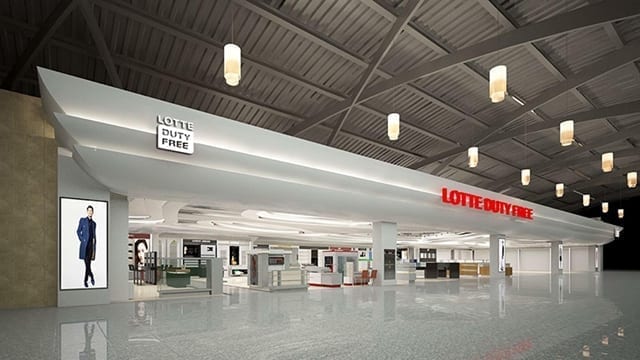
After winning a Korea Airports Corporation (KAC) tender, Lotte Duty Free has officially re-launched at Gimhae airport.
The retailer now has 980.44 sqm of space, an increase of 329.2 sqm over its area last year. Lotte Duty Free had a 158.34 sqm presence at the terminal when it opened in 2007 until early 2014.
Fellow Korean retailer Shinsegae, which was at the airport until last month, is believed to have terminated its contract to focus on the city – it plans to open a 13,350 sqm store in the city centre – and its Incheon airport outlets.
Meanwhile, Lotte is targeting sales of W120 billion ($US99.2 million) at the airport this year with daily sales of W200 million.
Following an analysis of consumer shopping trends at Gimhae airport, the cosmetics area has been expanded by 40 percent with the introduction of such brands as Giorgio Armani, Jo Malone and Tumi.
In its entirety, the Lotte offers more than 120 food, electronics and accessories brands at the airport, along with fragrances and cosmetics labels such as Chanel, Dior and Sulwhasoo.
A special promotion to commemorate the grand opening at the airport offers as a grand prize for each of 30 Korean nationals and their partners a trip to Okinawa to watch the Lotte Giants baseball team train.
Other customers can win pre-paid shopping cards, movie tickets, drinks coupons and gift certificates.
Dufry Group also runs a duty-free concession at the airport.
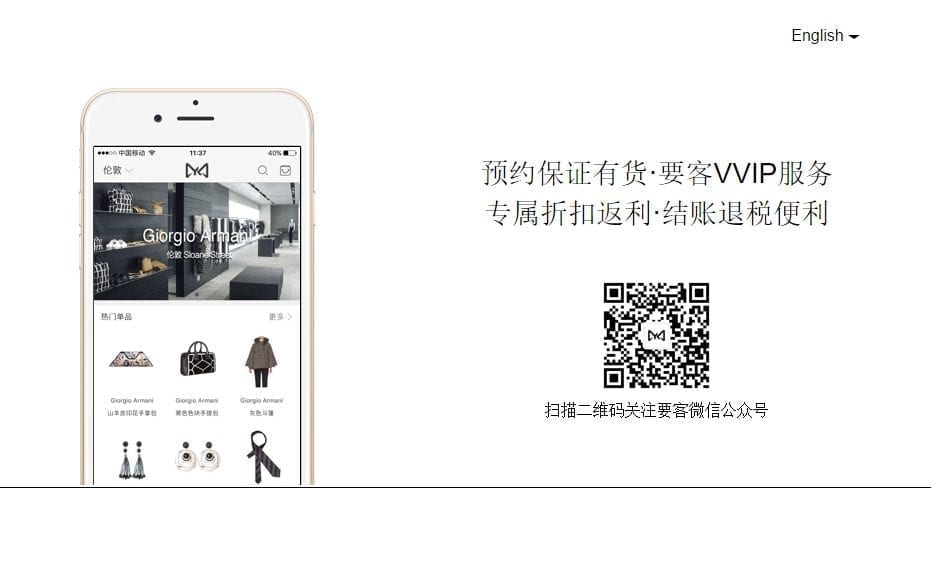
Chinese company Yaok has built an online reservation service for offline brand boutiques to tackle the online/offline conflict.
It is the result of 10 years of market research the preparation, including five years of in-depth communication with more than 100 luxury brands.
Founder/CEO Steven Yao says that many luxury brands, including Chanel and Dior, have realised the importance of the internet, but while finding online partners still have concerns about brand image.
“Everyone is looking for an online solution, especially one that’s appealing to Chinese consumers,” he says. “Unfortunately, current Chinese online players can’t fulfill luxury-brand needs because of false brand perception, unfit target audience, and lack of control on product authenticity.
“Some chose to set up their own eCommerce platforms, but found it difficult to attract traffic with one single brand.”
Through Yaok, a brand can have its own official reservation platform, giving it absolute control in managing its image, product inventory, order status and customer database. It also allows instant communication between brand and customer.
According to the China’s Fortune Character Institute, 73 per cent of Chinese consumers have a shopping list before overseas travel, 45 per cent of which cannot be fulfilled because of such factors as lack of desired size or model, resulting in loss of sales and unsatisfying customer experiences.
Agreements in place
Yaok lets customers reserve products in advance and have VIP services in store. Already the company has global or regional collaboration agreements with most international luxury brands.
Yao says that when the platform officially launches at the end of next month, products from 80 per cent of luxury brands will be available. Users will be able to make VIP reservations in nine countries and regions.
He estimates that 500,000 shoppers, all with a net wealth exceeding $2 million, will use Yaok to buy luxury goods globally. Its prestige service is either by invitation only or for current brand VIPs. Applications can be submitted via Yaok app or WeChat, but acceptance is not guaranteed.
Yaok has completed two rounds of fundraising, with Feng Ye as angel investor.
Yao was the first CEO for the Hurun Report, the magazine known for its “China Rich List”. Other core Yaok members have also worked in brand houses like Giorgio Armani or Louis Vuitton for more than 10 years.
Yaok is affiliated to the Fortune Character group, founded in 2008, which specialises in researching the luxury market.
India’s DLF Brands, which runs high-street fashion brands mall Emporio in Delhi, is quitting the luxury business.
It has just shut down two of the seven stores of US fashion brand DKNY after parting ways earlier with such brands such as Giorgio Armani, Mango, Salvatore Ferragamo and Sephora.
“We don’t have any plans to open more DKNY stores,” says DLG Brands MD Timmy Sarna. “And we don’t want to be in the high-fashion business. It’s difficult to scale up that business because there aren’t too many locations in the country where you can sell luxury.”
Instead, DLF Brands, the retail arm of real-estate company DLF, wants to focus on mass brands. “We have profitable businesses in Kiko, Mothercare and Sunglass Hut,” says Sarna.
DLF Brands has bought the franchise rights of UK-based Mothercare for 15 years, and plans to launch smaller stores, even in community-based markets, selling value-added products.
“From 109 stores at present, we want to increase the number to 300. A major part of production is happening here now, so prices will eventually come down,” Sarna says. “Apart from this, our other brands such as Sunglass Hut, Claire’s and make-up brand Kiko are doing extremely well and are profitable.”
DLF Brands started its exit from the luxury market in 2012, quitting its joint ventures with Ferragamo and Giorgio Armani. In 2014, it shut down stores of Italian menswear brand Boggi Milano, then last year parted with LVMH’s make-up and skincare brand Sephora, which was taken over by Arvind Lifestyle Brands.
“You can either be in the fashion business or in the mass-brand business. You cannot have your finger in too many pies,” says Sarna.
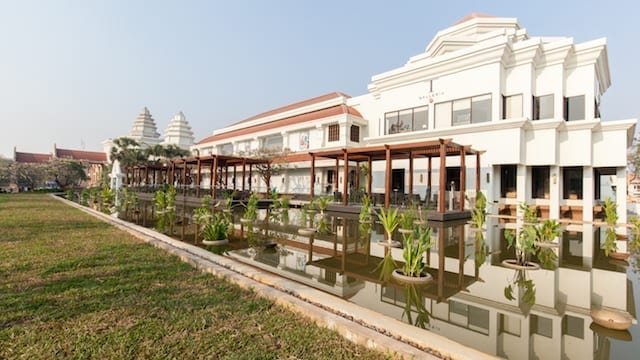
Luxury travel retailer DFS Group Cambodia has marked the opening of its first store, T Galleria by DFS, Angkor, with a gala event for more than 300 guests.
In the resort town and provincial capital of Siem Reap, near the ancient temple of Angkor Wat, T Galleria by DFS, Angkor is the largest duty-free luxury department store in Cambodia. It offers travelers an integrated retail, hospitality and leisure experience with 170 brands across 86,000 sqft (7989 sqm).
The opening celebration began with a ribbon-cutting ceremony, after which traditional Cambodian Apsara hostesses led guests through the two-storey store for traditional cultural performances and demonstrations by Cambodian craftsmen.
From DFS Group were chairman/CEO Philippe Schaus and co-founder Robert Miller, while special guests included Cambodia’s Senior Minister of Economy and Finance Aun Pornmoniroth and Minister of Tourism Thong Khon.
The store features a curated collection of Cambodian artisanal products designed and produced by more than 30 Cambodian artist workshops. At the event, Angkor Artwork, a Siem Reap design studio, demonstrated the art of lacquer work, while Golden Silk, one of the last fully integrated silk producers in the world, wove silk spun from Cambodian silk worms.
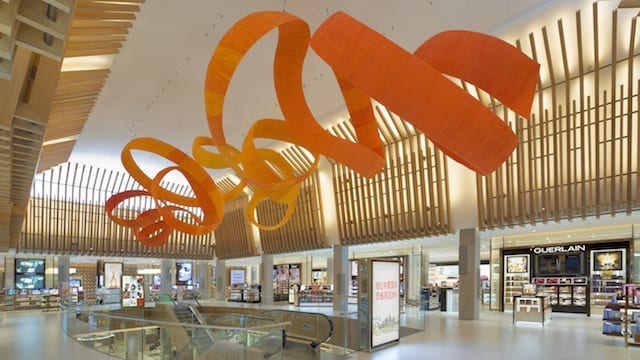
Traditional Khmer motifs and carvings feature throughout the store, including a nearly 20m art installation suspended above the vaulted atrium.
T Galleria by DFS Angkor also ranges more than 130 international brands including watches and jewellery from Bulgari, Cartier and Tiffany & Co and fashion from Bottega Veneta, Burberry, Fendi, Gucci and Saint Laurent. There are also more than 30 beauty and fragrance brands such as Cle de Peau Beaute, Dior, Estee Lauder and Giorgio Armani.
The gala event also marked the official opening of the onsite restaurant, the first Crystal Jade outlet in Cambodia, serving traditional Chinese cuisine in a setting overlooking the gardens and reflecting pools outside.
The event also provided a platform to officially announce the company’s sponsorship of several non-profit organisations focussed on helping underserved populations in Cambodia. Schaus presented a donation to Kuma Cambodia, which aims to reduce poverty through providing education, healthcare and nutrition to vulnerable youngsters, English and computer courses for teenagers, and workshops and guidance for parents and guardians.