Tag: GlobalData Retail

  • Ikea services foray boosts loyalty and sales

    Ikea services foray boosts loyalty and sales

    Ikea is turning to services to increase turnover and boost engagement with customers. Moreover, partnering with specialist companies in such areas as delivery and assembly allow it to focus on product design and sales, leaving post-checkout experiences in the hands of specialists, rather than committing its own staff and training resources. An example of the new Ikea services initiative is US odd-jobs app TaskRabbit, which Ikea bought in late 2017. Ikea recommends the service to customers who lack the time or patience to assemble their own kitset furniture products.

    Ikea reports that the number of jobs handled by TaskRabbit staff since it acquired the business had doubled and 10 per cent of the jobs undertaken are now assembling kitset furniture – five times the pre-purchase rate.

    Since the acquisition, TaskRabbit has expanded coverage to all 48 US cities with an Ikea store, launched in Toronto, Canada, and expanded in the UK beyond London.

    In Hong Kong, where few customers own cars, Ikea now offers both a delivery and assembly service with fixed fees according to location. Previously, it partnered with an app-based third party contractor.

    In Australia, Ikea has partnered with Airtasker and in India with UrbanClap, to offer assembly services.

    Reuters describes the Ikea services strategy as “a major strategic shift that it has been forced to adopt to stay in the game as waves of new competitors in an increasingly online world erode its dominance”.

    TaskRabbit’s quick success is prompting Ikea in the US to consider expanding services offered through Ikea, to include such tasks as interior design and furniture repair which would in turn potentially boost sales from stores.

    Jesper Brodin, CEO of Ingka Group, which owns most US Ikea stores, says TaskRabbit’s customer data could also help Ikea come up with new ideas for furniture.

    “As this community grows, it’s not only about fixing one or two things but actually to add professionalism in interior decoration, into ‘life at home’ practicalities,” Brodin said in an interview.

    “TaskRabbit is a super interesting business case because it is scalable, not only geographically but also into services at home.”

    GlobalData Retail MD Neil Saunders says a services foray could help Ikea boost its market penetration in the US, which is currently just 2 per cent. Despite the low market share, the US represents Ikea’s second-largest international market behind Germany, where it enjoys as 12 per cent share. Rivals like Walmart and Wayfair in the US have started offering assembly through TaskRabbit’s rival app Handy.

    Brodin wants TaskRabbit to expand into more countries.

    “We are convinced this is a way to access new customers in our cities. The convenience customer today has so many more choices, and they are used to getting a quick answer.”

  • Jimmy Choo Asia sales soar

    Jimmy Choo Asia sales soar

    Jimmy Choo Asia sales soared 19.2 per cent last year, according to its annual results.

    The solid performance reflects considerable investment in the Asian market – and was enough to mitigate a worrying 3.9 per cent in wholesale sales in the US.

    “While other luxury players such as Gucci and Louis Vuitton have struggled due to the demand for luxury goods falling in (Asia), Jimmy Choo’s strong British heritage has struck a chord with consumers,” observes Fiona Paton, a retail analyst with GlobalData Retail.

    Jimmy Choo CEO Pierre Denis says the brand “remains underpenetrated” in Asia and the company will continue to pursue new distribution opportunities there.

    For the year to December, Jimmy Choo’s global revenue grew at 1.6 per cent in constant currency and by 14.5 per cent in reported currency – up from £317.9 million in 2015 to £364 million last year.

    “On the surface these are an impressive set of results for Jimmy Choo with retail revenues climbing to £243.9 million and operating profits soaring 42.6 per cent,” says Paton.

    “However, the retailer’s reported high revenues were largely a result of currency changes during the year, which caused both sales values gains and changes to shopping patterns, as tourists favoured buying luxury items in the UK.”

    A foray into menswear boosted sales and broadened brand appeal during the year.

    “The move into men’s accessories and footwear comes as men show more interest in style and fashion, while its range of luxury trainers has helped leverage the lucrative athleisure trend,” says Paton.

    “The retailer reported both developments have been successful, especially men’s footwear and accessories which is now its fastest-growing category representing 9 per cent of all sales.”

    But she said Jimmy Choo’s greatest concern moving forward had to the the American market.

    “The fall in footfall to department stores’ luxury concessions caused total wholesale revenue to decline 3.9 per cent. Globally, the retailer opened 10 new format stores, but in the US the retailer relocated its New York flagship from Madison Avenue to SoHo and closed one of its new format stores. Jimmy Choo will need to develop more innovative marketing to ensure the brand still has the appeal it once did in a tougher US market.”

    With global like-for-like sales down 0.8 per cent, Jimmy Choo will be banking on Asian sales to continue to drive growth. Paton says the brand also needs to do more to boost its brand appeal.

    “Competitors like Burberry have invested in personalised marketing campaigns and teamed up with high-profile stars such as Sienna Miller to create feature-film style content. Jimmy Choo should look to create more creative campaigns and hire a well-known brand ambassador to gain more relevance and excitement.”

    Last year, the brand opened 16 new company-owned stores, taking its network to 150 worldwide, accounting for 45 per cent of revenues. Online sales account for  a further 6 per cent.

  • Abercrombie & Fitch ends year weak

    Abercrombie & Fitch ends year weak

    Abercrombie & Fitch ended the year in a tailspin, with sales down by almost 7 per cent and operating profit falling 49 per cent.

    The embryonic recovery seen at the start of this fiscal is now little more than a faded memory. Fortunately, the group has a fairly strong balance sheet and remains profitable, which provides some comfort that it has the time and financial firepower to try and turn things around.

    That said, it is now clear that fairly decisive and radical action is required to reconnect the brands with consumers. Especially so for Abercrombie which has, like last quarter, seen same-store sales deteriorate at a rapid pace. While factors like reduced tourist spend at flagship stores and negative mall traffic have pushed down sales, the main reason for the decline is that Abercrombie simply doesn’t resonate with customers like it once did. In essence it has lost its reason for existing.

    This is a serious issue and is one that needs an urgent remedy. Worryingly, A&F has already tried to shift perceptions and engineer a turnaround, but this is clearly not delivering. Part of this comes down to the fact that, to date, the company’s efforts have been rather patchy and piecemeal, and this has been insufficient to cut through with consumers.

    The recent marketing campaign, with the strapline of “people have a lot to say about us, they think they’ve got us figured out”, exemplifies this approach. Not only is the message confusing and opaque, but the promise of change that it suggests is not entirely delivered on by stores which look and feel the same as they have always done. To be fair, some developments – including making products more mature and stylish – have been substantial. However, when the package they are delivered in has not evolved it is difficult to communicate such efforts effectively.

    Fortunately, A&F is making an effort to change its stores – as the new format launch in Columbus, Ohio proves. This is a step forward and is more reflective of what the brand now wants to stand for. The integration of improved customer service elements – like better fitting rooms and the ability to place online orders from the store – are also helpful in making the environment more friendly, inclusive and welcoming.

    As good as the new format looks and feels, A&F will only roll out seven of them this year, so it is unlikely they will have a material impact on sales growth. However the cautious pace is sensible given the new concept has yet to be proven. In any case, it is likely that there will be existing stores in some locations where poor performance and declining traffic does not justify significant capital expenditure on refurbishments.

    A&F is clearly hoping that all of its changes will allow Abercrombie to shift into a higher gear – much as has been the case for Hollister, where positive same-store sales were achieved this quarter. But A&F still has much more work to do in building a new base of customers and this is a long-term effort that may not have a tangible impact on sales for many quarters.

    This noted, A&F is going in the right direction. As it has shown with Hollister, which is more advanced in its redevelopment program, the reinvention work will ultimately pay dividends. However, the company cannot turn on a dime and there will likely be a number of bumpy quarters ahead before recovery comes.

  • Abercrombie & Fitch unveils new store concept

    Abercrombie & Fitch unveils new store concept

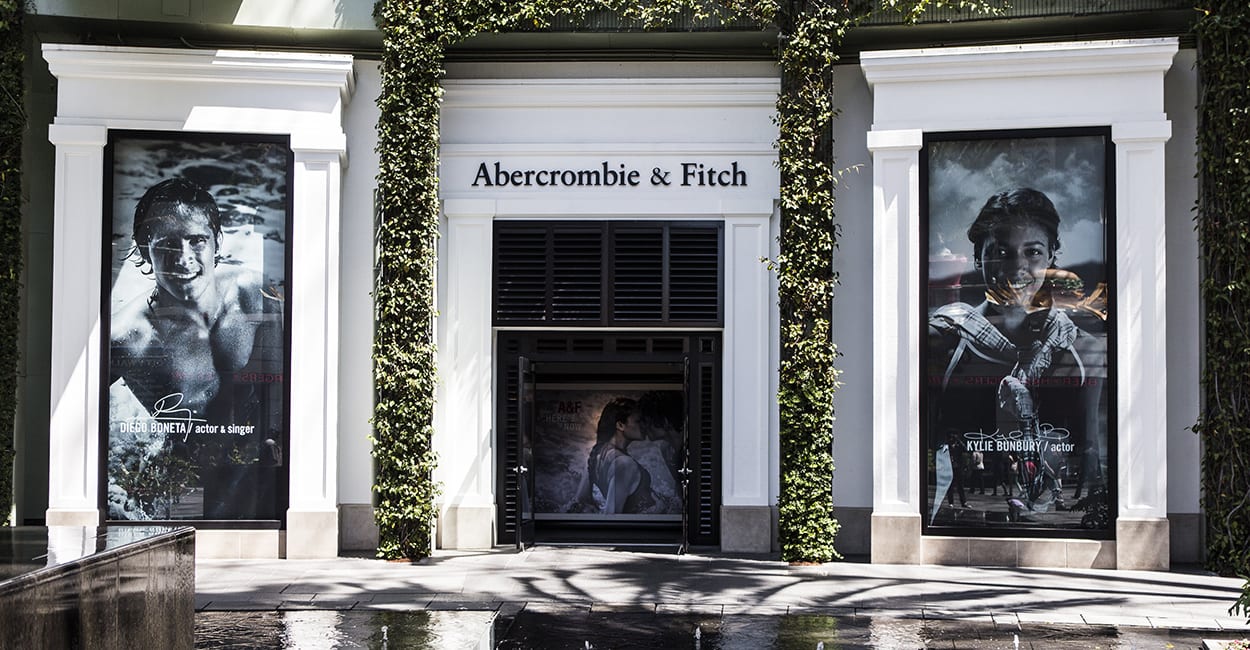
    US casualwear retailer Abercrombie & Fitch is about to unveil its first concept store for 15 years.

    In a dramatic change of direction, customers will be able to actually see the stock on display, the brand’s heavy scenting has been toned down and stock will be visible from outside.

    Only two images have been released by the brand, but these show the magnitude of the change of direction.  The concept store will open its doors on February 17, inside the Polaris Fashion Mall in Columbus, Ohio.

    Abercrombie & Fitch previously took pleasure in assaulting customers’ nasal senses as well as providing never-ending entertainment for store staff members who could watch customers walking into mirrors, squinting as bright spotlight beams shining directly into their eyes – and for special kicks, watching mothers with pushchairs trying to navigate narrow aisles, staircases and darkened passages, or children crying because they were scared of the dark.

    In place of the “mausoleum” style of store, the new design is a soft brown hue, strong lighting and subtle fixtures. The concept store was designed by MJ Sagan Architecture, which was also involved in creating the company’s New Albany headquarters.

    An A&F statement says the prototype’s look and feel “is in line with the brand’s new evolution”.

    However, A&F is in serious trouble. In November, Neil Saunders, New York-based MD of GlobalData Retail, described the company’s latest quarterly performance as “disastrous” by any standard.

    “Not only are total sales sequentially worse than last quarter, but revenues at Abercrombie have slumped and net income is down by more than 80 per cent.”

    At the core of the problem is the fact that consumers have grown out of clothing ranges bearing oversized logos.

    “A&F is changing – moving away from its traditional brash, image-obsessed focus toward a more inclusive and more gentle approach with an emphasis on stylish, quality clothing,” said Saunders.

    A&F concept store 2017

    First of seven

    Meanwhile, the new Ohio boutique, which covers 4860 sqft (451 sqm), is the first of seven to be built this year, providing the customer “with a new vision of the brand,” A&F says in a statement.

    “In line with the changes that have taken place over the past 18 months, the space was imagined with the best customer experience in mind, encouraging the discovery of the brand’s new collections.”

    A&F and Abercrombie Kids brand president Stacia Andersen says she hopes customers old and new will rediscover what is at the core of the American Heritage brand: “timeless, high-quality clothing you want to live in”.

    “The new A&F store design illustrates a strong brand, with a rich history that is evolving and moving forward. A cohesive material palette, an elevated collection and residential-scale elements enhance the personal, more intimate aspect of the A&F shopping experience,” says architect MJ Sagan.

    In place of the dark, product-devoid entrances more akin to a theme park’s “House of Horrors” than a retail store, the new storefront is transparent and features a metal sculpture of an A&F logo first used in the early 1900s. Inside, there are two shops-in-shops: a fragrance “apothecary” and an area for seasonal capsule collections. There is also a dedicated denim room.

    Mannequins for both genders stand on a concrete platform running from the storefront through the middle of the store, showcasing key trends and ideas for the current season. Throughout the store, the collections are merchandised to inspire the customer and showcase how pieces can be mixed together.

    “Looking to provide a unique and personal shopping experience, the updated layout includes accommodating features such as innovative fitting rooms and omni-channel capabilities,” says the company.

    “The fitting rooms will serve as a comfortable haven from the mall or street, comprising two individual capsules within a larger private suite. This allows each guest to share new looks with a friend or family member while also enjoying privacy. Each suite has thoughtful amenities that heighten the customer’s mood, including separate controls for light and music, as well as a phone-charging dock.”

    The interior features a cohesive palette of modern, tactile materials including cork, bronze, galvanised steel, concrete, “vegan leather”, wood and marble that act as a neutral but complementary background to the collections.

    And that obnoxious olfactory assault that is a trademark of A&F will – thankfully – be laid to rest: “The store will be subtly scented with a lighter, cleaner, gender-neutral fragrance.”

    Store staff members will help shoppers place and pick up online orders in store, and cash wraps will be located throughout the space rather than hidden in a back corner, which was a challenge for first-time visitors to find. Clearly, A&F realised it was too hard to find the register in the old store format, its statement conceding the new approach will “enable a quicker and more accessible checkout experience”.

    Gilly Hicks in comeback

    Meanwhile, A&F’s Hollister Co brand says it has relaunched its intimates brand, Gilly Hicks, in all Hollister stores across the US and will sell it globally online at HollisterCo.com.

    Gilly Hicks, “the brand to start and end your day with”, includes bras, bralettes, undies, swimwear, loungewear and sleepwear. The company launched the brand in 2008 and built a network of 28 exclusive stores, but these were closed in 2013. An online store was rolled into Hollister two years later.

    “We recognised an opportunity to redefine the Gilly Hicks brand, and we know our Hollister customer will enjoy another destination for fun and cozy bras, undies and sleepwear,” says brand president Kristin Scott. “We’ve designed our Gilly product to be effortless and comfortable to align with our customer’s on-the-go, busy lifestyle.”

    Some US stores will host shops-in-shops to provide “a unique Gilly Hicks brand experience”.

    The Old A&F look...(Image: A&F Canada)

    The Old A&F look…(Image: A&F Canada)
  • New Look loses market share in tough year

    New Look loses market share in tough year

    New Look’s share of the UK clothing market has fallen to 2.6 per cent for calendar year 2016 – from 2.7 per cent in 2015.

    Stores have failed to drive the necessary footfall to return its like-for-like performance to positive territory, with year-to-date (39 weeks to 24 December 2016) UK like-for-likes are down 7.3 per cent with the likes of Next, Primark and Matalan also finding it tough to grow organic stores sales during 2016. Moreover, weaker sales and significant levels of discounting throughout the year led to a 32.6 per cent decline in underlying operating profit to £111.5 million, bringing margins down 4.2 percentage points to 9.8 pr cent.

    The strength of the online competition has dampened the appeal of New Look’s physical stores.

    The fashion-led product mix, attractive pricing and inspiring shopping experience at the likes of boohoo.com, Missguided and Asos continue to encourage New Look’s core shopper base to browse and shop more online reducing the need to visit physical stores. This shift has benefited New Look’s online platform as has its investment in product styling, delivery options and editorial content.

    The double digit growth in online sales highlights that the problem does not lie with product – it is the number of stores New Look operates and their lack of responsiveness during periods of unseasonal weaker.

    Store closures, enhanced visual merchandising, increased product newness and adapting its seasonal mix and phasing is essential to return like-for-likes to growth and limit the threat of the online pure-plays.

    Honor Strachan

  • Sales up, revenue down for Michael Kors Holdings

    Sales up, revenue down for Michael Kors Holdings

    While retail net sales grew 9.2 per cent to US$836.7 million for luxury lifestyle brand Michael Kors in its third quarter, ended December 31, its revenue decreased 3.2 per cent to $1.35 billion.

    It sales growth was mainly driven by 193 store openings since the end of the third quarter, including 143 stores associated with the company acquiring its the previously licensed outlets in Greater China and South Korea. This resulted in licensing revenue dropping 22.9 per cent to $43 million, but revenue in Asia growing 89.1 per cent to $112.3 million.

    At the end of December, the company had 816 retail stores, including concessions, compared to 623 at the same time the previous year. There were also 128 retail outlets run by licensing partners.

    Chairman/CEO John Idol says the company believes Asia represents a $1 billion opportunity over the long term.
    For the first nine months ended December 31, the company saw retail net sales increase 9.6 per cent to $2 billion while comparable store sales fell 6.6 per cent. Wholesale net sales dropped 15 per cent to $1.32 billion. Gross profit eased 2.8 per cent to $2.04 billion.

    “More work to do”

    Neil Saunders, MD of research company GlobalData Retail, says the poor holiday quarter shows that Michael Kors has a lot more work to do before it is back on track.

    “The numbers provide a marked contrast to those of Coach, a company going through a similar brand reinvention, which had a much more positive third quarter. To be fair, the overall decline is partly because of the decision to cut back on distribution through department stores and other channels, which Michael Kors believes have been undermining its brand through excessive discounting, ” says Saunders.

    While the resulting 17.8 per cent slide in wholesale revenues and 22.9 per cent drop in licensing revenues was painful. “We believe the decision to dial back is a necessary step in making the brand less ubiquitous, and driving higher margins.

    “However, the issue is that the reduction in the number of doors through which Michael Kors is available is not immediately translating into an uplift in sales through its own stores. With a 9.2 per cent rise in retail sales, the numbers look robust enough, but most of this is down to store openings and the shops acquired in Asia where Michael Kors bought out the brand licence.”

    Saunders says the underlying comparable sales tell a more revealing story. “These remain weak and have actually deteriorated since the previous quarter. Only a small element of this decline is because of the stronger dollar; indeed, on a constant currency basis same-store sales are still down by 6.4 per cent.

    “As much as we believe that Michael Kors is headed in the right direction, and that its new lines are generating interest, it has much more work to do in reconnecting with customers who have been alienated by the overexpansion of the brand. As yet, it is simply not exciting customers in the same way that Coach or Kate Spade are. ”

    Saunders says that reconnecting customers with the brand is particularly important as Michael Kors expands its range.

    “The new Access smartwatches and fitness trackers, and the new fragrance lines are sensible additions to the portfolio. However, they will only really drive sales as part of a strong lifestyle brand that consumers want to buy into. In our opinion, on this front Michael Kors has more convincing to do. ”

  • Subdued Amazon results clouds impressive growth

    Subdued Amazon results clouds impressive growth

    Amazon is usually a retailer that operates at full volume, the noise of its sales growth a clarion call in an often muted retail sector.

    However, this quarter that volume seems to have been turned down a couple of notches. While the latest Amazon results show impressive growth, and is a long way above the retail sector overall, by the high benchmark the company has set, the latest numbers have a certain softness. Revenue totalled US$43.7 billion, up 22 per cent year-on-year, below analysts’ expectations.

    Some of the loss in momentum comes down to a more unfavorable exchange rate. On a constant currency basis, Amazon’s overall growth is a more respectable 24 per cent; while its international growth leaps to 23 per cent from 18 per cent, once the impact of the strong dollar is factored out. Even so, these upticks still leave a gap in growth compared to what Amazon delivered over the first three quarters of the fiscal.

    Part of the softness comes down to shipping-related revenue, which grew by its slowest pace in over a year. This has placed a little downward pressure on the revenue line. More worryingly it means that shipping revenue from consumers is now strongly adrift from Amazon’s shipping costs. In the final quarter, the former grew by 29 per cent, while the latter surged by 35 per cent to just over $5.6 billion. This is one of the reasons the company missed its profit forecasts, and why operating profit came in at 2.9 per cent of sales versus 3.1 per cent over the same period last year.

    Arguably, low cost and fast delivery are a fundamental part of Amazon’s appeal to consumers. However, they are also its Achilles’ heel – and with Prime becoming more popular, and with a greater focus being put on speedier shipping times, we have concerns that Amazon could see further profit erosion as it enters its new fiscal year. This view is supported by Amazon’s own guidance for the next quarter, which suggests profit will come in well below last year.

    As niggling as these points are, they do not diminish Amazon’s success in other areas. Over the holiday quarter, the company saw demand for its devices, including the Echo product, boom. This helped Amazon to a very strong performance in electricals at a time when the overall market was struggling with a lack of newness and innovation. It also aids Amazon to extend its ecosystem to more households, something we believe will yield fruit over the coming years as it becomes a more integrated and critical part of people’s lives.

    The AWS (Amazon Web Services) division is also a success story. Here revenue grew by 47 per cent off the back of a very strong prior year comparative. This part of the business is helpful as its relatively strong profitability gives buoyancy to Amazon’s balance sheet.

    As much as this quarter has been more subdued, Amazon remains firmly on the front foot in terms of innovation. This alone will continue to make it a retail outperformer, at least in sales terms, over the next year and beyond.

  • Apple China sales slide further

    Apple China sales slide further

    Apple China sales have fallen for the fourth consecutive quarter, but the tech giant is putting on a brave face, buoyed by rising global revenue.

    Apple sold 78.29 million iPhones in the quarter ended December 31, up from 74.78 million last year, marking the first quarterly growth in iPhone sales in 12 months. It was as many as 2 million handsets more than analysts were predicting.

    But revenue in Greater China fell 11.6 per cent to US$16.23 billion as the iPhone came under heavy pressure from a raft of locally produced Android-based handsets with similar or higher specification and half the price.

    Apple executives put a positive spin on the China problem. “We were encouraged by our performance in China because it was clearly an improvement over the last couple of quarters,” CFO Luca Maestri said in a conference call. “In Mainland China in particular, our revenue was flat and actually grew in constant currency terms.”

    Neil Saunders, MD of GlobalData Retail, (formerly Conlumino), said both the new model iPhones and MacBook Pros helped deliver global growth for Apple: iPhone sales rose by 5 per cent in terms of units and revenues, and Mac sales were up by 7 per cent in revenue, and by 1 per cent in units.

    “In our view, the new MacBook Pros have a niche appeal, but the much higher price points helped to inflate sales. That said, given there is a more limited market for this fairly expensive kit, we question how much of a contribution to growth the new laptops will make over the remainder of this fiscal year.”

    Saunders said the first quarter results were a fairly positive note for the company, “finally pulling out of the tailspin of lower sales which have dogged it over the past year”.

    “However, the revenue uplifts have come off the back of fairly soft prior year comparatives, especially so in the North American market. Even so, the performance will come as a relief to Apple.”

    Services key to future

    Apple CEO Tim Cook said he expects revenue from services – which include the App Store, Apple Pay and iCloud – to double in the next four years after an 18 per cent improvement to to US$7.17 billion in the last quarter. Pokemon Go and subscription revenues had driven the growth.

    Saunders notes that in monetary terms services is now bigger than iPad sales and is almost as big as Mac sales.

    “Encouragingly, the division is nowhere near as mature as other parts of Apple’s business and we believe there is significant scope for future growth as Apple rolls out more content and services.”

    Despite these positives, Apple’s results do not provide the company with a completely clean bill of health, according to Saunders.

    “The iPad business, which was once a key driver of growth, is now firmly in decline with sales down 22 per cent over the prior year. And despite both product and operating system updates, sales of the Apple Watch continue to be anemic and it is clear that this product line is unlikely to be a significant winner.

    “The other major negative comes from the profit line where net income fell by 2.6 per cent. Admittedly this is much better than the circa-20 per cent declines that Apple has posted across the past three quarters. However, it underlines the fact that the top line is not moving ahead by enough to keep pace with the increased investment costs in store refreshes, product development, and research. Given that Apple remains extremely profitable, this is not a huge problem – but it does indicate that the days of heady bottom line growth are over, at least for this fiscal year.”