Tag: gome

  • Gome Retail boosts GMV, cuts losses as restructure continues

    Gome Retail boosts GMV, cuts losses as restructure continues

    Gome Retail says its revenue last year fell, but it nearly halved its annual loss as its restructuring program continued to pay dividends.

    Gome Retail is in the midst of a major transition and restructure from a brick-and-mortar-dominated format into a multichannel digital business anchored around its online platform. It is also expanding its physical store network into low tier cities and rural locations across China.

    The company says its gross merchandise volume (GMV) doubled last year. GMV from stores in rural parts of China soared by 61 percent and from new businesses such as home solutions and kitchen cabinets integrating electrical appliances, increased by 86 percent. GMV from smart products increased by 43 percent and from services by 61 percent, the company said.

    Despite a 7.57-per-cent decline in total sales to RMB 59.48 billion (US$8.376 billion), the company’s loss attributable to shareholders fell from RMB4.887 billion ($688 million) in 2018 to RMB2.590 billion ($365 million) last year.

    “The booming new business indicates that the group’s strategic transformation is progressing well,” the company said in an earnings statement.

    During the year ahead, it plans to accelerate its strategy to penetrate into lower-tier markets, using a franchising model.

    “This will enable Gome to seize market share with low operating costs.”

    The company plans to build 100 franchise stores this year, with a target turnover of RMB100 million ($14 million) for each.

  • Gome launching on JD.com

    Gome launching on JD.com

    A Gome flagship store has launched on JD, giving the Chinese home appliance retailer access to JD’s more than 360 million active annual customers.

    “JD.com is pleased to launch Gome’s third-party flagship store on our platform, making home appliances from Gome’s offline store available to more Chinese consumers online,” said a spokesperson from JD. “JD’s third-party platform welcomes all qualified merchants with high-quality products and services to launch stores on our platform. Gome will also use JD’s supply chain to introduce consumer goods to its online platform gome.com.”

    The cooperative agreement reflects an emerging dynamic in Chinese retail where businesses that would normally tend to compete are instead leveraging each other’s strengths to take advantage of the scale of China’s online reach.

    For the time being, Gome will use its own warehouse and logistics facilities for the third-party store. JD will provide data, technology and customer service-related support to Gome.

  • Gome Retail to target smaller cities as part of restructuring

    Gome Retail to target smaller cities as part of restructuring

    Gome Retail Holdings will speed up its penetration into lower-tier Mainland China markets during the year ahead, with about 1000 stores slated for opening.

    The move is part of a broader strategy dubbed ‘Home.Living’ in which the retailer is rolling out innovation and transformation throughout the business.

    For the first half of this year, Gome Retail reported a loss attributable to shareholders of RMB380 million (US$53.1 million), a reduction of the RMB457 million loss during the  corresponding period last year as its restructuring began to show results.

    Group sales for the first half were RMB34.333 million, relatively stable compared with RMB34.706 billion for the corresponding period last year.

    Chairman Zhang Da Zhong says that in the months ahead, the company will further expand into third- to sixth-tier Chinese cities to meet the constantly growing demand of these markets.

    Moving into these markets efficiently is possible due to Gome’s advantages in brand, supply chain and logistics, he said.

    During the first six months of this year, the group’s total gross merchandise volume (GMV) increased by about 1.8 per cent compared with the same time last year, with GMV of its county-level stores (both self-operated stores and New Retail stores) growing by 339 per cent. Sales through its Me Shops grew by about 123 per cent, while sales from smart products grew by 62 per cent. Sales by its new businesses, such as home solutions and the integration of kitchen cabinets with electrical appliances, grew by 108 per cent, and service GMV grew by 32 per cent.

    This year, Gome has entered “a critical stage of its strategic transformation” said Zhang Da Zhong.

    “Leveraging on the advantages of internet technology, Gome has set up a user-base interaction and operation platform under the integration of the three terminals – the Gome app, physical stores and Me Shop.”

    As well as the company’s foray into smaller cities, the company will begin opening a second wave of new Ixina stores, its self-operating integrated kitchen cabinets and electrical-appliances business collaboration with European cabinet brand Ixina. Stores will open in cities including Wuxi and Nanjing, after Beijing and Shanghai, to further boost the brand’s awareness and reputation. Cozy Home, the home-hardware integration solutions chain, will also be developing at full speed, he said.

  • Gome profit warning issued to Shareholders

    Gome profit warning issued to Shareholders

    Another Gome profit warning has been issued as the company’s massive restructuring program continues.

    However the group says the reforms are beginning to show results and while a loss is anticipated for the latest quarter, it will be less than that of the previous period.

    According to a stock exchange filing, Gome says its loss attributable to owners is expected to range somewhere between RMB20 million (US$3 million) and RMB90 million ($13.4 million), as compared with a profit of RMB113 million for the corresponding period last year. The loss will be “significantly reduced” compared with the loss for the December quarter, the company said. Last full year, Gome lost RMB4.887 billion ($728 million).

    The group says it continued to actively pursue its transformation into an integrated home solution, service solution and supply chain provider based on its strategy of ‘Home • Living’. It expects the group’s total GMV for both online and offline to grow about 5 per cent year on year for the March quarter.

    Of that, GMV from Me Shop is expected to grow by more than 200 per cent, service GMV by more than 30 per cent, GMV from smart products by more than 50 per cent; and GMV from new businesses such as home solution and integration of kitchen cabinets with electrical appliances, by more than 100 per cent.

  • Gome Retail’s loss soars tenfold After Restructuring

    Gome Retail’s loss soars tenfold After Restructuring

    Gome Retail’s loss tenfold last year to RMB4.887 billion (US$728 million), compared with RMB450 million in the previous year.

    The loss – projected early last month in a profit warning – was largely due to massive write downs as the once brick-and-mortar based retailer continued its transformation into a New-Retail-era business, with its focus moving online. On a day-to-day trading basis, the company has almost broken even.

    During the reporting period, GMV (gross merchandise volume) from its ME Shop increased by 368 per cent, while GMV from new businesses such as home solution and integration of kitchen cabinets with electrical appliances increased by 116 per cent and from smart products by 89 per cent. Services GMV rose by 51 per cent.

    “The booming new business indicates that the group’s strategic transformation is progressing well,” the company said in an earnings statement.

    Overall sales revenue fell 10 per cent to RMB64.356 billion, and consolidated gross profit margin of 16.8 per cent was down on the 18.26 per cent of 2017.

    “Looking forward, Gome will continue to focus on major large-scale integrated flagship store projects in the first- and second-tier cities in an effort to provide one-stop comprehensive household solution, from home appliance to decoration, construction and household services,” the Hong Kong-listed company said.

    The group expects to open 16 large-scale integrated flagship stores and 200 home-decoration materials and home furnishing shops this year.

    “Gome will step up the output of its supply-chain service in the third- to sixth-tier cities to achieve swift development of store coverage in county-level cities, with an emphasis on franchising. It is expected that 500 franchise “new retail stores” and 200 self-operating county-level stores will be opened this year.”

  • Gome Retail sales free falling

    Gome Retail sales free falling

    Gome Retail has plunged US$64million into the red as its restructuring program takes its toll. The company took the unusual step of releasing third-quarter financial data, which shows group sales were down 11.2 per cent in the first nine months of the year, to $7.3 billion.

    Total gross merchandise volume (GMV) of the group for both online and offline grew by 4.83 per cent year on year, with its e-commerce business growing by 26.04 per cent.

    Gome’s consolidated gross profit margin was 18.06 per cent, up by one percentage point compared with the same time last year.

    But the loss for the period contrasted with a $31.7 million profit last year.

    Gome issued a profit warning early this month, with the actual figure turning out to be at the top end of its projected range. While yesterday’s statement did not include any commentary, the company has made considerable effort to keep shareholders aware of the scale of the task it faces and the short-term pain required to effect the restructuring plan.

    Gome Retail is integrating its online and offline business and promoting a new ‘Social + Business + Sharing’ shared retail model. As part of that strategy, the company is combining its electrical appliances, home decoration, household systems and supermarkets to create sizable “experiential stores” in tier 1 and 2 cities. The group is also optimising its platform to include the Xiaomei Net Cafe, VR Cinemas and Gome esports.

  • Gome Retail restructure ends up disappointing

    Gome Retail restructure ends up disappointing

    Gome Retail Holdings has posted a loss attributable to shareholders of RMB457 million for the first half of this year as it continued with implementation of its Home – Living strategic restructure.

    The loss was a contrast to the profit of RMB122 million in the same period last year.

    Gome Retail chairman Zhang Da Zhong said the group accelerated its transformation into “a one-stop home solution provider. At the same time, it promoted the overall integration of its online to offline businesses, aimed at raising management efficiency and enhancing consumer experience.

    Gome is combining its electrical appliances, home decoration, household systems and supermarkets to create sizable “experiential stores” in tier 1 and 2 cities. The group is also optimising its platform to include the Xiaomei Net Café, VR Cinemas and Gome esports.

    During the six months, the group’s total gross merchandise volume (GMV) for both online and offline operations increased by 14.94 per cent year on year, with 67.39 per cent growth in the GMV from the marketplace of the e-commerce business.

    As a result of the implementation of the strategic transformation plan, the group recorded sales revenue of RMB34.706 million, representing a decrease of 8.84 per cent when compared with RMB38.073 billion for the corresponding period last year.

    Gome proposed the ‘Triple New’ initiative of ‘New Business, New Market, New Technology’ to rapidly open county-level stores in tier 3-6 cities, and introduced new service initiatives including the integration of kitchen cabinets and electrical appliances, home furnishing/kitchen cabinet and kitchen interior design services.

    “The Triple New initiative proposed by Gome not only represents an operational shift of focus from products to users, but also demonstrates Gome’s determination to attract customers with quality services,” said Zhong.

    In the months ahead, he says the group will continue to open county-level stores at a quicker pace and work on merging its online and offline operations.

  • China’s Gome set to open in India

    China’s Gome set to open in India

    Chinese electronics retailer Gome is to expand into India.

    The move will involve opening a manufacturing centre in India in order to sell its locally made branded products on the Indian market, which will include appliances, smartphones, and televisions to be sold through multi-brand outlets and online.

    It has already revealed plans to launch three competitively priced smartphones to catch the upcoming festive season in the target region.

    The new firm will be a wholly owned subsidiary of Gome Telecom Equipment, which is part of Hong Kong’s Gome Retail Holdings. Gome Group’s headquarters are based in Beijing.

  • Gome Electric issues profit warning

    Gome Electric issues profit warning

    Electrical appliance retailer Gome Retail has issued a profit warning despite a strong year, the result of impairments and financial costs.

    During the 12 months to the end of December the group launched its “Home Living” strategy, a blueprint aimed at helping it evolve into a one-stop provider, going beyond the traditional home-appliance retailer.

    Based on a preliminary review of the latest management accounts, the group’s total gross merchandise volume (GMV) both online and offline is expected to grow by more than 20 per cent year on year. Sales from the comparable stores of the group are expected to increase by more than 2 per cent with the consolidated gross profit margin expected to exceed 18 per cent.

    With the e-commerce business entering the online/offline integration stage, its direct sales revenue decreased by about 7 per cent. However, the GMV from the e-commerce business is expected to more than double.

    With more than 200 million members in its loyalty program, the group is speeding up expansion of its services while expanding into China’s fourth- and fifth-tier cities.

    Despite the strong trading, Gome impaired the goodwill for some of its under-performing business units and long-term assets related to the e-commerce business. That, together with rising financial costs related to the increased debts, is likely to produce a loss attributable to the owners of the company during the year of between RMB300 million (US$47.2 million) and RMB500 million, compared to a net profit 12 months earlier.

    The financial data also covers Artway Development and its subsidiaries from April 1, following its acquisition on March 31.

  • Gome Retail Holdings satisfying result

    Gome Retail Holdings satisfying result

    Both online and offline business showed strong growth for electrical appliance retailer Gome Retail Holdings during the nine months to the end of September.

    Total gross merchandise volume (GMV) of the group for both online and offline grew by 20.04 per cent, while GMV of online e-commerce business grew by 58.13 per cent.

    Sales revenue was about RMB57.4 billion (US$8.6 billion), up 3.68 per cent on the same period last year.

    Consolidated gross profit margin was about 17.05 per cent, up 1.03 points, while profit attributable to the owners of the parent was about RMB220.1 million, a decrease of 10.71 per cent.

  • US$1 billion in first five minutes of 11.11

    US$1 billion in first five minutes of 11.11

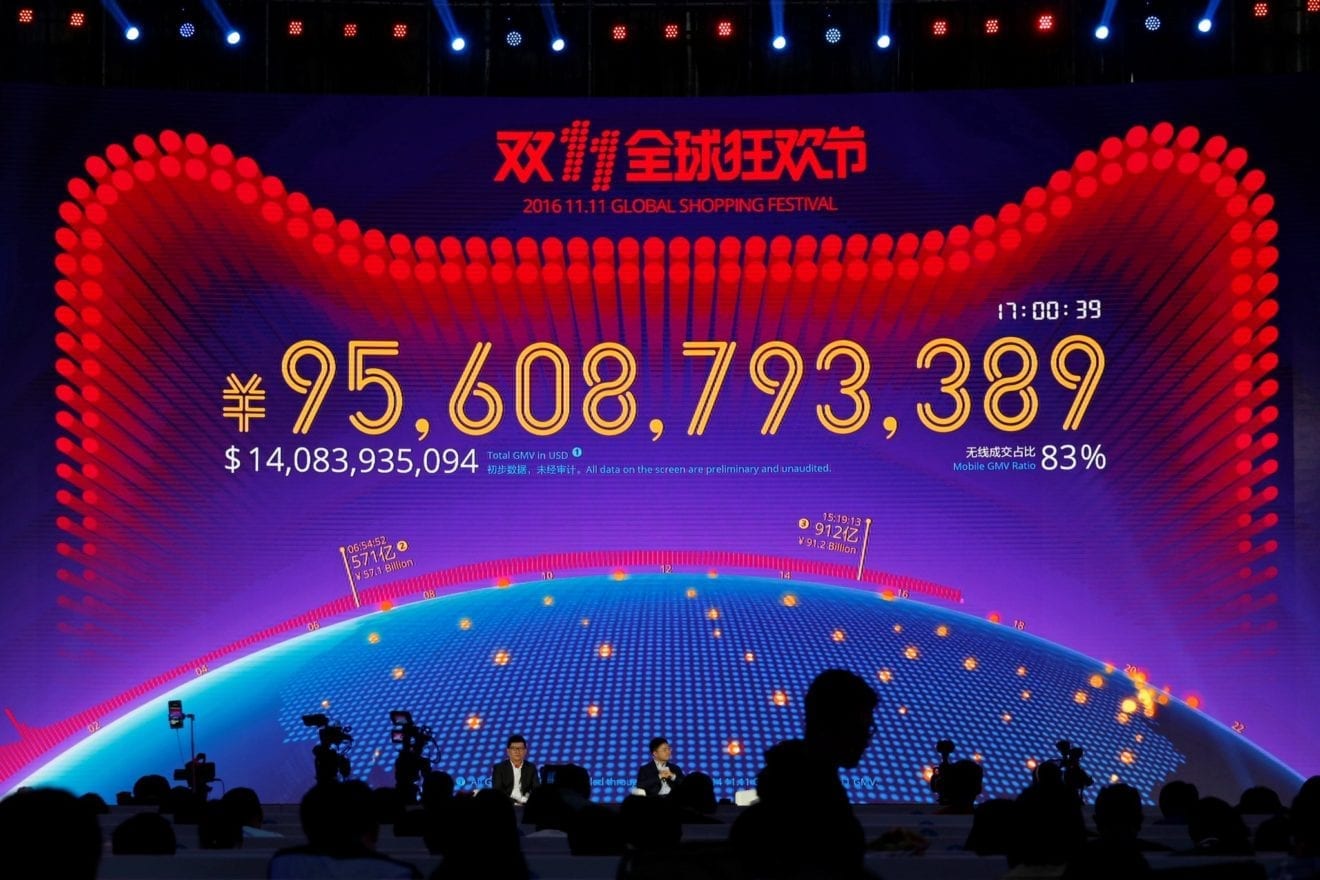
    Alibaba Group says more than US$7 billion (RMB 47.5 billion) of gross merchandise volume (GMV) was settled through Alipay on Alibaba’s China and international retail marketplaces within the first two hours of the 2016 11.11 Global Shopping Festival.

    And more than $1 billion was transacted in the first five minutes – from 12 midnight.

    “Chinese consumers purchased more in the first hour of 11.11 this year than the entire 24 hours in 2013, reflecting the incredible evolution of our global shopping festival,” said Daniel Zhang, Alibaba Group CEO. “This unprecedented level of engagement demonstrates both the consumption power of Chinese consumers and their embrace of online shopping as a lifestyle.”

    In the hours leading up to the official midnight start of November 11, millions of viewers watched the Alibaba Group 11.11 Global Shopping Festival Countdown Gala live online and on mobile devices via Youku Tudou, and the Tmall and Taobao apps. The gala was televised live across China through Zhejiang Satellite TV, as well as in Hong Kong and Macau for the first time.

    “This year, we innovated new ways for consumers watching the live broadcast of our countdown gala. Viewers were able to influence the production of the show in real-time through their mobile phones,” said Chris Tung, chief marketing officer, Alibaba Group. “Consumers in front of their televisions were shaking, tapping, scanning, chatting, browsing and buying with their mobile devices, creating a seamless and truly immersive entertainment experience.”

    VR drives surge

    International think tank Fung Global Retail & Technology predicts sales of $20 billion during the full 24 hours, up an extraordinary 40 per cent over last year’s total of $14.3 billion, thanks in part to the introduction of Buy+, the world’s first-ever end-to-end virtual reality (VR) shopping experience.

    “Buy+ will enable global retailers (even those without a physical presence in China) to offer an engaging, virtual in-store experience to Chinese consumers,” writes Fung Global Retail & Technology MD Deborah Weinswig in Singles’ Day Online Shopping Festival Could Also Benefit Retailers’ Physical Stores, a new report.

    The platform features eight virtual stores: Macy’s, Target, Costco, P&G, Chemist Warehouse, Freedom Foods, Tokyo Otaku Mode and Matsumoto Kiyoshi. Using cardboard VR headsets distributed in October, consumers can virtually walk around Macy’s Herald Square flagship in New York City to find products and, with just a nod of the head, confirm payment to purchase an item they see.

    “One of Alibaba’s strategies for Singles’ Day is to merge gamification with online shopping. The company will leverage its media and entertainment assets to drive increased online consumption,” says Weinswig.

    These include a televised countdown gala event and fashion show that was held last evening. In addition, the company is promoting products on TV screens, allowing viewers to scan QR codes for a real-time purchase.

    The concept has expanded beyond Alibaba, with chief rival JD.com, Gome and Suning also creating promotions. International retailers will target Chinese shoppers, and Chinese retailers target international shoppers. In 2015, Newegg, OTTE New York and Nasty Gal, all launched Singles’ Day promotions.

    “A year ago, Alibaba promised that Singles’ Day will be a true omni-channel event, and this year the company seems dedicated to continue delivering on the promise, armed with more technological innovations that bridge the gap between the virtual and physical worlds,” Weinswig writes.
  • Artway sales surge

    Chinese electrical retail giant Gome says sales by its takeover target Artway during the first half year rose 7.85 per cent year on year, to RMB10.858 billion.

    Same store sales rose 3.66 per cent overall, while in second tier cities same store sales rose 5.93 per cent, demonstrating the success of Artway’s focus on smaller centres.

    Gross profit margin rose by 0.85 percentage points to 20.28 per cent.

    Profit for the period was RMB256 million, up 75.34 per cent compared to the same period last year.

    Gome Electrical Appliances, the Hong Kong-listed Chinese electrical appliances retailer – is planning to spend US$11.268 billion acquiring rival Artway, allow it to expand its presence from 269 cities to 436 cities across Mainland China.

    As at June 30, Artway operated 590 stores, including eight self-owned stores, covering 17 provinces in China (including Jiangsu, Zhejiang, Shanghai, Fujian, Jiangxi, Hunan, Hebei, Henan, Liaoning, Jilin, Heilongjiang, Inner Mongolia, Shanxi, Guizhou, Guangxi, Shaanxi and Xinjiang). It opened 56 stores and closed 22 in the six month period, representing a net increase of 34 stores.

  • Gome snaps up rival

    Gome snaps up rival

    China’s largest electrical equipment retailer Gome has purchased rival Beijing Dahong House Home equipment.

    Gome paid three.83 billion yuan US$617 million for the chain, which it has successfully managed for the final eight years since pumping mortgage finance into the enterprise.

    The seller was Beijing Zhansheng Funding Co, with the cost a mix of money and debt forgiveness of a three.6 billion yuan mortgage.

    Gome stated in a press release filed with the Hong Kong inventory trade that phrases of the mortgage included an choice to purchase the enterprise sooner or later. It had now determined to train that curiosity.

    It isn’t but clear if Gome will rebrand the shops it has acquired underneath its personal branding or function a twin model technique.

  • Tangshan malls to open in spring

    LT Business Actual Property is in search of tenants for the buying malls of its large-scale business and residential complicated venture, Tangshan Lerthai Metropolis, within the Chinese language mainland metropolis of Tangshan.

    The Hong Kong based mostly developer says the department stores will open within the second quarter of 2016.

    LT is looking for well-known home and worldwide manufacturers as tenants to hitch Hong Kong Broadway, Baolongcang, Gome Electronics, Hai Di Lao Scorching Pot, Grandma’s Residence, Parkson division retailer and Xiabu.

    The primary part of Tangshan Lerthai challenge, which occupies a website space of roughly 157,000 sqm and has a gross flooring space of 680,000 sqm, has referred to as for a complete funding of RMB4 billion. LT Business holds purchasing malls there as funding properties which have a mixed gross flooring space of 180,000 sqm.

    Within the prime spot of the Fenghuang buying district in Tangshan, Tangshan Lerthai Metropolis is located east of Western Outer Ring Rd and north of Xinxibei Rd, and is positioned as a one-stop large-scale metropolis business complicated that includes a world purchasing centre, a tradition and leisure middle, a leisure and catering middle, a world enterprise middle, a world-class deluxe built-in challenge of economic and residential properties and a boutique house. The challenge goals to convey tradition, catering, leisure, leisure and buying underneath one roof, permitting individuals to expertise a multifaceted way of life and thus set the development for city dwelling.

  • New stores, eCommerce drive Gome growth

    New stores, eCommerce drive Gome growth

    China’s Gome Electrical Appliances boosted online sales by 84 per cent last year helping fuel a 43.5 per cent boost in annual profit.

    The full year surplus was 1.28 billion yuan, (US$206.2 million).

    The booming online operation is clearly still growing with a quarter on quarter sales boost of 117 per cent in the three months to December 31.

    At the same time, Gome says it continued to refurbish its bricks and mortar store network and revamp its supply chain, procurement and distribution operations.

    In annual figures released Monday, Gome said it continues to pursue its goal of becoming an ‘Open Omni-channel Retailer’ by optimising its open supply chain platform, driving further improvements in the areas of procurement, logistics, information system and financial services, and building an open omni-channel platform encompassing ‘online + offline + mobile terminal + other socialised channels’.

    “The group has managed to provide cross-regional and cross-channel full services to consumers as a whole. The launch of this strategic transformation, supported by the low-cost highly-efficient open supply chain, has enabled the group to achieve year-on-year growth in key financial indicators for eight consecutive quarters and increase its operating efficiency,” the company said in a statement.

    As well as renovating 100 existing stores, Gome continued its push into tier 2 markets, strengthened partnerships with supermarkets and department stores and promoted its eCommerce development. Last year it opened 145 new stores, 78 of them in tier 2 cities. A further 154 concessions were opened.