Tag: Hang Seng Index

  • Shein Shares Drop 8 per Cent in Hong Kong Debut

    Shein Shares Drop 8 per Cent in Hong Kong Debut

    Shares in Shein fell 8 per cent on their first day of Hong Kong trade on Tuesday, valuing the online fast-fashion retailer at roughly US$24 billion.

    The morning price of HK$44.60 represents a steep reset from the company’s peak valuation of nearly $100 billion in 2022. Hong Kong’s benchmark Hang Seng Index slipped 0.6 per cent over the same session.

    Shein turned to Hong Kong after regulatory pushback from Chinese authorities blocked earlier listing attempts in New York and London. The public offer sold about 6.6 per cent of the company’s enlarged share capital. Cornerstone investors took roughly one-fifth of the shares on offer, leaving just 5 per cent freely tradeable under a six-month lockup agreement.

    Valuation gap with regional rivals

    Investor appetite remained muted throughout the sale. The retail portion was subscribed 5.63 times and the international tranche 2.59 times, trailing the hundreds-fold subscriptions common in Hong Kong’s technology and robotics listings.

    Saxo market data shows Shein listed at 15 times forward earnings. That multiple is more than double the valuation of PDD Holdings, the owner of Temu, giving Shein a premium price tag despite heightened geopolitical friction and slower earnings visibility across major Western markets.

    RetailNews Asia notes that the muted debut reflects how quickly cross-border e-commerce economics deteriorated once Western customs loopholes vanished. For years, Chinese discount retailers expanded into the US and Europe by relying on tax exemptions for low-value parcels. Now that both jurisdictions levy duties on direct-shipped goods, margins across the entire ultra-fast fashion export sector are compressing simultaneously.

    Tariffs squeeze operating margins

    Policy changes in Shein’s largest markets dismantled its core cost advantage. The US repealed its duty exemption for packages under $800 last year, and the European Union instituted collection fees on small consumer shipments.

    Higher customs duties, tariffs and logistics expenses across Europe and the Middle East dragged Shein’s net income down 39 per cent last year, pushing the business into an operating loss in the first quarter. To compensate earlier venture backers who bought in at higher price points, Shein agreed to disburse $3.5 billion in cash payments and execute share adjustments for select preferred stockholders.

    Management has turned to acquisitions and marketplace fees to diversify revenue. The company purchased American clothing label Everlane in May, adding to earlier takeovers of British brand Missguided and French fashion label Pimkie.

    Attention now turns to Shein’s upcoming first-half financial report, where the company projected operating profit margins will fall below first-quarter levels.
  • Hang Seng Index Registers Sharp Weekly Losses

    Hang Seng Index Registers Sharp Weekly Losses

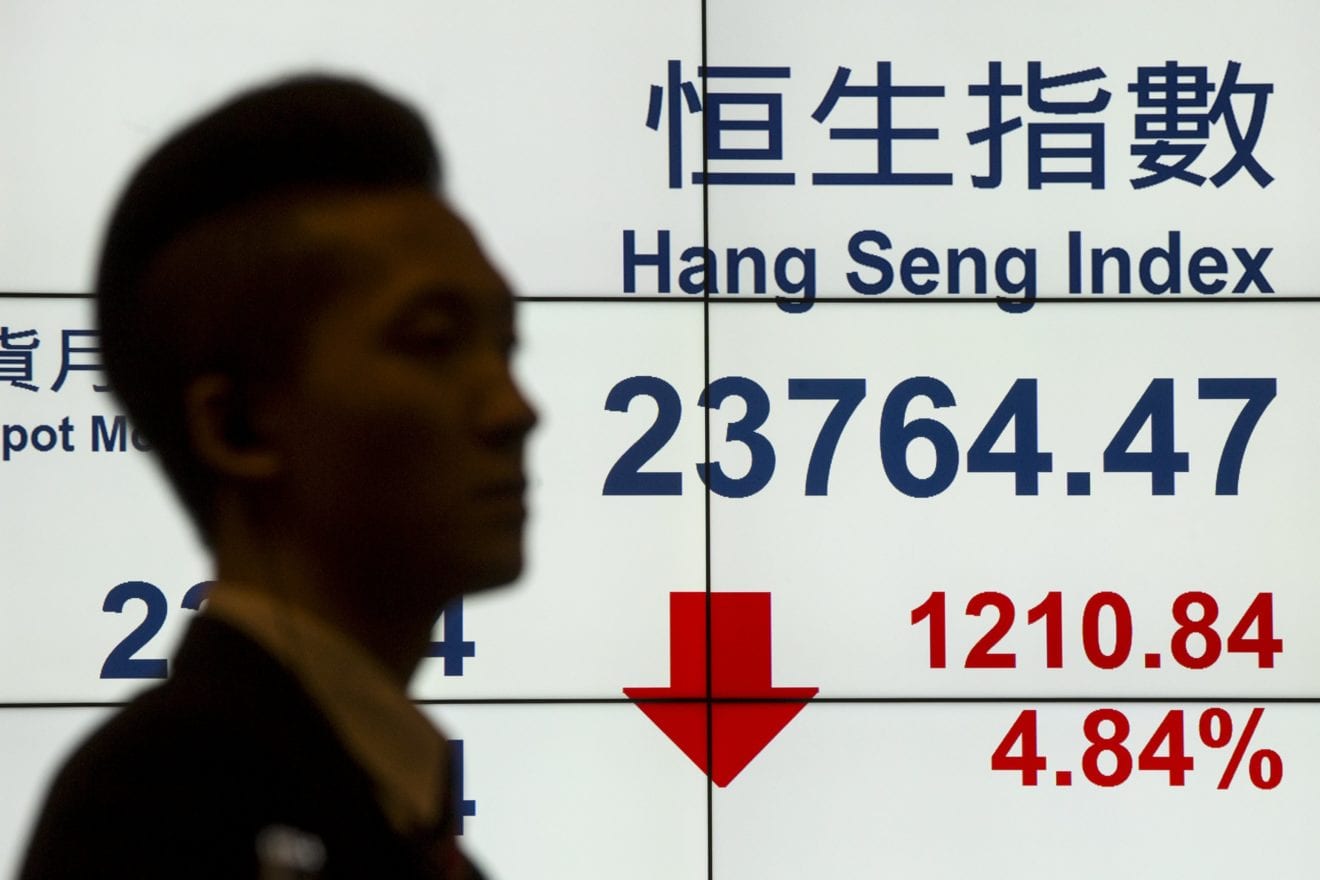
    Hong Kong shares continued to move lower on Friday with the fifth successive daily Hang Seng retreat and sharpest weekly decline for close to three months as confidence deteriorated further.

    US equity markets were unable to make any significant impression on Thursday with marginal losses in the S&P 500 index and weakness in Asian markets. Oil prices were subjected to choppy trading conditions with slight net losses.

    There were further concerns surrounding the Chinese economic outlook with fears that stronger data in March and April would not be sustainable. Sharp declines in mainland Chinese equity markets also had an important impact in undermining Hong Kong confidence.

    Hong Kong retail sales data, released after Thursday’s market close was weaker than expected with a 9.8% annual decline in the year to March, the 13h successive decline with domestic demand subdued and weakness in international arrivals. There were some hopes that a weaker yuan in trade-weighted terms and recent dollar losses would help improve competitiveness and cushion the retail sector from further selling pressure.

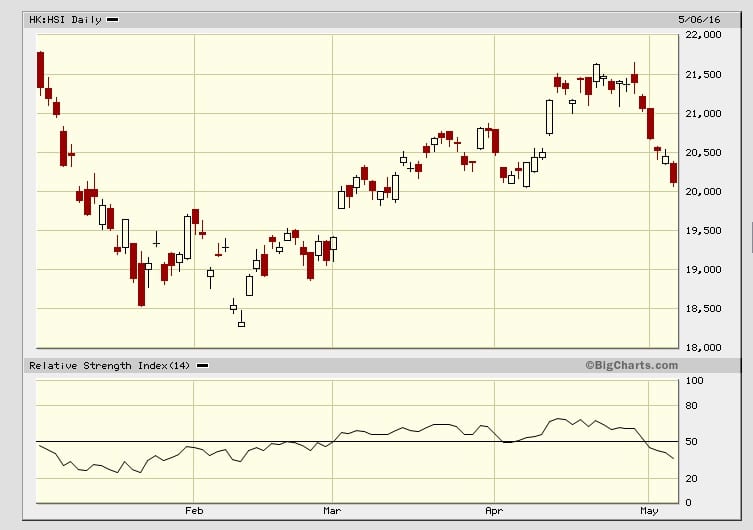
    After opening significantly lower the Hang Seng index moved steadily weaker during the morning session with lows close to 20,150 ahead of the break. Buyers were unable to make any impression during the afternoon session and there was fresh selling late in the session. The index closed with a loss of 339.95 points and 1.66% at 20109.87, the weakest close since the second week of March.

    There were daily losses of over 2.00% for the finance and property sectors and the utilities sector also edged slightly lower despite gaining defensive support. HSBC and AIA dipped significantly lower during the day. The China Enterprises index fell 1.80% for the day, also the fifth successive retreat.

    Friday’s US employment data will be important for global markets with a particular focus on the dollar, which will influence regional markets next week. China’s trade and international reserves data is scheduled over the weekend, which will have an important impact on confidence surrounding the Chinese economy and equity markets with any decline in exports undermining sentiment.

    Hang Seng Daily Chart

    hangseng daily chart 06-05-16

  • Should We Worry About The Hong Kong Dollar?

    Should We Worry About The Hong Kong Dollar?

    Winter is coming to Hong Kong. The Hong Kong dollar breached its 2007 low today, down to as low as 7.8226, just haircuts away from the 7.85 level that would prompt the Hong Kong Monetary Authority to intervene.
    After China decoupled its loosely pegged yuan from the dollar last August, we Hong Kong residents are understandably worried Hong Kong may de-peg its currency as well.

    But really, rather than the Hong Kong dollar, we should worry about the Hong Kong economy instead.

    First of all, it is highly unlikely Hong Kong would want to rock the boat even though Hong Kong’s economy is more closely tied to China (and so should its monetary policy be). After all, this is the government that lets its citizens kidnapped across the border without consequences.

    Second, HKMA has enough gun power to defend its currency when it comes to it. Hong Kong’s foreign reserve is currently at $359 billion, which covers 1.75 times its monetary base. See my last week’s blog for Credit Suisse‘s commentary on the possibility of Hong Kong de-pegging.

    But what this means is that Hong Kong has to raise its interest rates to compensate for the Hong Kong dollar outflow, estimated to be around 300 billion Hong Kong dollars, or $38 billion. This certainly is not good news for the Hong Kong economy, especially when it is already in the downturn. In 2015, Hong Kong retail sales, a growth engine in recent years, is expected to slump over 5%, even worse than the SARs epidemic in 2003.

    Hong Kong investors are catching up to reality today, sending the Hang Seng Index down 3.1% a new 40-month low. No surprise, Hong Kong property developers tumbled today. Cheung Kong Property fell 5.6%, Wheelock dropped 4.8%, Wharf Holding was down 3.7%.

    Year-to-date, the iShares China Large-Cap ETF (FXI) fell 13.5%, the iShares MSCI China ETF (MCHI) fell 13.4%, the iShares MSCI Hong Kong ETF (EWH) was down 10%.

  • UBS Capitulates, Slashes Hang Seng Forecast

    UBS Capitulates, Slashes Hang Seng Forecast

    As China devalues yuan and the U.S. is on track to raise rates, Hong Kong, whose currency is pegged to the dollar, is in trouble.

    Forecasting “black sky”, UBS now sees the Hang Seng Index to end the year at 19,775, another 5.5% downside from its current level. The Hang Seng Index has fallen by about 25% since its late April high.

    Apart from China slowdown, “we have seen a combination of the three pillars of Hong Kong’s economy weakening (tourism and re-export) or showing signs of weakness (property),” wrote Spencer Leung.

    The Hang Seng Index is now valued at only 9.4 times forward earnings, a good 0.8 times standard deviation below its 2-year average, but “the current valuation of Hong Kong equity may not be attractive enough to compensate for potential earnings downside.” UBS estimates Hong Kong companies’ earnings could drop 31% next year.

    It is not easy for retail businesses to operate in Hong Kong, because the rent is simply too high. UBS estimates that ground-level stores in prime shopping districts in Hong Kong will have to see their rental expenses drop 70% from their peak to break even. Last week, U.S. handbag bag Coach closed its flagship shop in the Central shopping district.

    Overnight, the iShares MSCI Hong Kong ETF rose 0.5%.