Retail News CRM

Tag: Harley

  • 2021 Harley-Davidson Pan America 1250 Launched Globally

    2021 Harley-Davidson Pan America 1250 Launched Globally

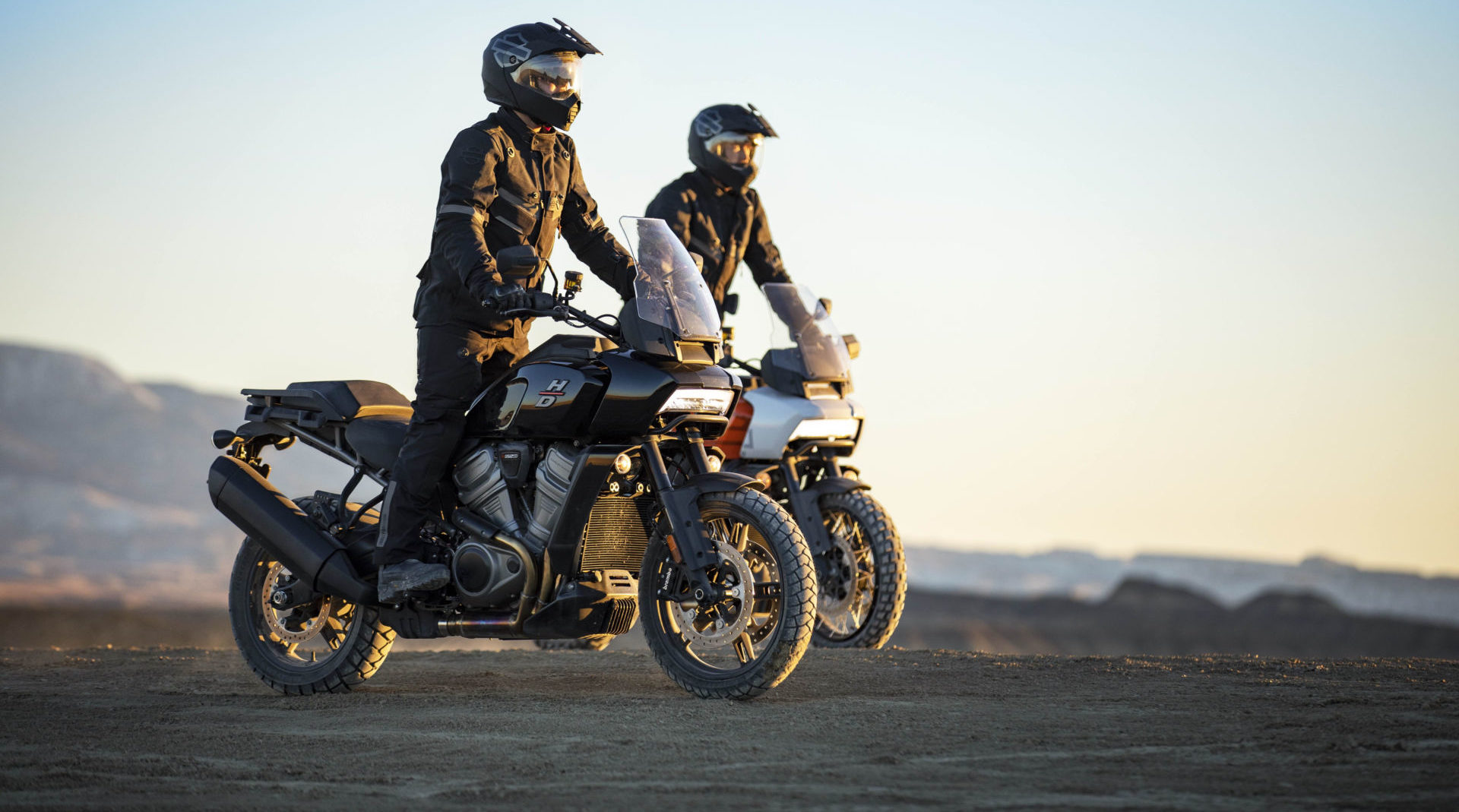
    Three years after we first got a glimpse, Harley-Davidson has launched its first-ever adventure motorcycle globally, the Pan America 1250. Harley will sell two variants of the Pan America, the Pan America 1250 and the Pan America 1250 Special. While the stance of the Pan America is typically that of an ADV, the face is what has divided opinions. While some may like the Max Max-esque, post-apocalyptic, scourge of the earth sort of a design, others may not be too fond of it! Good thing is, you are not going to mistake it for some other motorcycle when you see it on the road. The front end gets a wide fairing, with Harley’s ‘Daymaker LED headlights’ and a tall windscreen. View it in profile and you see the sculpted fuel tank along with Harley’s signature V-Twin engine, but more on that later. You get an exposed sub-frame at the rear along with split seats and an upswept exhaust.

    The quirky Pan America gets a 1,252 cc Revolution Max V-Twin which is first of its kind from the company. The engine is liquid-cooled and it makes 150 bhp at 9,000 rpm along with 127 Nm of peak torque at 6,750 rpm. The engine is paired to a 6-speed gearbox. Harley claims that the Pan America 1250 has a fuel efficiency of 48 miles per gallon or 20.4 kmpl, which is quite impressive indeed.

    Talking about the chassis, the Pan America is built on a low alloy steel trellis frame along with a one-piece cast Aluminium swingarm. The motorcycle is suspended on 47 mm BFF forks up front and a linkage-mounted piggyback mono-shock at the rear, both adjustable for compression, rebound and preload. Both suspension units get a travel of 191 mm. Up front, the motorcycle gets 320 mm twin discs gripped by a radially mounted Brembo 4-piston calliper. The rear wheel gets a 280 mm single disc with a 2-piston calliper. The motorcycle gets 19-inch alloy up front and a 17-inch alloy at the rear and both are wrapped in Michelin Scorcher adventure radial tyres.

    In terms of features, the motorcycle gets a 6.8-inch TFT touchscreen display along with Bluetooth phone connectivity via the H-D app. The Pan America also gets an inertial measurement unit (IMU) which supplies data to ABS, traction control, drag torque slip control and hill hold control. There are also five riding modes to choose from – road, sport, rain, off-road and off-road plus. Each riding mode has different settings for other electronics.

    Now there are a few differences between the Standard model and the Special. The Pan America 1250 Special gets semi-active suspension along with vehicle load control, tyre pressure monitoring system, standard centre stand, adjustable rear brake pedal, Aluminium skid-plate, heated hand grips, steering damper, adaptive ride height and tubeless spoked wheels. The colour options are different on both motorcycle variants as well.

    Prices for the H-D Pan America 1250 start at 14,000 pound sterling while the Pan America 1250 Special gets a starting price of 15,500 pound sterling. Converted to Indian rupee, the starting prices come to ₹ 14.27 lakh and ₹ 15.80 lakh respectively.
  • Harley Unveils Turnaround Plan As Shares Nosedive On Disappointing Results

    Harley Unveils Turnaround Plan As Shares Nosedive On Disappointing Results

    Harley-Davidson Inc’s shares plunged more than 20% on Tuesday after the motorcycle maker unexpectedly swung to a quarterly loss, overshadowing a new turnaround plan that targets low double-digit earnings growth through 2025.

    Since the middle of last year, the Milwaukee, Wisconsin-based company has shifted focus back to big bikes, traditional markets like the United States and Europe, and older and wealthier customers.

    Harley has trimmed its workforce and global dealer network eliminated slow-selling models, and exited markets where weak sales and profits do not justify the investment.

    Chief Executive Jochen Zeitz, who took charge last year, is focused on enhancing Harley’s brand and has done away with promotional offers, tightened supplies and reduced inventory, enabling dealers to charge the sticker price for the company’s bikes.

    This more than halved dealer inventory last year and drove up prices for pre-owned bikes, which used to be a drag on new-bike sales. The leaner inventory as well as a switch in the introduction of new models to January from August, however, took a toll on the bike sales in the quarter through December.

    Fourth-quarter revenue dropped 39% versus a year earlier as motorcycle shipments almost halved, leading to a loss of 63 cents per share. Analysts surveyed by Refinitiv, on average, expected the company to report a profit of 14 cents a share.

    Harley’s shares, which had gained 38% since July when the company shared an earlier plan to reboot its business, fell as much as 22% on Tuesday morning and were still down 18.8% at $32.62 at midday.

    “Many investors had thought the turnaround plan was leading to better profitability faster than the plan the company laid out today,” said Brian Yarbrough, an analyst at EdwardJones.

    “While they are shrinking the business currently to drive more sustainable growth longer term, we continue to be concerned about lack of demand for Harley products longer term.”

    Retail sales in the United States – the company’s biggest market – fell for the 16th straight quarter, resulting in an 8 percentage-point decline in big-motorcycle market share.

    The decline comes at a time when motorcycle sales have gone up on the back of a demand for socially distanced recreational outdoor activity.

    Polaris Inc last week said retail sales of its Indian brand of motorcycles in North America were up more than 30% in the December quarter. In contrast, Harley’s sales in the region declined 15.4% year-on-year.

    Harley’s new leadership, however, remains steadfast in the strategy of keeping inventories tight as it prefers building

    The decline comes at a time when motorcycle sales have gone up on the back of a demand for socially distanced recreational outdoor activity desirability of the brand to expanding market share.

    “We are going to continue to manage inventory in line with demand,” Chief Commercial Officer Lawrence Hund told investors on an earnings call.

    As part of the five-year turnaround plan unveiled on Tuesday, the 118-year-old company would lean on combustion motorcycles to increase sales in touring, large cruiser and trike bike segments to achieve revenue growth in the mid-single digits.

    The company, which launched its first electric motorbike in 2019, will create a separate division focused on the development of electric vehicles. It also intends to make forays in premium low displacement bikes via partnerships.

    The latest turnaround strategy from the company, which has struggled for years to expand sales beyond baby boomers, comes after a decade-long effort to increase business overseas and draw younger riders with cheaper and newer models.

    Overall, Harley would invest between $190 million and $250 million a year over the next five years.

    It forecast a 5%-7% operating margin, or profit from sales, for 2021 on the back of a 20%-25% growth in motorcycle revenue.

  • Harley-Davidson plans a Thailand factory to serve SE Asian market

    Harley-Davidson plans a Thailand factory to serve SE Asian market

    otorcycle maker Harley-Davidson said on Thursday it will build a plant in Thailand, a major Asian automotive hub, to serve the growing Southeast Asian market, a move criticized by a U.S. labor union.

    The company did not give a figure for the planned investment in Thailand’s Rayong province, southeast of Bangkok.

    Katie Whitmore, Harley-Davidson public relations manager, said the company had its best results in Asia-Pacific in 2016, though she gave no numbers.

    The Thailand facility “will allow us to be more responsive and competitive in the ASEAN region and China,” Harley-Davidson public relations manager Katie Whitmore said.

    “Increased access and affordability for our customers in the region is key to growth for the company in total,” she said. “There is no intent to reduce H-D U.S. manufacturing due to this expansion.”

    The plant would let Milwaukee-based Harley-Davidson avoid Thailand’s up to 60 percent tariff on imported motorcycles and help it get tax breaks when exporting to Thailand’s neighbors, thanks to a trade arrangement among members of the Association of Southeast Asian Nation (ASEAN).

    Harley opened a plant in India in 2011. It also assembles motorcycles at a plant in Brazil.

    After the New York Times reported on Harley’s planned Thai investment, United Steelworkers (USW) International President Leo W. Gerard on Tuesday said the decision was “a slap in the face to the American worker and to hundreds of thousands of Harley riders across the country.”

    USW represents members at Harley plants in two U.S. states and 850,000 workers in North America.

    Gerard also said that production outside the U.S. “puts in jeopardy the success that has propelled Harley over the years.”

    Whitmore said motorcycles assembled in Thailand would have the same “authentic look, sound and feel” as those manufactured in the U.S.

    Demand for Harley motorcycles in the U.S., the company’s biggest market, continues to be slow as its loyal baby boomer demographic changes ages.