Tag: HKT

  • HKT Posts First-Half Results

    HKT Posts First-Half Results

    HKT announced a 3% increase in its total revenue for the first half of the year, amounting to HK$16,157 million, while total revenue excluding mobile product sales grew by 5% to HK$14,868 million.

    The company cites continued strong demand for high-speed broadband services alongside the growing adoption of its 5G services by both consumer and enterprise customers as the reason for their revenue growth.

    According to HKT’s press release, total EBITDA increased by 2% to HK$5,834 million, while adjusted funds flow increased by 2% to HK$2,377 million, and profit attributable to holders of Share Stapled Units increased by 1% to HK$1,910 million.

    Despite the pandemic’s negative impact on the Hong Kong economy, HKT said it remained focused on its strategic priorities in serving both the consumer and business segments and thus managed to achieve steady growth during the period.

    With the subdued consumer sentiment in the first half, its mobile business recorded a 2% growth in services revenue to HK$3,647 million for the six months ended 30 June. Local core revenue grew by 2%, benefiting from continued 5G adoption, growth in the company’s post-paid customer base, as well as higher revenue contribution from mobile enterprise solutions.

    Comparatively lower mobile product sales were recorded by HKT during the period as a result of elevated sales in the first half of 2021 following the delayed launch of popular handset models and the adverse impact of supply chain disruptions.

    EBITDA from the mobile segment increased by 2% to HK$2,122 million during the period, in line with growth in mobile services revenue.

    As individuals, households and enterprises returned to hybrid arrangements during the onset of the fifth wave, the Telecommunications Services (TSS) business continued to benefit on the back of its reliable and extensive fixed network, with revenue growing by 5% to HK$11,596 million.

    The consumer broadband business, meanwhile, witnessed further uptake of its high-speed fiber-to-the-home (FTTH) services and home Wi-Fi solutions, helping to lift average revenue per user (ARPU). The enterprise segment continued to demonstrate robust growth as both private enterprises and the public sector accelerated their digital transformation and smart city initiatives. As a result, the local data services business registered a solid revenue growth of 6% during the period.

    The International Telecommunications Services business achieved 9% growth in revenue, driven by increased global voice revenue, resilient data revenue supported by recent cable projects and      the growing adoption of our Console Connect platform. Total TSS EBITDA increased by 2% to HK$4,104 million, reflecting further operating efficiencies.

    HKT’s group managing director, Susanna Hui, said, “This May, together with PCCW Limited and in partnership with The Sandbox, HKT became the first Hong Kong-based integrated communications, media and technology organisation to join the metaverse. We aim to leverage our digital ecosystem to explore opportunities presented by Web3 by connecting the physical world with the virtual.”

    Hui added, “As we capitalise on our resources for the good of the public and our business, we shall continue to closely observe the macroeconomic environment for effective contribution and efficient business judgement, to ensure our capabilities and resilience yield sustained returns for unitholders.”
  • HKT wins smart parking system contracts

    HKT wins smart parking system contracts

    Hong Kong operator HKT has secured HK$680 million ($86.6 million) worth of contracts to design, deploy and manage a new-generation smart parking meter system in Hong Kong.

    The two contracts with the HKSAR government’s Transport Department will see HKT deploy a mobile app-enabled parking meter system as part of the government’s Smart Mobility initiative.

    The system will use vehicle sensors to detect the occupancy of parking spaces and provide real-time information on parking vacancy for motorists. It will also allow users to pay parking fees with multiple payment methods, including credit that can be topped up to the app remotely.

    In addition, data from the system will be collected ad provided to the Transport Department to conduct parking analysis. The new parking meters will gradually replace existing meters in Hong Kong Island, Kowloon and the New Territories by early 2022.

    HKT’s contract includes the design, development and implementation of the new parking meters, as well as management, operation and maintenance of the system.

    “At HKT, we are very committed to helping accelerate Hong Kong to become a smarter city and empowering digital transformation for enterprises,” HKT Commercial Group managing director Tom Chan said.

    “We have been investing on advanced ICT and digital solutions in the last five years. We will continue with our dedication to develop innovations with latest technologies to empower the development of Hong Kong.”

  • Hong Kong’s Ofca assigns first 5G spectrum

    Hong Kong’s Ofca assigns first 5G spectrum

    Hong Kong operators HKT, SmarTone and China Mobile Hong Kong have all been granted spectrum in the 26-GHz and 28-GHz frequency bands for 5G use.

    The three operators, which had each applied to be assigned spectrum across the two bands, have each been offered 400 MHz of spectrum on a provisional basis by telecommunications regulator Ofca.

    The applicants were all found to have fulfilled the required licensing criteria to be granted assignment of the non-shared spectrum.

    The administrative assignment of the 26-GHz and 28-GHz spectrum will be followed up with the auction of 380MHz of spectrum in the 3.3-GHz, 3.5-GHz and 4.9-GHz bands in the middle of the year.

    Hong Kong’s second largest operator by market share 3 Hong Kong declined to apply to be assigned 26-GHz and 28-GHz spectrum, opting instead to rely on its existing airwaves and the spectrum it expects to be able to acquire in the upcoming 5G auction.

    In addition, 3 Hong Kong cited factors including Ofca’s requirement that operators establish thousands of radio units compatible with the spectrum within five years of the assignment, as well as the shortage of announced devices that support the two frequency bands.

  • HKT becomes a Carbon Black MSSP partner

    HKT becomes a Carbon Black MSSP partner

    HKT has arranged to become a managed security services provider (MSSP) partner of endpoint security company Carbon Black.

    As an MSSP partner, HKT will offer a suite of managed security services based on Carbon Black’s Cb Defense and Cb Response security solutions.

    These will include managed endpoint detection and response (EDR) services to help customers detect, prevent, predict and respond to advanced cyberattacks.

    Cb Defense is a cloud-based next generation antivirus and EDR solution for desktops, laptops and services. It is powered by Carbon Black’s Cb Predictive Security Cloud, which collects and analyzes unfiltered endpoint data to protect customers against future and unknown attacks.

    HKT will meanwhile use Cb Response to allow its security operations center team to identify malicious files used to execute an attack, pinpoint which endpoints and services are being attacked, diagnose the root cause, and provide actionable recommendations.

    “HKT is the largest telecommunications service providers in Hong Kong and the collaboration with Carbon Black will enable more enterprises and consumers to access next-generation security technology designed to thwart the sophisticated cyberattacks prevalent today,” Carbon Black VP and managing director for Asia-Pacific and Japan Matt Bennett said.

    “With Carbon Black’s market-leading cybersecurity solutions, HKT’s customers will be protected from advanced threats better than ever before.”

  • HKT, Huawei co-found C-V2X consortium

    HKT, Huawei co-found C-V2X consortium

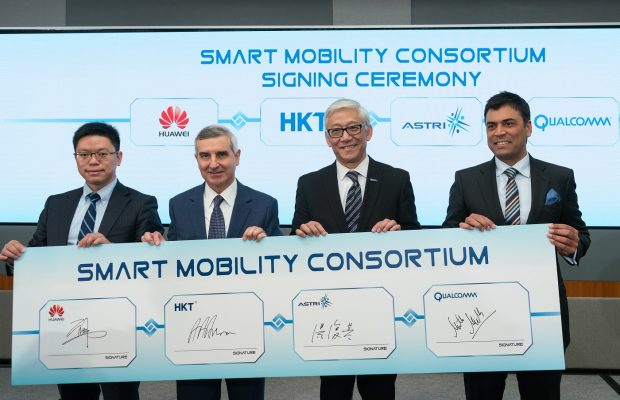
    The Hong Kong Applied Science and Technology Research Institute (ASTRI), operator HKT and vendors Huawei and Qualcomm have formed a consortium aiming to build a smart mobility system for Hong Kong using cellular vehicle-to-everything (C-V2X) technologies.

    The consortium aims to revolutionize Hong Kong’s transportation sector using C-V2X, a standard covering both network-based and direct communications for vehicles.

    A C-V2X powered smart mobility system will therefore enable vehicles to connect to both the cloud and each other, as well as to pedestrians and to traffic infrastructure.

    Vehicles can use the “co-operative awareness” this enables to improve mobility safety as well as autonomous driving, and can help law enforcement and traffic and urban planners to plan and monitor the safety and efficiency of traffic movements.

    The consortium aims to use C-V2X to introduce intelligent transport services including a warning mechanism for collision and control, assistance for cruise control and parking, and alert systems for speed and lane violations.

    It plans to work with government, the automobile industry and other stakeholders to realize this vision. The project is also expected to generate opportunities for other sectors including shipment, ridesharing, home-delivery, insurance, infotainment and mobile healthcare.

    “Hong Kong is a well-connected city with good infrastructure. If we complement these strengths with the latest innovation in science and technology, Hong Kong can become one of the most sophisticated and advanced smart cities in the world,” ASTRI chairman Wong Min-yam commented.

    “This Smart Mobility Consortium is a giant step in that leap. ASTRI is developing state-of-the-art applications, platforms and prototypes which can benefit not just Hong Kong, but potentially other cities in this region too. We, as the SAR’s largest technological R&D institution, are partnering with three eminent organisations to bring revolutionary changes to the way we manage our city’s traffic.”

    The consortium plans to carry out C-V2X pilot in the second quarter of this year. “Our trial sites will likely be at Hong Kong Science Park and the Chinese University of Hong Kong. We hope to extend the pilot to East Kowloon at a later stage,” said Peter Lam, managing director for engineering at HKT.

    “For C-V2X implementation, dedicated spectrum in 5.9GHz is needed. We will try to seek a spectrum testing license from the government to do the pilot,” he added.

  • HKT warns admin fee for consumers to increase by 67% in 2021

    HKT warns admin fee for consumers to increase by 67% in 2021

    HKT, the telecoms unit of the Richard Li-owned PCCW Group, warned that the administration fees charged by the telecoms industry to consumers are set to rise significantly by 2021, due to higher spectrum cost and “monopoly rents”.

    HKT group managing director Alex Arena said the government’s focus on raising billions of dollars from higher mobile spectrum fees only threatens to further diminish the competitiveness of Hong Kong.

    According to a consultation paper published in February, the government is expected to pocket at least HK$10.8 billion from its planned auction of part of the 900-MHz and 1800-MHz spectrum used by mobile network operators in 2021.

    Arena said should spectrum costs rise as a result of the government’s decision to auction off spectrum space currently used by the mobile operators, HKT would have no choice but to pass the higher costs on to customers,.

    “If the government is using higher spectrum costs as a way of taxing the telecommunications industry, then we will simply pass this tax on to the consumer,” the executive said.

    According to HKT, the administrative fee that is billed alongside a user’s service charge is expected to increase to more than HK$30 a month by 2021, up from the current HK$18.

    That could amount to nearly HK$400 in additional fees a year paid by each mobile subscriber in Hong Kong, on top of their regular service charges, the incumbent said.

    The administrative fee was first levied by mobile network service providers at HK$10 per customer each month in 2001. Since then, it has increased twice: to HK$12 in 2006 and HK$18 in 2014.

    Arena said the fee was implemented by the industry to deal with “certain costs that we cannot control, which are imposed by monopolies”.

    Those comprise the so-called spectrum utilization fee paid to the government; annual license fees collected by the Office of the Communications Authority (Ofca); fees to access, install and maintain networks throughout the MTR Corp’s rail network; and similar fees to operate networks in the various road tunnels in Hong Kong.

    While the administrative fees charged by the mobile operator have stayed flat since 2014 , fees collected by monopolies such as the MTR and tunnel operators have gone up, HKT said.

    “It is expected that the admin fee will increase significantly because the monopolists insist on extracting higher fees to subsidize their core businesses. On average, road tunnel costs and MTR costs have been increasing by 8% and 10% each year respectively,” the company said in a statement.

    “The current admin fee does not cover HKT’s full costs in paying the monopolists’ fees and charges, and HKT has been slow to pass the full costs onto its customers… but inevitably HKT cannot be expected to continue to absorb these cost increases.”

  • HKT urges reforms to spectrum policy

    HKT urges reforms to spectrum policy

    HKT has publicly criticized the Hong Kong government over its handling of spectrum-related matters, asserting that the region risks becoming “a third-class citizen in mobile service development.”

    In an open letter to the government, HKT expressed concern over a range of issues, including a belief that the government is not doing enough to release more spectrum to the market, the failure to follow up on a pledge to introduce spectrum trading and insufficient public engagement over a planned spectrum reassignment exercise.

    HKT also expressed concern over the fact that spectrum prices have “increased astronomically over the years [to the extent that] Hong Kong spectrum prices are now the most expensive in the world.”

    Such high prices aren’t necessary when the government already has a huge budget surplus, HKT said. The charges are also inevitably passed on to consumers, who could see prices go up by more than HK$12 per month if the government sticks to its current pricing proposals.

    “What Hong Kong needs is a forward-looking, accommodating and holistic approach to spectrum policy, not a simplistic spectrum auction that is purely designed to maximize government revenues at the expense of the spectrum policy objectives,” HKT concluded.