
Tag: home Delivery

  • Ikea Acquires Us Tech Firm Locus To Reinforce Delivery Services And Optimize Online Shopping Experience

    Ikea Acquires Us Tech Firm Locus To Reinforce Delivery Services And Optimize Online Shopping Experience

    Swedish furniture giant Ikea has announced the acquisition of US-based logistics technology company, Locus. This strategic move is aimed at enhancing Ikea’s delivery services and facilitating a faster and more streamlined online shopping experience.

    The Strategic Acquisition

    The acquisition is part of a broader $2.2 billion strategic investment by the Ingka Group, the world’s largest Ikea franchisee, in the US market. In the highly competitive US retail sector, Ikea is up against major players like Wayfair and Walmart, while also grappling with increased costs due to higher import tariffs.

    While the specifics of the deal have not been made public by Ikea, Locus was valued at $300 million during its most recent investment round in 2021. Ikea’s decision to acquire Locus is projected to simplify its logistics framework and decrease delivery costs by an estimated 100 million euros ($117.41 million) globally each year.

    Utilizing Artificial Intelligence

    Locus employs artificial intelligence to optimize the grouping of orders and define routes that reduce time spent in traffic by delivery vehicles. This is a significant improvement over the current manual planning process carried out by Ikea employees, according to Parag Parekh, Chief Digital Officer at Ingka Group.

    In addition to delivering faster, Locus will also facilitate Ikea in providing customers with more delivery windows and options. Shoppers will also receive live updates on the location of their packages. Initially, Ikea plans to pilot this technology in the US and UK before implementing it worldwide.

    Improving the Customer Experience

    “Apart from the aspect of speed, the flexibility and the ability to track will significantly improve customer experience,” explained Parekh. As part of the agreement, Locus will continue operating independently and servicing clients beyond Ikea.

    Expansion in the US Market

    With a reputation for its large, blue suburban stores featuring an array of furniture in a maze-like layout, Ikea has been shifting its focus towards its online business and investing in smaller city-center stores to attract younger, urban shoppers.

    Online sales constituted 28% of Ikea’s total retail sales in the 2024 financial year, a significant increase from 11% in 2019. This strategic acquisition follows Ingka Investments’ purchase of a Manhattan building for $213 million, indicating a commitment to US expansion, despite higher furniture import tariffs.

    Questions & Answers

    What is Ikea’s aim with the acquisition of Locus?
    Ikea aims to enhance its delivery services and facilitate a faster, more efficient online shopping experience with the acquisition of Locus.

    How will Locus’ technology benefit Ikea’s operations?
    Locus’ artificial intelligence technology will allow Ikea to optimize the grouping of orders and define delivery routes, reducing delivery times and associated costs. It also enables Ikea to offer customers more delivery options and real-time tracking of their packages.

    What impact has the focus on online sales had on Ikea’s business?
    The focus on online sales has significantly boosted Ikea’s retail sales, accounting for 28% of total sales in the 2024 financial year, up from 11% in 2019.

  • 7-Eleven Japan to start home delivery from stores

    7-Eleven Japan to start home delivery from stores

    Japanese convenience-store operator 7-Eleven is launching a home-delivery service from its outlets to meet continued demand sparked by the Covid-19 outbreak.

    The service will commence this year initially with 100 Tokyo stores, to be expanded to 1000 from next year. The service will take on other e-commerce operators in the territory such as Amazon with a 30-minutes target delivery time and by accepting late-night ordering, partnering with Seino Group to handle logistics.

    Tests of the service are already being conducted at 39 stores in the Tokyo area within a limited delivery radius. Observers say a full rollout of the service may depend on 7-Eleven’s ability to secure the necessary workforce at a time of labor shortage in the market.

    The news comes as the firm deals with what may be a growth ceiling on its 50,000-store network, while e-commerce continues to blossom in Japan.

  • RedMart offers 1-hour delivery of orders from food, retail partners

    RedMart offers 1-hour delivery of orders from food, retail partners

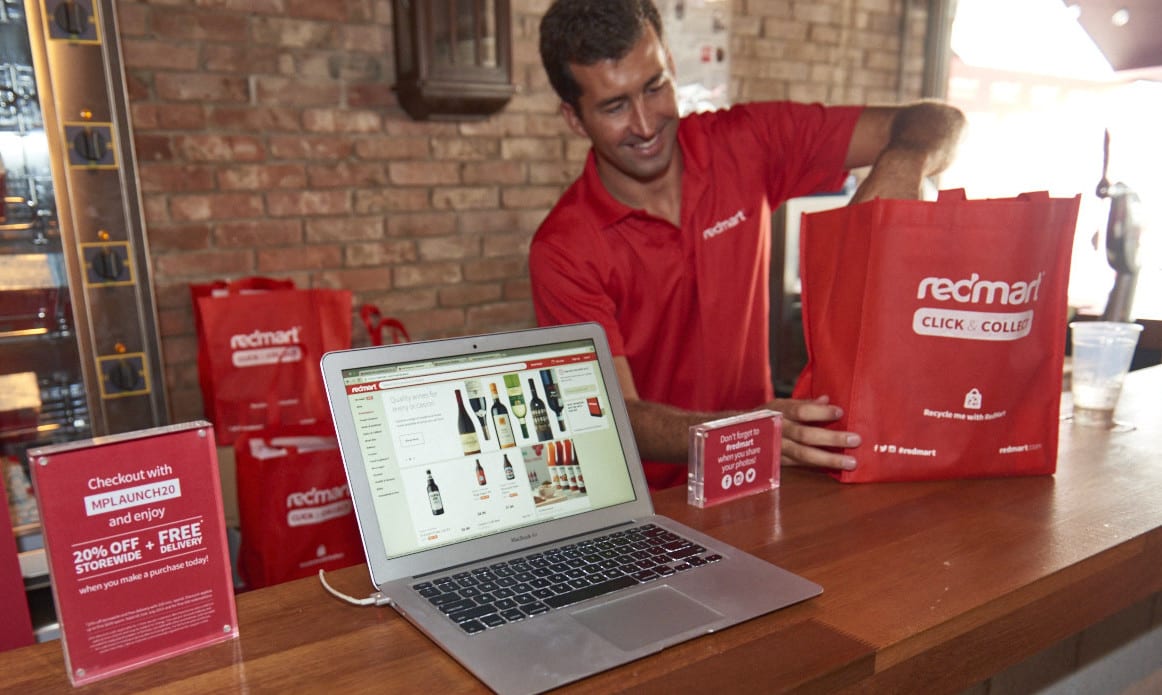
    Singapore based online grocery service provider RedMart has launched an on-demand marketplace, RedMart Relay, which will allow customers to order products from participating food and retail partners, in selected parts of Singapore.

    These products, including food, household items, apparel and electronic items will be delivered by “runners” – personal shoppers who go to the participating stores, purchase the products, and deliver directly to the customer, within one hour of ordering. The service will be accessible via a mobile App.

    RedMart’s co-founder and CEO, Roger Egan, told The Business Times that the launch of RedMart Relay was a natural next step for the company following the introduction of RedMart Marketplace, which is for groceries, earlier this year.

    “Whilst groceries will always be the foundation of what we do and remains a core part of our business, our new on-demand marketplace allows us to leverage our extensive delivery network and is all part of our long-term strategy to become an ‘everything store’, delivering a wide range of products to consumers across Singapore within the hour.”

    Mr Egan noted that when the company launched RedMart Marketplace, it partnered with Singapore’s best niche grocers, restaurants and speciality shops to “offer over 25,000 products, the largest product range of any grocer in Singapore”.

    Marketplace products are picked up from partners, consolidated, and delivered along with the regular RedMart grocery order, he said. Customers are clearly appreciating this “one stop shop” and “our marketplace has been growing at 30-40 per cent per month”, Mr Egan said.

    “With RedMart Relay we are now extending this marketplace model to be “on-demand”, where we collect from retail partners or restaurants and deliver directly to our customers within an hour,” he said.

    Mr Egan added that RedMart Relay has two main advantages over other e-commerce companies and marketplaces.

    “First, we have more engaged customers, with more frequent repeat purchases. Our customers buy from us around twice a month and that frequency is increasing. With RedMart Relay, we can now develop an even deeper relationship with our customers and deliver a much wider range of products to them, whenever they want.”

    The other advantage for RedMart Relay, according to him, is its extensive delivery network which is seamlessly integrated into the marketplace.

    “We can offer customers and marketplace partners faster, cheaper delivery than ‘software only’ marketplaces which typically partner with third party couriers. We encourage any retailer who is looking to leverage the e-commerce wave to contact us and see how RedMart Relay can help grow their business.”

    Vikram Rupani, the company president and another co-founder, added that the company was founded with the mission to “save people time for the important things in life”.

    “Our grocery service is delivering on this promise, and now we’re taking it one step further with RedMart Relay – effectively bringing RedMart’s promise of convenience to just about any product, from any store, anywhere in Singapore, he added.

    Initially the RedMart Relay service will be available to customers living in Tiong Bahru, Telok Blangah, Keppel, Sentosa, West Coast, Tanjong Pagar and Marina Bay neighbourhoods.

    The company plans to launch it nationwide by early 2016.