Tag: IDX

  • IDX Overhauls Listing Rules with IDR100 Trillion Pathway

    IDX Overhauls Listing Rules with IDR100 Trillion Pathway

    The Indonesia Stock Exchange has rewritten its primary listing rules, establishing a 10,000-investor post-listing requirement for Main Board applicants alongside an IDR100 trillion market capitalisation route.

    Board of Directors Decree No. Kep-00152/BEI/10-2026 took effect on 9 October 2026, replacing the earlier framework under Decree No. Kep-00045/BEI/03-2026 to govern public offerings across the IDX.

    The revision eliminates standalone net tangible asset qualification for prospective issuers. Companies pursuing Main Board entry must now pair at least IDR250 billion in net tangible assets across their last two audited financial years and latest interim accounts with an established market capitalisation and an additional operating metric: pre-tax earnings averaging IDR100 billion over three years, revenue of IDR800 billion, total assets of IDR2 trillion, or operating cash flow of IDR100 billion. Alternatively, applicants can bypass asset tests entirely if they reach a market capitalisation of IDR100 trillion and equity of at least IDR10 trillion.

    Stricter Hurdle for Small Floats

    Development Board standards also faced upward revisions. Minimum commercial operating histories now span 24 consecutive months instead of 12, requiring full revenue records across that two-year period.

    Financial thresholds for the secondary tier require IDR50 billion in net tangible assets alongside market valuations between IDR300 billion and IDR500 billion, depending on whether applicants qualify via profits, revenue, assets, or cash generation. A standalone route on the Development Board requires an IDR10 trillion market capitalisation alongside IDR1 trillion in equity. Applicants must also distribute allocations across at least 5,000 single investor identification holders after the offering closes, up from earlier distribution practices.

    Shareholder Dispersion and Floats

    Capital markets in Southeast Asia have wrestled with tightly held listings that leave thin public floats after debut trading. Indonesia’s exchange is tackling that structural issue by enforcing absolute investor counts rather than relying strictly on percentage-based public floats.

    For regional consumer conglomerates, retail chains, and fast-growing technology platforms eyeing Jakarta, the rules cut off quiet, insider-dominated public exits. Companies can no longer slip onto the Main Board through balance-sheet asset valuations alone without proving wide retail or institutional buy-in across 10,000 separate accounts. Existing listed issuers also face a higher bar, requiring more than 1,000 active investor accounts to maintain their Main Board tenure compared with the earlier 750-holder floor.

    Five-Year Projections Replace Shorter Targets

    Underwriting teams now absorb deeper accountability under the disclosure terms. Lead managers must submit equity research reports at the time of application, at the end of the sixth month following admission, and at the close of the twelfth month.

    Filing documentation must feature integrated financial projections spanning at least five years, stretching past the historical three-year standard. Underwriters must execute and document formal due diligence on these five-year operating estimates, restricting aggressive growth claims often used to price retail and e-commerce listings.

    Scrapping the Share Price Floor

    Regulators removed the mandatory IDR100 minimum offering share price, handing dealmakers pricing room for fractional or high-volume issuances. Prospective applicants can also seek exchange clearance to count shares held by investment vehicles toward their official free float when underlying beneficiaries qualify as public investors.

    Companies that lodged listing applications before 9 October 2026 remain subject to review under the previous regulations during the transitional window. The exchange has yet to release the operational timetable and verification steps for approving beneficiary-level free-float exemptions.
  • Indonesian Stock Exchange ends 2018 in the red

    Indonesian Stock Exchange ends 2018 in the red

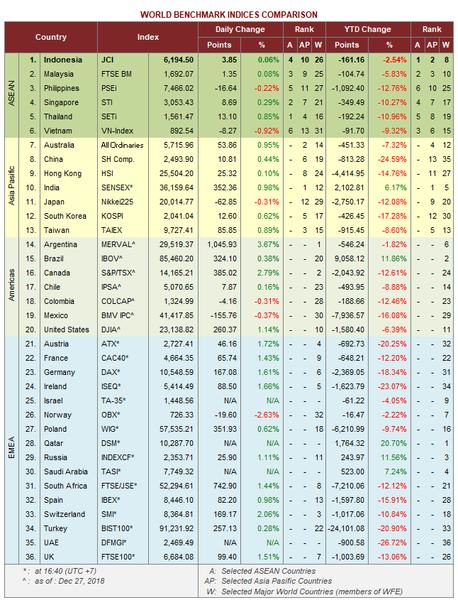
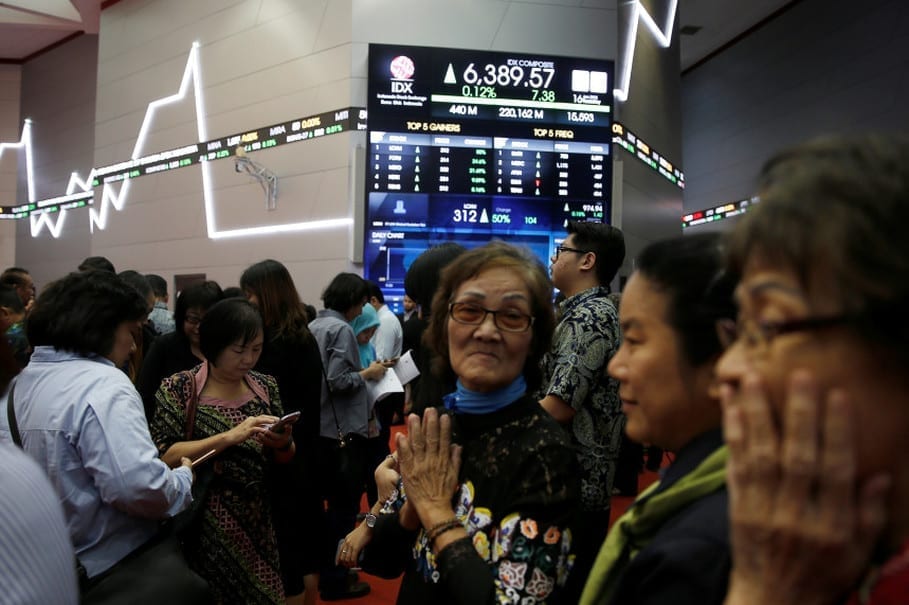
    Indonesia’s benchmark stock index declined 2.54 percent overall in 2018 amid a rough year for equities globally. Foreign investors sold a net Rp 50.75 trillion ($3.52 billion) in Indonesian stocks for the whole of 2018, compared with Rp 39.6 trillion in 2017. The market capitalization of Indonesia’s stock market meanwhile stood at Rp 7,023 trillion, compared with Rp 7,052 trillion a year earlier.

    The last trading day of 2018 on Friday last week saw the Jakarta Composite Index (JCI) closing 0.06 percent higher at 6,194.5.

    Inarno Djajadi, the new chief of the Indonesia Stock Exchange (IDX), said during Friday’s closing ceremony in South Jakarta, attended by President Joko “Jokowi” Widodo, that 57 companies listed their shares in 2018. This is a record high.

    Wimboh Santoso, chairman of the Financial Services Authority (OJK), expressed optimism during the event that the JCI would hit a level of between 6,500 and 7,000 next year.

    “We are still upbeat that the JCI has a chance to gain further. The OJK will provide stimulus to encourage more companies to list by offering various instruments,” he said.

    Wimboh said despite negative sentiment from external factors, such as the ongoing trade war between the United States and China, the business community remains optimistic about the Indonesian economy.

    Not Too Bad?

    President Jokowi also expressed optimism that the JCI may perform better next year. Citing IDX data, he said despite the 2.54 percent decline, the JCI was the second-best performer in Asia after India, which saw its benchmark stock index gain 6.17 percent this year overall.

    Jokowi said 2018 was not an easy year for the country’s economy, which was impacted by both external and internal factors.

    He said Indonesia’s large current-account deficit put pressure on the rupiah, which ultimately also affected the financial performance of listed companies. Meanwhile, normalization of US monetary policy, which caused capital outflows from emerging markets such as Indonesia, the US-China trade war and weak commodity prices also impacted Indonesian companies.

    “All of these have caused volatility in the JCI’s performance and dragged down the performance of listed companies,” he said.

    Jokowi said the government was fully committed to strengthening Indonesia’s stock market, as it should not only serve investors’ interests, but also function as a source of long-term funding for local companies to expand their business and help boost the country’s economy.

    According to Inarno, the number of registered investors on the IDX increased by roughly 222,000 to about 851,000, with 29 percent of them actively trading every day.

    The average daily trade for the whole year stood at Rp 8.5 trillion with an average frequency of 386,968. This is the biggest in Asia.

    Fundraising Down

    Fakhri Hilmi, deputy commissioner for capital market supervision at the OJK, said fundraising by Indonesian companies from capital markets in 2018 is estimated at Rp 163 trillion, which is 35.9 percent lower than last year.This figure includes initial public offerings, rights issuances and bond sales.

    “This year’s isn’t as much as last year; the value of IPOs were smaller,” he said.

    More Stocks Booking Losses

    More stocks booked losses in 2018 compared with last year. Of the 619 companies listed on the local bourse, 252 saw gains in their stock prices, while 327 booked losses. The remainder were stagnant.Of the shares that increased in value, 41 booked gains of more than 100 percent, while four increased by more than 1,000 percent.

    They are Super Energy, a company engaged in oil, gas and mining and petroleum transportation services, which saw its stock price rise by 1,450 percent this year, and financial services provider Pool Advista Finance, which saw its stock price jump 1,529 percent.

    The stock price of Prima Cakrawala Abadi, an exporter of fishing products, jumped 2,006 percent and Transcoal Pacific, a sea transportation and logistics service provider, saw its stock price skyrocket by a massive 3,714 percent.

    However, these are penny stocks. Indonesia’s shallow capital markets allow traders and brokers to trick the price of stocks that have low market values.

    Meanwhile, only 11 companies of Indonesia’s top 45 listed companies by market value, known as LQ45, booked gains in 2018.

  • Most SE Asia stocks fall in line with broader Asia; Indonesia climbs 1 pct

    Most SE Asia stocks fall in line with broader Asia; Indonesia climbs 1 pct

    Most Southeast Asian stock markets fell on Tuesday, tracking broader Asia after a selloff on Wall Street overnight. As reported, citing sources from both sides, that China’s top trade negotiator Liu He may visit Washington to prepare for the talks between U.S. President Donald Trump and his Chinese counterpart Xi Jinping on the sidelines of the G20 summit in Argentina later this month.

    Philippine shares declined 1.2 percent, extending falls into a third session, dragged by industrial and real estate stocks. SM Prime Holdings declined 2.3 percent, while JG Summit Holdings fell 6.9 percent.

    Singapore shares declined for a third consecutive session, dragged by financials. DBS Group Holdings, the city-state’s largest lender, slipped 0.9 percent, while rival United Overseas Bank Ltd fell 1.2 percent.

    Malaysian shares extended falls into a third session, with IOI Corp Bhd shedding 3.1 percent to a near 11-month closing low and IHH Healthcare Bhd declining 2.8 percent to its lowest close since July 2014.

    Trade tensions between the United States and China will create a “domino effect” and prompt other countries to turn protectionist, said Malaysian Prime Minister Mahathir Mohamad.

    Vietnam shares declined 1.4 percent, dragged by financial and real estate stocks. Joint Stock Commercial Bank for Investment and Development of Vietnam (BIDV) fell 3.7 percent, while real estate investor Vingroup JSC ended 2.7 percent lower.

    Indonesian shares were the top gainers in Southeast Asia with a rise of 1 percent. Consumer staples and financials led the gains with United Tractors Tbk PT and Bank Central Asia Tbk PT rising 5.5 percent and 1.6 percent respectively.

    Thai shares climbed 0.3 percent, helped by consumer staples.

    Glass container manufacturer Berli Jucker PCL rose 1.4 percent, while convenience stores operator CP All PCL climbed 2.6 percent to a more than one-month closing high.

    “Stocks are rising on internal factors like government improving infrastructure and linking of our three airports,” said Teerada Charnyingyong, an analyst with Phillip Capital Thailand.”The government also announced measures to stimulate spending by promoting the tourism sector.”

  • New Stock Exchange Boss Faces High Expectations

    New Stock Exchange Boss Faces High Expectations

    Indonesia’s Financial Services Authority, or OJK, has approved Inarno Djajadi as new president director of the Indonesia Stock Exchange.

    The appointment will be effective after the bourse’s general shareholders meeting on June 29. Inarno, who will serve during the 2018-21 period, replaces Tito Sulistyo who was holding in office in 2015-18.

    Issuers, investors and analysts have high expectations toward the new Indonesia Stock Exchange (IDX) leadership.

    “It [the stock exchange] needs more derivative products and exchange traded funds [ETF] to deepen the capital market. So far, derivative trading on IDX has not been doing too well,” said Investa Saran Mandiri director Hans Kwee.

    Hans said the new IDX director should begin to think of a new regulation that would allow securities companies or third parties to act as liquidity buffers on the market to prevent issuers, who have just held an initial public offering, from seeing their stock prices fall steeply.

    “If our capital market is good and growing, then entrepreneurs and investors will have the confidence to make IDX the place to raise funds or to invest,” he said.

    Isakayoga, director of the Indonesian Issuers Association (AEI) said the bourse needs to reduce its annual listing fees.

    “Do not calculate the annual fee based on market capitalization, but based on total assets. Today, the higher the stock price, the higher the listing fee will be, as if the issuer was penalized for it. Instead, he should be rewarded,” said Isakayoga.

    According to the Indonesian Securities Analysts Association (AAEI), which members serve more than 1.3 million individual investors, the new IDX director should focus on good corporate governance.

    “Issuers on IDX need to be more transparent, especially to analysts. There are still many companies that are difficult to get in touch with,” said AAEI chairman Edwin Sebayang.

    Inarno has extensive expertise in capital markets. The Gadjah Mada University graduate began his career as a treasurer at local lender Uppindo Bank in 1989. Since then, his career has been centered on brokerage firms and the stock market. In 1991-97, he was serving as director of Aspac Upindo Sekuritas, after which he moved to Mitra Duta Sekuritas, Widari Securities, Madani Securities, Maybank Kim Eng Securities and CIMB Sekuritas Indonesia. He served as chief executive of the Stock Market Clearing House (KPEI) in 2003-09.

    Aside from Inarno, OJK also appointed six other directors.

    President director: Inarno Djajadi

    Listing director: IGD N. Yetna Setia

    Trade director: Laksono Widito Widodo

    Monitoring transaction director: Kristian Sihar Manullang

    IT director: Fithro Hadi

    Human resources and finance director: Risa Effennita Rustam

    Development director: Hasan Fawzi

  • Indonesian Stocks Slump 2.5% as Trade Resumes After Idul Fitri

    Indonesian Stocks Slump 2.5% as Trade Resumes After Idul Fitri

    Indonesian shares slumped 2.5 percent on Wednesday (20/06), their sharpest intraday fall in nearly two months, after trade resumed following a long holiday for Idul Fitri celebrations.

    Global equity markets saw a selloff during the Idul Fitri holiday and Indonesia is expected to play catch-up, driven by stocks with high foreign ownership such as Bank Central Asia and Bank Mandiri, according to a Trimegah Securities note. Indonesian financial markets were closed from June 11 to 19.

    Financials were the biggest losers with Bank Central Asia declining 3.8 percent and Bank Mandiri shedding 6.5 percent.

    An index of the country’s 45 most liquid stocks slid 3.6 percent to its lowest in nearly one month.

    Among other Southeast Asian stock markets, the Philippines was down for a fifth straight session while Thailand rose after five consecutive sessions of declines ahead of central bank policy meetings.

    The Bank of Thailand is expected is expected to leave its policy interest rate near a record low, while a slim majority of economist expect the Bangko Sentral ng Pilipinas to raise rates.

    Energy and financial stocks were among the biggest boost in Thailand with PTT climbing 0.5 percent and Bangkok Dusit Medical Services rising 3.3 percent.

    Malaysian shares were higher after seven straight sessions of falls with Axiata Group gaining 1 percent and Genting adding 1.8 percent. The consumer price index rose 1.8 percent last month from a year earlier, meeting market expectations, on stronger fuel and transport prices and rising demand for food, government data showed.

  • Indonesia Bourse May Snap Losing Streak

    Indonesia Bourse May Snap Losing Streak

    Ahead of Friday’s holiday, the Indonesia stock market had tracked lower in back-to-back sessions – surrendering almost 120 points or 2 percent. The Jakarta Composite Index now rests just above the 5,950-point plateau, although it may tick higher on Monday as it catches up on missed positive sentiment.

    The global forecast for the Asian markets is soft thanks to political concerns in the United States, although a spike in crude oil prices should limit the downside. The European and U.S. markets were down and the Asian bourses figure to follow suit.

    The JCI finished sharply lower on Thursday following losses from the food and resource sectors.

    For the day, the index plummeted 109.23 points or 1.80 percent to finish at the daily low of 5,952.14 after peaking at 6,058.60. There were 215 decliners and 131 gainers, with 120 stocks finishing unchanged.

    Among the actives, Bank Pan Indonesia skyrocketed 13.68 percent, while Bank Danamon Indonesia plummeted 5.19 percent, Tiga Pilar Sejahtera Food plunged 5.19 percent, Jasa Marga tumbled 1.92 percent, Lotte Chemical skidded 1.62 percent, XL Axiata dropped 1.60 percent, Voksel Electric shed 0.68 percent, Bumi Resources retreated 1.96 percent, Vale Indonesia lost 0.72 percent, Indofood fell 3.62 percent and Bank MNC Internasional and Bank Mandiri were unchanged.

    The lead from Wall Street is negative as stocks opened sharply lower on Friday. They recovered in afternoon trade but still finished firmly in the red as they backed off recent record closing highs.

    The Dow slipped 40.76 points or 0.17 percent to 24,231.59, while the NASDAQ fell 26.39 points or 0.38 percent to 6,847.59 and the S&P 500 dipped 5.36 points or 0.20 percent to 2,642.22. For the week, the NASDAQ slid 0.6 percent, the Dow surged 2.9 percent and the S&P jumped 1.5 percent.

    The late-morning sell-off came on news that former National Security Adviser Michael Flynn has agreed to cooperate with prosecutors in the investigation of Russian meddling in last year’s election.

    However, stocks regained ground as Senate Majority Leader Mitch McConnell, R-Ken., declared that Republican leaders have won over enough reluctant lawmakers to pass their tax reform bill.

    In economic news, the Commerce Department reported a bigger than expected increase in construction spending in October, while the Institute for Supply Management noted a modest slowdown in the pace of growth in manufacturing activity in November.

    Crude oil futures rallied Friday after OPEC producers voted to extend supply cuts through 2018. January WTI oil climbed 96 cents or 1.7 percent to $58.36/bbl. Prices dropped 1 percent for the week.

    Closer to home, Indonesia will release November inflation data later today, with forecasts expected to show an increase of 0.3 percent on month and 3.45 percent on year following the 0.01 percent monthly increase and the 3.58 percent yearly gain in October.

  • IDX Again Wins Global Islamic Finance Award

    IDX Again Wins Global Islamic Finance Award

    The Indonesia Stock Exchange (IDX) was again awarded “The Best Supporting Institution for Islamic Finance of the Year 2017” from the Global Islamic Finance Award.

    Head of IDX Communication Division Yulianto Aji Sadono in an official statement in Jakarta, Sunday (9/10/2017) said that the bourse is the only institution from Indonesia that received the award from GIFA for two consecutive years.

    “This award is a benchmark for Indonesia to show that the Indonesian Sharia Capital Market has been able to compete at the international level,” he said.

    The award was handed over directly by Edbiz Consulting CEO Sofiza and received directly by the IDX Director Tito Sulistio in China on Saturday (9/9).

    The award, he added, is inseparable from the role of IDX which consistently encourages Indonesia’s sharia capital market industry to continue to advance and develop with world-level credibility, in accordance with the company’s vision and mission.

    He said that GIFA is one of the international awards in the world’s sharia financial industry organized by EdBiz Consulting, headquartered in London. GIFA 2017 is the seventh award.

    Yulianto Aji Sadono explained that since its establishment in 1997, Syariah Capital Market of Indonesia currently has two sharia indices namely Indonesian Sharia Stock Index (ISSI) and Jakarta Islamic Index (JII), 342 sharia shares, 16 fatwas from National Sharia Council-Indonesian Ulema Council (DSN-MUI), nine Regulations of the Financial Services Authority (OJK) and one Government Sukuk (SBSN) Law.

    By trade percentage, he also said that stock transactions in the IDX are dominated by sharia-based stocks. As much as 62 percent of the total shares traded on the IDX are sharia-based stocks, or about 55 percent of the market capitalization on the Stock Exchange.

    He said the market regulator expects the sharia capital market industry to be a safe investment alternative especially for Indonesian people who want to invest in accordance with sharia principles and can give real and optimal contribution in the growth and development of a sustainable national economy.

  • Indonesia Stock Market May Spin Its Wheels On Monday

    Indonesia Stock Market May Spin Its Wheels On Monday

    The Indonesia stock market has climbed higher in back-to-back sessions, collecting almost 35 points or 0.7 percent along the way. The Jakarta Composite Index now rests just above the 5,855-point plateau, although it may run out of steam on Monday.

    The global forecast for the Asian markets is mixed to slightly lower, with a decline in crude oil prices likely to weigh. The European and U.S. markets were roughly flat but mostly in the red, and the Asian bourses are expected to follow that lead.

    The JCI finished modestly higher on Friday following gains from the financial shares and resource stocks.

    For the day, the index advanced 24.81 points or 0.43 percent to finish at 5,857.12 after trading between 5,819.53 and 5,866.99. There were 159 gainers and 142 decliners, with 130 stocks finishing unchanged.

    Among the actives, Tiga Pilar Sejahtera Foods plummeted 5.03 percent, while Indofood Sukses perked 1.47 percent, Bumi Resources advanced 0.83 percent, Bank Pan Indonesia spiked 1.95 percent, Bank Danamon Indonesia collected 0.47 percent, Bank Mandiri jumped 1.92 percent, Bank MNC Internasional skidded 1.92 percent, Lotte Chemical added 0.78 percent, Jasa Marga shed 0.42 percent and XL Axiata gained 0.26 percent.

    The lead from Wall Street provides little clarity as stocks moved mostly lower on Friday, although the Dow eked out a modest gain.

    The Dow added 13.01 points or 0.1 percent to 21,797.79, while the NASDAQ fell 37.68 points or 0.6 percent to 6,360.19 and the S&P shed 3.67 points or 0.2 percent to 2,461.43. For the week, the NASDAQ tumbled 1.2 percent, the Dow slid 0.9 percent and the S&P lost 0.6 percent.

    The weakness came amid concerns about the economic impact of Hurricane Irma, which made landfall in Florida early Sunday. Irma followed close on the heels of Hurricane Harvey, which led to widespread devastation and flooding in Texas.

    In economic news, the Commerce Department said wholesale inventories rose more than expected in July, while the Federal Reserve said consumer credit jumped more than expected in July.

    Crude oil futures fell Friday but held onto weekly gains as data showed the U.S. oil rig count fell again in what is becoming a rough hurricane season. U.S. West Texas Intermediate light crude oil shed 2.04 percent or $1 at $48.09 a barrel.

  • IDX datafeed disruption has no effect on investor confidence

    IDX datafeed disruption has no effect on investor confidence

    The Indonesian Stock Exchange (IDX)s Datafeed disruption on Monday morning was claimed to have no effect on investors confidence.

    “We measured our Key Performance Indicator, and the result was still good,” IDX General Director Tito Sulistio stated here on Monday.

    To date, the disruption had been fixed, and IDXs information system has returned to normal; however, Sulistio added that IDX would continue to develop its information technology to upgrade their trade availability system in order to avoid and minimize disruption.

    He explained that the system had a maximum availability of 99.999 percent, and IDX already had 99.975 percent, which will be upgraded to 99.98 percent.

    “Every 0.05 percent hike may need US$20-25 million,” he remarked.

    At the same time, IDX is trying to upgrade its trade infrastructure system from Tier-2 to Tier-3.

    “Hopefully, we will be moving to the new Tier-3 system on August 30,” noted Sulistio.

    Separately interviewed, IDX Director of Information Technology and Risk Management Sulistyo Budi revealed that the disruption was caused by uneven distribution of information from Datafeed application.

    “During investors trading, information for public has to be provided. When it is not available, we have to suspend the trade in order to check the problem. Once it is resolved, activities return to normal,” he stated.

    Despite the IDXs claims, Indosurya Mandiri Securities analyst William Surya Wijaya explained that the bourse could anticipate more technical systems disruption that might affect investments plan from the stakeholders.

    “This could be a lesson for the stock market players, so that they should also anticipate systems disruption,” he explained.

    Wijaya was optimistic that the investors confidence in Indonesian market was still high as the domestic economy remained conducive, despite being overshadowed by some negative sentiment, especially current geopolitical situation.

  • Indonesia Bourse Poised To Rebound On Monday

    Indonesia Bourse Poised To Rebound On Monday

    The Indonesia stock market headed south again on Friday, one session after it had ended the two-day slide in which it had fallen more than 85 points or 1.3 percent. The Jakarta Composite Index now rests just beneath the 5,815-point plateau although it is expected to bounce higher again on Monday.

    The global forecast for the Asian markets is upbeat after better than expected jobs data from the United States, although those numbers may fan concerns over the outlook for inflation rates. The European markets were mixed and the U.S. bourses were higher, and the Asian markets figure to follow the latter lead.

    The JCI finished modestly lower on Friday following losses from the financials, resource stocks and food companies.

    For the day, the index shed 34.87 points or 0.59 percent to finish at 5,814.79 after trading between 5,810.36 and 5,863.59. Volume was 5.91 billion shares worth 6.4 trillion rupiah. There were 239 decliners and 102 gainers, with 101 stocks finishing unchanged.

    Among the actives, Bumi Resources retreated 2.92 percent, while Vale Indonesia added 0.27 percent, Jasa Marga plunged 3.21 percent, Lotte Chemical Titan dropped 2.38 percent, Tiga Pilar Sejahtera tumbled 1.88 percent, XL Axiata sank 0.31 percent, Bank MNC Internasional and Bank Pan Indonesia were unchanged, Bank Danamon Indonesia skidded 1.64 percent and Bank Mandiri dipped 0.56 percent.

    The lead from Wall Street is positive after Friday’s jobs report as the markets regained some ground after heavy losses in the previous session.

    The Dow climbed 94.30 points or 0.4 percent to 21,414.34, while the NASDAQ added 63.61 points or 0.1 percent to 6,153.08 and the S&P gained 15.43 points or 0.6 percent to 2,425.18. For the week, the Dow rose 0.3 percent, the NASDAQ added 0.2 percent and the S&P was up 0.1 percent.

    The rebound followed a Labor Department report showing stronger than expected job growth in June. The report said non-farm payroll employment jumped by 222,000 jobs in June following an upwardly revised increase of 152,000 jobs in May.

    The Federal Reserve is scheduled to make its next decision on interest rates following a two-day meeting later this month.

  • Cyber attack not disrupting stock market at IDX

    Cyber attack not disrupting stock market at IDX

    WannaCry malware attack has not disrupted the countrys share market, Tito Sulistio, President Director, Indonesia Stock Exchange (IDX), stated here, Monday.

    “The stock authority performs a routine check two hours before opening at 9 a.m. I directly oversaw todays monitoring system; I hope the market is protected from any threats, including the virus (ransomware),” Sulistio said in Jakarta.

    Some 88 countries, including Indonesia, have adopted a multi-layered security system which was already being used by US-based Nasdaq stock market.

    “We have Nasdaqs JATS-NextG (Jakarta Automated Trading System Next Generation) in our security protocols,” Sulistio revealed, while adding that the stock authority would continue to protect the system from any upcoming threats.

    During a separate occasion, earlier, Adena T Friedman, Nasdaq President, remarked her agency had committed to support IDXs trading and monitoring systems.

    “We have been partnering with Indonesia Stock Market to provide technology application for improving supervision and trading activities,” Friedman affirmed.

    Concerning the malware threat, the Indonesian Internet Service Providers Association (APJII) had suggested several preventive acts to reduce the impact of ransomware WannaCry.

    As the malware has infected only Microsoft-based computers, users have been asked to update the system by downloading Security Update Patch MS-17-010.

    “If the users are not aware about system updates, they can disconnect from any internet wires (LAN), or Wifi, and download the security patch from a non-Microsoft computer.

    Rifan has also recommended that users back up their files in a separate flash drive (USB) or a portable hard disk, before updating the security system on the computer.

    He further revealed that WannaCry malware had attacked computers in some 200 countries, including Indonesia.

    The malware works by locking the computers internal system and encrypting the file, after which the users are asked to pay a “ransom” in exchange for their data.

  • IDX Inaugurates 250th Investment Gallery

    IDX Inaugurates 250th Investment Gallery

    The Indonesian Stock Exchange (IDX) has inaugurated the 250th Investment Gallery located at the Faculty of Economy and Business of Udayana University in Denpasar, Bali. The galleries are spread in 240 universities in Indonesia.

    IDX President Director Tito Sulistio said investment gallery is a means to introduce the capital market to academicians. It is established in collaboration between the IDX, universities, and companies that are Members of Exchange (AB).

    “It is hoped that academicians will not only know the capital market from the theoretical aspect only but can also directly implement the practice,” Tito said in Bali on Friday (10/3).

    The Investment Gallery provides all publications and printed materials about capital market published by the IDX, including regulations and laws on the capital market.

    Academicians can use information and the data for academic purposes and research. The materials can also be used as a reference in decision making when doing share transactions.

    Tito hopes that those galleries can disseminate information on the capital market, not only among academicians but also economists, investors, capital market observers or the public  in the regions.

    Tito added that this year, IDX inaugurated 10 Investment Galleries this year, seven of which are located Bali and five of them are in Denpasar.

  • IDX Closes on Regional Election Day

    IDX Closes on Regional Election Day

    The Indonesia Stock Exchange (IDX) will close on the simultaneous regional election day, February 15, 2017, the IDX website page stated. Earlier, Vice President Jusuf Kalla had asked Indonesians to use their voting rights and vote for credible candidates to improve their respective regions.
    JK said that election is a peaceful, responsible, and clean democratic process that ensure individual right to vote. He expects to see a smooth democratic process during the simultaneous regional elections. “Let’s go to the polling station with a smile, happiness, and peacefully vote for leaders who can lead us to a better life,” he said.
  • IDX Suspends Bumi Citra Permai

    IDX Suspends Bumi Citra Permai

    The Indonesia Stock Exchange (IDX) has suspended the Bumi Citra Permai (BCIP) from trading because of significant, cumulative stock price declines.

    BCIP opened at Rp478 per share before plunging 46 bps (9.62%) to Rp432.

    “With regards to BCIP’s significant, cumulative price drops, the IDX deems it necessary to suspend the stock from being traded,” IDX head for transaction supervision Irvan Susandy said in an exposure on Friday, October 7.

    BCIP is not only suspended from trading in the regular market but also in the secondary market, starting today, October 7. The suspension is aimed at giving investors enough time to make thoughtful considerations in deciding what to do with their BCIP stocks.

    BCIP is an issuer engaged in the field of real estate, construction, trading, mining, services, transportation, publishing, and agriculture. The company’s main businesses are real-estate and water management, operated by subsidiary Milwater Pratama Mandiri.

    BCIP also has two real estate subsidiaries Millenium Power and Citra Permai Pesona.

  • BEI launches online investment-based simulation game

    BEI launches online investment-based simulation game

    The Indonesia Stock Exchange (BEI) launched an online investment-based simulation game “Nabung Saham Go” (Saving Stocks Go) as one of the measures to introduce the capital market industry to the public, especially to university students.

    “The game was one of the steps to introduce the capital market to the public. The Nabung Saham Go game can be played by anyone although it is aimed at university students as it is easier for them to play. The game is similar to Pokemon Go,” Development Director of BEI Nicky Hogan stated here on Tuesday.

    Hogan emphasized that the game falls under the education category and offers a fusion of the virtual and real worlds. Players will encounter small adventures bearing different themes and will get a series of interesting information.

    “The application encourages players to become more familiar with the capital market,” he remarked.

    Hogan elaborated that the “Nabung Saham Go” game invites players to collect points gained after answering the questions posed by the gaming application.

    “Players can visit certain places, such as the Financial Services Authority Building and Indonesia Stock Exchange Building to get information on how to gain points in the game. In each of the places visited, the player will have to answer a few questions on the stock market. Each correct answer will be given points,” he explained.

    In addition to “Nabung Saham Go,” Hogan said the users can play an analog game called “Stocklab,” which is associated with investment instruments, such as stocks and mutual funds.

    “The game Stocklab uses media cards and as an outline, the players will be guided on the strategy of investing and are invited to find out how the company made its initial public offering,” he added.