Tag: interest rates

  • Bank of Japan Expected to Raise Rates to 1.25 Percent on September 18

    Bank of Japan Expected to Raise Rates to 1.25 Percent on September 18

    The Bank of Japan will raise its key interest rate to 1.25 percent on September 18, according to 97 percent of surveyed economists. The projected hike marks an accelerated tightening cycle that would push benchmark borrowing costs to 1.75 percent by the second quarter of 2027.

    A survey of 68 economists conducted between September 1 and September 8 showed 66 respondents anticipate the immediate 25-basis-point increase, up from 57 percent in the previous polling round. More than one-third of respondents, 24 of 66, expect the central bank to deliver another hike to 1.50 percent in October or December. Beyond this year, 89 percent of analysts see the policy rate reaching at least 1.50 percent by the end of March, while 62 percent expect a 1.75 percent rate by mid-2027.

    Washington Pressure and Currency Shifts

    Over 80 percent of polled economists said joint United States and Japanese currency intervention to rescue the yen from 40-year lows, alongside statements from US Treasury Secretary Scott Bessent, substantially lowered domestic political barriers to tightening. Bessent met with BOJ Governor Kazuo Ueda during a gathering of G20 finance leaders, urging decisive monetary action to anchor inflation expectations and curb yen volatility. Following those interventions, the yen strengthened to around 153.37 per dollar, its firmest trading level since February.

    Half of the 54 economists who answered a supplementary question identified 1.75 percent as the terminal policy rate. The proportion projecting a terminal rate of 2.00 percent or higher expanded to 40 percent, up from 36 percent in August and 23 percent in July.

    Cost Pressures for Retail and Consumer Markets

    For consumer goods importers, supermarket chains, and multinational brands operating in Japan, a faster rate hike trajectory creates a double-edged commercial environment. A firmer yen provides relief against imported food and raw material costs that squeezed operating margins over the past two years. Food processors and apparel retailers that absorbed higher procurement prices can begin stabilizing shelf prices without sacrificing unit margins.

    Higher domestic borrowing rates will elevate debt servicing expenses for heavily used retail developers and franchise operators. Household budgets face higher mortgage repayments just as wage gains struggle to outpace core consumer inflation. Retailers relying on discretionary consumer spending will need to defend basket sizes as debt costs rise for domestic shoppers.

    Fiscal Spending and the Planned Food Tax Cut

    Government spending plans are complicating the central bank’s inflation calculus. Budget requests for the upcoming fiscal year climbed to 143.1 trillion yen ($931.2 billion), matching spending levels seen during the pandemic as Prime Minister Sanae Takaichi advances an expansionary fiscal platform. Nearly three-quarters of surveyed economists reported that the request volume elevates market concerns regarding Japanese fiscal discipline.

    With a consumption tax cut on food items also planned, financial markets are likely to have strong concerns about securing funding.

    The earlier policy inertia that allowed price pressures to broaden across services and food now forces faster rate adjustments. The Bank of Japan delivers its rate decision on September 18, with investors tracking the final budget compilation and government debt issuance volumes due before year-end.

  • Yen Traders Brace for Silver Week Intervention as BOJ Decision Looms

    Yen Traders Brace for Silver Week Intervention as BOJ Decision Looms

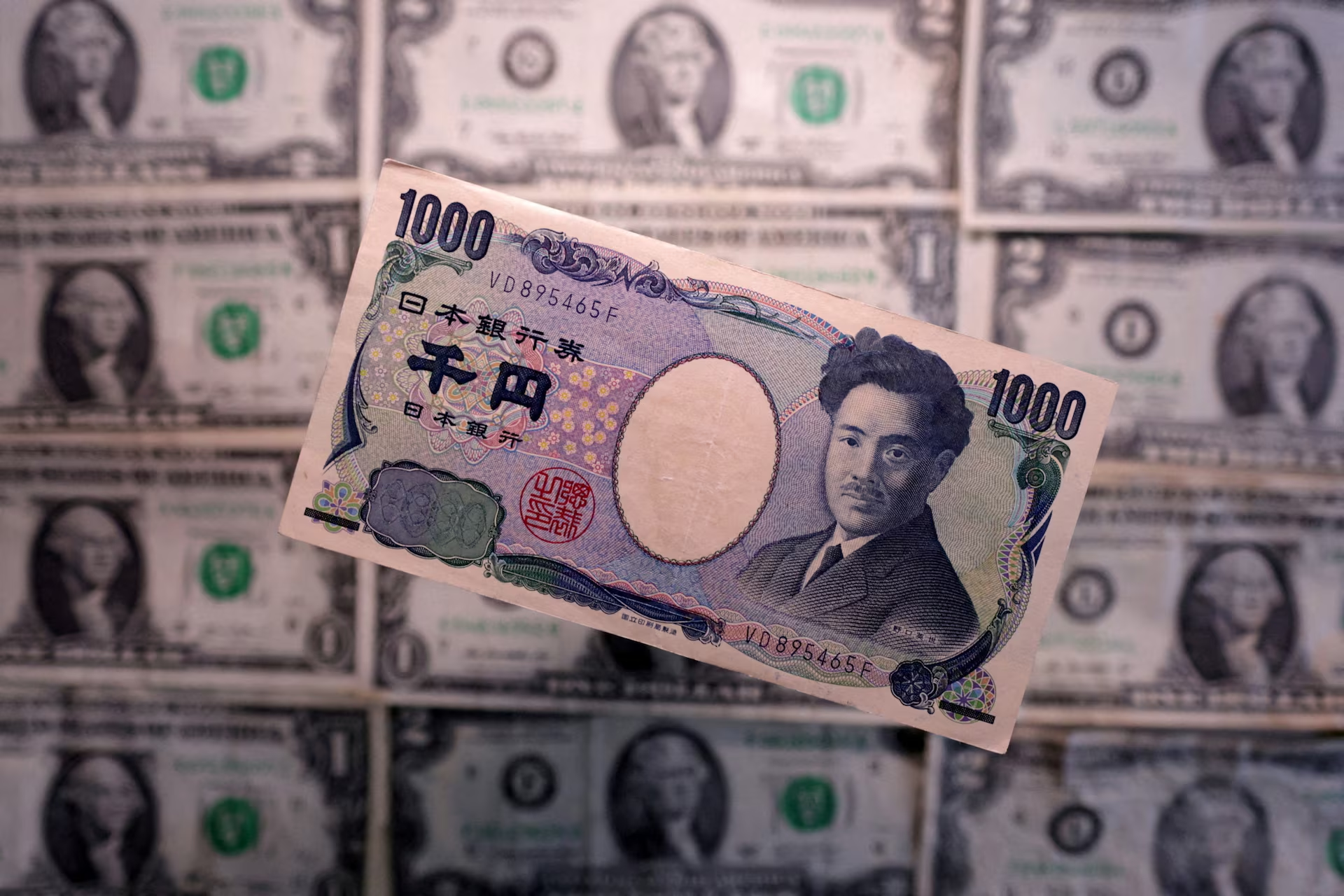
    Currency traders in Tokyo are bracing for official market intervention around the Bank of Japan’s September 18 policy meeting, eyeing the upcoming three-day holiday for sudden yen buying.

    The Japanese yen climbed 0.5 per cent to 157.99 against the US dollar on Thursday as markets began pricing in an interest rate increase larger than 25 basis points.

    Trading desks expect sharp swings during Silver Week, a long holiday weekend starting immediately after the central bank convenes. Thin liquidity during national holidays gives authorities greater traction when buying yen, echoing April when the government stepped in during an extended break for the first time since 2024.

    Holiday Liquidity and Rate Gaps

    Tokyo deployed a record $96.4 billion over the past month to prop up the currency, backed by coordination with Washington. Japanese Finance Minister Satsuki Katayama and US Treasury Secretary Scott Bessent both confirmed readiness to enter foreign exchange markets without hesitation.

    Hedge funds have nevertheless started rebuilding short bets against the yen. Elevated crude oil import bills and a persistent interest-rate gap with the United States continue to drag the currency down toward the 160 line, where SBI FX Trade president Marito Ueda warned fresh intervention becomes probable.

    Pressures Across Asian Balance Sheets

    For retailers and consumer brands across Asia, rapid currency swings disrupt cross-border supply chains and contract pricing settled in dollars. Japanese store operators face relentless cost increases on imported food and inventory, while regional exporters must recalibrate margins against an unpredictable yen.

    Attention now shifts to the US Federal Reserve’s rate decision days before the Bank of Japan meets on September 18, with traders watching whether the exchange rate tests the 160 level before holiday trading begins.

  • Asian Markets Gain as JGB Yields Slide Ahead of US Jobs Data

    Asian Markets Gain as JGB Yields Slide Ahead of US Jobs Data

    Asian stocks and government bonds climbed on Thursday as investors recalibrated interest rate expectations ahead of crucial United States labour data.

    MSCI’s broadest index of Asia-Pacific shares outside Japan rose 0.5 per cent, tracking modest overnight gains on Wall Street as benchmark sovereign borrowing costs pulled back across major economies.

    Japanese government bonds led the fixed-income recovery ahead of a Ministry of Finance auction of super-long debt. The yield on 30-year Japanese government bonds dropped 10 basis points to 4.065 per cent, retreating from near-record highs, while benchmark 10-year US Treasury yields dipped 0.99 basis point to 4.784 per cent.

    Bond Yields Ease Across the Region

    Relief across regional debt markets followed remarks from Federal Reserve Bank of New York President John Williams, who noted that elevated long-term yields reflect economic resilience while policymakers assess upcoming data. Traders using the CME Group FedWatch tool now price a roughly two-in-three probability of a 25-basis-point rate increase this month, up from 37 per cent a week earlier.

    Economic data from Tokyo offered fresh evidence of domestic momentum. Japan’s services sector expanded in August at its fastest pace in five months, supporting expectations that the Bank of Japan retains room to raise borrowing costs further.

    For retailers and consumer operators across Asia, the pause in yield expansion offers short-term relief on commercial debt and capital expenditure plans. Persistent rate differentials and elevated debt costs have weighed on cross-border expansion financing throughout the region this quarter.

    Currency and Commodity Shifts

    Currency trading remained steady, with the dollar index slipping 0.05 per cent to 99.54. The Japanese yen held its ground at 158.59 per dollar after surging 0.9 per cent in the prior session, while the euro edged up to $1.1589.

    Energy markets softened slightly despite geopolitical friction between the United States and Iran. Brent crude fell 0.44 per cent to $95.21 a barrel and US crude dropped 0.3 per cent to $90.74 a barrel, while spot gold gained 0.32 per cent to trade at $4,400.47 an ounce.

    Market attention turns next to Friday’s US nonfarm payrolls report and an upcoming address by Federal Reserve Governor Christopher Waller.

  • China Sovereign Bond Yields Drop to 1.69 per Cent as US Gap Widens

    China Sovereign Bond Yields Drop to 1.69 per Cent as US Gap Widens

    China’s 10-year government bond yield fell to 1.692 per cent on Monday, widening the policy divergence with the United States as domestic economic growth slowed.

    The yield sits near a 12-month low after July retail sales, industrial output, and fixed-asset investment all missed analyst forecasts.

    Brokerages including Great Wall Securities project the 10-year yield will drop further to 1.65 per cent. The slide reflects rising domestic calls for borrowing cost cuts to counter deflation and a prolonged property slump.

    In contrast, long-term borrowing costs in the United States remain elevated. The US 30-year Treasury yield hovered near a two-decade high of 5.304 per cent. Federal Reserve Chairman Kevin Warsh indicated at the Jackson Hole symposium that inflation control remains the primary focus over employment, while eliminating forward policy guidance. US Treasury Secretary Scott Bessent pledged to double a bond buyback programme, yet investors continue demanding higher yields for long-dated American debt.

    Foreign Inflows and Diverging Policies

    Overseas investors purchased 9.5 billion yuan ($1.4 billion) in Chinese government bonds in July, logging their third consecutive month of net buying. Total foreign holdings in China’s nearly 200 trillion yuan debt market stand at approximately 4.3 trillion yuan, representing roughly 2 per cent of the market.

    A stronger yuan alongside lower local yields has helped attract offshore capital seeking insulation from volatile global equities. While the US central bank confronts energy price pressures and heavy fiscal debt issuance under the Trump administration, Beijing faces the opposite challenge of stimulating dormant consumer demand.

    Capital Flows Across Asian Markets

    For corporate borrowers and retailers across Asia, the widening interest-rate spread alters funding strategies. Chinese issuers are leaning harder into yuan-denominated debt to capture ultra-low domestic borrowing costs, while dollar-denominated debt servicing grows heavier.

    Markets now watch whether the People’s Bank of China will deliver an official policy rate cut before the third quarter ends, testing the projected 1.65 per cent floor on sovereign yields.

  • Philippine Central Bank Lifts Key Rate to 5% to Tackle Sticky Inflation

    Philippine Central Bank Lifts Key Rate to 5% to Tackle Sticky Inflation

    The Bangko Sentral ng Pilipinas raised its benchmark policy rate by 25 basis points to 5 per cent on Thursday. The decision targets persistent price pressures across consumer staples and fuel.

    Overnight deposit and lending facilities climbed to 4.5 per cent and 5.5 per cent. That brings a third straight quarter of tightening, following rate increases in April and June.

    Headline inflation dropped to 6.2 per cent in July from 6.4 per cent in June, easing for a third consecutive month. Core inflation, which strips out volatile energy and food items, edged down to 4.2 per cent from 4.4 per cent. Both figures remain above the government target corridor of 2 per cent to 4 per cent.

    Pressures across food, fuel and wages

    Monetary officials warned that broader price pressures continue to build across supply networks. Volatile global oil benchmarks, potential crop losses from El Niño, and rising agricultural input costs threaten retail food prices nationwide.

    Labor expenses also sit high on the central bank’s monitoring list. A pending minimum wage increase for Metro Manila remains frozen in court. Even so, authorities noted that higher payroll expenses will filter into consumer prices if businesses pass on the cost.

    Bank of the Philippine Islands lead economist Emilio Neri Jr. Pointed out that monetary tightening cannot fix supply bottlenecks. Extreme weather, elevated fertilizer costs, and currency weakness threaten to drive import bills higher for retail operators and food manufacturers.

    Slower growth tests consumer demand

    Higher borrowing costs arrive at a delicate moment for consumer spending and commercial investment. Philippine gross domestic product expanded by 2.3 per cent in the second quarter, decelerating from 2.8 per cent in the first quarter. Gross capital formation shrank 9.2 per cent year-on-year.

    Across Southeast Asia, central bankers are balancing household purchasing power against softening corporate investment. While regional peers have paused rate adjustments to protect domestic commerce, Manila is prioritizing price stability. The focus is on preventing inflation expectations from taking root in retail checkouts.

    Average inflation will exceed the 4 per cent upper boundary through both 2026 and 2027 before settling near the 3 per cent target in 2028, according to central bank forecasts.

  • Asian Markets Mixed Amid US Economic Worries, Retail Sales Dip

    Asian Markets Mixed Amid US Economic Worries, Retail Sales Dip

    Asian stock markets exhibited mixed performance on Monday following a downturn on Wall Street. Investors are currently weighing new economic data that suggests a potential weakening in the world’s leading economy, thereby tempering expectations for an immediate US interest rate hike.

    Last week, anticipation that the Federal Reserve might not increase policy rates next month had bolstered equities, with the S&P 500 and Nasdaq reaching record highs. This sentiment was driven by reports indicating a softening labor market and easing inflation, despite it remaining above target levels. However, recent figures have raised questions about the economy’s underlying health, prompting market observers to advise caution.

    US Economic Concerns Shift Market Focus

    Retail sales in the US declined by 0.6 percent month-on-month in July, marking the poorest performance in over a year. Concurrently, consumer sentiment plummeted as households, grappling with the economic impact of President Donald Trump’s Iran conflict, curtailed spending and anticipated higher inflation. According to Fawad Razaqzada at Forex.com, payroll data earlier in the month, coupled with inflation figures, softer retail sales, and weaker consumer sentiment, collectively suggest a loss of momentum in the US economy. This reinforces expectations that the Federal Reserve might maintain current rates in September, with traders now assigning a one-in-four probability of a hike, down from 50:50 last week.

    This week, market attention will turn to the release of earnings reports from prominent retail companies such as Walmart, Home Depot, and Target. These results are expected to provide clearer insights into the prevailing consumer sentiment, which is critical for understanding future retail trends. For companies operating across Asia, tracking these shifts in consumer behavior and market confidence is essential for strategic planning and investment. RetailNews Asia has been monitoring how similar pressures on discretionary spending, whether from geopolitical events or inflationary environments, often ripple through regional markets, influencing consumer brand strategies and investment in the retail sector.

    Asian Tech Sector Resilient Amid Regional Swings

    Despite mounting worries about the US economy, investors in Asia are currently maintaining a more optimistic outlook, particularly with technology firms showing signs of recovery after July’s sell-off. Hong Kong saw gains driven by tech giants including Alibaba, Tencent, and JD.com, while Shanghai and Taipei also recorded increases. Tokyo’s market remained largely flat, though chipmaker Kioxia gained over five percent, and SoftBank, Advantest, and Tokyo Electron added between 1.3 and two percent. Japan’s economic growth falling short of forecasts in the second quarter appeared to have minimal immediate market reaction.

    Conversely, markets in Sydney, Singapore, Wellington, and Manila experienced slight declines. The US dollar continued to weaken against other currencies, extending losses from Friday, which were a direct consequence of the latest economic data. Meanwhile, oil prices extended their one-percent gains from Friday, fueled by ongoing tensions between the US and Iran over the Strait of Hormuz. The prolonged standoff suggests that elevated oil prices, potentially contributing to inflationary pressures, could persist.

  • Yen Weakness Persists Despite Intervention, Raising Concerns for Asia-Pacific Businesses

    Yen Weakness Persists Despite Intervention, Raising Concerns for Asia-Pacific Businesses

    The Japanese yen continues to face significant downward pressure, with a historic joint intervention by the United States and Japan failing to provide lasting relief. Weeks after the coordinated effort, the currency has reversed half its brief gains and is approaching the 160 yen per US dollar mark, having previously hit a 40-year low above 163 yen in late July.

    This persistent weakness is largely attributed to the widening interest rate differential between the US and Japan. US Treasury yields have reached multi-year highs, making dollar-denominated assets more attractive and fueling the yen carry trade. Despite a more hawkish stance from the Bank of Japan, investors continue to prioritize higher US yields, according to market observers.

    Intervention’s Limited Impact

    Market analysts suggest that while currency interventions can temporarily shift market positioning and disrupt momentum, they do not address underlying fundamental drivers such as interest rate differentials. Gary Dugan, CEO of The Global CIO Office, noted that the yen’s continued decline despite direct intervention indicates that US yields remain the primary factor influencing its value.

    The 30-year US Treasury yield recently reached 5.285 percent, while the rate for 30-year Japanese government bonds closed at 4.141 percent. This substantial gap incentivizes investors to borrow in yen at lower rates and invest in higher-yielding US assets, contributing to the yen’s depreciation.

    Implications for Asia-Pacific Retail

    The continued weakness of the yen has direct consequences for businesses operating across the Asia-Pacific region. Japanese companies, from luxury brands to electronics manufacturers, face higher import costs for raw materials and components, potentially impacting their pricing strategies and profitability. Conversely, the weaker yen can make Japanese exports more competitive, which could boost sales for some retailers and manufacturers focusing on international markets.

    For global retailers with a presence in Japan, purchasing power for Japanese consumers may diminish, affecting sales of imported goods. This situation mirrors challenges seen in other Asian markets where local currency depreciation against the dollar has driven up operational costs and consumer prices, requiring careful strategic adjustments from brands and retailers across the region.

  • Asian Stocks Soar as US Treasury Intervention Calms Bond Market Fears

    Asian Stocks Soar as US Treasury Intervention Calms Bond Market Fears

    Asian stock markets rallied strongly on Thursday after the US Treasury intervened to calm fears over rising bond yields. The announcement that the Treasury would significantly increase its long-term bond issuance provided a much-needed boost to investor confidence, leading to a rebound in equities across the region.

    This intervention comes after weeks of heightened concern over US bond yields, which had climbed to near two-decade highs. The prospect of sustained high inflation, increased government borrowing, and potential further interest rate hikes by the Federal Reserve had pushed yields on 10- and 30-year US Treasuries to unsustainable levels, sparking a sell-off in riskier assets, including Asian stocks.

    Yield Concerns Eased By Treasury Move

    The US Treasury’s unexpected decision to “at least double” the amount of long-term bonds it issues is a clear signal to the market that authorities are uncomfortable with the recent spike in borrowing costs. This move is intended to inject liquidity and bring down yields, which had seen the 30-year US Treasury yield reach its highest point since June 2007 earlier in the week. The immediate effect was a reversal of losses in US equities and a decline in the dollar against other major currencies.

    For Asian markets, the impact was immediate and positive. Technology firms, which often rely on significant debt for capital expenditure, particularly in areas like artificial intelligence, had been hit hard by rising yield concerns. Seoul’s Kospi index led the charge, jumping over six percent at one point. South Korean chipmaker SK hynix saw its shares rocket more than 12 percent, partly bolstered by its recent US$29 billion share buyback announcement, with Samsung also climbing almost nine percent. Elsewhere, Tokyo, Hong Kong, Shanghai, Sydney, Wellington, and Manila also reported strong gains. RetailNews Asia has observed that stability in financial markets is crucial for regional consumer brands planning expansions or significant capital investments, as it directly influences their cost of funding and investor sentiment.

    Future Outlook For Rates And Oil

    Despite the current relief, market observers question how long the fall in yields will last. Key factors that could reignite pressure on the long end of the Treasury curve include persistently high oil prices and ongoing concerns about US government borrowing. Crude prices have been on an upward trend for the past two weeks, fueled by fading hopes for a US-Iran deal regarding the Strait of Hormuz, with tensions in the region remaining high.

    Investors are also closely watching the US Federal Reserve’s stance on interest rates. Minutes from the Fed’s July meeting indicated that many policymakers believe further rate hikes might be necessary if inflation does not sufficiently decline. Three of the twelve voting members of the Federal Open Market Committee advocated for an immediate rate increase, noting robust economic activity driven largely by the AI industry. Attention now turns to the upcoming annual meeting of central bankers in Jackson Hole, Wyoming, next week, where Fed boss Kevin Warsh is expected to provide further clarity on the central bank’s rate strategy.

  • Gold Prices Steady Amidst Soaring Global Interest Rates

    Gold Prices Steady Amidst Soaring Global Interest Rates

    Vietnam’s gold market showcased resilience on Wednesday morning, with gold bar prices firming up even as global bullion rates experienced an uptick.

    Steady Prices in Vietnam Amid Global Trends

    The Saigon Jewelry Company set its gold bar price at VND 117.2 million (approximately US$4,496.46) per tael, while gold rings were priced at VND 113.5 million per tael. A tael is equivalent to 37.5 grams or about 1.2 ounces—enough to dazzle anyone in the jewelry store!

    Meanwhile, the international scene saw gold prices ascend, driven by a wave of uncertainty surrounding U.S.-China trade relations and broader global economic fears, as reported by Reuters. The price of spot gold climbed 0.3% to reach $3,361.03 an ounce, with U.S. gold futures mirroring this trend, rising 0.2% to $3,384.20.

    Kelvin Wong, a senior market analyst for Asia Pacific at OANDA, noted, “We potentially see dip-buyers coming back into the picture… things remain uncertain, especially concerning the trade relationship between China and the U.S., and even between the EU and the U.S. as well.” Amid these turbulent waters, gold continues to shine as a preferred safe-haven asset.

    The outlook became even murkier when the Organisation for Economic Cooperation and Development (OECD) issued a stark warning earlier this week about an impending sharper economic slowdown, which could be exacerbated by the Trump administration’s trade policies negatively impacting the U.S. economy.

    Wong added, “The OECD report will certainly enhance safe-haven demand from a medium-term perspective.”

    As gold maintains its allure amid uncertainty, could it be the shining light investors need during these rocky economic times?

    Questions & Answers

    What was the price of gold bars in Vietnam on Wednesday?
    The Saigon Jewelry Company priced gold bars at VND 117.2 million (US$4,496.46) per tael.

    How did global gold prices perform on the same day?
    Spot gold increased by 0.3% to $3,361.03 an ounce, while U.S. gold futures rose 0.2% to $3,384.20.

    What economic factors are influencing the gold market?
    Uncertainty in U.S.-China trade relations and warnings from the OECD regarding an economic slowdown are pushing safe-haven demand for gold higher.