Tag: internet provider

  • KT increases fixed-line network speed tenfold, to 10Gbps

    KT increases fixed-line network speed tenfold, to 10Gbps

    KT announced Wednesday it will introduce a fixed-line network 10 times faster than its current offerings in Seoul as well as six major Korean cities.  The launch of Korea’s first home internet with speeds of up to 10 gigabits per second (Gbps) comes about four years after the mobile carrier launched wired internet with 1-Gbps speed.

    According to the company, Korea’s largest fixed-line internet service provider, a faster home internet has become a necessity as the number of independent content creators, like YouTubers and dedicated Esports players, has grown explosively.

    “The 10 times faster network will enable creators to air their content in ultra high-definition quality,” said Lee Pill-jai, senior executive vice president for marketing at KT. “It will also make virtual reality and augmented reality content a norm.”

    In a demonstration Wednesday at KT headquarters in Gwanghwamun, central Seoul, the actual download and upload speeds of the new internet service exceeded 8 Gbps whereas the existing internet achieved speeds of less than 1 Gbps. With the new internet, it takes only 30 seconds to download a 33-gigabyte ultra high-definition movie, according to KT. At 1 Gbps, it takes four minutes and 30 seconds.
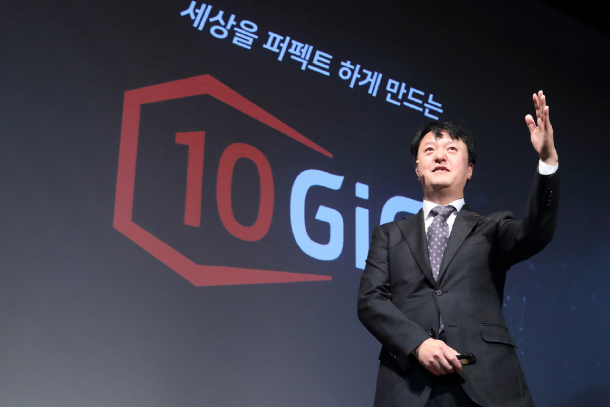
    “You also need to think of the many devices that will be connected to home internet in the future,” said Park Hyun-jin, head of the wire and wireless business unit at KT. “I personally use five internet-powered devices, but by 2021, an average person will have 13 devices connected to the internet.”

    According to Park, the connection of numerous devices will slow internet speeds and make a 10-Gbps fixed-line a necessity to maintain tolerable internet speeds on each device.

    Faster fixed-line internet will also support the deployment of the high-speed 5G wireless internet nationwide, according to KT.

    “The 5G network is offered as wireless internet through base stations, but 5G network equipment and base stations need to be connected via a wired backbone network,” a spokesperson from KT said. “Having a 10-Gbps fixed-line network as the 5G’s backbone network will increase the stability of the wireless service.”

    The so-called backbone is a part of a computer network that connects other networks.

    According to KT, its 10-Gbps internet will be able to cover about 60 percent of the country by the early half of next year.

    To subscribe to the 10-Gbps internet, it costs 110,000 won ($96) per month, but if users already subscribe to KT for TV services, the monthly fee could be discounted to 77,000 won on a three-year contract basis.

    The company also released 5-Gbps and 2.5-Gbps internet plans, for those wanting faster but affordable home internet.

    To enable users to get a feel for 10-Gbps internet, KT said it will gradually install the network at 80 Starbucks Reserve shops in Korea and six PC rooms operated by AfreecaTV by this year.

  • Zong 4G Continues The Momentum of F-16

    Zong 4G Continues The Momentum of F-16

    Pakistan’s No. 1 Data Network, Zong 4G has risen to earn the distinguished title of being the “F-16 of Pakistan” on account of its fastest 4G speed and matchless connectivity. The genesis of the F-16 lies in its unmatched speed, precision and accuracy and so are the underlying features of Zong’s 4G network that offers blazing speed at the same reliability level of F-16 to more than 8 million subscribers. With the manoeuvrability like F-16, Zong 4G is enabling people to reach new heights and accelerating the tech-empowered young people to adopt digital lifestyle on the go.

    In telecommunication arena, network coverage outreach and speed are two key characteristics for being a market leader, particularly in 4G domain. Zong 4G is equipped with both these attributes; it is the largest 4G operator in Pakistan having widest network coverage ensuring seamless data connectivity.

  • Net1 Ready to Support Broadband Internetin Rural Area of Indonesia

    Net1 Ready to Support Broadband Internetin Rural Area of Indonesia

    Net1 Indonesia is ready to support the government in accelerating the provision of internet connections in rural areas, especially in frontier, outermost and least (3T) developed regions of the country. Net1 Indonesia’s mission to spread the internet access in the rural area is in line with the government nine agenda priorities or often referred to Nawa Cita, which mentions developing Indonesia’s rural area within the framework of Republic of Indonesia.

    One of the pillars of those points is realizing the availability of telecommunication infrastructure and network connectivity in the regions. Currently, the Government, through the Ministry of Communications and Informatics, is spurring the availability of internet network for rural areas. According to data from the ministry, currently 73% of villages/sub-lower districts already have internet connection based on 3G technology.

    Meanwhile, the LTE 4G network only 55%. By 2019, the government is targeting to provide 3G-based internet for more than 83,000 villages. Another target for the upcoming year is covering total of 514 districts/cities by 4G LTE network. So far, only 64% of them have access to 4G LTE.

    “The advantage of Net1 4G LTE network is running at 450 Mhz frequency, which is perfect for rural area geographic character, with large area but low density. The characteristic of low-frequency is not pursuing the access speed, but covering the larger area,” said Larry Ridwan, CEO of Net1 Indonesia, in a discussion forum on Universal Service Obligation (USO), held by Indonesia LTE Community (ILC), at Balai Kartini Exhibition and Convention Center, Jakarta (24/05).

    Net1 Indonesia can serve the markets or areas that geographically are difficult to reach and economically are very costly by other operators. Most of 450 Mhz 4G LTE operators in other countries also operate in special areas, such as suburban and rural areas or targeting a very segmented market, such as corporations (mining, plantation, fishery), Machine-to-Machine (M2M) and others.

    Larry added that the biggest challenge in deploying internet networks in rural areas is the varying of geographical conditions, ranging from mountains to coastal areas, with scattered populations. This kind of conditions is requiring a large investment for operators. Meanwhile, observed from the business side, developing telecommunication infrastructure in rural area with less population is less profitable.

    However, this condition will not break Net1 Indonesia’s spirit to continuously supporting the government’s program in rolling out the Internet network for rural areas. “Net1 4G LTE Network at 450MHz is able to reach 50-60 Km, even up to 100 Km, from a base transceiver station (BTS), so it is suitable for archipelago country like Indonesia which has 16,056 islands. In terms of infrastructure investment in developing the site, it is certainly more efficient,” revealed Larry.

    Therefore, Net1 Indonesia can reduce the investment of building 4G LTE network for rural areas more efficiently and effectively. Investment can be pushed much lower. So far, Net1 has deployed 4G LTE service in 19 Provinces spread across Indonesia. A total of 306 districts/cities have accessed Net1 4G LTE network, consisting of 25,279 villages. Overall, 126,299,415 populations have been reached by Net1 Indonesia.

    Net1 Indonesia has also cooperated with a number of local governments in district and province level throughout Indonesia. The local governments cooperate with Net1 Indonesia to provide data broadband access for societies in sub urban and remote areas in their domain. Among others, Musi Banyuasin Regency, West Halmahera Regency, Talaud Islands Regency, Tual City, Siau Tagulandang Biaro (Sitaro) Islands Regency, Sangihe Islands Regency, Teluk Bintuni Regency and Kaimana Regency, have signed a Memorandum of Understanding (MoU) to working together building 4G based communications infrastructure with Net1 Indonesia.

    The cooperation with a number of local governments that have been started since 2017 is a first step for Net1 Indonesia to be able to meet the needs of data access for up to 260 million Indonesian populations who lives in more than 14.000 islands.