Tag: ipay

  • VietinBank pioneers online foreign exchange services

    VietinBank pioneers online foreign exchange services

    VietinBank has launched FX Online 24/7, allowing customers to perform transactions at any time, anywhere on platforms VietinBank eFAST and VietinBank Ipay.

    VietinBank focuses on innovating its system to improve FX services. Just by taking some simple steps on a smartphone or a laptop with an internet connection, without having to go to the bank, customers can perform FX transactions online with VietinBank for different currencies.

    Corporate customers can buy and transfer foreign currency online within business hours.

    Corporate customers or individual customers can sell foreign currency online from foreign currency accounts and receive Vietnamese dong into their accounts anytime, including weekends and holidays.

    With a multi-level authorized matrix, VietinBank eFAST can meet the diversified demand of customers for authorization. The system provides security methods meeting the State Bank of Vietnam’s requirements including OTP verification and keypass token verification.

    VietinBank is offering a promotional campaign for corporate customers using the service “Customers sell foreign currency online 24/7” through VietinBank eFAST platform. Customers are offered 20 preferential points with USD/VND transactions; 50 preferential points with EUR/VND and 0.5 preferential point with JPY/VND. There are also special offers for other currency pairs.

  • Malaysia’s MYEG partners with Philippine I-Pay to bring e-services to Philippines

    Malaysia’s MYEG partners with Philippine I-Pay to bring e-services to Philippines

    I-Pay Ventures Commerce Ventures, Inc. (I-Pay) recently signed a joint-venture agreement with MY E.G. Services Bhd (MYEG) to enable government and large enterprises in the Philippines to offer a Payment Gateway and related value-added online services.

    I-Pay is the company behind the NBI’s online registration system. MYEG is Malaysia’s fastest-growing company as the country’s civil service embraces the digital way of providing services to the public. Its tie-up with the Immigration Department and Road Transport Department has resulted in massive growth in the company’s top and bottom lines.

    Both parties envision the joint venture will replicate the business model of MYEG in Malaysia. The new agreement represents each organization’s strong commitment to provide Philippine public service sector with the best and trusted e-commerce platform with an excellent track record.

    According to its latest annual report, MYEG recorded a 36.8% compounded annual growth rate (CAGR) in revenue for the five years between 2011 and June 2016 while its profit grew at a CAGR of 45.1% over the same period.

    MYEG has also been constantly recognized by Forbes as one of Asia’s “Best Under A Billion” companies.

    “We are very excited to work with I-Pay to offer a superior G2C user experience in the Philippines,” said TS Wong, managing director, My E.G. Services Bhd. “Our unique model provides significant cost savings and increased efficiency to all stakeholders. Combined with I-Pay’s established operating record, we are confident of achieving mass adoption in the coming years.”

    I-Pay’s vision is to facilitate Government and enterprises in delivering technology-driven services encompassing the Internet, automation, big data and electronic payments.

    I-Pay is a payment processing provider and a direct agent of Western Union in the Philippines. It is the payment processing investment of the IP Ventures Group (IPVI).

    IPVI has successfully built market leading companies in the data center space, IP Converge Data Center Inc. (CLOUD); online gaming space, IP E-games (EG); and business outsourcing, PCCW Teleservices Philippines, Inc.

    IPCVI is backed by renowned investors such as IP Ventures Inc. (leading technology and retail conglomerate in the Philippines), Kaikaku Fund (Softbank affiliated fund), JJ Atencio (Founder and CEO of 8990 Holdings Inc.) and Derrick Chiongbian.

    “Our partnership with MYEG gives us access to world class technology that can upgrade Internet infrastructure and government services in the Philippines. Its ultimate goal is to improve delivery of government services for the Filipino people,” said Enrique Y. Gonzalez, president of IP Ventures Group.

  • iPay you now: Singapore’s millennials demanding mobile wallets

    iPay you now: Singapore’s millennials demanding mobile wallets

    Millennials demand faster and easier ways to pay. It seemed awkward at first, as J.D Power Director Gordon Shields recalls it, having to pay using his phone at a local supermarket in Singapore. He tells how the checkout assistant confusingly shouted “Apple Pie, Apple Pie” across the store when he handed her his iPhone in an attempt to pay using the mobile app Apple Pay at that time.

    “It makes you wary of trying the payment option again,” he says, although the cashier team finally managed to make it work.

    Launched in just May by Apple and followed in June by Samsung and Android, mobile wallets have now been adopted by one in four Singaporeans but one in three millennials. Shields said that as mobile wallets allow transactions to be made quickly and also for notifications to be registered on the mobile phone, this allows cardholders to have access to their most recent account activities, as well as to receive any alerts or messages from the card issuer on their account.

    “It also helps to improve overall transparency over the account and can work to provide greater control on spending – either for someone who wants to manage their spend on certain categories, or others who may be working towards a certain cashback or rewards spend target,” he says.

    He adds, “In essence, as consumers like to have greater transparency over their accounts and prefer quicker access and control, without going through certain hurdles with OTPs or hard tokens, mobile wallets offer a good solution. However, the barriers to usage are multifold, including acceptance level across merchants, perception of fraud or misuse by cardholders, as well as the simple awkwardness for some users when trying the first time.”

    Contactless payments using mobile phones in Singapore have gained popularity only this year with more than 30,000 retail points in Singapore have enabled payment through apps such as Apple Pay, Samsung Pay, and Android Pay.

    “We expect overall usage to increase, as people move more to having their cards and loyalty programmes on the smartphone rather than in the physical wallet. However, how fast the growth will be still remains unclear,” he explains.

    A certain way to gauge how fast mobile wallet will gain more traction is by looking at how banks in Singapore embrace the innovation. OCBC Bank says it has seen over 35% growth in contactless payments for the past year.

    “It was an easy decision to embrace digital wallets, be it Apple Pay, Samsung Pay or Android Pay, as we want to make this convenient payment method available to as many OCBC customers as possible,” says OCBC lifestyle financing group head Desmond Tan.

    For Usman Khalid, Standard Chartered Singapore’s payments head, mobile wallets dissolve friction from payments.

    “Customers have strongly embraced these platforms as part of their lifestyles, with our customer engagement metrics showing a positive increase. We are also seeing significant growth in customers’ overall contactless spends,” he notes.

    Standard Chartered says it is the only international bank in Singapore to have launched services in three mobile wallets for its clients. As the technology cuts across all three mobile phone operating systems, Khalid said they have seen consumers use mobile wallets for small ticket size “everyday spend” categories such as supermarkets, coffee shops and fast food restaurants.

    Meanwhile, Maybank Singapore Community Financial Services Head Choong Wai Hong notes that their card members have the option to pay using Samsung Pay app. More than the ease of using one, Choong says customers could rely on the added security the technology offers.

    “The mobile wallet is also safe to carry and use. While some consumers may forget to bring their cards or wallets when leaving home, they rarely forget their mobile phones. Hence it provides the added comfort that they have their wallets with them even when they forget to bring their physical cards,” he underscores.

    Wai stresses that one challenge for banks is to get more customers to adopt the new mode of payment.

    “Another challenge is that not all models of mobile handsets support the respective mobile payment apps, so we have seen cases where customers want to embrace this form of digital payment, but their current mobile handsets are not compatible,” he says.

    Out of all the apps, only Android Pay can be used by older NFC-enabled mobile phones. Samsung Pay and Apple Pay support only the latest handsets of their respective brands.

    But for users who had positive experience using mobile wallets, Wai acknowlodges it is likely that there will be high penetration of mobile wallets in the long run.

    “In the short to medium term, what’s more likely is the scenario of consumers using a combination of physical card payment and mobile payment. Furthermore, physical cards are still necessary for payment in other countries where there is no or low mobile payment acceptance,” he says.

    OCBC’s Tan has the same sentiment, adding that financial institutions should speed up their innovation process or risk becoming a laggard in this rapidly-changing world of payments.

    “We are expecting digital wallets to lead the next revolution in the rapidly growing world of payments,” he foresees.

    Some banks have gone so far as creating contactless ATMs. UOB, aside from launching Asia Pacific’s first contactless payment option through its UOB Mighty app, has promised to roll out 60 contactless ATMs around the city-state by January next year. It ambitiously eyes to replace all of its 634 ATMs with NFC-enabled ones by the end of 2018.

    UOB Head for Personal Financial services Dennis Khoo says the bank even worked with partners to introduce contactless mobile payments at all MRT stations in Singapore.

    “This means that UOB cardmembers can now simply top up their EZ-Link cards at any General Ticketing Machine with a tap of their smartphone,” he notes. “It is as important to grow acceptance points in areas that are most relevant to our customers’ lives, from retail and groceries to transit. “

    He, like Shields, believes that it will be millennials who will advance the adoption of mobile wallet technology in Singapore.

    “We have noticed that they are generally early adopters of new innovations such as contactless mobile payments. As they will soon make up the largest demographic of consumers in Singapore, it is natural that they will continue to influence and shape the consumer landscape in Singapore,” he concludes.


  • iPay to expand in India and Indonesia

    iPay to expand in India and Indonesia

    V Arundhati, 52, helps her son Srinivas in running a small kirana store in Himayatnagar in Hyderabad. Apart from selling soaps and sugar, she has begun placing orders on an e-commerce platform for her customers, who have never bought any product online. The duo has increased average daily revenue from ₹1,500 to ₹5,000.

    They are among the 600-odd street-corner outlets that have become part of the e-commerce platform for the uninitiated, giving ‘offers’ on products that range from home appliances to electronic gadgets.

    Daily sales

    On an average, they deliver goods worth ₹10-13 lakhs a day.

    This model, developed by tech start-up iPay, is going to make a foray into Indonesia where it has tied up with a major telecom player to replicate the idea there. Set up by serial entrepreneur Krishna Lakamsani, iPay’s platform ‘dukanline’ works on the premise that there is a huge potential in the retail industry in India that is not yet tapped by the e-commerce players.

    “They (the e-com players) reach only a small portion of those who have access to the Internet. There are about 1.3 crore mom-and-pop stores across the country who have built a loyal customer base over a period of time. These customers too are becoming aspirational and are willing to buy things that their urban peers buy,” Krishna Laksamsani, Chief Executive Officer of iPay Tech, told BusinessLine.

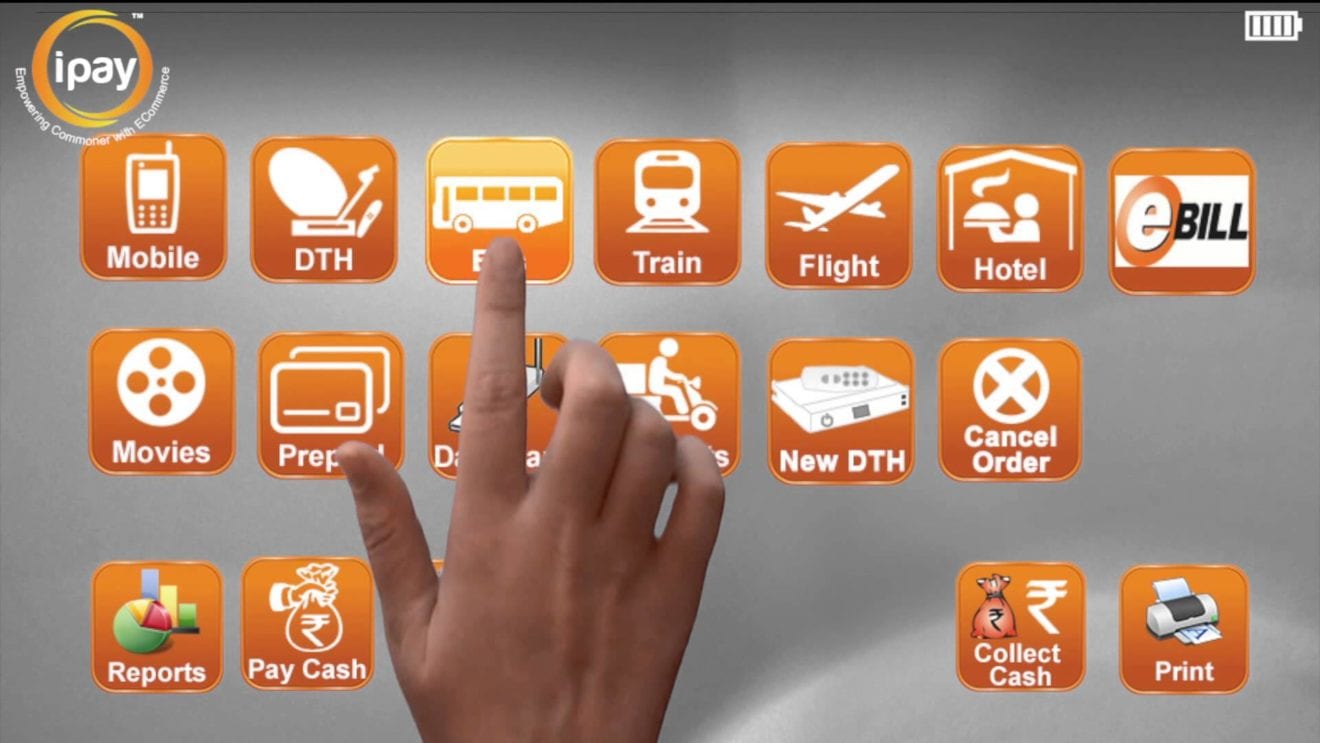
    Set up two years ago, the firm has just completed one year of operations, after doing market research and studying the pulse of the market in the 12 months preceding it. The stores buy kiosks priced at ₹8,888 that comprises a tablet, which gives an access to its e-commerce platform. It throws up a list of offers available for that particular day on the homepage. Besides, it gives a full list of products that can be bought online.

    Store payment

    “Customers pay cash at the store after surfing. They will get an SMS after the product is delivered to the store,” Krishna said.

    Krishna built and sold two firms in the United States before moving to Hyderabad to set up iPay. It is now planning to expand to Karnataka and Tamil Nadu. He has invested $2 million so far, including $1.2 million on technology. In the first year, it registered a gross merchandise value of $10 million through a network of ₹3,900.

    “We have tied up with an Indonesian telecom player. It wants to use our technology platform to provide the e-commerce channel to its customers,” he said.

    The firm is planning to raise $15 million in the next few months to fund its expansion in India.