Tag: Jin Air

  • Tax office probes Jin Air over possible evasion

    Tax office probes Jin Air over possible evasion

    Korea’s tax office is investigating Jin Air over potential tax evasion, the latest in a series of investigations into Hanjin Group’s founding family members over alleged wrongdoings, industry sources said Monday.

    The tax probe came days after the transportation ministry last week said it has decided not to revoke Jin Air’s business license, ending weeks of uncertainty for the low-cost affiliate of Korean Air. The company appointed a foreign national to its board of directors, a violation of Korean aviation law.

    In the interest of national security, only Koreans are permitted to serve as directors of commercial airlines.

    The company, however, appointed Cho Hyun-min, an American citizen and the younger daughter of Hanjin Group Chairman Cho Yang-ho, to serve as a board member of Jin Air between 2010 and 2016.

    The tax probe centers on whether a severance payment to Hyun-min was acceptable and whether the airline gave undue favor to the Cho family through its in-flight duty-free goods operation.

  • Jin Air’s second-quarter profit falls 88 percent

    Jin Air’s second-quarter profit falls 88 percent

    Jin Air, the budget affiliate of Korean Air, said Friday that its second-quarter net profit fell 88 percent from a year earlier on increased fuel costs and a decline in travel demand.

    Net profit for the three months that ended on June 30 came to 1 billion won ($886,000), down from 8.1 billion won a year earlier, the company said in a regulatory filing.

    Operating profit dropped 50 percent to 6.2 billion won in the second quarter from 12.5 billion won a year ago. Meanwhile, sales rose 18 percent on-year to 226.5 billion won.

    The earnings results came as the South Korean government has been mulling whether to cancel the airline’s license over its illegal appointment of a foreign national to its board of directors.

    Under Korean aviation law, only Koreans can be registered as the directors of an airline.

    Jin Air named Cho Hyun-min – the younger daughter of Korean Air Chairman Cho Yang-ho – as its director between 2010 and 2016, even though she is legally an American citizen.

  • Budget airlines fly high with huge first quarter

    Budget airlines fly high with huge first quarter

    Budget airlines flew high in the first quarter, with combined operating profits soaring to more than double the figure inked in the same quarter last year.

    Combined operating profits from Korea’s six low-cost carriers (LCC) – Jeju Air, Jin Air, T’way Air, Eastar Jet, Air Busan and Air Seoul – jumped by roughly 131 percent year-on-year to 186.1 billion won ($171.96 million) in the first quarter according to tentative performance reports from each company on Wednesday. Revenue grew by 34.2 percent to 1.18 trillion won.

    LCCs typically release a tentative earnings report before releasing their fixed figure as they do not vary much.

    The largest growth booster was the rapidly increasing demand for both international and domestic travel.

    According to data from the Ministry of Land, Infrastructure and Transport released last month, the number of passengers that traveled through Korean airports reached 9.58 million in March, increasing by 12.6 percent year-on-year. While March is not traditionally a high-season for international travel, the number of overseas travelers increased by 17 percent to 7.1 million in the same month, showing traveling is becoming a year-round event.

    The budget airlines’ efforts to diversify flight services to Japan and Southeast Asian destinations also paid off. After tension with China over the deployment of the U.S.-led terminal high-altitude area defense antimissile system stopped Chinese tourists from visiting Korea, LCCs specializing in short-haul overseas travel quickly sought out alternative destinations.

    Korea’s largest LCC Jeju Air said its focus on Japan and Southeast Asian destinations, favored by Korean travelers, was a big driver for growth. Jin Air also credited its growth to flight service diversification.

    Airlines are still in the process of expanding their travel routes. Eastar Jet will introduce a service to Da Nang, Vietnam, in June and Sapporo, Japan, in July. By the second half of the year, it will also start services to Kyushu and Nagoya in Japan.

    T’way Air diversified its routes by creating flight services that depart from various regional airports in Korea including Daegu, Busan and Jeju.

    “Airlines posted positive first quarter earnings despite soaring oil prices largely thanks to strong demand for overseas travel,” said Choi Go-woon, an analyst from Korea Investment & Securities. “Budget airlines, which had struggled in business in traditional low seasons, will see continuous performance growth now that people enjoy traveling abroad, especially to Japan and Southeast Asia, regardless of the season.”

    During the same period, the combined operating profits of full service carriers Korean Air and Asiana Airlines grew 14.2 percent to 241.1 billion won. Asiana’s operating profit soared 144 percent to 64.3 billion won in the last quarter, the highest quarterly profit in three years, however Korean Air posted negative 4.3 percent growth and posted 176.8 billion won in operating profit.

    Korea’s largest airline said one-time incentive payouts to employees, of about 53.4 billion won, and losses from unfavorable currency rates ate up its operating profit. Though the owner family scandal has tainted the airline’s brand image, it wasn’t until April that the “water rage” scandal involving Korean Air heiress Cho Hyun-min broke. Any effect from resultant boycotts will show in second quarter reports.

    Revenue growth of the two full service carriers was limited to 8.3 percent. The total earnings of 4.62 trillion won, however, remains an unbeatable sum for the six budget airlines combined.

    Full service carriers are trying to survive through a fierce battle in the aviation market by bolstering their long-haul flight services. According to a spokesperson from Asiana Airlines, it will make 60 percent of its services long-haul flights by 2022.

  • Jin Air ready to fly to lombok using Boeing 777

    Jin Air ready to fly to lombok using Boeing 777

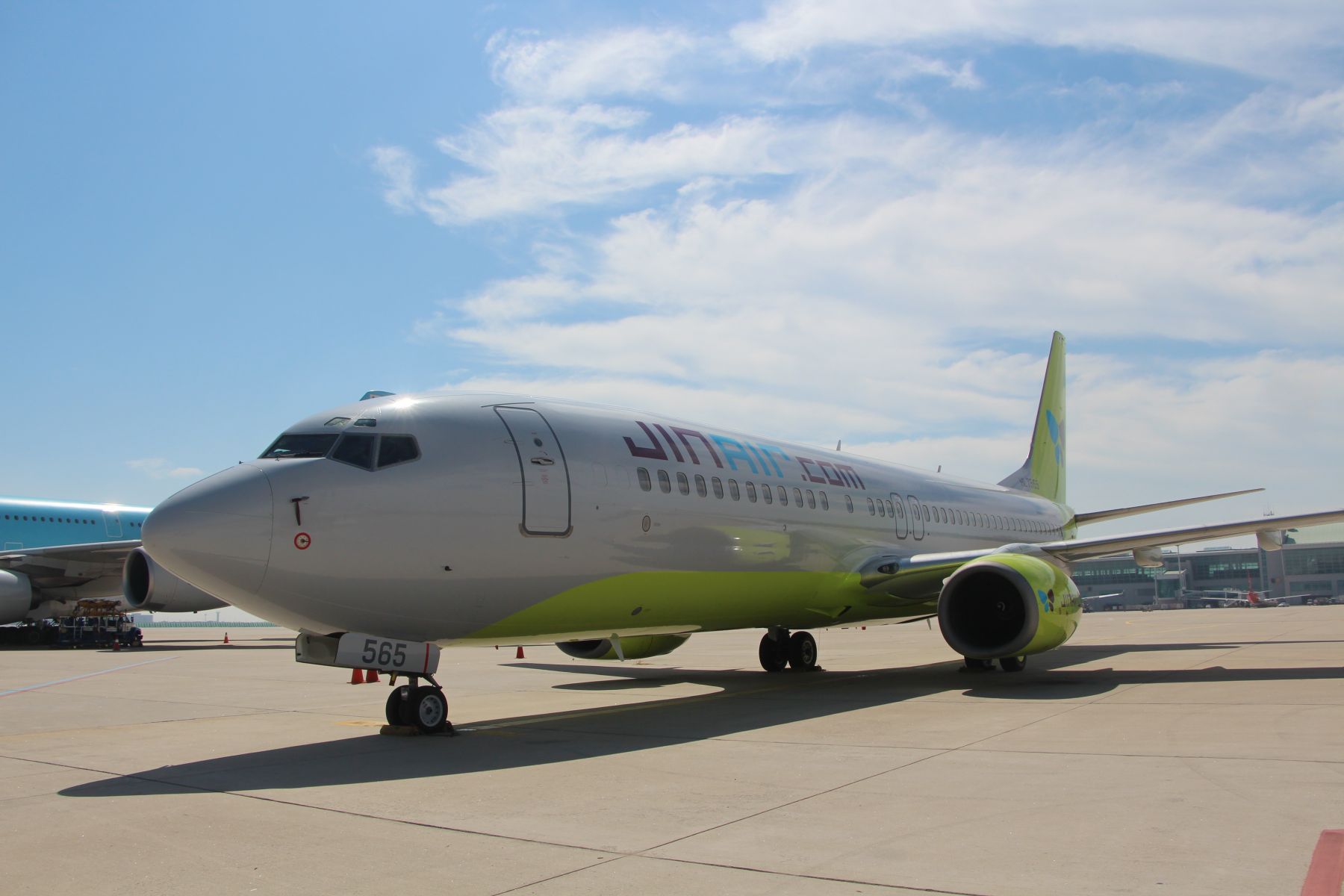
    South Korean low-cost carrier Jin Air is ready to fly to Lombok in the Indonesian province of West Nusa Tenggara using a wide-bodied Boeing 777 plane to encourage the tourism industry there, an official said.

    “I have received an official (notification) from the chairman of Korean Air that its subsidiary, Jin Air, is ready to fly to Lombok using Boeing 777,” Chief of the Investment Coordinating Board (BKPM) Thomas Lembong noted following a meeting at the Coordinating Ministry for Maritime Affairs here on Monday.

    He stated that low-cost carriers are badly needed to boost the tourism industry in Indonesia.

    Although investment in the tourism sector is not large, it still plays a very strategic role in creating jobs and bringing in foreign exchange earnings from international tourists, he said.

    “This needs an extraordinary teamwork as many tourists depend on air connectivity. We need air connectivity, particularly through budget carriers, so that there will be low-cost flights from Korea, China, Japan, Australia, India, and so on,” he remarked.

    Besides low-cost carriers, the government must also prepare supporting infrastructures to boost the tourism industry, he pointed out.

    “Although the runways and terminals of airports are still good, we still need to upgrade them. We must check their electronic navigation system, so that planes can land and take off despite bad weather,” he stated.