
Tag: k-fashion

  • South Korea Fashion Market Targets $25.15 Billion by 2029 as Domestic Labels Scale

    South Korea Fashion Market Targets $25.15 Billion by 2029 as Domestic Labels Scale

    South Korea’s fashion market is projected to reach US$25.15 billion by 2029, driven by an expanding roster of independent designer labels scaling across wholesale and retail channels.

    The figure reflects more than two decades of steady commercial development since Seoul Fashion Week debuted in 2000.

    Exporting Seoul’s Contemporary Aesthetic

    Seoul-based labels are capturing market share by combining technical fabrics with clean, structured tailoring. Amomento, founded in 2016 by designer Lee Mee-Kung, operates standalone stores in Seoul and sources textiles from South Korea and Japan. Open YY, launched by sisters Jiyoung and Boyoung Kim after rebranding from TheOpen Product, has secured global stockists through international luxury e-commerce platforms.

    Footwear and accessories have carved out dedicated niches. Heejin Kang established handbag label Osoi to target contemporary shoppers across Seoul. In jewellery, Numbering produces sterling silver and 14k gold-plated pieces. Eyewear specialist Gentle Monster built international presence through art-installation concept stores and high-profile product collaborations with Maison Margiela and Blackpink’s Jennie.

    Global Trajectories and Wholesale Reach

    Several Korean designers have anchored operations directly in major European fashion capitals. Rok Hwang, an alumnus of Celine, Louis Vuitton, and Chloe, established his label Rokh in Paris after training in London. Hyein Seo launched her utilitarian label in 2014 following graduation from the Antwerp Royal Academy of Fine Arts, staging runway presentations in London and New York.

    Veteran designers maintain long-running commercial runs at home. Former K-pop artist Seung Gun Park founded Pushbutton in 2003, making it one of Seoul’s most established independent brands. Other labels, including Lee Myoung Shin’s Low Classic, Hyunwoo Kim and Myungjun Shin’s Kijun, and outerwear specialist Dunst, continue to build volume through department store channels and multi-brand boutiques.

    For department stores and specialty stockists across Asia-Pacific, Korean contemporary labels offer mid-tier luxury price points with high cultural resonance among younger consumers. This commercial momentum increasingly challenges established Japanese and Chinese designers for shelf space across regional retail hubs.

    Buyers now track the upcoming seasonal order books, where South Korean labels must prove they can convert international runway visibility into steady wholesale reorders.

  • Korean Fashion Labels Cluster in Seoul’s Hannam District for Flagship Retail

    Korean Fashion Labels Cluster in Seoul’s Hannam District for Flagship Retail

    Independent Korean fashion labels are securing standalone flagship stores across Seoul’s hillside Hannam-dong district, establishing physical footprints along Itaewon-ro to capture rising domestic and inbound tourist spending. The neighborhood offers an alternative to the crowded retail pop-ups of Seongsu-dong, giving younger brands space for full-collection stores and dedicated hospitality concepts.

    Womenswear label Glowny anchors the strip with a 660-square-meter flagship, its first physical location before opening a second store in Apgujeong. Founded in 2020 by sisters Choi Jane and Choi Ji-ho, the label built an audience of nearly 400,000 social media followers on basic jersey lines and low-rise denim before scaling into multi-level retail.

    Celebrity Placement Drives Footwear and Apparel Sales

    Physical stores in the quarter rely heavily on styling seen on Korean pop performers. Open YY, operated by sisters Kim Ji-young and Kim Bo-young, pairs its runway apparel and in-store cafe with sell-out shoe lines, including ballet boots that emptied inventory after appearances during Paris Fashion Week. The store combines seasonal ready-to-wear with swimwear and footwear on open floor plans.

    Streetwear outfit SunburnProject sells graphic apparel alongside accessories like its multi-way M.O.S Bag, supported by licensed partnerships including a collaborative line with American character brand Paul Frank. Nearby, Davichi singer Kang Min-kyung opened a dedicated Hannam outpost for her brand Avie Muah in June, selling higher-priced tailoring alongside metal phone accessories.

    Global Retail Roadmaps and Category Expansion

    For several emerging operators, Hannam flagships serve as testing grounds before international rollouts. TooMuchTax, launched in 2023 around bodywear and swimwear, merchandises its hotel-lounge concept store with individual displays for waffle knitwear and scarves. The label plans to run a US pop-up next year ahead of a targeted permanent American store opening in 2028.

    Across menswear, brand Pottery occupies an entire multi-story building focused on workwear and durable textiles, incorporating lounge space to increase dwell time. Multi-brand retailer Beaker provides broader distribution for domestic labels alongside international home goods from Tekla and Ilkwang Lighting, while makeup brand Hince operates a standalone cosmetic store offering custom palette formulation.

  • Misto Holdings Swings into Solid Q1 Profit Boosted by Golf Gear and K-Fashion Surge

    Misto Holdings Swings into Solid Q1 Profit Boosted by Golf Gear and K-Fashion Surge

    Misto Holdings, the South Korean fashion and golf corporation, has announced an impressive surge in their first-quarter earnings, owing to robust demand for K-fashion labels and golf equipment. The company reported a 4.2% year-over-year increase in revenue, generating KRW 1.3 trillion (US$864.9 million) and an operating profit of KRW 193.7 billion (US$128.8 million), marking a 19% increase.

    Driving Factors Behind the Growth

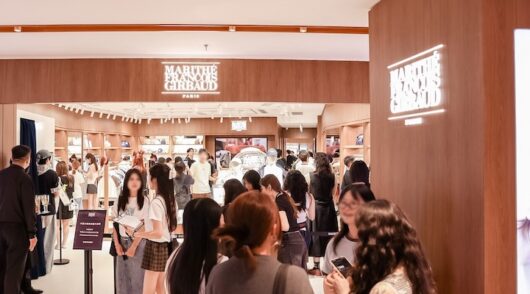
    The impressive growth is attributed to the strong performance of the firm’s golf business and the continued success of its fashion labels in the Greater China region, particularly in Mainland China and Hong Kong. K-fashion brands such as Marithé + François Girbaud, Matin Kim, Rest & Recreation, and Raive have continued to extend their retail presence throughout the region. Their expansion has played a pivotal role in sustaining double-digit growth in Greater China over the quarter.

    Fila, another brand under Misto Holdings, reinforced its position in the lifestyle sector through its footwear and apparel offerings. Standout collections include the Echappe franchise and the newly released Glio lineup. Fila’s Knit Track collection recorded a substantial sales growth of approximately 74% during the first 12 weeks of the 2026 Spring/Summer season, compared to the same period in the previous Fall/Winter season.

    The company’s Acushnet segment also contributed to the successful quarter, generating KRW 1.1 trillion in revenue, an 8% year-over-year increase, due to strong performance across all categories.

    Outlook and Future Plans

    Despite the ongoing macroeconomic uncertainties, Misto Holdings has managed to maintain stable growth momentum. This has been a result of the enhancement of brand competitiveness and improvement of operational efficiency, as stated by the company’s CFO, Ho Yeon (Aaron) Lee. Looking ahead, the company plans to further ensure its sustainable growth through the expansion in Greater China, enhancement of its brand portfolio, and a focus on profitability in management.

    Questions & Answers

    What has contributed to Misto Holdings’ significant first-quarter growth?
    The surge in demand for golf equipment and K-fashion brands have been the key drivers of Misto Holdings’ solid first-quarter growth.

    How does Fila contribute to the growth of Misto Holdings?
    Fila, a brand under Misto Holdings, has reinforced its dominance in the lifestyle sector with its footwear and apparel. Its collections such as the Echappe franchise and the Knit Track collection have recorded substantial sales growth.

    What are the future plans for Misto Holdings?
    Misto Holdings plans to solidify its growth by expanding in Greater China, enhancing its brand portfolio, and maintaining a focus on profitability in management.

  • Misto Holdings Amplifies K-fashion Revolution: 100+ Retail Outlets and New Brand Launches in Greater China on the Horizon

    Misto Holdings Amplifies K-fashion Revolution: 100+ Retail Outlets and New Brand Launches in Greater China on the Horizon

    Misto Holdings is set to broaden its reach in the Greater China region, bringing a multitude of Korean fashion brands to the rapidly growing market. The company’s portfolio consists of brands such as Matin Kim, Marithé+François Girbaud, Raive, and Rest & Recreation. It aims to manage over 100 retail units by mid-year.

    Misto Holdings reports that its brands have shown a substantial early rise. Mardi Mercredi, for example, saw its sales increase by 190 per cent in its second year, while Raive experienced a 200 per cent growth in its first year.

    In terms of digital presence, Misto Holdings oversees platforms like Tmall, Xiaohongshu, and Douyin. It uses a blend of in-house content, live-commerce studios, and influencer collaborations to interact with local consumers.

    Moreover, the company is re-evaluating its Greater China portfolio this year. It aims to diversify into men’s high-end contemporary, women’s casual, and athleisure categories. Commencing next year, the plan is to introduce approximately five new brands in the region.

    Misto Holdings emphasizes that its focus is on sustainable, long-term brand growth across both online and offline channels.

    “We are not just managing brands; we are long-term partners dedicated to building brand value across both online and offline touchpoints,” said a spokesperson for Misto Holdings. “Our focus remains on building sustainable brand equity across the Greater China region.”

    Earlier this month, Misto Holdings also announced a surge in fourth-quarter sales as the company restructured its US operations.

    Questions & Answers

    What is the expansion plan of Misto Holdings in the Greater China region?
    Misto Holdings plans to introduce multiple Korean fashion brands to the market and aims to manage over 100 retail units by the middle of this year.

    What digital platforms does Misto Holdings manage and how does it reach local consumers?
    Misto Holdings manages platforms like Tmall, Xiaohongshu, and Douyin. It reaches local consumers through a blend of in-house content, live-commerce studios, and influencer collaborations.

    What is the focus of Misto Holdings?
    The company is focused on sustainable, long-term brand growth across both online and offline channels. It aims to build brand value across both online and offline touchpoints in the Greater China region.