Retail News CRM

Tag: Kakao

  • Kakao Friends expands to Europe with IMG

    Kakao Friends expands to Europe with IMG

    Korean mobile lifestyle platform company Kakao has associated with IMG to exclusively license its character brand Kakao Friends in Europe.

    Originating from South Korea’s leading messenger platform Kakao Talk, Kakao Friends’ characters have gained millions of fans with its charisma and unique personalities. As K-pop culture has become a global phenomenon, Kakao Friends decided to enter Europe markets by launching an European online store to reach its global fans.

    Eight Kakao Friends’ characters have already collaborated with some of premium brands such as Louis Vuitton or Nike. There will be approximately 30 Kakao Friends stores opened in South Korea and Japan in the future.

    “Having already connected emotionally with millions of fans and aspirational brands, Kakao Friends is a leading K-POP culture export and is powerfully on trend in Europe,” said Matthew Primack, senior vice president of licensing at IMG. “Now is the perfect time for a social and culturally rich lifestyle brand like Kakao Friends to explore new product opportunities that reflect its unique identity and booming popularity.”

    Kakao Friends in Europe will primarily feature apparel and accessories, homeware with future extension into additional categories.

  • Kakao T signs MOU with premium taxi service

    Kakao T signs MOU with premium taxi service

    Kakao Mobility is partnering with premium taxi provider Tago Solutions to improve customer service quality and drivers’ income levels. The move comes as tensions continue to boil over with much of the taxi industry fiercely protesting the company’s carpooling business. On Thursday, Kakao’s mobility subsidiary announced that it signed an MOU with Tago Solutions, a company co-established by some 50 taxi companies and 5,000 taxi drivers last September with the goal of offering distinguished and premium taxi services like pet-friendly options.

    Tago hit headlines last month for requesting the Seoul Metropolitan Government’s approval to offer Korea’s first women-only taxi services. The service, dubbed Waygo Lady, will only allow female drivers and customers.

    Kakao is expected to give customers the option to choose Tago’s services via the Kakao T taxi-hailing app.

    “We hope to create an environment where drivers are friendly and do not refuse customers,” Kakao added in a statement. One of Tago’s stated missions is to accept all customers regardless of destination. Though refusing customers is illegal in Korea, some drivers still do it if the requested destination is unprofitable.

    Kakao is also hoping to improve drivers’ working environment with Tago. The premium services, which are expected to come at a premium price, will improve drivers’ income levels while the services for women will provide new opportunities for female taxi drivers – a minority in Korea.

    The move comes as many other taxi drivers and unions are boycotting Kakao for its plan to launch a carpooling service that potentially threatens the taxi industry. A Kakao spokesman said the company and Tago are on good terms and have been working on the partnership for months.

    Ahead of launching the premium services, Kakao said it will focus on developing technology that will allow for the seamless matching of users to taxis, while Tago will focus on training and educating drivers to provide high quality services.


  • Kakao postpones carpooling service

    Kakao postpones carpooling service

    Kakao Mobility announced las week that it would postpone the official launch of its carpooling service after a week of fierce protests from the local taxi industry. The Kakao affiliate started offering a beta version of the service last Friday that was made available to a randomly selected pool of users nationwide. On the same day, it declared that the official launch date of its carpooling service would be on Dec. 17.

    “After much consideration, we decided to postpone the official launch in order to listen and apply a wider range of opinions from taxi drivers, users and many others,” Kakao said in an official statement Thursday afternoon.

    But it did not specify when the official launch will be delayed until. The statement sparked rumors that this may be the start of Kakao indefinitely postponing the service’s official release, which the company denied.

    “What we know for now is that it’s not going to happen this year,” said a Kakao spokesperson. “But this doesn’t mean the delay is going to be an indefinite one. The exact date is still a matter of discussion.”

    The beta service will continue to be offered to random users selected regardless of age and region. Kakao explained that the beta service was being offered to a very limited pool of users, just enough to examine the technology and check the effect it may have on taxi drivers.

    The announcement comes six days after the beta service and the official launch date were released.

    The backlash from taxi drivers has been fierce, with widespread protests that culminated in a 57-year-old taxi driver setting himself on fire in front of the National Assembly in western Seoul on Monday.

    Two days later, a committee that consists of two taxi company associations and two taxi driver labor unions announced plans to stage a protest in Seoul on Dec. 20, with more than 100,000 people expected to attend. This would be the third protest targeted at putting a stop to carpooling services.

    Regardless of Kakao’s decision to postpone the launch, a source from the committee said there is no change to the plans for the protest.

    Taxi drivers also launched a sleep-in protest in front of the National Assembly starting from Wednesday, with members of the four organizations continuing their vigil in shifts through the night.

    Kakao, the local taxi industry and government officials have been in talks for more than half a year, but are still failing to agree on a solution to the carpooling service issue.

    Kakao wants to introduce a carpooling service during busy commuting hours, but drivers say that even if rides are limited to twice a day, they will still eat up around 59 percent of all taxi demand.

  • Kakao’s carpooling app goes live in beta test

    Kakao’s carpooling app goes live in beta test

    Kakao’s carpooling service was introduced Friday for beta testing and will be officially rolled out Dec. 17. The start of the service comes after months of battling fierce opposition from local taxi services. They staged a strike on Oct. 18, two days after the IT company started accepting applications from carpool drivers.

    With the beta service, the Kakao T mobile app, a platform for all of Kakao’s mobility services from taxi hailing to navigation, was upgraded to enable the “Carpool” button on its main screen. The beta service will not be accessible to everybody.

    “The beta service is aimed at increasing the stability of the technology and collecting opinions,” Kakao said in a statement. “For that reason, it will only be offered to some users.”

    The selection of testers will be random and independent of age and location. Anyone upgrading the Kakao T app Friday will see the new “Carpool” button, but only the selected users will be able to input words in the destination box. Those who weren’t selected will see an image with the words “This service will launch soon.”

    The base fare is set at 3,000 won ($2.68) for the first 2 kilometers (1.24 miles), the same as for regular taxis. After that point, the fare will increase proportional to the driving time and distance. The company did not disclose details, but a spokesman said the cost will be equivalent to around 70 to 80 percent of regular taxi fares.

    Kakao’s carpool drivers are allowed to offer carpooling services twice a day at any time of the day. The twice-a-day rule is due to the domestic law that limits carpooling to commuting purposes. More than 50,000 drivers who met Kakao’s requirements have been selected so far.

    A government-led task force composed of lawmakers from the ruling Democratic Party, public officials and taxi companies met Friday to discuss carpooling. Executives from Kakao Mobility, the affiliate in charge of the IT company’s transportation services, decided to launch the same day,

    Kakao acquired the Luxi carpooling app in February and completed preparations for its service later in the year.

    The official launch was postponed previously as the task force failed to reach an agreement on the service’s details, including the fare and limits on use. During a task force meeting held Thursday, some government officials opposed Kakao’s request to release the service that same day, demanding more time to find common ground.

    Korea has been a difficult place for carpooling. Uber closed down its service in 2014, and Seoul’s local government questioned the legality of carpooling app Poolus in 2017.

  • Kakao profit falls in Q3 as investment costs rise

    Kakao profit falls in Q3 as investment costs rise

    Kakao, the operator of Korea’s top mobile messenger, KakaoTalk, said Thursday its third-quarter operating profit fell 35 percent from last year due to increased costs from new businesses. Operating income reached 30.7 billion won ($27.3 million) in the July-September period from 47.4 billion won a year ago, the company said in a regulatory filing.

    Sales rose 16 percent on-year to a quarterly record high of 599.3 billion won, the company said.

    Kakao said its operating income plunged due to increased investments in new businesses, such as Kakao Mobility, that the company recently launched in an effort to secure new growth engines.

    Kakao said the revenue from its content platform remained steady at 306.7 billion won, with the figure representing a 17 percent year-on-year increase.

    Advertising sales grew 10 percent year on year to 167.1 billion won over the cited period on the back of mobile advertising revenue growth.

    Music content sales increased by 11 percent year on year to 136 billion won in the third quarter due to steady revenues from the Melon streaming service.

    Kakao said it will keep up efforts until the end of this year in order to expand its foothold by wrapping up a merger with its entertainment affiliate, Kakao M. The tieup will allow the company to move forward on various business collaborations.

    Kakao said the decision is aimed at bolstering its entertainment content based on the users of Melon, which is currently operated by Kakao M.

  • Kakao’s blockchain gets 9 development partners

    Kakao’s blockchain gets 9 development partners

    Nine companies have agreed to develop apps for Kakao’s new Klaytn blockchain system. The public platform was developed by Ground X, Kakao’s blockchain subsidiary. It was offered on Oct. 8 on a test basis, or testnet. Kakao, Korea’s largest messenger app company, announced the introduction on Monday.

    The companies building the apps are from a wide range of industries from gaming to health care. They are planning to use Klaytn for the development and operation of dApps, or decentralized applications.

    Service operators are attracted to dApps because of their decentralized nature, transparency and ability to incentivize users through in-app rewards.

    Wemade Tree, a subsidiary of game developer Wemade Entertainment, is one of the Klatyn partners. Wemade said it wants to use blockchain because it allows for smooth and speedy operations. Wemade’s games, including its popular Legend of Mir massively multiplayer online role-playing games (Mmorpg) series, have over 200 million accumulated users.

    Piction Network, which helps web comic and novel creators retain ownership over their works while making them available for users, has also partnered with Klaytn. Piction Network plans to provide its Klaytn-powered network to webtoon platform Battle Comics, which currently has over a million active users.

    A blockchain-based food data project called Hint Chain, operated by Vital Hint, has also announced a plan to utilize Klaytn. Vital Hint first gained popularity for providing recipe recommendations through apps like Foodiest. Hint Chain goes one step further and analyzes individual tastes and eating habits. Hint Chain plans to use Klaytn to help consumers manage their eating and purchasing habits, and make this information available to restaurants, convenience stores, supermarkets and hospitals.

    Other notable industry partners include Nabu Studio, a sports simulation game developer, Airbloc, a data marketplace for businesses interested in gathering personal information for research and advertising, and Humanscape, a data marketplace specifically dealing with health information related to rare and incurable illnesses.

    Cosmochain, another partner, is a beauty information platform that incentivizes users to provide feedback on cosmetics products.

    VETTA is a crowdfunding platform for games selected by GTR, a game accelerator. Rayon connects borrowers and lenders.

    “It’s important to prove the value and utility of blockchain in order for the technology to commercialize,” said Han Jae-sun, chief executive of Ground X. “We will soon gradually begin presenting high-quality services that we worked on together with partners.”

    After the selected partners complete a test run, Klaytn plans to launch in the first quarter of 2019. Until the official release, Klaytn will continue forming new partnerships with qualified companies.

    “Service providers and developers interested in using Klaytn’s testnet can still register on the official Klaytn homepage,” said a Kakao spokesperson.

  • Kakao starts carpool recruitment

    Kakao starts carpool recruitment

    Kakao Mobility has opened recruitment for its carpool app, infuriating taxi drivers who are vehemently opposed to the move. According to the mobility company that operates taxi-hailing app Kakao T, recruiting drivers is one of the crucial steps in preparation for the launch of its carpool service. The hiring process opened on Tuesday with the launch of a driver registration app, dubbed Kakao T Carpool for crews.

    Kakao Mobility was quick to point out that recruitment does not mean it will immediately launch a carpool app, adding that there is no set date for release. Instead, Kakao is looking to move drivers registered on Luxi to the new Kakao app, although this process will mean that it has a pool of drivers readily available, allowing it to immediately launch the app whenever it wants.
    Kakao Mobility has actually been attempting to launch its own carpool service since it acquired Luxi for 25.2 billion won ($22.4 million) in February. At the time, the company made it clear that it would only use the carpool service to cover shortages in taxis during peak hours, “within the legal boundaries.”

    Kakao’s statement did little to appease taxi drivers back in February, and they’re not any happier with the service now. Korea’s taxi drivers are fiercely opposed to ride-sharing apps, which they consider an unlicensed threat to business.

    This is the main reason why popular international ride-hailing companies like Uber are illegal in Korea under Article 81 of the Passenger Transport Service Act, which says that personal vehicles cannot be exploited for business purposes.

    Carpooling services, however, have been operating by taking advantage of a loophole that says that carpooling during commuting hours is permitted. Still, the vagueness of the term “commuting hours” has caused conflicts between carpool service providers and taxi drivers.

    Taxi drivers argue that Kakao is taking work away from them. As Kakao operates Kakao T, which thousands of taxi drivers rely on for work, the feeling of betrayal is even stronger.

    “It feels as if we are being backstabbed by Kakao, who we have been thinking of as a business partner,” said a spokesperson from the Korea National Joint Conference of Taxi Association, a group representing over 100,000 corporate taxi drivers nationwide, in a phone call Tuesday. “I can’t believe Kakao is making this announcement without delivering any message to drivers who have been holding a series of rallies against the company’s plan to start the carpool business.”

    The drivers held two rallies in Pangyo, Gyeonggi, where the Kakao Mobility office is located, on Oct. 4 and 11. About 500 people gathered at the second rally from four taxi driver unions, including the Korea National Joint Conference of Taxi Association. Tomorrow, a bigger protest is due to take place in Gwanghwamun Square in central Seoul at 2 p.m.

    To participate in tomorrow’s rally, about 4,000 drivers from Incheon, about half the city’s taxis, are expected to walk out, according to Incheon’s taxi association. About 2,000 taxis in Jeonju, the capital city of North Jeolla, are also due to stop operations for the rally, according to the city’s government.

    Some other cities are also facing similar problems as taxi drivers say they will leave for the rally.

    Despite the controversy, Kakao Mobility maintained Tuesday that carpool apps could be a great complementary service for taxis, citing data that on Sept. 20 there were 205,000 calls for taxis on the Kakao app from 8 a.m. to 9 a.m., but only 37,000 taxis were available.

  • Kakao to spin off e-commerce unit for expansion

    Kakao to spin off e-commerce unit for expansion

    South Korean mobile messaging platform Kakao is spinning off its e-commerce unit for further expansion.

    The new organisation will be Kakao’s largest spin-off, worth about KRW510.3 billion (US$458.6 million) by December. It will take over the operation of the Kakao Gifts, Shopping, Kakao Style and Kakao Farmer services.

    Kakao has also made plans to acquire global e-commerce firms and has expressed being open to securing additional funds through its spin-off.

    A spokesperson for the company said: “We are indeed open to securing additional investments after the process is completed. But at the moment we do not have any specific plans.”

    Kakao’s e-commerce business is weak in comparison with industry leader Naver, achieving only one seventh of the sales of its competitor. Its messenger service, conversely, remains dominant in its market.

  • Kakao’s technical glitches cause disruptions Monday

    Kakao’s technical glitches cause disruptions Monday

    Korea’s top mobile messenger Kakaotalk resumed normal services after experiencing disruptions around 5 p.m., its operator Kakao said Monday.

    Kakao said the messenger suffered problems for around an hour before being normalized at 5:48 p.m. It claimed there seems to have been some sort of error while the system was being updated.

    Earlier in the day, deliveries of messages on its platform were delayed, and the personal computer version of the program was also not working properly.

    The company said the service is now fully normalized.

    KakaoTalk is the most popular mobile messenger app in Korea, boasting a whopping 40 million users.

  • Naver and Daum to track cryptocurrency prices

    Naver and Daum to track cryptocurrency prices

    Naver and Daum, Korea’s two largest search engines, will begin providing real-time cryptocurrency prices on their websites.

    Dunamu, an affiliate of Kakao which operates the cryptocurrency exchange Upbit, will run the service, the company said. Users can enter the name of a cryptocurrency in either search engine, and the current price will show up in the results.

    Service began on Daum, which is owned by Kakao, immediately after the announcement. Naver plans to start the service early next month.

    Users of KakaoTalk chat app could also check cryptocurrency prices inside the chat app.

    Dunamu already provides real-time cryptocurrency prices as well as information about highs and lows of the day, week, month and year, and transaction size on its own website.

    Its trading platform, Upbit, deals in 124 different cryptocurrencies.

  • Net profit slumps 92 per cent for GS Retail, raise questions

    Net profit slumps 92 per cent for GS Retail, raise questions

    GS Retail, which runs South Korea’s GS25 convenience store chain, is facing questions over its profitability after it posted contracted numbers in its earnings last year.

    According to its regulatory filing, GS Retail logged KW30.9 billion (US$28.4 million) in operating profit last year, down 19.3 per cent from 2016. Its net profit also skidded to KW10.7 billion, a  dive of 92.4 per cent.

    It has had slumps in its core business of convenience stores, which account for 70 per cent of its earnings.

    GS Retail last year posted KW1.57 trillion in sales from its convenience stores, up 6 per cent from 2016. The number of GS25 stores also increased from 12,199 to 12,429 last year.

    Despite this growth, the operating profit at its convenient stores declined by 6 per cent to KW37.1 billion during the same period. Per-store sales also shrank by 9 per cent.

    Saturated market

    Analysts say GS25’s weakening profitability is related to the saturation of the domestic convenience store industry.

    There are about 40,000 convenience stores in Korea. Between them, the main players – GS25, CU run by BGF Retail and 7-Eleven run by Lotte affiliate Korea Seven – have more than 30,000 outlets. This means there is one convenience store to every 1250 Koreans.

    Meanwhile, at the start of the year the government hiked the minimum wage rate by 16.4 per cent to KW7530, which is expected to add extra burden on franchise owners.

    Also, GS Retail has seen poor performance for its health and beauty products store chain. It has been the sole operator of Hong Kong-based Watsons in Korea since February last year.

    GS is hoping its earnings deadlock will be broken by its hotel and leasing subsidiary Parnas Hotel. This runs the Grand Intercontinental Seoul Parnas, the Intercontinental Seoul Coex and other hotels and malls in Seoul. It is also in charge of leasing Parnas Tower in Gangnam.

    Parnas Hotel logged KW75.4 billion in sales last year, up 15 per cent. Its operating profit also improved to KW17.1 billion, up 141 per cent as the leasing rate at Parnas Tower rose to 98 per cent.

    As part of its efforts to diversify revenue sources, GS Retail signed a memorandum of understanding with internet company Kakao last month for the development of a chatbot for the retailer.

    The company has also opened its first convenience stores outside Korea – in Vietnam’s commercial capital, Ho Chi Minh City, last month.

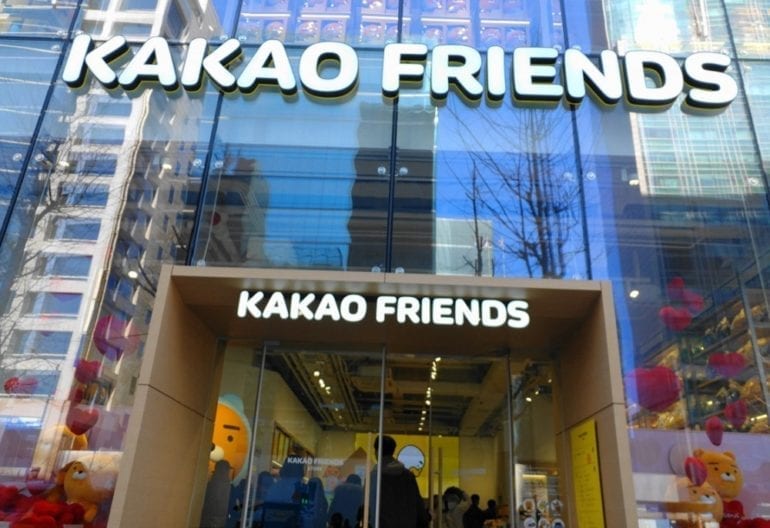
  • Inside the “Musée de KAKAO FRIENDS”

    Inside the “Musée de KAKAO FRIENDS”

    Kakao Friends is holding a second exhibition at the “Kakao Friends Concept Museum” in Hongdae, Seoul from 15 December 2017 to 27 May 2018.

    This exhibition is dedicated to the cultural icon Kakao Friends which represents modern times.

    Kakao Friends’ second exhibition project theme is ” Musée de KAKAO FRIENDS”, which is a parody of the space and classic works reminiscent of famous museums through the Kakao Friend Character. It is characterized by the reinterpretation as a witty artwork.

    Through this, Kakao Friends, the most popular character in the daily life of the tech-savvy Koreans, has expanded into aesthetic form, expressing the process of being born into a cultural time characterized by artistic inspiration.

    In the seven-section exhibition, visitors can see the parody works of Kakao friends characters Ryan, Muzi, Apeach, Frodo, Neo, Tube, Jay. Each section features a variety of interesting spaces where visitors can experience photo spots and characters all over the body to make unique experiences with Kakao Friends characters.

    The second basement floor of the exhibition hall is a well-coming space that welcomes visitors. It embodies the mysterious character sculpture park with a vague border between outdoor and indoor areas, with the motif of the Versailles Palace in France and the Moma Museum in New York.

    Additionally, in the central ceiling, a large chandelier lighting installation art utilizing the “Ryan Mood Lamp”, a standard product of Kakao Friends, is placed to enlighten the scene.

    The first floor of the exhibition hall is a full-scale work experience space, and the overall concept is composed of an art deco style that can be seen in a typical classical museum.

    In the last section of the exhibition, Kakao friends character illustration is placed on the entire wall to provide a large coloring space where visitors can paint their own characters, giving visitors the opportunity to complete their own works.

    “This exhibition is designed to create opportunities for consumers to experience cultural contents from different perspectives through the Kakao Friend character, which is based on emoticons and is loved by the people,” said Kakao Friends. “I hope that it will be an opportunity to experience a new type of exhibition that combines familiar characters and art.”

    Kakao Friends second exhibition, “Musée de KAKAO FRIENDS”, is operated as an online reservation system, and other details can be found on the official site of the Kakao Friends Concept Museum.

  • Kakao takes its leap into the smart speaker market

    Kakao takes its leap into the smart speaker market

    Kakao on 5 September 2017 unveiled its smart speaker, Kakao Mini, which will officially hit shelves by the end of September this year.

    Kakao, which operates the country’s most popular messaging app Kakao Talk, said the Kakao Mini will work on its artificial intelligence platform called Kakao I. It can be controlled by voice commands.

    The Kakao Mini has a square design with fabric on the sides, which has a minimalist, familiar design that can fit well with the surroundings in small sizes.There are four buttons at the top that let users adjust the volume and turn the microphone on and off.

    The Kakao Friends figure, which is released together, has a magnet and can be easily attached to the top of the Kakao Mini. The figures are provided to the initial purchaser on a first come, first served basis.

    The Kakao Mini is equipped with four high-end microphones to accurately capture users’ speech. As the device can connect to other speakers via Bluetooth, users can utilize features of the Kakao Mini through other premium audio systems as well.

    The speaker also connects to KakaoTalk, allowing users to check and send messages verbally.

    The device automatically updates software to continuously provide users with new features, the company said.

    The Kakao Mini offer users convenience by being linked to portal site such as daum as well as Kakao Talk. Kakao Mini will evolve to reflect new features with automatic update method.

    Pre-orders for the Kakao Mini will start later in September 2017.

  • Kakao food-delivery service planned

    Kakao food-delivery service planned

    Korean internet company Kakao, known for its chat app KakaoTalk, plans to jump into the food-delivery sector.

    The Kakao food-delivery service is planned for launch by January, and it is expected to be incorporated into the app, which has four menu buttons. One of them lists extra services such as sending gifts or making reservations.

    A Kakao spokesperson says the deliveries would mainly be from franchise restaurants.

    In July, Kakao acquired a 20 per cent stake of CNT Tech, a developer of an order-receiving platform for more than 80 franchise restaurant brands in Korea.

    CNT Tech has 90 per cent of market share in the ordering platform sector. Once an order is placed through a franchise’s key number or homepage, the start-up connects orders to stores nearest the customer.

    Already companies are battling for share in the food-delivery market, including Baedal Minjok, Baedaltong and Yogiyo. Baedal Minjok, which has more than 50 per cent market share, is the only start-up that has turned around its business from losses.

    Kakao head of communications Lee Su-jin says its new on-demand service will follow the company’s business perspective that an online-to-offline service should add value both to individual service providers and customers.
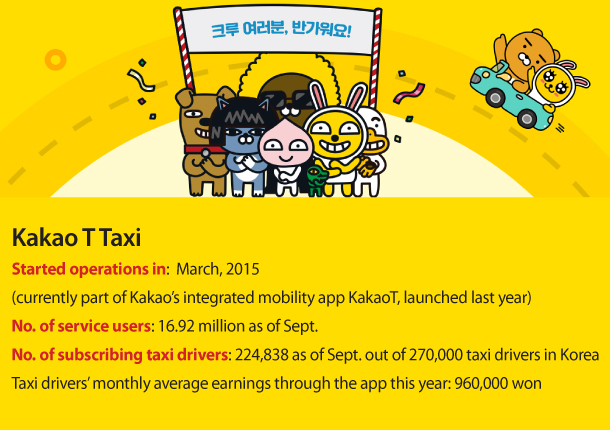
    “Through our Kakao Taxi service, the annual income of taxi drivers rose by more than 3 million won [US$2650],” he says.

  • Kakao launches Hair Shop O2O

    Kakao launches Hair Shop O2O

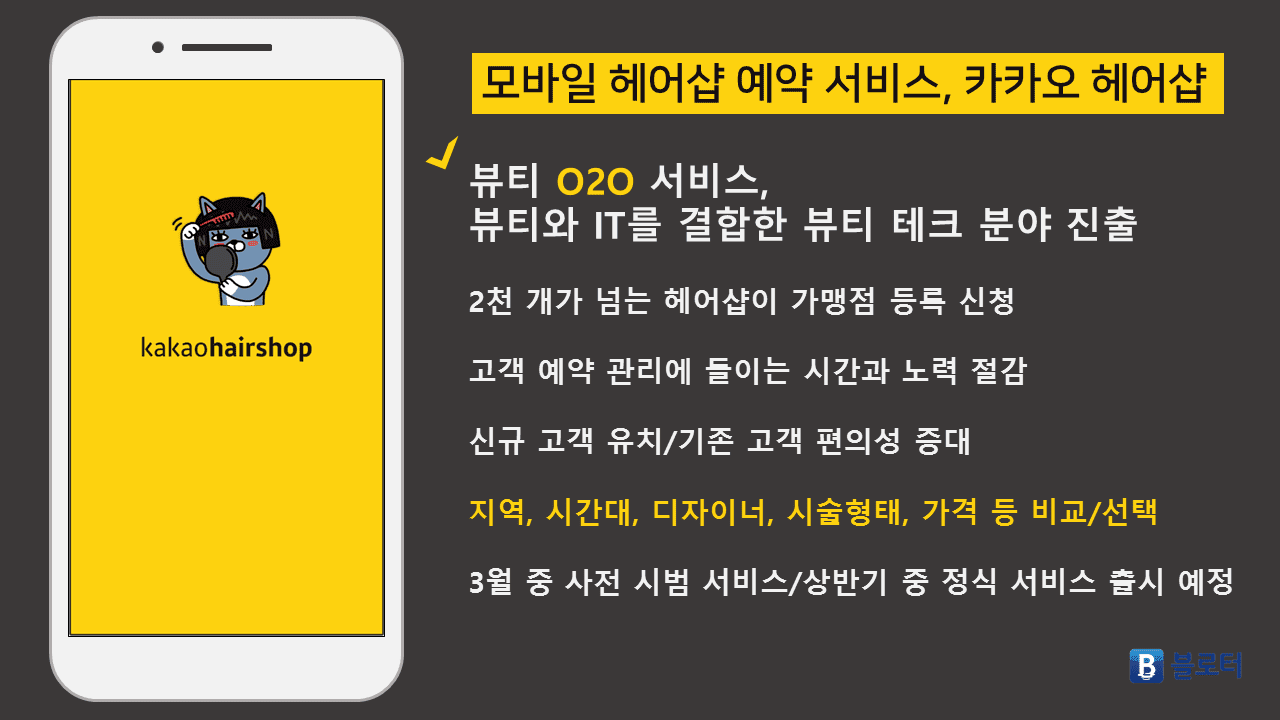
    Kakao, the Korean internet pioneer, has  selected ‘Hair Shop’ as its first O2O (online to offline) business in the beauty sector.

    Kakao plans to expand its O2O business by releasing new services  – relief drivers and the hair industry.

    According to industry analysts, Kakao is planning to launch ‘Kakao Hair Shop’ (working title) during the first half of the year through its affiliate Hasys.

    If Kakao’s Hair Shop is launched, related businesses could use Hasys solutions such as ‘Hair Zzang’ or ‘Beauty Zzang’ to easily build online and mobile reservation systems. Research on consumer satisfaction and marketing education could also be supported.

    Customers could have access to information about various hair shops through a Kakao-based platform, and compare prices at each salon.

    Some predict that Kakao will charge a commission for providing the platform when a user makes a reservation through the Hair Shop application and pays through Kakao Pay. However, Kakao claims that the details of the service have yet to be confirmed.

    Hasys is a beauty solution business Kakao took over in October 2015 through K-Venture Group, an affiliate of Kakao specialising in investments. Hasys has developed and is providing solutions such as ‘Hair Zzang’ and ‘Beauty Zzang’, which manage clients of beauty salons, skin care parlors and nail shops.

    Hasys has 10,000 beauty businesses as members, and ranks at the top of the industry with 69 per cent market share as of September 2015.

    Kakao revealed its intentions to launch O2O services related to the beauty industry at the time it took over Hasys. As a first step, Kakao officially entered the hair industry.

    Kakao officials said the company is planning to concentrate on the Hair Shop business, as it could be a service that is attractive to people of all genders and ages. “We have no other plans to expand our offerings into other beauty businesses.”

    Hasys is currently meeting with owners of hair shops across Korea, explaining about the launch of Kakao Hair Shop. Currently 2000 shops have agreed to become members of the service.