Tag: KB Kookmin Bank

  • AI Tools Used in Cyberattacks on South Korean Banks

    AI Tools Used in Cyberattacks on South Korean Banks

    Hackers used artificial intelligence agents to breach at least nine South Korean financial institutions in October 2026. The attack compromised personal data from more than 25,000 banking customers.

    Major domestic lenders bore the brunt of the intrusions. Shinhan Bank reported 25,000 compromised customer records, while KB Kookmin Bank confirmed 119 leaked customer profiles.

    Automated Penetration Tools In Action

    Running from late September to early October, the campaign relied on an open-source security tool named ARTEX paired with Anthropic’s Claude Code. A Chinese security researcher using the alias Autumn published ARTEX on GitHub earlier this year. The software functions as an automated penetration agent. It links directly into external large language models including ChatGPT, Claude and DeepSeek to run vulnerability tests across target servers.

    The software repository explicitly restricts use to local testing and research. Even so, the attacker weaponised the framework against live online banking infrastructure. Cybersecurity firm CrowdStrike tracked the interactive sessions. The firm found that the operator fed target environments directly into AI coding interfaces to accelerate intrusion paths and system mapping.

    Traces Left In Model Prompts

    During the operation, the operative inadvertently leaked personal information directly into model prompt logs. Session records show queries asking where threat actors sell compromised Korean databases and requesting specific Korean data-trading channels on Telegram. In a separate prompt, the attacker instructed Claude to compile a curriculum vitae. That document contained a personal Telegram handle, educational background, age and an address in Maoming, Guangdong province.

    Digital infrastructure and Chinese-language prompts pointed investigators toward a 26-year-old individual operating out of southern China. “While this activity has not been attributed to a named adversary, the threat actor is likely a Chinese speaker and financially motivated,” CrowdStrike stated in its findings.

    Operational Risks For Retail Banking

    Automated AI penetration shifts the economics of perimeter defense for financial institutions and retail digital banking platforms across the Asia-Pacific region. Attackers no longer need deep bespoke code writing. Open-source agents can autonomously test attack surfaces and parse enterprise firewalls around the clock at negligible cost. Traditional web application filters now face automated scanning that iterates faster than standard manual patch schedules.

    Commercial banks face compounding costs from consumer notification mandates, regulatory fines and identity theft remediation. Containment protocols must now focus on rapid API throttling and continuous identity verification rather than static perimeter defenses. Retail platforms managing high volumes of consumer payments and stored credentials represent immediate targets as autonomous agent frameworks lower execution barriers.

    Escalating AI Incursions In Asia-Pacific

    Earlier incursions set the stage. In June, an autonomous AI agent breached a government health portal in Australia in one of the region’s earliest documented cases of autonomous agent exploitation. Financial regulators in Japan and South Korea had heightened network surveillance earlier this year as code-generation tools expanded the volume of automated attack scripts circulating in private forums.

    Police in South Korea opened a formal criminal investigation into the nine targeted institutions this week following directives from President Lee Jae Myung for immediate security interventions. Regulatory authorities in Seoul are auditing network logs across commercial lenders to determine if secondary data exfiltration occurred before defensive patches took effect.

  • South Korean bank launches hand palm recognition verification

    South Korean bank launches hand palm recognition verification

    A South Korean bank has launched a service allowing customers to use palm recognition to withdraw cash – a likely precursor to similar technology becoming available in retail stores.

    KB Kookmin Bank says by using palm prints, customers no longer have to use a bankbook, stamp or password.

    The bank explained that palm vein recognition is safer and more precise than other biometric identification methods such as fingerprint or iris recognition. It believes the service will appeal to older customers who often have difficulty recalling passwords.

    According to a report, using palm recognition is also quicker than current means. Palm vein patterns differ by individual, allowing the scanner to correctly identify the customer.

    Similar palm-vein scanners are already being used at automated teller machines (ATM) from major banks worldwide, including Barclays in the UK and Ogaki Kyoritsu Bank in Japan.

    To prevent biometric information from leaking, the bank will encrypt the vein pattern database and work with the Korea Financial Telecommunications and Clearings Institute to store the information. The data will be disassembled into multiple blocks when stored, and reassembled when used for transactions.

    KB Kookmin Bank expects that the new palm-recognition service will particularly benefit senior customers who often have a hard time remembering passwords.

  • KB duplicates its success in global markets

    KB duplicates its success in global markets

    KB Kookmin Bank, one of the country’s leading lenders, is striving to duplicate its notable success here in the global market through briskly tapping into lucrative businesses across the world.

    Such efforts have started to bear fruit and the most recent example is its work of jointly arranging a 750 billion won ($660 million) project financing deal for a power plant in the United States.

    Earlier this month, the Seoul-based lender said that it joined forces with global banks Mitsubishi and ING Bank to finance the 790 megawatt gas-fired power plant construction.

    They attracted investors who purchased senior debt worth $660 million and of that amount, KB Kookmin arranged $200 million that is composed of a direct investment of $50 million and $150 million from other Korean firms.

    In overseas project financing in which Korean constructors are not directly involved, domestic financial firms have played limited roles. But the recent feats showcase KB’s capacity, according to experts.

    In retail banking, KB Kookmin has also been a pioneer in making a foray into offshore markets. As of the end of last year, it had 12 subsidiaries, branches and offices outside the country.

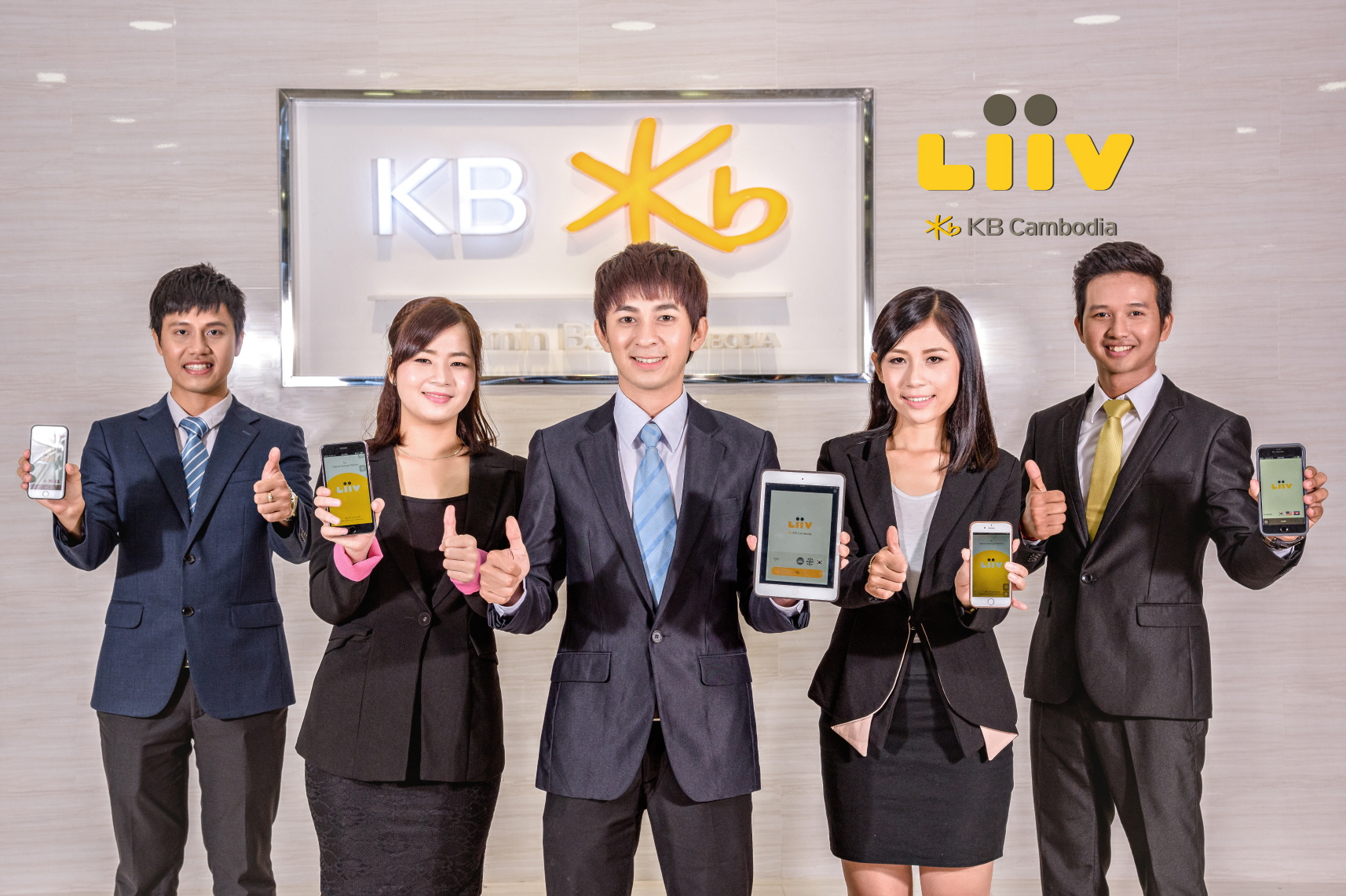
    One of its latest initiatives in the overseas retail market took place in Cambodia where KB Kookmin opened a mobile-oriented bank, Liiv KB Cambodia, this September.

    The digital bank offers various services such as account transfers, cross-border remittances and mobile payment services as well as various non-banking features like letting people top up their handsets.

    A KB Kookmin official said that the new-concept bank has been accepted well and for further growth momentum, it plans to enable its customers to withdraw money at automatic teller machines by forming business alliances with Cambodia’s top-tier banks.

    Observers point out that many successful firms tend to forget about management principles such as putting existing customers first and respecting business ethics but KB Kookmin appears to be different.

    Its CEO Yoon Jong-kyoo has stressed globalization to secure new cash cows for the lender, but at the same time he reiterates that the bank should stick to principles.

    “In an effort to become the most respected bank in the nation and to solidify its role as the leader of the Korean financial services industry, KB Kookmin Bank is committed to paying close attention to every one of our customers while providing the best customer-oriented services,” Yoon said.

    “Upholding high moral standards and work ethics as bankers, KB Kookmin Bank’s entire staff and management will keep striving to fulfill our responsibilities to our customers and society, making it the most dependable and socially responsible bank.”

  • Korean bank deploys optical encryption from Ciena

    Korean bank deploys optical encryption from Ciena

    KB Kookmin Bank, Korea’s largest financial institution, is deploying Ciena’s encryption capabilities for secure, high-capacity data centre interconnect (DCI), in a bid to better protect customer data.

    The encryption solution protects KB Kookmin Bank’s data transmissions from its offices and enables secure data centre interconnect (DCI) between its data centers.

    Several security solutions exist to protect data at-rest that secure servers, databases, routers, and switches by managing user access and credentialing. However, large amounts of critical data are in-flight and transported beyond the walls of the data center, traversing a larger, wide area network. Ciena’s optical-layer encryption solution gives KB Kookmin Bank an additional level of protection and protects data in flight as it leaves the private cloud and is transported between locations and data centers. Ciena’s solution adheres to local and international regulations and legislations, including the Federal Information Processing Standard (FIPS) 140-2 encryption certification.

    Additionally, Ciena’s software-based MyCryptoTool gives KB Kookmin Bank a dedicated management user portal that allows end-users to remotely control all of the security parameters associated with their encrypted services.

    “We are committed to providing the best possible service to our customers, which includes data protection and security. Ciena’s optical encryption solution provides an extra layer of protection and gives our customers the confidence to know their personal information is safe,” said Kim Ki-Hyun, CIO of KB Kookmin Bank.